2008 Honda Pilot TPMS Reset Button Location: Located & Explained
Seeing a stubborn TPMS light on your 2008 Honda Pilot dashboard can be frustrating, especially when you have already performed the necessary maintenance on your tires. Many owners spend hours searching under their steering column, inside the glove box, or near the driver’s side kick panel for a “reset button” that simply does not exist for this model year. This guide will clear up the confusion, explain how your system actually recalibrates, and provide the exact steps to get that warning light turned off for good.

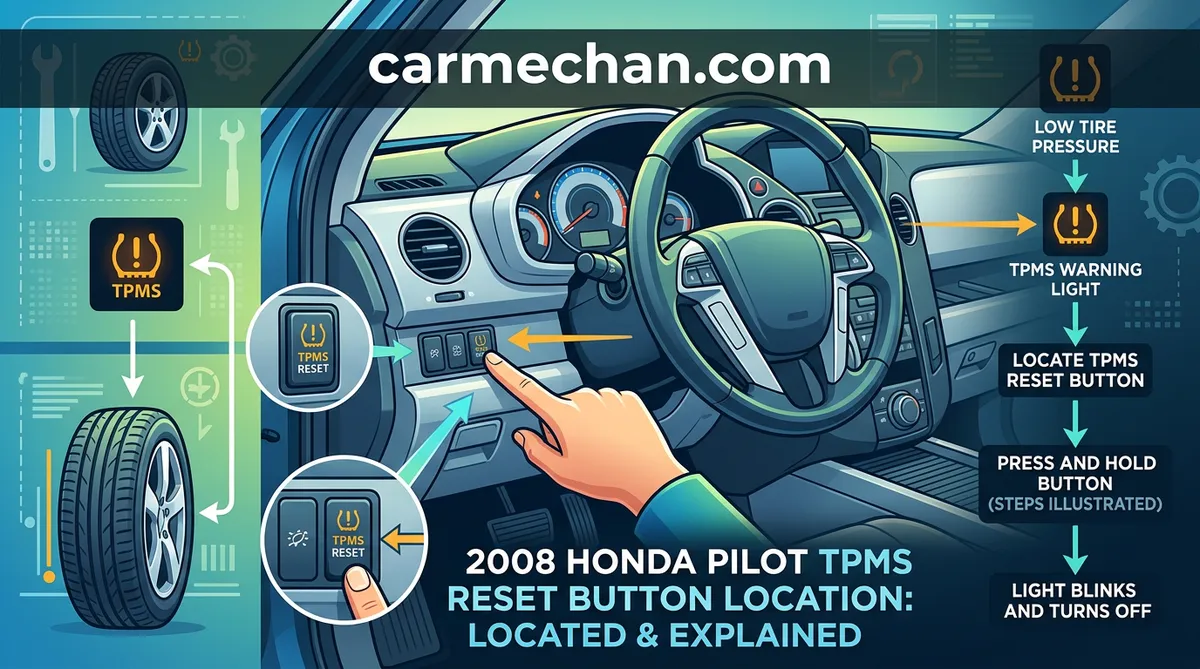
Why the 2008 Honda Pilot TPMS Reset Button Location Is Non-Existent
Recommended Best Deal Products


📤 Share Image

Debunking the Hidden Button Myth
A common misconception among owners is that a “hidden” switch exists to manually clear system errors. In the 2008 Honda Pilot, the TPMS (Tire Pressure Monitoring System) is a fully automated, passive system. It does not require a manual trigger because it is engineered to monitor tire pressure status in real-time. If you are searching for a button under the dash, you are chasing a feature that was never part of the original design architecture for this generation of the Pilot.

How the TPMS Control Module Monitors Your Tires
The system utilizes individual pressure sensors mounted inside each wheel. These sensors transmit radio frequency (RF) data to the TPMS control module located within the vehicle. When the module detects that the pressure in one or more tires has dropped significantly below the factory-recommended threshold, it triggers the indicator on your instrument cluster. Because this is a direct, data-driven link, the module does not need a “reset” command; it simply needs valid, updated pressure data from the sensors.
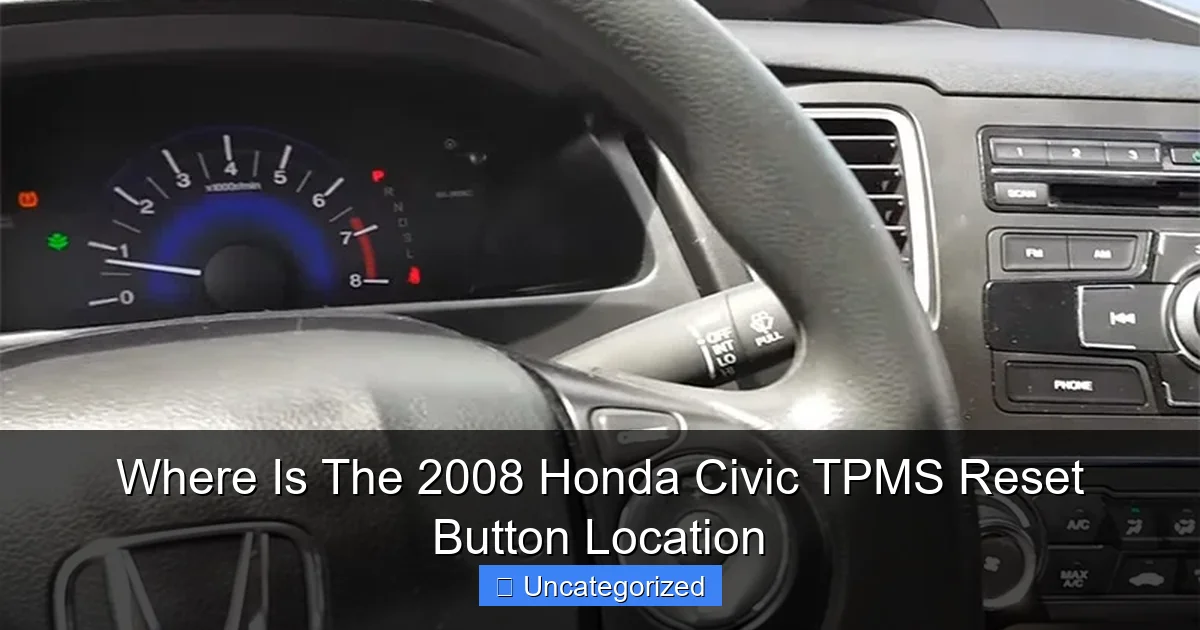
Direct vs. Indirect TPMS Differences
Some vehicle manufacturers use “indirect” TPMS, which relies on wheel speed sensors to detect tire diameter changes. Those systems often require a manual reset button to calibrate after a tire rotation. However, your 2008 Honda Pilot uses a “direct” system. By utilizing specific sensors inside the tire assembly, the vehicle knows exactly which corner is low, removing the need for a user-initiated calibration sequence.
How to Properly Reset 2008 Honda Pilot TPMS Light
📋
Step-by-Step Tire Pressure Correction
Recommended Best Deal Products


Use an accurate tire pressure gauge to measure the PSI in all four tires. Crucially, do this when the tires are “cold”—meaning the vehicle has been parked for at least three hours or driven for less than one mile.
Do not rely on the maximum PSI printed on the tire sidewall. Open the driver’s side door and reference the sticker on the door jam for the manufacturer-specified cold tire pressure (typically 32 PSI for the 2008 Pilot).
Once the tires are properly inflated, drive the vehicle at speeds consistently above 20 mph for at least 10–15 minutes. This allows the sensors to detect the correct pressure and transmit that signal to the TPMS control module to turn the warning light off.
Troubleshooting 2008 Honda Pilot TPMS Warning Light Symptoms
If your tire pressure is correct and the light remains on, the system is signaling a hardware-level issue rather than a simple inflation problem. Understanding the light’s behavior is key to diagnosing the fault:
- Solid Warning Light: Typically indicates that the system has detected a tire pressure deviation. This is usually corrected by adjusting your PSI to match the door jam placard.
- Flashing TPMS Light: This is a definitive sign of a system malfunction. It often points to a dead or dying battery within one of the tire pressure sensors, or a communication failure between the sensor and the TPMS module.
- False Positives in Cold Weather: As ambient temperatures drop, the air inside your tires contracts, causing the PSI to decrease. This is a common trigger for a solid light in the winter months.
Ignoring a flashing light is a mistake. Since the system cannot monitor your tire pressure while in a fault state, you lose the safety benefit of the TPMS. A professional scan tool is required to identify which specific sensor has failed.

Audible — Listen Free for 30 Days
One free credit a month and thousands of titles included.
Listen Free for 30 DaysEssential Maintenance for Your 2008 Honda Pilot TPMS Hardware
Recommended Best Deal Products


Because these sensors are integrated into your wheels, they require specific attention during routine vehicle service. Extending the life of your TPMS components ensures you won’t be dealing with unnecessary dash lights.
Sensor Battery Life
The internal batteries in the tire pressure sensors have a typical service life of 7 to 10 years. For a 2008 model, many sensors may be at or past their functional capacity.
Valve Stem Integrity
Always replace the rubber seals and gaskets when having tires mounted. This prevents moisture ingress, which can corrode the sensor electronics.
Avoid the temptation to over-inflate your tires to make the light go away. Over-inflation creates uneven tire wear and alters vehicle handling dynamics. Always follow the PSI recommended on the door jam.
2008 Honda Pilot TPMS Light Summary
To recap the essential points regarding your 2008 Honda Pilot, keep the following in mind: there is no manual reset button, and the system relies entirely on accurate, cold-tire inflation followed by a brief driving cycle to reset itself. A solid light is typically a pressure issue, while a flashing light indicates a hardware failure. If you have inflated your tires to the correct PSI and the light persists—or if it is flashing—the most efficient path forward is to visit a qualified tire technician who can use a specialized scan tool to identify the specific faulty sensor. Maintaining your tire pressure properly will not only keep that light off but also maximize the fuel efficiency and safety of your Pilot.
2008 Honda Pilot Tpms Reset Button Location: Frequently Asked Questions
Why does my TPMS light stay on after I fill my tires?
The system often requires a brief driving period to receive updated signals from the TPMS sensors. If you have inflated the tires to the correct pressure listed on the driver-side door jamb and driven for at least 10 minutes above 20 mph, the light should turn off. If it remains illuminated, one of your sensors may be failing or the pressure may still be outside the threshold.
Do I need a scan tool to reset the TPMS on my Pilot?
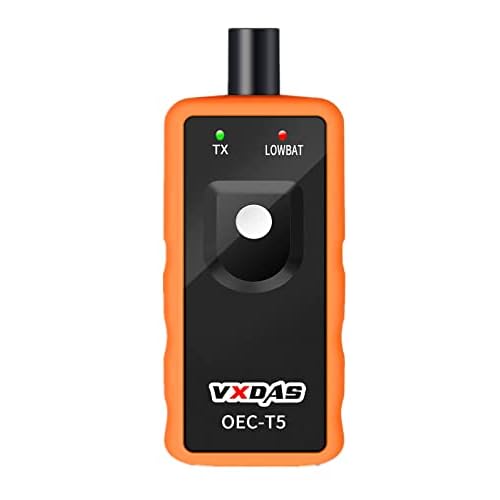
No, you do not need a scan tool for a standard reset after tire inflation. The system is designed to be self-resetting. However, if you are replacing a faulty TPMS sensor, a specialized TPMS scan tool is required to ‘register’ or ‘learn’ the new sensor’s unique ID code to your vehicle’s onboard computer, as the car will not recognize a new sensor automatically.
What does it mean if the TPMS light flashes?
A flashing TPMS light indicates a system malfunction rather than low tire pressure. This usually suggests that a sensor has stopped communicating, the battery inside a sensor has died, or the TPMS control module is experiencing a communication error. Unlike a solid light, a flashing light will not resolve by simply adding air; it requires a diagnostic scan to identify which specific sensor has failed.
Can low tire pressure in the spare tire trigger the TPMS light?
Yes, if your 2008 Honda Pilot is equipped with a full-size spare that features an integrated TPMS sensor, the system will monitor it. If that spare tire loses pressure over time, it will trigger the warning light on your dashboard. Always check your spare tire pressure when you are performing routine tire maintenance to ensure it isn’t the source of your persistent TPMS alert.
Audible Premium Plus — Annual Membership
12 audiobook credits up front, plus the full Audible catalogue.
See Annual PlansHow often should I replace my TPMS sensors?
TPMS sensors typically have a service life of 7 to 10 years, as the internal battery is non-replaceable and sealed within the unit. If your vehicle is over a decade old and you are experiencing persistent TPMS light issues despite correct tire pressure, the most likely culprit is a depleted sensor battery. In this case, replacing all four sensors during your next tire change is recommended.