how does cruise control work downhill Decoded for Safety
Ever notice your vehicle gaining speed despite having the cruise control set on a highway grade? Drivers often mistakenly assume that cruise control automatically manages braking, leading to dangerous speed spikes on steep descents. Understanding the distinction between basic throttle management and active vehicle control is critical for safety. In this guide, we will decode how modern systems handle downhill driving, when you should switch to manual control, and the mechanical differences that determine your vehicle’s safety features.
Understanding How Does Cruise Control Work Downhill: The Physics


![[UPGRADED PROTECTION] 4 Set (8 pcs) Reusable Wine Bags for Travel, Wine…](https://m.media-amazon.com/images/I/51udmIJIgHL._SS500_.jpg)
📤 Share Image
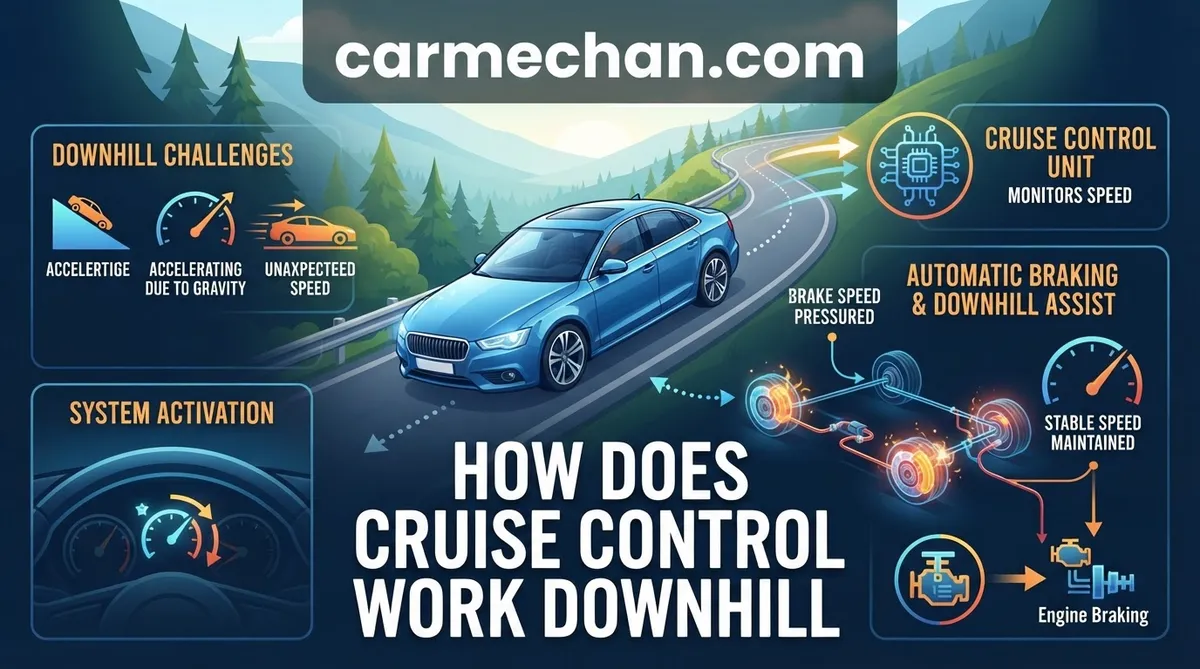
To understand how does cruise control work downhill, one must first recognize the fundamental battle between gravity and the vehicle’s propulsion system. When a car descends a slope, the force of gravity accelerates the vehicle regardless of the engine’s power output. In a traditional 2005 sedan with a cable-actuated throttle, the cruise control system acts solely on the intake manifold; when it detects the speed is too high, it simply closes the throttle completely. If the vehicle’s drag coefficient—the measure of aerodynamic resistance—is insufficient to counteract the force of gravity, the car will inevitably exceed the set speed.
Gravity and the Limits of Conventional Throttle Control
Conventional systems lack “authority” over the drivetrain. They are passive. In older models, the Engine Control Module (ECM) only controls the throttle plate. Once that plate is closed, the system has exhausted its options. It cannot force a downshift or engage the hydraulic brakes.
How Grade Logic Systems Detect Descent
Modern 2026-model SUVs utilize advanced “Grade Logic.” By monitoring an inclinometer (a sensor that detects the tilt of the vehicle) and wheel speed sensors, the ECM can anticipate a descent before the vehicle gains significant momentum. By communicating with the Transmission Control Module (TCM), the car can force a lower gear, using engine compression—often called engine braking—to keep the vehicle at the target speed.
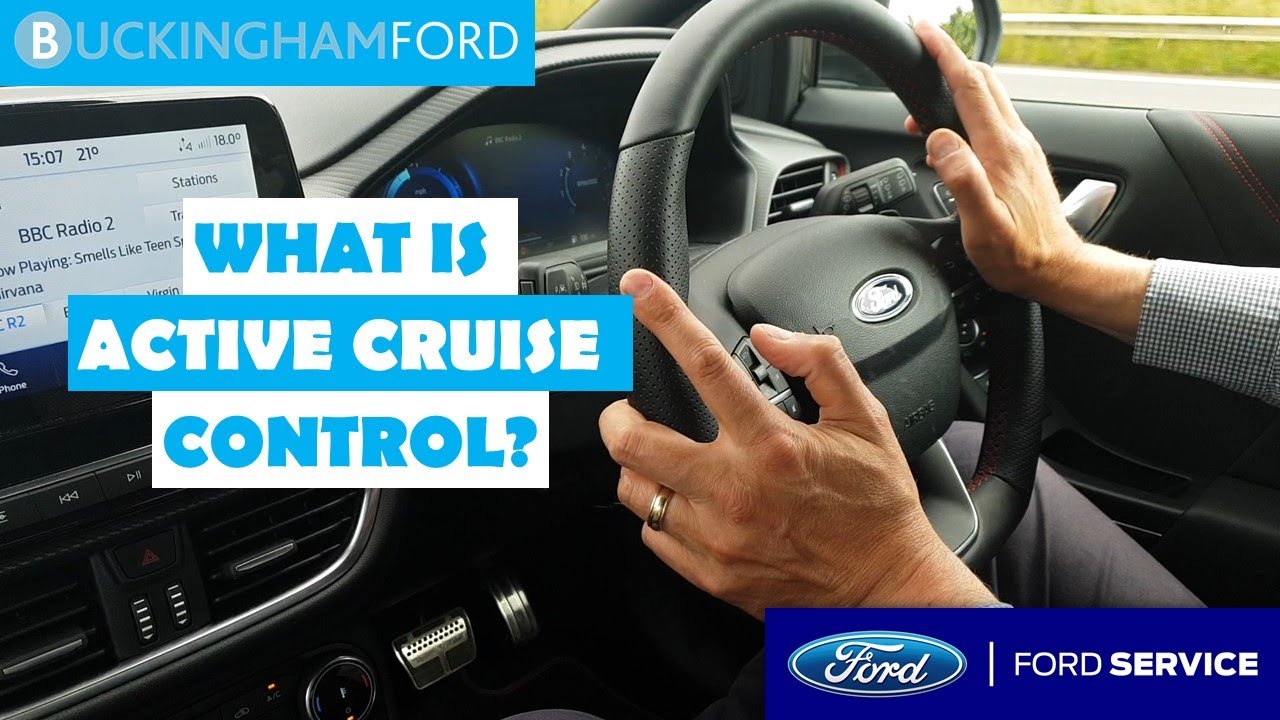
Distinguishing Between Cruise Control and Hill Descent Control
It is vital to distinguish between standard cruise control and Hill Descent Control (HDC). While cruise control aims to maintain a set speed on open roads, HDC is designed for low-speed, off-road applications, using the Anti-lock Braking System (ABS) to independently pulse brakes on steep, loose terrain. Confusing the two can lead to improper vehicle behavior on mountain highways.
How Does Cruise Control Work Downhill: Mechanical and Electronic Components
Maintaining speed on a grade requires a synchronized effort between several electronic modules. Understanding these components reveals the limitations of the technology.
- Wheel Speed Sensors: These transmit constant data to the ECM, allowing it to calculate precise velocity changes to within 0.1 mph.
- Transmission Control Module (TCM): This unit determines if a downshift is necessary to increase RPM, thereby creating higher internal engine drag.
- Brake System Controller (ABS/ESC): In premium Adaptive Cruise Control (ACC) systems, this module can independently pressurize hydraulic brake lines to physically slow the car if engine braking proves insufficient.
- Inclinometer: An essential sensor in modern architecture that informs the ECM about the severity of the road grade, allowing the software to adjust shift points preemptively.
Mastering How Does Cruise Control Work Downhill: Operation Steps
To safely navigate inclines, operators must bridge the gap between human intuition and machine automation. Use these steps to ensure you are in control.
Consult your owner’s manual. Look specifically for mention of “Active Brake Support” or “Grade Logic.” If these terms are absent, your system is likely passive.
On steep grades, if your RPM climbs between 3,000 and 5,000, your transmission is actively engine braking. If it stays at idle (1,000 RPM) while the speed climbs, the system is failing to hold the target speed.
If you find yourself on a long mountain descent, set your speed slightly lower than your desired pace to account for the “coasting” lag found in many older electronic systems.
Safety Protocols for How Does Cruise Control Work Downhill Systems
The most common pitfall is over-reliance on technology during hazardous weather. In rain, snow, or ice, the automated braking systems that make cruise control effective on dry descents can actually cause a loss of traction. If the system senses a speed discrepancy and triggers a sudden downshift or brake application, the surge in torque to the wheels could induce hydroplaning or a skid.
Never use cruise control on wet, icy, or snow-covered mountain roads. The system cannot detect road surface friction and may attempt to maintain speed by applying power or braking precisely when it is most dangerous to do so.
Comparing Cruise Control Performance on Declines
The leap in technology between a conventional system and a modern EV’s regenerative system is significant. Electric vehicles (EVs) and hybrids have a distinct advantage: they utilize the electric motor as a generator, creating massive magnetic resistance that acts as a powerful, silent brake during descents.
By The Numbers
Standard Speed Deviation Tolerance
Typical Downshift Threshold
Mastering Your Vehicle’s Descent Characteristics
Mastering downhill cruise control is about knowing your vehicle’s limitations. Not all systems are capable of active braking or aggressive downshifting. Always prioritize manual control over technology in heavy rain, ice, or steep mountain conditions. Before your next mountain road trip, test your vehicle’s speed maintenance on a safe, familiar slope, and always stay ready to take control. Your safety depends on being an active participant in the driving process, not a passive passenger to your vehicle’s onboard computer.
How Does Cruise Control Work Downhill: Frequently Asked Questions
Why does my car speed up when going downhill on cruise control?
Most standard cruise control systems are designed to modulate the throttle to maintain speed. When gravity accelerates the vehicle, the system cuts fuel to a minimum. Once the throttle is fully closed, the system has no further mechanical way to slow the car down, allowing gravity to overcome engine braking and cause the vehicle to exceed your set speed.
Does cruise control apply the brakes when going downhill?
In most older or standard-equipped vehicles, no. Cruise control generally does not trigger the hydraulic braking system. However, many modern vehicles with Adaptive Cruise Control (ACC) do have the capability to apply brakes to maintain a set distance from a lead vehicle or to maintain a speed on a descent, but this is system-dependent.
Why does my engine rev high when going downhill on cruise?
This usually indicates your vehicle’s transmission control module (TCM) is engaging ‘Grade Logic.’ The computer senses the descent and downshifts to increase engine braking, which keeps the vehicle from accelerating out of control. The high revs are a safety feature designed to help manage your speed without requiring you to ride your friction brakes constantly.
Should I turn off cruise control in the rain or snow?
Yes, absolutely. You should never use cruise control in rain, snow, or icy conditions. These systems can react inappropriately to loss of traction, such as accelerating when they detect a drop in speed due to wheel slip. This can lead to a total loss of vehicle control, as the cruise system may attempt to regain speed when you actually need to reduce it.
Is it safe to use cruise control on mountain highways?
Using cruise control on winding mountain roads is generally discouraged. The system’s inability to ‘read’ upcoming curves or steep changes in grade can cause erratic acceleration and deceleration. It is significantly safer to maintain manual control, allowing you to proactively adjust speed for curves and use engine braking effectively to preserve your primary brakes during long descents.