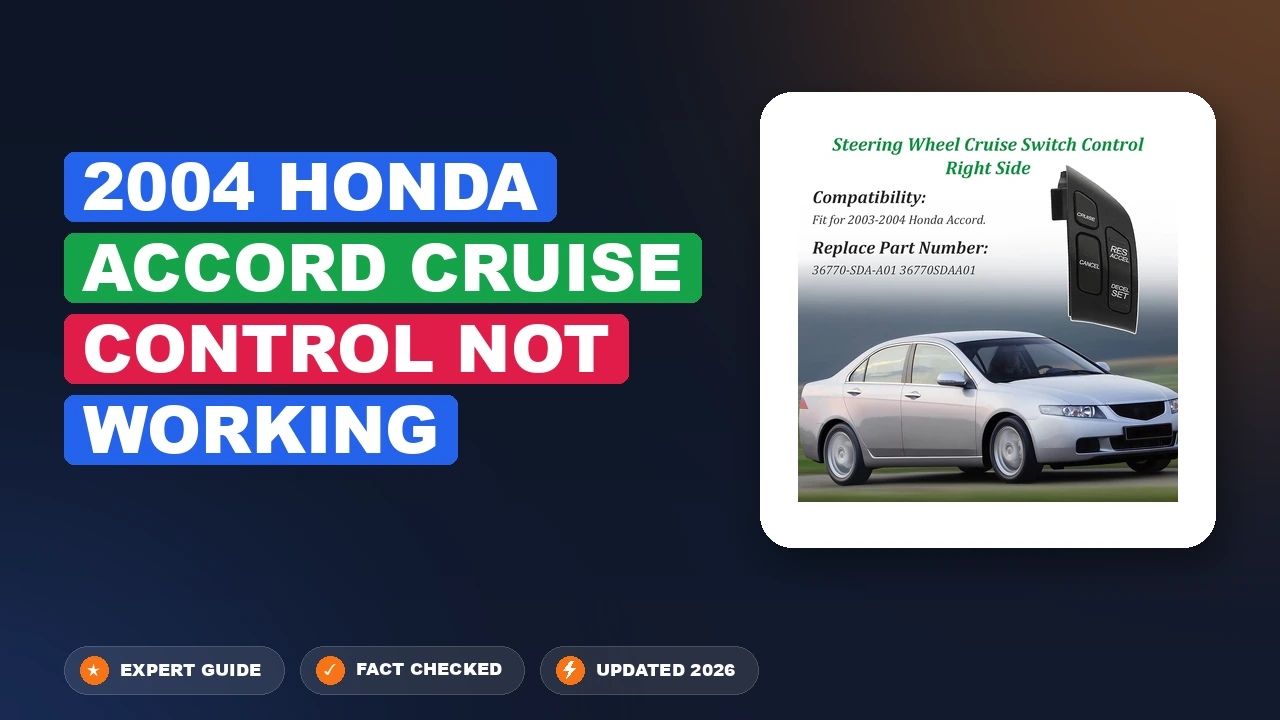
2004 honda accord cruise control not working: Diagnosed & Fixed
Is your 2004 Honda Accord failing to maintain highway speeds, leaving you stuck manually adjusting the throttle on long drives? Cruise control failure is a common nuisance for this generation Accord, often stemming from simple electrical switches rather than major engine failures. This guide provides a comprehensive, systematic approach to diagnosing and fixing your 2004 Honda Accord cruise control system, saving you from expensive shop diagnostic fees.

Why Is My 2004 Honda Accord Cruise Control Not Working?
Recommended Best Deal Products


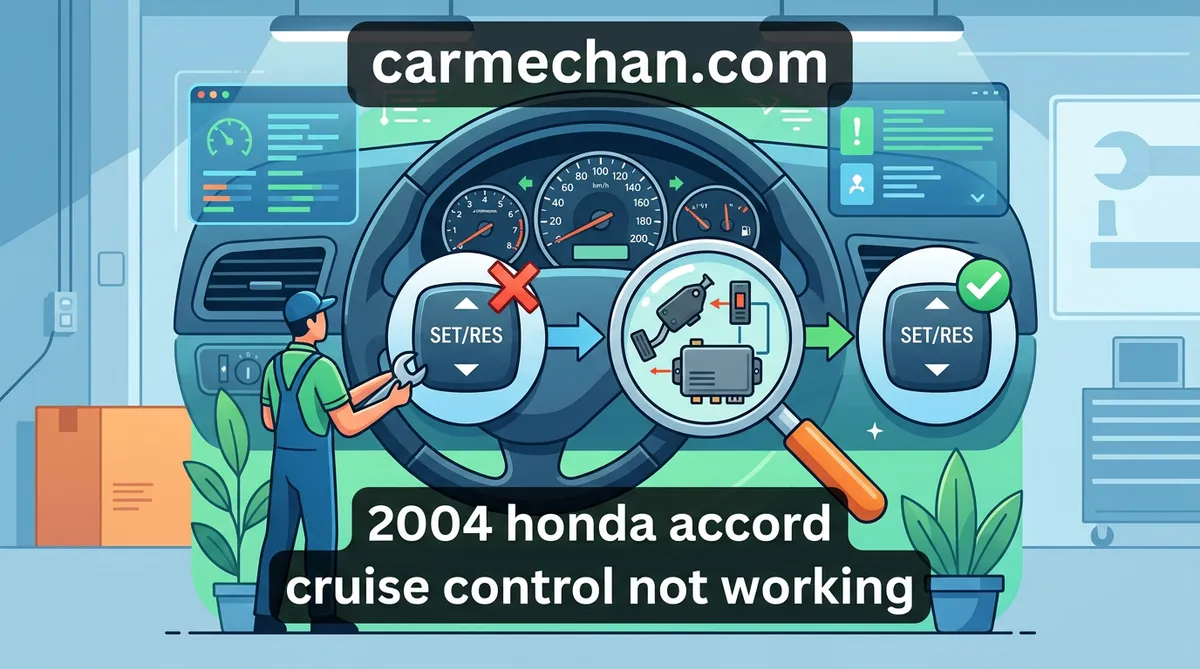
Understanding the architecture of your vehicle is the first step to successful repair. The 2004 Honda Accord utilizes a cable-driven actuator system. Unlike modern “drive-by-wire” setups that rely purely on electronic signals to the throttle body, this era of Honda engineering physically pulls the throttle body butterfly valve using a dedicated cable connected to an engine bay actuator.
📤 Share Image

How the Cable-Actuator System Functions
The system operates through a delicate balance of electrical input and mechanical force. When you engage the “Cruise” main switch, the Powertrain Control Module (PCM) performs a self-diagnostic check. If the PCM determines all safety parameters are met—such as no check engine lights, appropriate vehicle speed, and a closed circuit from the brake/clutch switches—it activates the vacuum-operated or motorized actuator. This actuator pulls a secondary throttle cable that mimics your foot pressing the gas pedal.

Common Symptoms of Cruise System Failure
The most common symptoms include the inability to set speed, the system disengaging immediately upon hitting “Set,” or the main cruise light failing to illuminate entirely. It is critical to note that the system is electronically locked; it will not engage below 25 mph or above 90 mph. If you are outside this window, the system is functioning exactly as designed by not engaging.
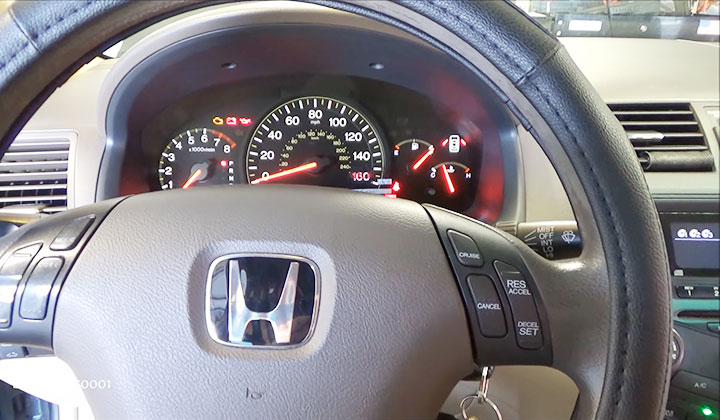
Dashboard Light Indicators vs. System Engagement
Distinguishing between a “Main” light failure and a system engagement failure is vital. If the “Cruise Main” light does not turn on when the button is pressed, the issue is typically electrical (fuse or switch). If the light turns on but the “Set” function fails to hold speed, the issue often lies with sensor inputs like the Vehicle Speed Sensor (VSS) or the brake/clutch position switches.
Industry Data
MPH Operational Range
Failure rate caused by switch/fuse
Common 2004 Honda Accord Cruise Control Not Working Fixes
To troubleshoot effectively, we follow the path of least resistance. Start with the components that are easiest to access and most prone to wear.
📋
Step-by-Step Guide
Recommended Best Deal Products


Inspect the under-dash fuse box. A blown cruise control fuse is the “low-hanging fruit” of diagnostics. Check for continuity on any fuse labeled “Cruise” or “ABS/Cruise” as they often share circuits.
The cruise control system disengages the moment it senses the brake pedal is depressed. If your brake light switch is faulty or the rubber stopper on the pedal arm has disintegrated, the PCM thinks you are braking, preventing activation.
Replacing the Clutch Position Switch (Manual Only)
If your Accord is a 5-speed manual, the clutch pedal assembly features a switch similar to the brake switch. If this switch fails or loses its adjustment, the system assumes the clutch is depressed and kills the cruise signal immediately.

Audible — Listen Free for 30 Days
One free credit a month and thousands of titles included.
Listen Free for 30 DaysRepairing Steering Wheel Switch Contact Issues
Over nearly two decades, the solder joints and contacts inside the steering wheel control switches often develop high resistance. You can use a multimeter set to Ohms to test the resistance when you press “Set” or “Resume.” A reading of “OL” or high resistance indicates the switch needs to be cleaned or replaced.
A common, inexpensive repair for the brake switch is checking the pedal arm stopper. If it has crumbled (common in 2004 models), the switch plunger doesn’t get pushed in. A simple coin taped to the pedal arm is a famous, durable DIY workaround.
Advanced Diagnosis for Complex Cruise Control Failures
When basic electrical checks do not yield a fix, we must look deeper into the mechanical and signal-based inputs required for the system to maintain a “cruise” state.
- Verifying VSS Data: The Vehicle Speed Sensor sends pulse signals to the PCM. If your speedometer is erratic or intermittent, your cruise control will not work. Scan for “Vehicle Speed Sensor” trouble codes using an OBD-II scanner.
- Inspecting the Actuator and Cable: Physically examine the cruise actuator located in the engine bay. Ensure the throttle cable is not frayed or seized. With an assistant, have them hit “Set” while you watch the actuator linkage. If you hear the motor hum but the cable doesn’t pull, the internal gear or cable attachment is the problem.
- Vacuum Leaks: Although the 2004 model is predominantly motorized, any vacuum-assisted components connected to the intake system must be airtight. A significant vacuum leak elsewhere in the engine can affect the idle air control and general PCM load calculations, causing the cruise system to default to a “Safe” mode.
Never attempt to adjust the throttle linkage while the engine is running or in gear. Ensure the vehicle is parked on a level surface with the parking brake engaged before inspecting any engine bay components.
✅ Why These Fixes Work
- Restores logical signal flow
- Addresses known switch degradation
- Verifies sensor health
- Eliminates mechanical slack
❌ When to See a Pro
- PCM internal logic failure
- Intermittent electrical shorts
- Clock spring wiring damage
- Systematic sensor signal loss
Diagnostic Summary and Final Recommendations
Recommended Best Deal Products


Restoring your 2004 Honda Accord cruise control system is a highly achievable goal for the home mechanic. By checking your fuses first for a total system failure, verifying the brake pedal position switch—which is the #1 culprit in this model—and using a multimeter to isolate electrical resistance in the steering wheel switches, you can resolve the majority of common issues.
Furthermore, never overlook physical throttle cable wear, which can occur due to age and heat cycling under the hood. If these steps fail to restore your system, consult a professional mechanic to perform a deep scan of the PCM for error codes, as this may indicate a deeper, more elusive controller or wiring harness issue that requires specialized diagnostic equipment. Consistency and methodical elimination of variables remain your best tools in resolving this problem.
2004 Honda Accord Cruise Control Not Working: Frequently Asked Questions
Why does my cruise control light turn on but not set?
If the ‘Cruise Main’ light illuminates but the system will not set speed, the problem is likely in the signal loop. Common causes include a failed brake pedal position switch, a malfunctioning ‘Set/Coast’ steering wheel button, or a faulty Vehicle Speed Sensor (VSS) that prevents the computer from confirming the vehicle is moving fast enough to maintain speed.
Is there a dedicated fuse for the 2004 Accord cruise control?
Yes, the 2004 Honda Accord utilizes specific fuses for the cruise control system located in the interior driver-side fuse panel. Refer to the interior cover map to identify the correct circuit. Often, the fuse is shared with other accessory systems, so if other dash items are also not working, the fuse is the highest probability culprit.
Clarify the meaning of a blinking light
The 2004 Honda Accord does not typically have a ‘blinking’ cruise light as an error code indicator. If your cruise indicator is flashing or acting erratically, this usually signals an electrical short or an issue with the instrument cluster’s circuitry rather than the cruise control system itself, potentially indicating a ground issue in the dash.
Audible Premium Plus — Annual Membership
12 audiobook credits up front, plus the full Audible catalogue.
See Annual PlansAddress the clock spring concern
The clock spring is a ribbon cable inside the steering column that allows electrical signals to pass between the steering wheel and the car’s computer. If the cruise control buttons are unresponsive while the horn or radio controls also act up, the clock spring is likely torn or worn, necessitating a professional replacement to restore connectivity.
Explain the relationship between the brake light and cruise safety
Cruise control is programmed to disengage instantly when the brake pedal is depressed to ensure safety. The system monitors the brake light switch; if that switch is faulty or stuck, the cruise control computer receives a constant ‘brake pressed’ signal and will refuse to set speed. If your brake lights stay on after you stop, your cruise will not work.