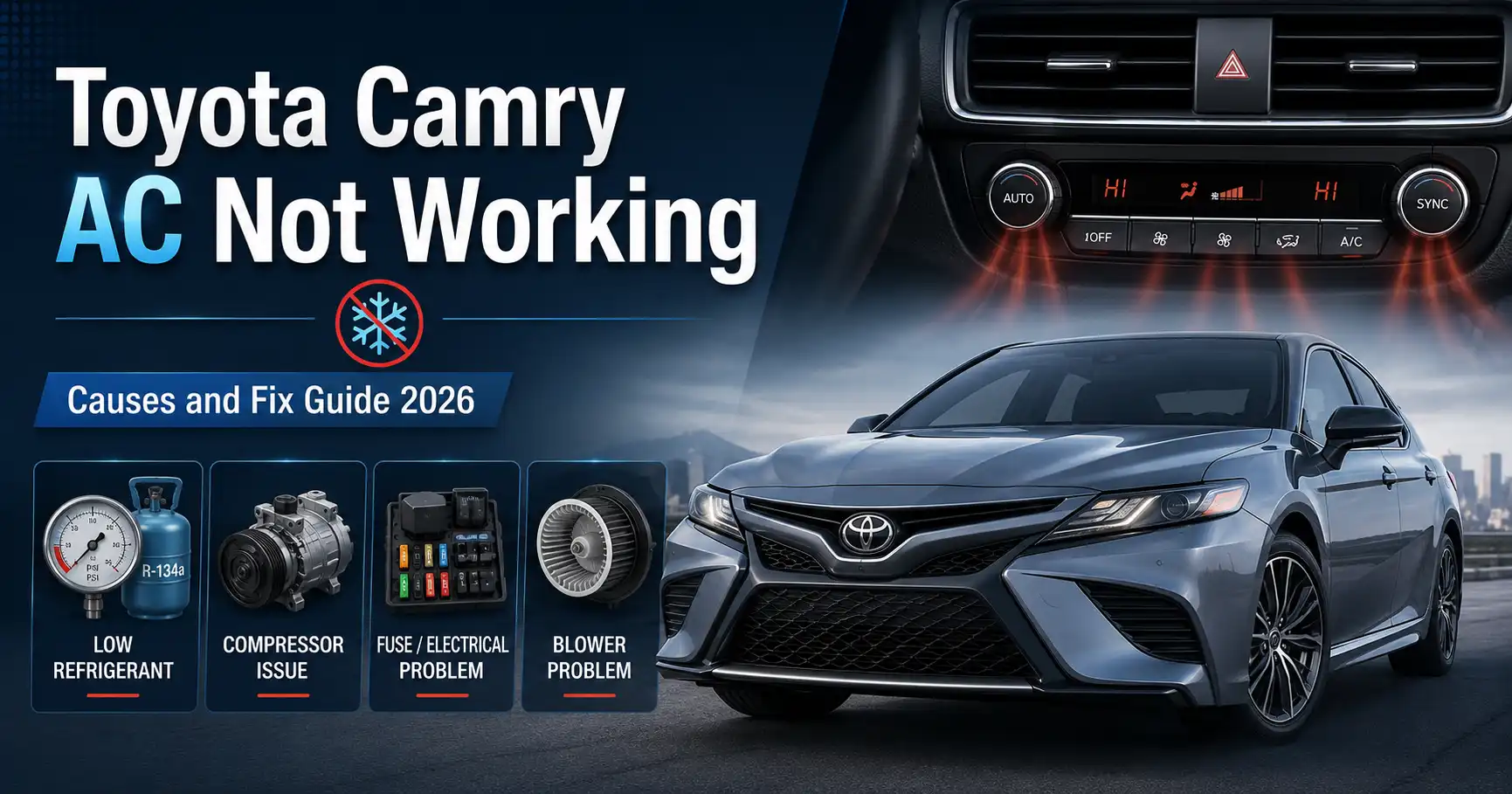
Toyota Camry AC Not Working Causes and Fix Guide 2026
Last Updated on June 24, 2026 by Albert Duke


When your Toyota Camry AC is not working, do not start by replacing the compressor. A Camry can lose cooling because of low refrigerant, a leak, a clogged condenser, a blower motor issue, a bad control module, or a blend door actuator fault.
The right first step depends on the symptom. Warm air, no airflow, cooling that comes and goes, and one side blowing hot air point to different parts of the HVAC system.
HVAC means heating, ventilation, and air conditioning. Start with the symptom you actually have, because that usually points to the right system first.
What Toyota Camry AC Not Working Usually Means
Toyota Camry AC not working can describe at least five different problems. The system may be cooling poorly, not cooling at all, failing to move air, or mixing hot and cold air incorrectly.
Use this table before buying parts.
| Symptom | Most Likely System | First Area To Check |
|---|---|---|
| Fan blows but air is warm | Refrigerant or compressor side | Refrigerant level, leak, condenser, compressor command |
| No air comes from vents | Blower side | Cabin filter, blower motor, fuse, relay, control module |
| AC works then stops | Electrical or compressor control | AC clutch command, sensor data, Toyota HVAC codes |
| One side cold and one side warm | Air mixing system | Blend door actuator, dual-zone temperature control |
This separation matters because a recharge will not fix a dead blower motor. A cabin filter will not fix a leaking refrigerant system.
Once you match the symptom, the next step is checking the most likely cause.
If Your Toyota Camry Blows Warm Air
If the fan blows normally but the air stays warm, start with the refrigerant and compressor side of the system. Toyota lists low refrigerant, a dirty or clogged condenser, and faulty compressor components among common car AC causes in its official car AC troubleshooting guidance.
Low Refrigerant Leak
Low refrigerant is one of the most common reasons a Camry AC blows warm air. But low refrigerant usually means the system has a leak.
Do not treat a recharge as a permanent fix unless the leak has been checked. If the AC gets cold after a recharge and then turns warm again, the refrigerant is escaping somewhere.
Dirty Condenser Airflow
The condenser sits at the front of the car and releases heat from the AC system. Bugs, leaves, road debris, or bent fins can reduce airflow and weaken cooling.
You can inspect the condenser through the front grille with the engine off. Do not spray high-pressure water directly into delicate fins.
Compressor Control Failure
The compressor moves refrigerant through the system. If the compressor does not engage, cycles too quickly, or cannot respond correctly, the vents may blow warm air even when the fan works.
For a deeper electrical check, use a dedicated guide on how to test a car AC compressor clutch before assuming the whole compressor is bad.
Pressure Sensor Fault
Modern AC systems use pressure data to protect the compressor. If the system sees pressure that is too low, too high, or unreliable, it may shut down cooling.
Warm air is a cooling-side problem, but no airflow points to a different part of the HVAC system.
If Your Toyota Camry Has No Airflow
If no air comes from the vents, the AC system may be cold but unable to move air into the cabin. This is usually a blower-side problem, not a compressor problem.
Start with the low-cost checks first.
- Check the cabin air filter.
A clogged filter can reduce airflow and make the AC feel weak. Camry owners can compare options in our guide to the best cabin air filter for Toyota Camry. - Test every fan speed.
If some speeds work and others do not, the blower resistor or control module may be involved. - Listen for blower motor noise.
A silent blower at every fan speed can point to a fuse, relay, wiring issue, control fault, or blower motor failure. - Check the fuse box guide for your year.
Fuse names and locations vary by Camry generation. Use your owner manual or the fuse box cover before pulling fuses. - Watch for intermittent operation.
If the blower works after tapping under the passenger side dash, the blower motor or connector may be failing.
If air does come out but the cooling changes randomly, the issue may be intermittent rather than completely failed.
If Your Toyota Camry AC Works Then Stops
Intermittent Camry AC failure is often more diagnostic than total failure because the system proves it can work briefly. The issue may be electrical, sensor-related, or tied to compressor control.
AC Light Blinking
A blinking AC light usually means the system detected a fault and shut off compressor operation. This can happen when compressor speed, clutch operation, or sensor data does not match what the control module expects.
Do not keep cycling the button repeatedly. Scan the system first if the blinking returns.
Cooling Stops After Driving
If the AC starts cold and turns warm after driving, the problem may be heat-related. Possible causes include compressor control failure, a pressure issue, cooling fan trouble, or a sensor fault.
This is where basic code readers may fall short. Toyota HVAC faults can require enhanced scanner coverage beyond simple engine codes.
Code B1479 Warning
Toyota issued TSB T-SB-0084-13 for some 2012 to 2013 Camry models where warm air may blow from the HVAC vents with the AC on. The bulletin states that DTC B1479, Flow Sensor Circuit, may be stored and that a malfunctioning AC compressor flow sensor may cause the condition.


The bulletin applies only to vehicles before specific production change VINs. Confirm applicability through the Toyota bulletin hosted by NHTSA before using it as a repair decision.
Intermittent cooling needs scan data, but uneven cooling from one side of the cabin points toward the air-mixing system.
If One Side Blows Hot Air
If one side of your Camry blows cold and the other side blows warm, the refrigerant system may still be working. This symptom often points to air-mix control, especially on Camrys with dual-zone climate control.
A blend door actuator moves internal doors inside the HVAC case. Those doors direct air across the heater core, evaporator, or mixed air path.
Watch for these signs:
- Driver side cold but passenger side warm
- Passenger side cold but driver side warm
- Clicking behind the dash
- Temperature changes that lag or do not match the control setting
- One vent temperature different from the others
Replacing refrigerant will not fix a stuck blend door or failed actuator. Check the exact actuator name and location for your Camry year before ordering parts.
After narrowing the symptom, the next question is what you can safely check yourself.
How To Check A Toyota Camry AC Problem Safely
You can check several Camry AC basics before paying for diagnostic labor. These steps do not require opening the refrigerant system.

- Set the climate controls correctly.
Set the temperature to full cold, turn AC on, use recirculation mode, and increase the fan speed. Confirm the problem is still present. - Replace or inspect the cabin air filter.
A blocked filter can make airflow feel weak even when the blower works. - Inspect the condenser face.
Look through the front grille for leaves, plastic bags, bent fins, or heavy debris. - Listen to the blower motor.
Run the fan at low, medium, and high speeds. A dead setting can point to a resistor or control fault. - Watch the compressor behavior.
If your Camry uses a clutch-style compressor, check whether the compressor engages when AC is requested. If it cycles rapidly or never engages, stop guessing and diagnose the control side. - Scan for codes.
OBD2 means On-Board Diagnostics. A basic OBD2 scanner reads engine codes, but Toyota HVAC and body codes may require enhanced Toyota coverage. Our best OBD2 scanner for Toyota guide can help you choose a scanner with broader system access.
These checks can narrow the problem, but repair cost depends on which system actually failed.
What Toyota Camry AC Repairs Usually Cost
Toyota Camry AC repair costs vary because a recharge, leak repair, blower repair, and compressor replacement are very different jobs. Use these numbers as planning ranges, not a final quote.
| Repair Type | Verified Cost Data | What It Means |
|---|---|---|
| AC recharge | $254 to $336 average | RepairPal lists this for Toyota Camry AC recharge, before taxes and location differences |
| 2021 Camry AC recharge | $313 to $393 average | Newer model-year estimates can be higher |
| AC compressor replacement | $1,235 to $1,637 average | RepairPal lists this average for Toyota Camry compressor replacement |
| 2021 Camry compressor replacement | $1,366 to $1,871 average | Newer Camry compressor estimates can run higher |
| Blower motor or blend door actuator repair | Shop diagnosis needed | Final cost depends on the failed part, dashboard access time, and your Camry model year |
RepairPal’s Toyota Camry compressor replacement estimate shows why diagnosis matters before replacing major parts. A compressor is one of the most expensive AC repairs on a Camry.
Cost matters, but the bigger mistake is replacing expensive parts before confirming the failure.
When To Stop DIY Camry AC Diagnosis
A few Camry AC checks are safe at home, but refrigerant-side work is not a guess-and-fill repair. Stop DIY diagnosis when the next step requires opening, recovering, evacuating, or charging the AC system.
Stop and use a qualified shop if:
- Refrigerant is low again after a recent recharge
- The AC compressor cycles rapidly
- The compressor makes grinding, rattling, or harsh noise
- The system shows B1479 or another HVAC control code
- The AC works only after resetting codes
- You see oily residue around AC lines, fittings, or the condenser
- You do not have the equipment to recover refrigerant properly
The EPA says technicians who service motor vehicle AC systems for payment must be trained and certified under Section 609. EPA guidance also covers proper refrigerant recovery and equipment requirements through its MVAC system servicing rules.
With the safety limits clear, the final decision comes down to matching your symptom to the next best action.
Quick Toyota Camry AC Decision Guide
Use this quick guide if you want the shortest path from symptom to next check.
Toyota Camry AC Symptom Decision Guide
Match the symptom first. A warm-air problem, airflow problem, intermittent failure, one-side temperature issue, and blinking AC light each point to a different diagnostic path.
Fan Blows Warm Air
Check condenser airflow, refrigerant leak signs, compressor command, and AC pressure data before replacing parts.
Cooling SideNo Air From Vents
Start with the cabin filter, fan speeds, blower fuse, relay, resistor, and blower motor operation.
Blower SideAC Works Then Stops
Scan HVAC codes and check compressor control, pressure readings, and heat-related sensor faults.
Intermittent FaultOne Side Blows Hot
Compare driver and passenger temperatures. A blend door actuator or air-mix control fault is likely.
Air Mix FaultAC Light Blinks
Stop cycling the button. Scan for stored HVAC faults such as compressor flow sensor related codes.
Scan Required| Your Symptom | Most Likely Direction | First Smart Check | Shop Needed When |
|---|---|---|---|
| Fan works but air is warm | Refrigerant, leak, compressor, condenser | Inspect condenser and scan for AC codes | Refrigerant is low or compressor will not engage |
| No air from vents | Blower motor, fuse, relay, filter, module | Check filter and fan speeds | Blower is silent on all settings |
| AC works then turns warm | Sensor, compressor control, pressure issue | Scan HVAC codes | Fault returns after restart |
| One side hot | Blend door or actuator | Compare driver and passenger temperature settings | Clicking or wrong vent temperature continues |
| AC light blinks | Control fault or compressor mismatch | Scan for stored codes | B1479 or compressor-related codes appear |
Everything points back to one rule: diagnose the symptom before buying the part.
Best Next Step For Camry Owners


The best next step is not replacing the compressor first. Start by deciding whether your Toyota Camry AC not working problem is an airflow issue, a cooling issue, an intermittent issue, or a one-side temperature issue.
If the problem is simple airflow, check the cabin filter, blower speeds, and fuses. If the problem involves warm air, refrigerant loss, compressor faults, or code B1479, get a proper AC diagnosis before spending money on parts.
A careful symptom check can save you from replacing the wrong component.
Toyota Camry AC Not Working FAQ
Why Is My Toyota Camry AC Blowing Warm Air
Your Toyota Camry AC is usually blowing warm air because of low refrigerant, a refrigerant leak, a dirty condenser, compressor control failure, or a pressure sensor fault. If the fan speed is normal but the air is warm, focus on the cooling side of the system first.
Why Does My Toyota Camry AC Work Then Stop
A Camry AC that works then stops may have an electrical fault, pressure problem, compressor control issue, or stored HVAC code. Some 2012 to 2013 Camry models may also be affected by the Toyota B1479 flow sensor bulletin, but VIN applicability must be confirmed.
Can A Bad Cabin Air Filter Make My Camry AC Stop Working
A bad cabin air filter usually reduces airflow rather than stopping the AC system completely. If the air is cold but weak, inspect the filter first. If no air comes from the vents at any fan speed, check blower-side electrical parts next.
What Does Toyota Camry AC Code B1479 Mean
Toyota bulletin T-SB-0084-13 identifies B1479 as a Flow Sensor Circuit code in the AC system. The bulletin says a malfunctioning AC compressor flow sensor may cause warm air from the vents with AC on in some 2012 to 2013 Camry models.
How Much Does It Cost To Fix Toyota Camry AC
Toyota Camry AC repair cost depends on the failed part. RepairPal lists Camry AC recharge around $254 to $336 on average, while compressor replacement is listed around $1,235 to $1,637 before taxes, fees, and location differences.
Should I Recharge My Toyota Camry AC Myself
We do not recommend using a recharge can as your first fix if the system is leaking or cycling abnormally. Low refrigerant usually means the leak needs to be found. A shop can recover, evacuate, test, and recharge the system with the right equipment.