Nissan Frontier Crankshaft Position Sensor Location All Engine Variants
Last Updated on April 25, 2026 by Ryan
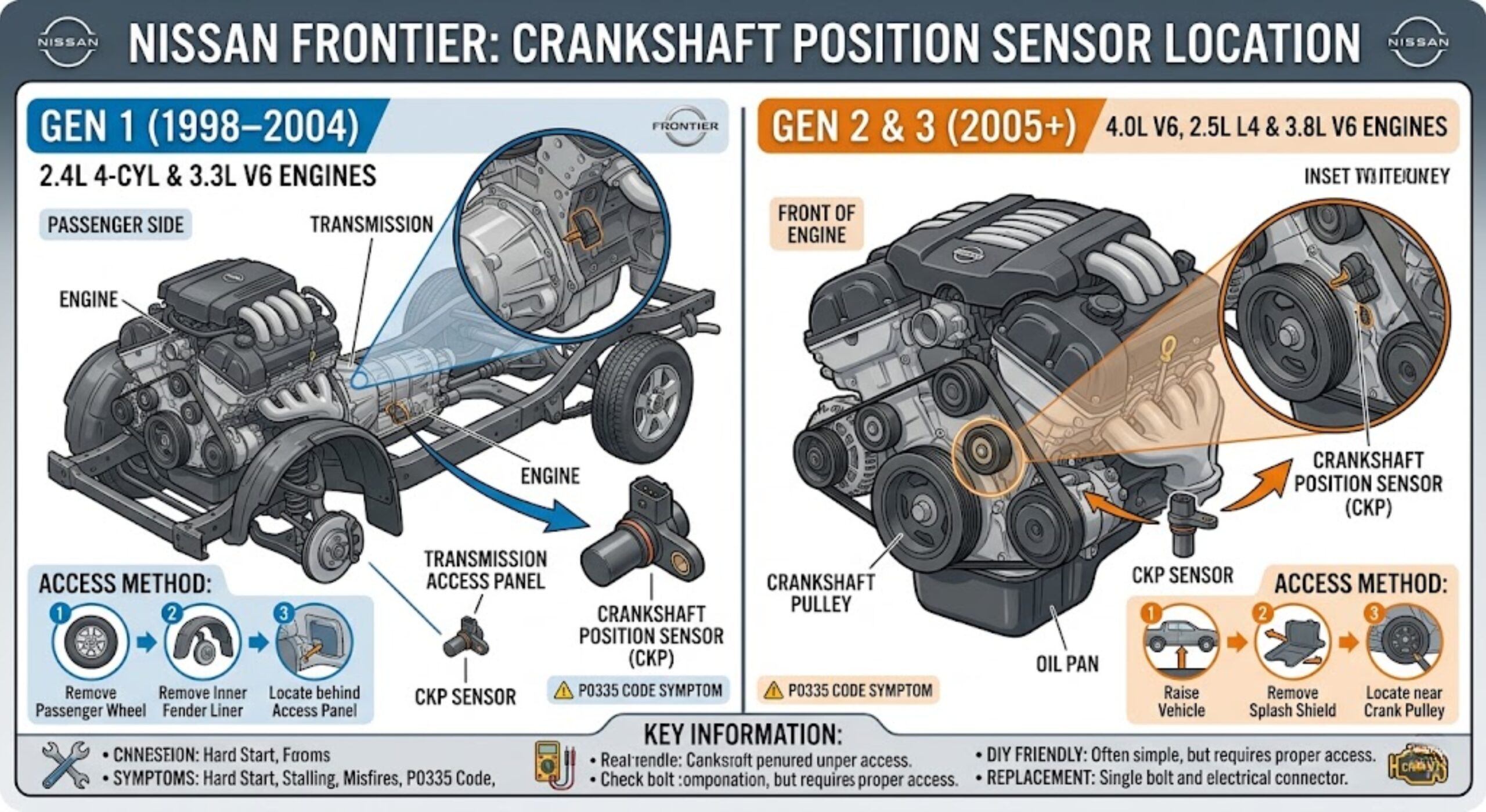
Finding the crankshaft position sensor on a Nissan Frontier depends entirely on which engine is under your hood. Search online and you’ll get conflicting answers — because they’re all correct for different trucks. If you’re chasing a P0335 or P0336 code, or dealing with a stalling or no-start condition, you need the right location for your specific engine before you touch a wrench.
We cover all four engine variants with directional descriptions for each — the 2.4L KA24DE, 3.3L VG33E, 4.0L VQ40DE, and 2.5L QR25DE. Find your engine in the table below, then go straight to your section.
Why the Sensor Location Differs by Engine and Year


The Frontier has used four distinct engine families across its generations. Each engine has a different block design, which puts the crankshaft position sensor (CKP sensor) in a different physical spot.
Here’s the fast lookup table:
| Year Range | Engine | Displacement | CKP Sensor Location |
|---|---|---|---|
| 1998–2004 | KA24DE | 2.4L 4-cyl | Transmission bellhousing, driver side, near top |
| 1998–2004 | VG33E | 3.3L V6 | Transmission bellhousing, passenger side, near top |
| 2005–2021 | VQ40DE | 4.0L V6 | Transmission bellhousing, passenger side — access via wheel well |
| 2005–2012 | QR25DE | 2.5L 4-cyl | Passenger side engine block, below starter, rearward of oil pressure switch |
A P0335 code points to the CKP sensor circuit. A P0340 code points to the camshaft position sensor instead — those are different sensors in different locations. If you’re unsure which sensor is which, our guide to Nissan CVT transmission speed sensor location covers how Nissan numbers and routes its sensor harnesses, which helps avoid mixing them up.
Find your engine below — each section describes the exact position and what you need to move to reach it.
2.4L KA24DE Crankshaft Position Sensor Location (1998–2004)


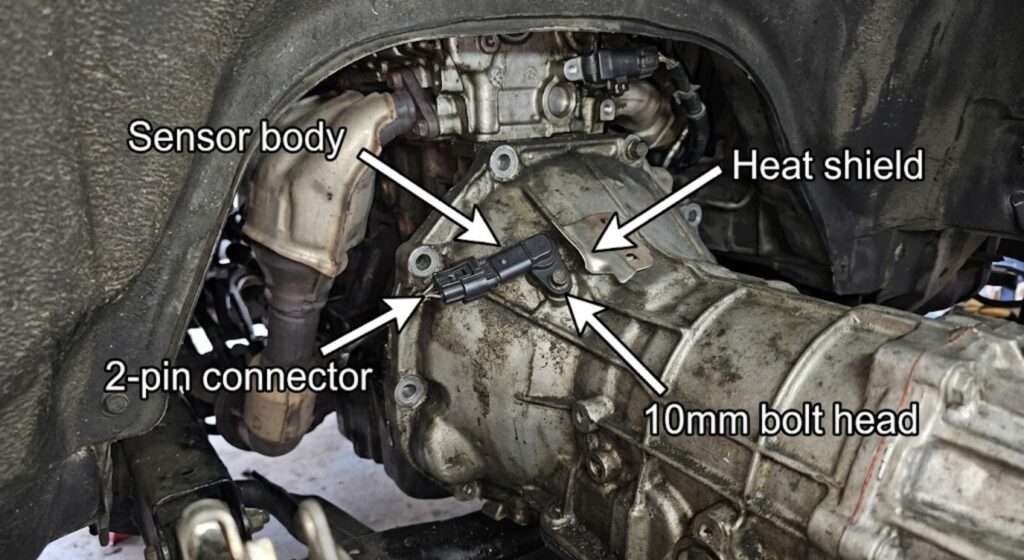
On the KA24DE, the crankshaft position sensor sits on the transmission bellhousing at the rear of the engine, near the top, slightly toward the driver’s side. It reads the flywheel teeth through the bellhousing to track crankshaft speed and position.
You can approach it two ways — from underneath the truck, or through the driver’s side front wheel well with the wheel removed. Most owners find the wheel well approach gives better visibility, though access is tight from either angle.
The sensor body is small and cylindrical with a single 10mm bolt holding it in place. A small metal heat shield sits over it, held down by a 6M x 1.0 bolt with a 10mm head. You need to remove that shield before the sensor is accessible.
What to move to access it:
- Remove the driver’s front wheel for wheel well access, or jack the truck and approach from below
- Remove the small heat shield (10mm bolt)
- Disconnect the wiring connector before unbolting — push the connector forward slightly, depress the release tab, then pull it back. These connectors get brittle with age and heat, so work slowly.
The connector on the KA24DE CKP sensor is a small 2-pin plug. The wiring runs along the bellhousing toward the driver’s side firewall.
Note: The camshaft position sensor on the KA24DE is inside the distributor — a completely different location. Don’t confuse the two.
3.3L VG33E Crankshaft Position Sensor Location (1998–2004)


Unlike the KA24DE, the VG33E places the crankshaft position sensor on the passenger side of the transmission bellhousing, also near the top, where the engine block meets the transmission. The physical mounting is similar to the 4-cylinder, but the side of the vehicle is different.
Access requires jacking the truck and removing the passenger-side front wheel, then pulling the plastic inner fender liner. Once the liner is out, you can see the rear of the engine clearly from that side.
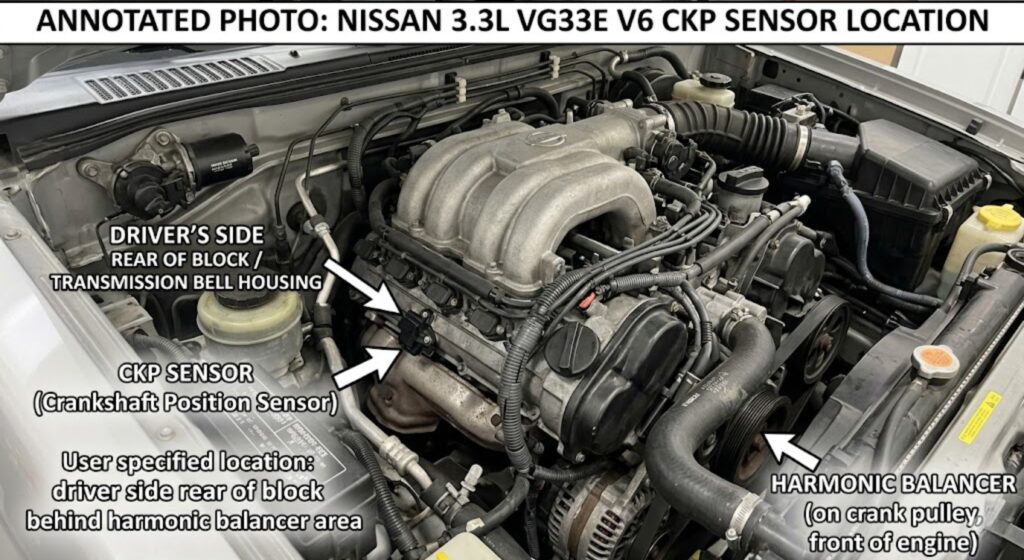
The sensor is a single-bolt design — 10mm bolt — with a small heat shield over it. The connector faces the passenger side, with the wiring connection also coming from that direction.
What to move to access it:
- Jack the truck, secure on stands
- Remove the passenger front wheel
- Remove the plastic inner fender liner (push-pin clips)
- Remove the heat shield (10mm bolt)
- Disconnect the connector by pushing it forward and releasing the tab
The OEM part for both the KA24DE and VG33E is the same sensor: Nissan part number 23731-EA20A (superseded by 23731-EA20D). Both engines share this sensor, which is why many parts databases list it as a single listing covering 1998–2004 Frontier 4-cyl and V6.
The connector on the VG33E is a 2-pin plug, same family as the KA24DE. The biggest access difference versus the 4-cylinder is which side of the truck you approach from — driver’s side for the KA24DE, passenger side for the VG33E.
4.0L VQ40DE Crankshaft Position Sensor Location (2005–2021)
On the most common Frontier engine — the 4.0L VQ40DE — the crankshaft position sensor is on the passenger side of the vehicle, mounted on the transmission bellhousing where the engine meets the transmission. This is the same general region as the VG33E, but the VQ40DE’s tighter engine bay means access is noticeably harder.
This sensor reads the position of the crankshaft via a reluctor wheel on the flywheel. It’s a Hall Effect sensor — if aftermarket versions fail quickly on your truck, that’s expected. The VQ platform is well-known for rejecting non-OEM sensors. Use OEM Hitachi or genuine Nissan only.
What to Move Before You Can See It
You cannot see or reach this sensor from the top of the engine bay. The only practical access route is through the passenger side wheel well.
- Jack the truck and secure it on jack stands
- Remove the passenger-side front wheel
- Pull back the plastic inner fender liner — it’s held by push-pin clips along the edges
- Look through the wheel well toward the rear of the engine, at the bellhousing area
- The sensor sits under a rubber boot — that boot needs to be pulled back before you see the sensor body
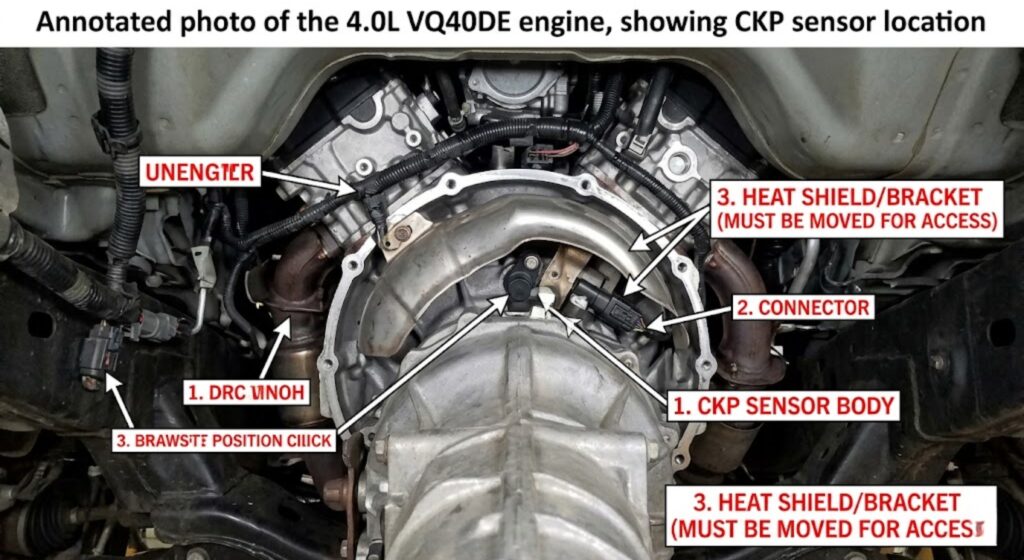
The bolt holding it in is a single 10mm. The tight workspace is the only real challenge — the sensor swap itself takes minutes once you have access.
What the Sensor Looks Like Once Found
The VQ40DE CKP sensor is a cylindrical sensor with a metal housing. It uses a 3-pin connector — note that one orientation has an angled connector body and another has a straight one. These are not interchangeable. Make sure the replacement matches the connector angle of the one you removed, not just the thread pitch.
The sensor does not come with a new O-ring. If the old O-ring is cracked or compressed flat, source a replacement before installing the new sensor.
2.5L QR25DE Crankshaft Position Sensor Location (2005–2012)
The 2.5L QR25DE powers the 4-cylinder version of the 2005–2012 Frontier and places the sensor in a completely different location from the V6. Many owners get confused because most online walkthroughs — and many forum answers — describe the V6 wheel well procedure, which does not apply here.
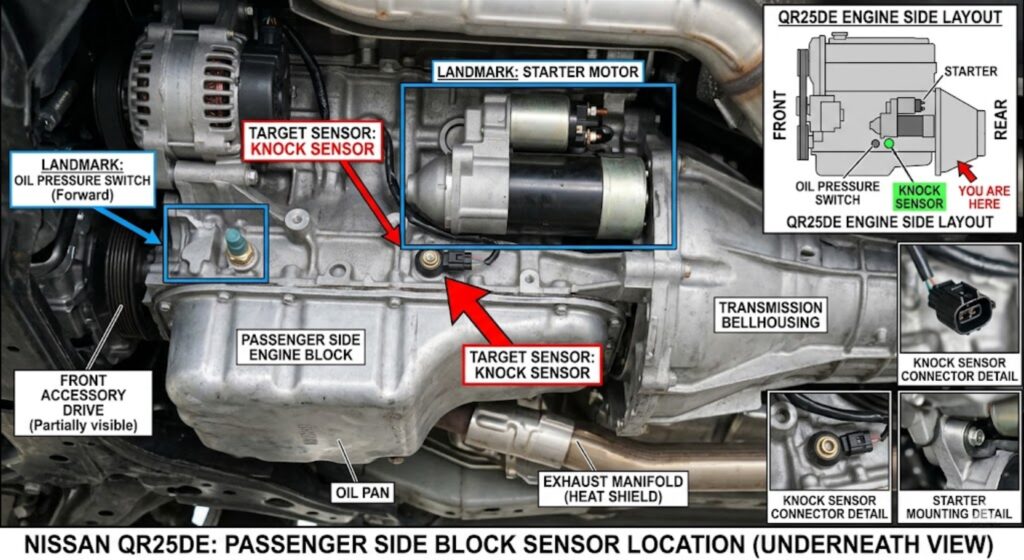
On the QR25DE, the crankshaft position sensor is on the passenger side of the engine block (right bank), below the starter motor, and rearward of the oil pressure switch. It mounts directly into the cylinder block rear housing, facing the signal plate at the end of the crankshaft.
Importantly, the cam position sensor and crank position sensor on the QR25DE share the same part number: Nissan P/N 23731-6N21A. They’re physically identical sensors in different locations. This is a common source of ordering mistakes.
What to move to access it:
Because it’s on the block itself rather than the bellhousing, you don’t need to go through the wheel well. You can access it from the engine bay on some builds, or from below with the truck raised. The location below the starter makes it tight but reachable without wheel removal on most 2WD models. 4WD trucks may require more clearance.
The QR25DE CKP sensor uses a 2-pin connector. Access difficulty is moderate — harder than the VG33E from a visibility standpoint, but faster than the VQ40DE once you know where to look.
All 4 Nissan Frontier CKP Sensor Locations Side by Side
Here’s how the four locations compare at a glance:
| Engine | Years | Location | Access Route | Connector | Access Difficulty |
|---|---|---|---|---|---|
| KA24DE 2.4L | 1998–2004 | Bellhousing, driver side, near top | Driver wheel well or underneath | 2-pin | Moderate |
| VG33E 3.3L | 1998–2004 | Bellhousing, passenger side, near top | Passenger wheel well | 2-pin | Moderate |
| VQ40DE 4.0L | 2005–2021 | Bellhousing, passenger side | Passenger wheel well — fender liner removal required | 3-pin | Moderate-hard |
| QR25DE 2.5L | 2005–2012 | Block, passenger side, below starter | Engine bay or underneath | 2-pin | Moderate |
The key pattern to notice: first-gen trucks (1998–2004) use bellhousing-mounted sensors read from the flywheel. Second-gen trucks (2005+) continue the bellhousing approach for the V6, but the 4-cylinder QR25DE moves the sensor onto the block itself.
Nissan Frontier crankshaft position sensor location comparison for all four engine variants: KA24DE, VG33E, VQ40DE, and QR25DE
1st gen · 1998–2004
KA24DE
2.4L 4-cylinder
Location: Transmission bellhousing, driver side, near top
Access: Driver wheel well or underneath
Connector: 2-pin
Bolt: 10mm · heat shield over sensor
1st gen · 1998–2004
VG33E
3.3L V6
Location: Transmission bellhousing, passenger side, near top
Access: Passenger wheel well + fender liner
Connector: 2-pin · brittle with age
Bolt: 10mm · heat shield + 6M×1.0 bolt
2nd–3rd gen · 2005–2021
VQ40DE
4.0L V6 · most common
Location: Bellhousing, passenger side — under rubber boot
Access: Passenger wheel + fender liner required
Connector: 3-pin · straight or angled — not interchangeable
Bolt: 10mm · O-ring not included with sensor
2nd gen · 2005–2012
QR25DE
2.5L 4-cylinder
Location: Passenger side block, below starter, rearward of oil pressure switch
Access: Engine bay or underneath — wheel removal often not needed
Connector: 2-pin · same P/N as cam sensor
Bolt: 10mm · Nissan P/N 23731-6N21A
OEM only on VQ40DE. The VQ platform has a well-documented high failure rate with aftermarket sensors. Use OEM Hitachi or genuine Nissan on all 2005+ trucks. All other variants also prefer OEM but tolerate quality aftermarket.
Connector and Wiring Callout on the Frontier CKP Sensor
Once you find the sensor, inspect the connector before assuming the sensor itself is bad. A failed connector or damaged wiring causes the same P0335/P0336 codes as a dead sensor — and it’s a $0 fix versus a $50–$120 part.
For all 1998–2004 engines (KA24DE and VG33E), the connector is a 2-pin plug. For the 2005–2021 VQ40DE, the connector is a 3-pin plug in either a straight or angled orientation depending on the specific sensor position. The QR25DE uses a 2-pin connector.
Nissan Frontier CKP sensor connector types by engine variant and damage inspection checklist showing four failure points to check before replacing the sensor
KA24DE · VG33E · QR25DE
2-pin
1998–2004 all engines · 2005–2012 four-cylinder
VQ40DE only
3-pin
2005–2021 V6 · straight or angled body — not interchangeable
-
Corroded pins
Green or white buildup on either terminal. Common when the rubber boot has cracked and allowed moisture in. Corrosion causes intermittent signal loss — same codes as a dead sensor.
-
Cracked connector housing
Plastic becomes brittle after heat cycling. On 1st-gen trucks (1998–2004), these connectors are 20+ years old. Squeeze the housing — any cracking or flex means replacement before the sensor is swapped.
-
Chafed wiring at heat shield edge
The harness bends around the heat shield on bellhousing-mounted sensors. Check where the wire contacts the shield edge — that’s where insulation wears first. Bare wire here causes an intermittent P0335 under vibration or heat.
-
Broken release tab
A snapped tab means the connector won’t lock. The sensor reads intermittently — codes appear under vibration or heat and clear when cold. Easy to miss visually. Test by firmly seating and tugging the connector before condemning the sensor.
Signs of Connector Damage to Check While You Are There
- Corroded pins: Green or white buildup on either terminal. This is common on high-mileage trucks where the boot has cracked and let moisture in.
- Cracked connector housing: The plastic gets brittle from heat cycling. On VG33E and KA24DE trucks especially, these connectors are 20+ years old.
- Chafed wiring: The harness runs near the heat shield on bellhousing-mounted sensors. Check where the wire bends around the shield edge — that’s where insulation wears first.
- Broken release tab: The connector won’t lock properly if the tab is snapped. The sensor will read intermittently, triggering codes only under vibration or heat.
For wiring repair beyond the connector itself, our Nissan wiring diagram color codes guide covers OEM wire colors and splice procedures for Nissan sensor circuits.
Frequently Asked Questions
Where is the crankshaft position sensor on a 2005–2021 Nissan Frontier?
On the 4.0L VQ40DE, the sensor is on the passenger side of the vehicle, mounted on the transmission bellhousing. Remove the passenger front wheel and fender liner to access it. It’s a 3-pin connector held in by a single 10mm bolt.
What codes does a bad Nissan Frontier crankshaft sensor throw?
A failing CKP sensor typically triggers P0335 (CKP sensor circuit malfunction) or P0336 (range/performance). A P0340 code points to the camshaft position sensor — a different sensor in a different location. Don’t replace the crank sensor for a P0340.
Is the crankshaft position sensor hard to replace on a Nissan Frontier?
The bolt is easy — one 10mm fastener on every variant. The difficulty is access. The VQ40DE requires removing the wheel and fender liner, which adds 20–30 minutes of prep. The KA24DE and VG33E are similar. The QR25DE is the most accessible since you can sometimes reach it from the engine bay without removing the wheel.
How do I know if my Nissan Frontier crankshaft position sensor is bad?
Common symptoms are a no-start condition, intermittent stalling when the engine is at operating temperature, rough idle, and a P0335 code. Many owners report the truck starts fine when cold and fails after warming up — this is heat-related sensor failure and is the most common pattern on VQ40DE trucks.
Does the Nissan Frontier use a 2-pin or 3-pin crankshaft sensor connector?
First-gen trucks (1998–2004 KA24DE and VG33E) use a 2-pin connector. The 2005–2021 VQ40DE uses a 3-pin connector in either a straight or angled body — they are not interchangeable, so match the orientation when ordering. The QR25DE (2005–2012 4-cylinder) also uses a 2-pin connector.
Conclusion
The nissan frontier crankshaft position sensor location changes with every engine generation — bellhousing driver side on the KA24DE, bellhousing passenger side on the VG33E and VQ40DE, and on the block itself on the QR25DE. Use the comparison table above to confirm your engine, then use the section for your variant to find the exact spot before reaching for tools.
Before you order a replacement, inspect the connector first. A cracked housing or corroded pin is a common false positive for sensor failure. If the wiring shows damage, check our Nissan wiring diagram color codes guide before splicing anything. And on any 2005+ Frontier — VQ40DE especially — use OEM or Hitachi only. Aftermarket sensors have a well-documented failure rate on this platform.