Nissan CVT Transmission Speed Sensor Location Guide by Model in 2026
Last Updated on September 1, 2026 by Ryan
Finding the CVT transmission speed sensor location on your Nissan starts with knowing which of two sensors you’re after. There is an input speed sensor and an output speed sensor — and they sit in different positions on the transmission housing.

Prime for Young Adults — 6 Months Free
Students and 18–24s get six months of Prime free, then half price.
Start 6 Months FreeThe position of each sensor also shifts depending on which CVT generation is in your car. RE0F09A, RE0F10A, and RE0F11A units have different housing configurations, which means the visuals that apply to one may not match what you see under your car.
This guide maps both sensors by CVT generation with annotated images at each section so you arrive at the right part before picking up a wrench.
Why Nissan CVT Speed Sensor Location Depends on Your CVT Generation
Recommended Best Deal Products


Not all Nissan CVTs are built the same — and the housing shape changes where each sensor mounts.
Nissan has used several CVT generations across its lineup. The three most common in service today are the RE0F09A, the RE0F10A, and the RE0F11A. Each has a distinct housing profile, which places the speed sensors on different faces of the transmission body.
How To Identify Your Nissan CVT Generation
The fastest method is your model and year:
| CVT Unit | JATCO Code | Common Models | Typical Years |
|---|---|---|---|
| RE0F09A | JF010E | Murano (3.5L), Altima V6, Maxima, Quest | 2003–2012 |
| RE0F10A | JF011E | Altima 2.5L, Sentra 2.5L, Rogue, NV200 | 2007–present |
| RE0F11A | JF015E | Sentra 1.8L, Versa, Versa Note | 2012–present |
If you have access to a VIN decoder or your Nissan’s factory service manual, the transmission code will be listed under the drivetrain section. Your Nissan CVT transmission problems guide can also help you confirm which unit your car carries.
Once you know your CVT generation, the input sensor is the first one to locate.
Input Speed Sensor Location on Nissan CVT Transmissions
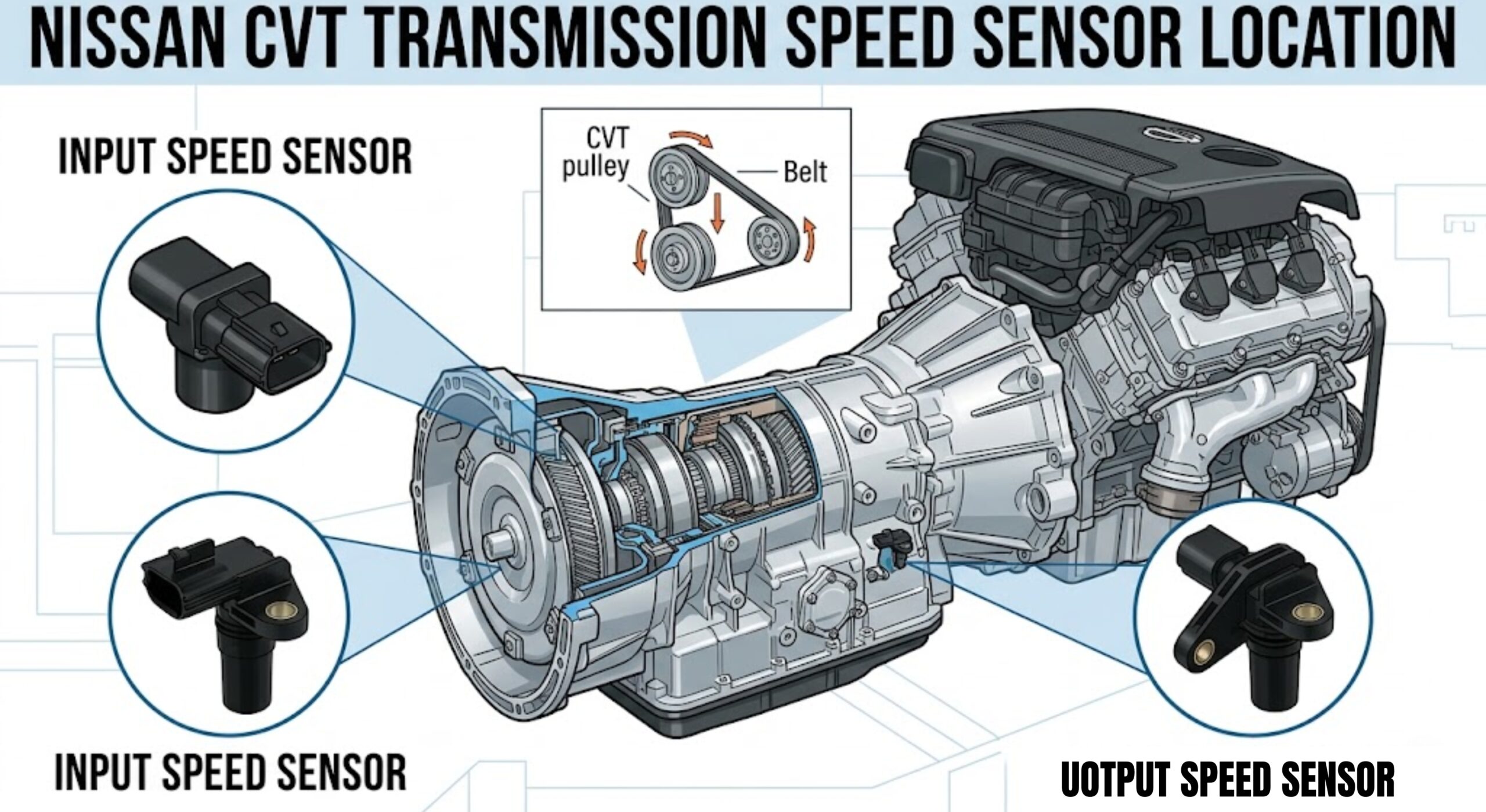
The input speed sensor — the one linked to fault code P0717 — is located on the front face of the CVT housing, toward the radiator side of the engine bay. On the RE0F10A (JF011E), it sits below and behind the transmission cooler assembly, which mechanics commonly call the “beehive cooler.”

Audible — Listen Free for 30 Days
One free credit a month and thousands of titles included.
Listen Free for 30 Days
As marked in the image above, the input sensor sits below the cooler assembly on the front face of the housing. The connector faces downward and routes toward the main CVT harness along the front of the transmission case.
Input Sensor on RE0F10A (Altima 2.5L, Sentra, Rogue)
On the RE0F10A, the primary (input) speed sensor is tucked under the transmission cooler unit on the front face of the housing. Notice the cooler assembly in the image above — the sensor body is directly beneath it, which is why it is not visible from above without removing the cooler or accessing from below.
Access requires raising the vehicle. The sensor is not reachable from the engine bay without removing the battery and starter — undercar access via the splash shield is the faster method.
Input Sensor on RE0F09A (Murano, Altima V6, Maxima)
On the RE0F09A, which is the larger 3.5L unit, the primary speed sensor is positioned on the front-facing side of the housing near the starter motor. As shown in the comparison section below, the RE0F09A’s taller, wider housing moves this sensor slightly further toward the driver’s side compared to the RE0F10A.
Access is undercar only — the sensor sits between the radiator and the transmission housing, adjacent to the starter.
The output sensor is in a separate position — and requires a different access approach.
Output Speed Sensor Location on Nissan CVT Transmissions
Recommended Best Deal Products


The output speed sensor — associated with P0722 — sits on the top of the CVT housing, near the breather vent tube. This is a distinctly different position from the input sensor, which is on the front face near the cooler.

As labeled in the image, the output sensor is positioned on top of the CVT case, near the breather tube. It is not adjacent to the input sensor — the two sit on completely different faces of the housing.
One point of frequent confusion: the output speed sensor, vehicle speed sensor (VSS), and secondary speed sensor are all names for the same physical part on Nissan CVTs. The Nissan factory service manual uses “secondary speed sensor” in some sections and “output speed sensor” in others — they reference the same unit in the same location. The P0722 Nissan diagnostic article covers the fault behavior of this sensor in detail.
Audible Premium Plus — Annual Membership
12 audiobook credits up front, plus the full Audible catalogue.
See Annual PlansReaching either sensor from underneath requires knowing what you’ll encounter before the car goes up.
How To Access Nissan CVT Speed Sensors From Under the Car
Both sensors are accessed from underneath — the undercar view above shows what you’ll see once the car is safely raised.

As shown in the image, the transmission sits transversely mounted with the front face toward the radiator. The plastic splash shield runs across the underside and must be removed before either sensor is accessible. The output sensor on top of the housing may also be visible from the engine bay side on some models — but working from below gives cleaner access to both.
Tools Needed
- Floor jack and two jack stands
- Drain pan (a small amount of CVT fluid will seep when the sensor is removed — typically less than half a cup)
- 10mm socket, ratchet, and a 4-inch extension
- Flathead screwdriver or trim clip tool for connector release
- Shop rags and nitrile gloves
- Torque wrench for reinstallation
- New O-ring for the replacement sensor (do not reuse the old O-ring)
Access Steps
- Raise the vehicle and secure on jack stands — never work under a car on a floor jack alone.
- Locate and remove the plastic undercarriage splash shield. It is typically held by 6–8 plastic clips or 10mm bolts depending on model year.
- Identify the target sensor using the OBD code table in the final section of this guide.
- For the input sensor: look toward the front of the transmission housing, below the cooler assembly. For the output sensor: look toward the top of the housing near the breather vent tube.
- Disconnect the sensor connector by pressing the locking tab and pulling the connector body straight out.
- Remove the sensor mounting bolt using a 10mm socket. If replacing an output speed sensor on a 2007–2011 Altima, Juke, Rogue, or Sentra, note that shim washers sit between the sensor and the housing — count them before removal and reinstall the same number.
- Pull the sensor straight out — have a drain pan positioned. A small amount of CVT fluid will drip from the sensor bore.
- Lubricate the new O-ring lightly with clean CVT fluid before installation. Install the sensor, torque the bolt to 5.9 N·m (52 in-lb) per the Nissan service bulletin for output sensors on the RE0F10A. Reconnect the harness and reinstall the splash shield.
Before you pull the sensor, confirm you’re at the right unit — RE0F09A and RE0F10A sensors sit in different positions on the housing.
RE0F09A vs RE0F10A Speed Sensor Positions Side by Side
Recommended Best Deal Products


The RE0F09A and RE0F10A share the same sensor function but not the same mounting position.
| RE0F09A (JF010E) | RE0F10A (JF011E) | |
|---|---|---|
| Common Models | Murano, Altima V6, Maxima, Quest | Altima 2.5L, Sentra, Rogue, NV200 |
| Engine Size | 3.5L V6 | 2.0L–2.5L 4-cyl |
| Input Sensor Face | Front of housing, driver’s side near starter | Front of housing, below beehive cooler |
| Output Sensor Face | Top of housing near breather vent | Top of housing near breather vent |
| Input Sensor Access | Undercar — between radiator and housing | Undercar — splash shield removal required |
| Output Sensor Access | Undercar or engine bay (top of housing) | Undercar or engine bay (top of housing) |
| Access Difficulty | Moderate — input sensor tight near starter | Moderate — input sensor hidden under cooler |
The key practical difference is the input sensor position. On the RE0F09A, the input sensor sits next to the starter motor, which makes it harder to access with a standard ratchet — a flexible extension or swivel socket is often needed. On the RE0F10A, the input sensor sits behind the cooler assembly, which blocks a direct line of approach from the front of the vehicle.
Whichever CVT you’re working on, the connector is the one part most mechanics misidentify.
CVT Speed Sensor Connector and Harness Routing on Nissan Models
The connector is where most DIYers pause — both sensors use similar connectors, but the harness routing tells you which is which.

As shown in the close-up above, the speed sensor connector on the RE0F10A is a 2-pin unit. The locking tab sits on the top face of the connector body and releases by pressing down toward the sensor and pulling the connector straight back.
The harness routing is the reliable way to tell the two sensors apart when you’re under the car:
- The input sensor harness routes from the front of the transmission toward the front of the engine bay, running along the lower front subframe toward the main CVT harness connector near the battery tray area.
- The output sensor harness routes from the top of the transmission upward and rearward, joining the main CVT harness at a clip point on the top of the transmission housing.
Trace the wire from the connector back toward the first harness clip. The input and output sensor wires join the main CVT harness at different clip points — the input sensor wire is noticeably longer since it runs from the front-bottom of the housing up and back to the main harness.
The most common mistake is disconnecting the output sensor connector when the fault code points to the input sensor. The image above shows both routing paths — use it before disconnecting anything.
With the right sensor confirmed, the fault code tells you which one to prioritize.
Which OBD Code Points To Which Nissan CVT Speed Sensor
Your OBD code is the fastest way to confirm which sensor location to go to first.
| OBD Code | Sensor | Location | First Check Before Replacing |
|---|---|---|---|
| P0717 | Input Speed Sensor (Primary) | Front of housing, below cooler | Connector and harness at the front face of housing |
| P0722 | Output Speed Sensor (Secondary / VSS) | Top of housing, near breather vent | Connector + CVT fluid level |
| P0720 | Output Speed Sensor (VSS) | Top of housing, near breather vent | Same sensor as P0722 — check connector and fluid first |
P0720 and P0722 both point to the same physical sensor — the output speed sensor on top of the housing. P0720 is a general output speed sensor range or performance fault, while P0722 is a no-signal fault. Both start with the same diagnostic step: inspect the connector at the top of the housing and check CVT fluid level before replacing the sensor.
Before replacing any sensor, check the connector and harness first. A corroded or unseated connector will trigger the same fault codes as a failed sensor — and costs nothing to fix.
If P0717 or P0722 returns after a clean connector inspection and sensor replacement, the issue may be internal CVT damage affecting the tone ring the sensor reads. At that point, the diagnostic scope expands beyond sensor replacement. The P0717 Nissan diagnostic article covers that escalation path.
Frequently Asked Questions
Where is the speed sensor on a Nissan CVT transmission?
The Nissan CVT has two speed sensors — input and output — in different positions. The input sensor is on the front face of the housing near the cooler assembly. The output sensor is on top of the housing near the breather vent tube. Both require undercar access via the splash shield.
What is the difference between the input and output speed sensor on a Nissan CVT?
The input sensor measures rotational speed entering the CVT from the engine side and is linked to fault code P0717. The output sensor measures speed leaving the CVT toward the wheels and is linked to P0720 and P0722. They are in separate positions on the housing and are not interchangeable.
Can I replace a Nissan CVT speed sensor without removing the transmission?
Yes. Both sensors are externally mounted on the CVT housing and are accessible from underneath the car with basic hand tools. Removing the plastic undercarriage splash shield is the only preparatory step required on most models.
What causes a Nissan CVT speed sensor to fail?
The most common causes are connector corrosion from road and moisture exposure, physical damage to the sensor body or harness, and CVT fluid contaminated with metallic debris that degrades the sensor’s magnetic tip. Always inspect the connector and fluid condition before ordering a replacement part.
Will a bad CVT speed sensor cause a Nissan to go into failsafe mode?
Yes. A confirmed speed sensor fault will typically trigger limp mode on Nissan CVT-equipped vehicles, limiting the transmission to a fixed ratio or reduced speed to prevent further damage. Clearing the code without fixing the root cause will result in limp mode returning.
Conclusion
The Nissan CVT transmission speed sensor location comes down to two variables: which sensor the fault code points to, and which CVT generation is in your car. The input sensor sits on the front face of the housing near the cooler assembly. The output sensor sits on top of the housing near the breather vent. Both are accessible without dropping the transmission.
Use the annotated images in each section to orient yourself before touching anything. Confirm your sensor using the OBD code table, trace the harness to verify you’re at the right connector, and inspect the connection before ordering a part.
Once you’ve confirmed the location and addressed the fault, check your Nissan CVT fluid change guide as the next maintenance step — contaminated fluid is a contributing factor in sensor failure and worth addressing at the same service interval.