Nissan CVT Shudder Fix By Symptom And Code 2026
Last Updated on May 18, 2026 by Ryan
A Nissan CVT shudder fix depends on whether the vibration is mild, code based, or already showing signs of internal transmission wear.
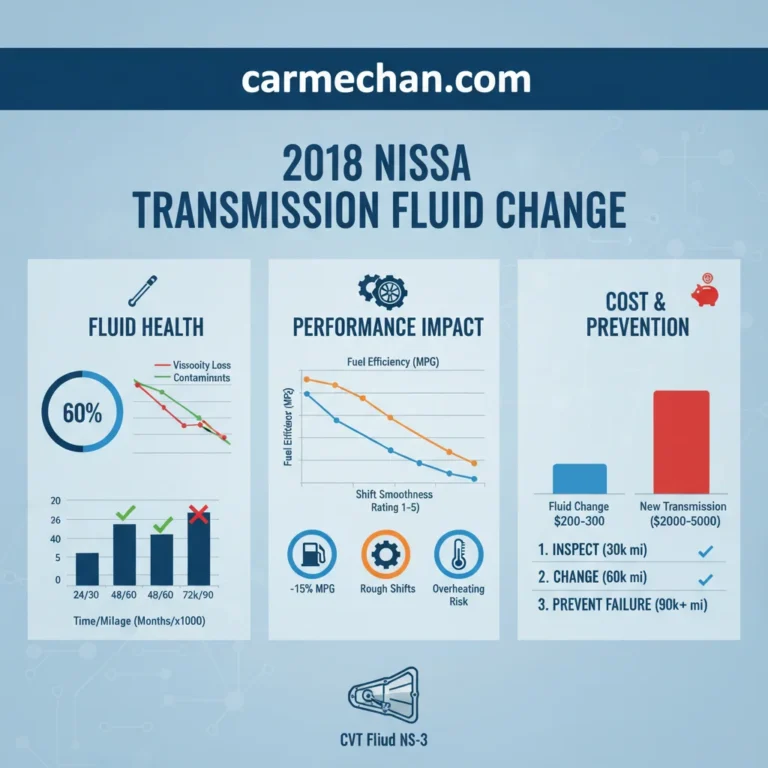
If the shudder is light and there are no transmission codes, the next step may be diagnosis, fluid history review, and possibly a proper CVT fluid service.
However, if the car stores P17F0 or P17F1, the repair path changes. Nissan’s own bulletin describes CVT judder as shake, shudder, bumps, or vibration when one of those codes is stored.
Start with the condition that matches your car.
Why Nissan CVT Shudder Has No Single Fix


If your Nissan only vibrates lightly at low speed, the first step is diagnosis, not replacement.
CVT shudder can come from old fluid, wrong fluid, valve body pressure problems, pulley wear, belt slip, software logic, or a non-transmission vibration that feels similar.
That is why a blind flush is risky. If the transmission is already slipping internally, fresh fluid may not fix the root problem.
For affected V6 Nissan models, Nissan’s bulletin applies only when the customer reports transmission judder and P17F0 or P17F1 is stored. The bulletin also says it does not apply if judder is not reported, if those codes are not stored, or if other DTCs are stored instead.
For model and year risk, see our guide on Nissan CVT transmission problem years.
Before choosing a repair, sort the car into the right condition group.
5 Checks Before Trying Any CVT Repair
Use these five checks before spending money.
- Check when the shudder happens
If it happens during light acceleration from low speed, CVT judder is possible. If it happens only at highway speed, also check tires, wheels, axles, and mounts. - Check whether it happens hot or cold
If the shudder appears after the transmission warms up, fluid breakdown or internal CVT pressure problems become more likely. - Scan the transmission module
If you only scan engine codes, the diagnosis is incomplete. You need a scanner that can read TCM codes. - Check CVT fluid history
If the fluid was never serviced, was serviced with the wrong fluid, or was recently flushed harshly, that changes the repair path. - Judge drivability
If the car slips, flares RPM, enters limp mode, whines loudly, or hesitates in traffic, do not treat it like a simple maintenance issue.
Once those checks are done, follow the diagnostic path below.

How To Diagnose Nissan CVT Shudder First
If you cannot read transmission control module codes, the diagnosis is incomplete.
Follow this order:
- Scan the TCM for stored and pending codes.
- Look specifically for P17F0 and P17F1.
- Road test the car gently and confirm when the shudder happens.
- Check whether engine misfire codes are present.
- Review CVT fluid service history.
- Inspect for leaks, burnt fluid smell, overheating warnings, and abnormal whining.
- Avoid a blind power flush if the car already slips or has severe judder.
If P17F0 or P17F1 is stored with transmission judder, Nissan’s bulletin points technicians to a CVT repair flow chart, not a simple code reset.
If the shudder is mild and no CVT judder code is stored, the repair path is different.
When A Fluid Change May Help Shudder
If the shudder is light, no CVT judder code is stored, and the car still drives normally, a proper fluid service may be worth considering first.
This applies best when:
- The fluid history is unknown
- The car has no limp mode
- There is no severe slipping
- There is no strong whining noise
- There is no metal debris found during inspection
- The shudder is early and intermittent
Use the correct Nissan CVT fluid type for the model. Do not use regular automatic transmission fluid in a Nissan CVT.
On CarMechan’s Nissan CVT problem years guide, typical repair ranges are listed as $200 to $400 for CVT fluid service, $800 to $1,800 for valve body replacement, $2,500 to $4,000 for rebuild, and $4,000 to $7,000 plus for a new or remanufactured unit.
For related service cost context, internally link to Nissan CVT fluid change cost.
However, once P17F0 or P17F1 appears, treat the problem as a code based CVT judder case.
When P17F0 Or P17F1 Changes The Repair

If P17F0 or P17F1 is stored, the repair path changes because Nissan treats this as CVT judder diagnosis, not normal vibration.
The bulletin defines the condition as transmission judder that may feel like shake, shudder, bumps, or vibration, with either P17F0 or P17F1 stored.
| Code | Practical Meaning | Next Step |
|---|---|---|
| P17F0 | CVT judder with transmission inspection path | Professional CVT diagnosis |
| P17F1 | CVT judder with control unit inspection path | Professional CVT diagnosis |
| No P17F0 or P17F1 | Shudder may still exist, but this bulletin path may not apply | Diagnose fluid, engine, mounts, axles, and tires |
Do not simply clear the code and keep driving. If the underlying problem is belt slip, pulley wear, or pressure loss, the shudder may return quickly.
This is where a dealer or transmission specialist matters. They can inspect live CVT data, fluid condition, pressure behavior, software updates, and whether the valve body or full transmission needs attention.
For model-specific context, add an internal link to Nissan Rogue CVT transmission problems if the article exists live on your site.
Still, not every vibration in a Nissan is the CVT itself.
What Else Can Feel Like CVT Shudder
If the vibration happens at a fixed road speed, under braking, or with a flashing check engine light, it may not be CVT shudder.
| Symptom | Possible Cause | What To Check |
|---|---|---|
| Vibration at one road speed | Tire balance or bent wheel | Tires, wheels, alignment |
| Vibration under braking | Warped rotor or brake issue | Brake rotors and pads |
| Shake with flashing check engine light | Engine misfire | Spark plugs, coils, injectors |
| Clunk on takeoff | Engine or transmission mount | Mount inspection |
| Vibration on turns | CV axle or driveline issue | Axles and AWD components |
| RPM rises but speed does not | CVT slip risk | Transmission diagnosis |
If you diagnose the wrong system, you may replace fluid or a valve body while the real problem is a misfire, tire, mount, or axle.
Use the decision matrix below to choose the safest next step.
Nissan CVT Shudder Fix Decision Matrix
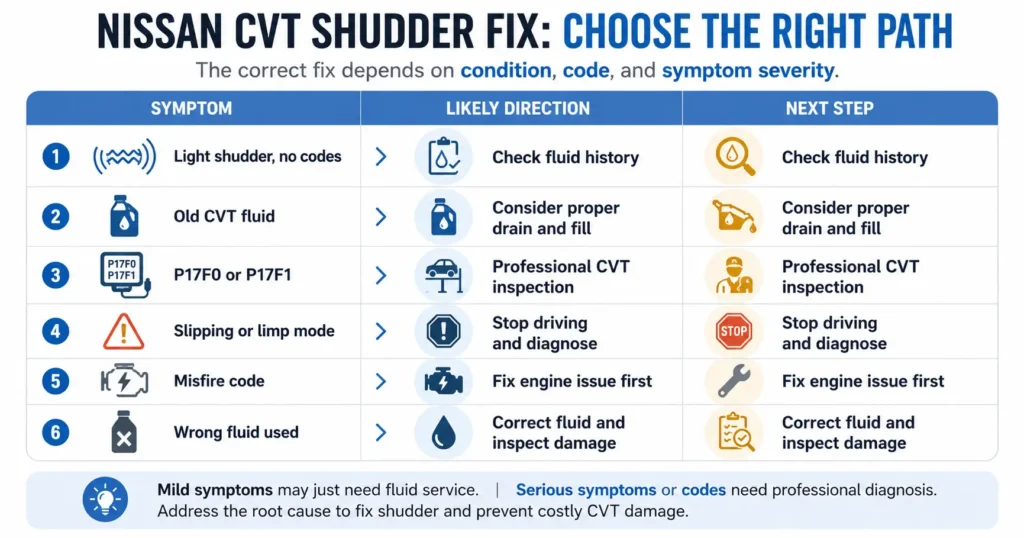
Use this table as a triage tool, not a final diagnosis.
| Condition | Likely Direction | Recommended Next Step |
|---|---|---|
| Light shudder with no codes | Early fluid or calibration issue possible | Scan TCM and review fluid history |
| Light shudder with old fluid | Maintenance may help | Consider proper drain and fill |
| Shudder with P17F0 | Code based CVT judder | Get professional CVT inspection |
| Shudder with P17F1 | Code based CVT judder | Get professional CVT inspection |
| Shudder with slipping or limp mode | Higher failure risk | Stop driving and inspect |
| RPM flare with poor acceleration | Internal CVT slip possible | Avoid flushing and diagnose |
| Vibration with misfire code | Engine issue possible | Fix engine fault first |
| Shudder after wrong fluid | Service related risk | Correct fluid and inspect damage |
CarMechan’s real Nissan Sentra case study documented a used transmission replacement total of $3,345, including a $1,800 used transmission, $1,260 labor, $150 specialty CVT fluid, $85 gaskets and seals, and $50 shop supplies.
For cost comparison, internally link to Nissan Sentra transmission replacement cost case study.
Some symptoms are serious enough that you should stop testing and get help.
When To Stop Driving And See A Mechanic
If the shudder is getting stronger, do not keep driving to test it.
Stop driving or limit driving if you notice:
- P17F0 or P17F1 stored
- Severe shudder under light acceleration
- RPM flare without matching speed
- Limp mode
- Transmission overheating warning
- Strong whining from the transmission
- Burning smell
- Metal debris in the pan
- Dangerous hesitation in traffic
Nissan’s bulletin says Nissan bulletins are intended for qualified technicians, not do-it-yourselfers, because qualified technicians have the proper equipment, tools, safety instruction, and know-how.
That warning matters here. A Nissan CVT is not like a basic drain plug repair. If the CVT is slipping internally, guessing can turn a repairable issue into a full replacement.
Here are the short answers Nissan owners ask most.
Frequently Asked Questions
Can A Nissan CVT Shudder Be Fixed Without Replacing The Transmission
Yes, but only in some cases. If the shudder is mild, there are no CVT judder codes, and the transmission still drives normally, fluid service or calibration may help.
If P17F0, P17F1, slipping, or limp mode is present, replacement or major repair becomes more likely.
Will Changing CVT Fluid Fix Nissan Shudder
It can help if the issue is early fluid breakdown and there is no severe internal wear.
It is less likely to fix shudder caused by pulley wear, belt slip, valve body failure, or code based CVT judder. Do not use a fluid change as a shortcut for diagnosis.
Is P17F1 Worse Than P17F0
Do not judge severity by the code name alone.
Nissan identifies P17F0 as CVT judder with transmission inspection and P17F1 as CVT judder with control unit inspection. The real severity depends on symptoms, live data, fluid condition, and inspection results.
Can I Drive With Nissan CVT Judder
If the shudder is light and there are no warning lights or slipping, drive only enough to get the car diagnosed.
If the car slips, enters limp mode, overheats, stores P17F0 or P17F1, or hesitates in traffic, continued driving can increase repair risk.
Should I Reset The CVT After A Fluid Change
A CVT reset or relearn may be needed after some services, but it should not be used to hide a mechanical fault.
If the shudder returns after a relearn, the problem is likely not just adaptation. Scan the TCM and inspect the transmission properly.
Conclusion
The right Nissan CVT shudder fix depends on what the car is actually showing.
If there is light shudder, no codes, and old fluid, start with proper diagnosis and fluid history. If P17F0 or P17F1 is stored, move to professional CVT inspection. If the car slips, whines, overheats, or enters limp mode, stop treating it like a small maintenance issue.
Your safest next step is simple: scan the transmission module first, match the symptom to the decision matrix, then choose the repair path based on evidence, not guesswork.