Is Adaptive Cruise Control Worth It? A 2026 Expert Guide
Adaptive cruise control is worth the investment if your daily routine involves heavy highway congestion or frequent long-distance travel. While it significantly reduces driver fatigue, it may not be a necessary expense for those who primarily drive in low-traffic or city environments.
Adaptive cruise control (ACC) is undeniably worth the upgrade if you spend more than twenty minutes a day in stop-and-go commuting or frequently tackle long-distance highway stretches. In 2026, the technology has evolved from a luxury novelty into a genuine stress-reduction tool that preserves your mental bandwidth. If you are a minimalist driver who sticks to local backroads, however, it remains an expensive piece of hardware that will rarely see an “on” switch.


This matters because the modern driving environment has become significantly more dense and unpredictable. Paying for ACC isn’t just about convenience; it is about delegating the most tedious aspects of vehicle spacing to a computer that doesn’t get distracted by a text message or road fatigue. Whether this tech justifies the premium depends entirely on your specific weekly mileage and the congestion levels of your primary commute.
Key Takeaways
- Prioritize ACC if you spend more than 30 minutes daily in stop-and-go highway traffic.
- ACC excels at maintaining safe following distances, reducing the risk of minor fender-benders in traffic.
- Budget-conscious buyers can skip ACC if they rarely drive on highways or long-distance routes.
- Always test-drive the system to ensure the braking sensitivity matches your personal comfort levels.
- Consider the resale value; most 2026 buyers now view active safety tech as a standard requirement.
The Real Problem With Standard Cruise Control in 2026 Traffic
The Constant Engagement Trap
Standard cruise control is effectively obsolete for any road shared with other vehicles. Because it maintains a fixed speed regardless of the environment, you are forced to manually disengage and reset the system every time a lead car brakes or shifts lanes. This creates a cycle of active disengagement that renders the feature useless on modern, high-density interstates. In 2026, the psychological cost of “babysitting” traditional cruise control often exceeds the physical effort of just using your own foot.

Safety Gaps and Reaction Times
Traditional systems lack the ability to react to sudden traffic surges common in 2026 smart-city traffic patterns. Relying on fixed-speed cruise control in heavy flow forces you to maintain an aggressive state of hyper-vigilance to avoid rear-ending someone who hits their brakes unexpectedly.
- Phantom Braking Risks: Without adaptive distance-keeping, standard systems offer zero protection against sudden speed changes.
- Fragmented Attention: The constant toggling between setting the cruise speed and braking leads to higher driver fatigue.
- Efficiency Loss: Frequent manual braking forces the car to downshift and accelerate harshly, negating the fuel-saving potential of cruise control.
How to Evaluate If Adaptive Cruise Control Is Worth Your Money
The Commuter’s Return on Investment
To determine if ACC is worth your money, look at your weekly transit time rather than just total mileage. If your daily route involves more than 10 miles of congested highway driving, ACC will pay for itself within the first year through reduced physical fatigue alone. In 2026, advanced versions of these systems—often bundled in driver-assistance packages—handle “stop-and-go” traffic with enough smoothness to prevent the neck strain associated with repetitive stop-start pedal work.
When to Skip the Premium
You should consider passing on the upgrade if your driving habits align with the following criteria:
- Rural Driving: If your commute is primarily empty backroads, the sensors will rarely have a lead vehicle to track.
- Short-Trip Cycles: If your average trip is under ten minutes, the time required to calibrate and engage the system is hardly worth the effort.
- Budget Constraints: If selecting ACC forces you to skip critical maintenance-related features (like upgraded brakes or safety sensors), prioritize the mechanical safety of your vehicle first.
If you identify as a “weekend driver” who prioritizes vehicle feedback and pure control, the interference of ACC might actually feel intrusive. Evaluate whether you want the car to assist you or if you prefer an unadulterated connection to the road surface.
A Step-by-Step Guide to Testing ACC During Your Next Test Drive
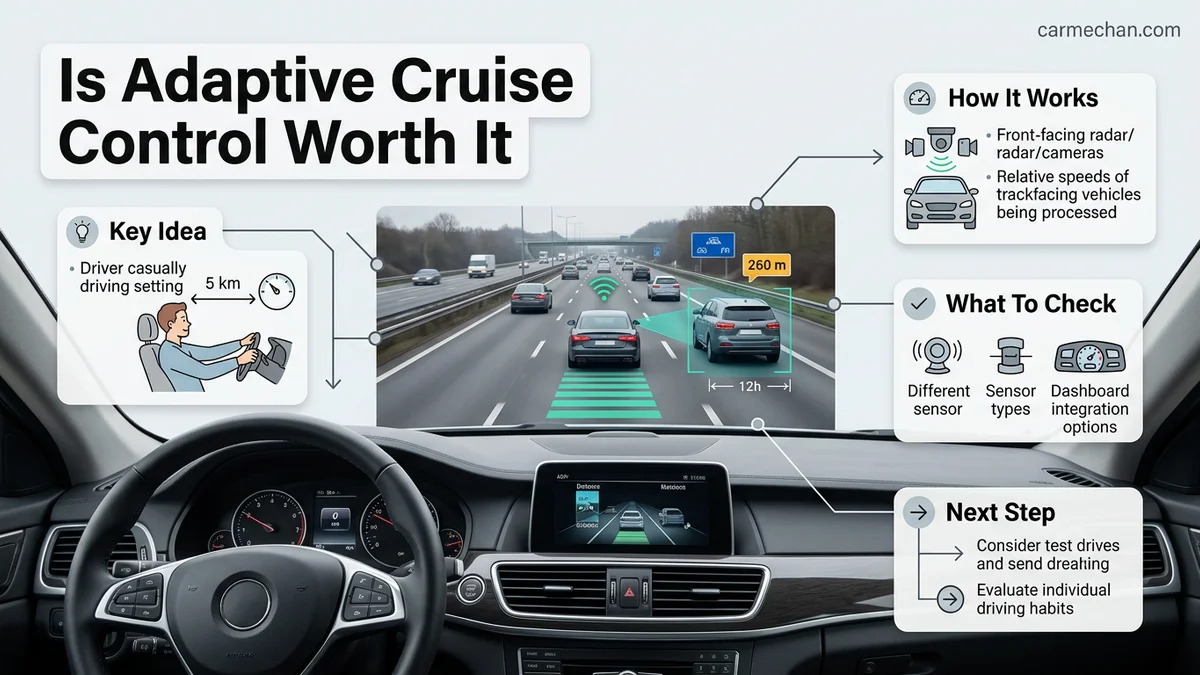
Evaluating Adaptive Cruise Control (ACC) requires more than a simple highway loop. Modern 2026 systems rely on fusion sensors—combining radar and LiDAR—to manage distance. You must test these systems in varied traffic patterns to ensure they align with your driving style.

Simulating Stop-and-Go Conditions
- Activate the system at speeds below 30 mph to test the low-speed follow functionality.
- Observe the “time-gap” setting; ensure the vehicle maintains a consistent distance without aggressive, jerky braking.
- Confirm the system brings the car to a complete stop and holds position for at least three seconds before requiring a tap on the accelerator to resume.
Assessing Lane Positioning and Curvature
- Test the system on a gentle highway curve to see if the radar maintains a lock on the lead vehicle.
- Monitor the instrument cluster for “target acquisition” indicators to see how quickly the system detects a vehicle cutting into your lane.
- Verify that the deceleration is smooth rather than abrupt, which is a hallmark of high-quality 2026 sensor calibration.
What to Do If You Choose to Skip the Feature or Find It Unreliable


If your current vehicle’s ACC performs inconsistently, or you opted against it, you are not necessarily relegated to manual throttle control. Many 2026 vehicles feature software-definable cruise control that can be updated via Over-the-Air (OTA) patches. If you find the system unreliable, prioritize these troubleshooting steps before assuming a hardware failure.
Troubleshooting Unreliable Performance
- Inspect the front grille and bumper sensors for debris, mud, or frost, which can degrade radar performance by up to 40 percent.
- Check your vehicle’s infotainment menu for “Driving Assistance” updates, as 2026 manufacturers frequently release firmware to improve radar-camera sensor fusion.
- If the system displays a persistent “Sensor Blocked” error, utilize a soft, lint-free cloth to clean the radar housing located near the front emblem.
- If issues persist, consult a certified technician for a radar alignment calibration, which typically ranges from $150 to $350 depending on the complexity of the sensor suite.
What If It Still Doesn’t Work?
If software updates and physical cleaning fail to resolve performance issues, the underlying hardware or camera calibration may be compromised. Follow these steps to address persistent technical failure:
- Document the exact conditions under which the system fails, including ambient light levels and vehicle speeds, to assist the technician.
- Schedule a diagnostic appointment with a brand-certified service center to perform a full system recalibration, a process required after any bumper or windshield work.
- Request a “Readiness Code” report from the dealership’s scan tool to identify specific fault codes within the Advanced Driver Assistance System (ADAS) control module.
- If repair costs exceed $800, evaluate the vehicle’s remaining warranty coverage, as sensor hardware is often covered under the basic bumper-to-bumper 3-year/36,000-mile policy.
Conclusion
Adaptive Cruise Control in 2026 provides significant safety and fatigue-reduction benefits for highway commuters. According to research from the Insurance Institute for Highway Safety (IIHS), systems that combine longitudinal control with active braking significantly reduce rear-end collision rates. If your system feels erratic, prioritize sensor alignment and software updates before seeking professional service. Your next actionable step is to request a 20-minute highway test drive specifically to evaluate how the ACC manages traffic density and braking comfort.
❓ Frequently Asked Questions
Is adaptive cruise control worth the high package cost?
If you drive long distances or face daily rush-hour congestion, the reduction in mental fatigue and stress justifies the price. However, if your driving is limited to short local trips, the extra cost may provide little return on investment.
Does adaptive cruise control make me a lazier driver?
While it handles speed adjustments, it requires you to remain fully attentive to the road. It is a convenience and safety tool, not a replacement for active steering or situational awareness.
How reliable are these systems in 2026?
2026 systems are highly reliable in optimal conditions, but they can struggle with erratic lane changes or extreme weather. Always be prepared to intervene immediately if the car fails to brake appropriately.
Are there specific scenarios where I should turn ACC off?


You should disable the system during heavy snowstorms, thick fog, or when driving on winding, unpredictable mountain roads. These conditions often exceed the sensor’s ability to track vehicles reliably.
Do I need to pay for a subscription to use ACC?
Generally, ACC is a one-time purchase included in the vehicle package price. However, check your specific manufacturer, as some high-end features now occasionally use subscription models.
Does ACC affect my fuel economy?
Adaptive cruise control often improves fuel efficiency by maintaining a consistent speed and preventing abrupt braking and acceleration. It generally outperforms human drivers in maximizing engine timing for efficiency.