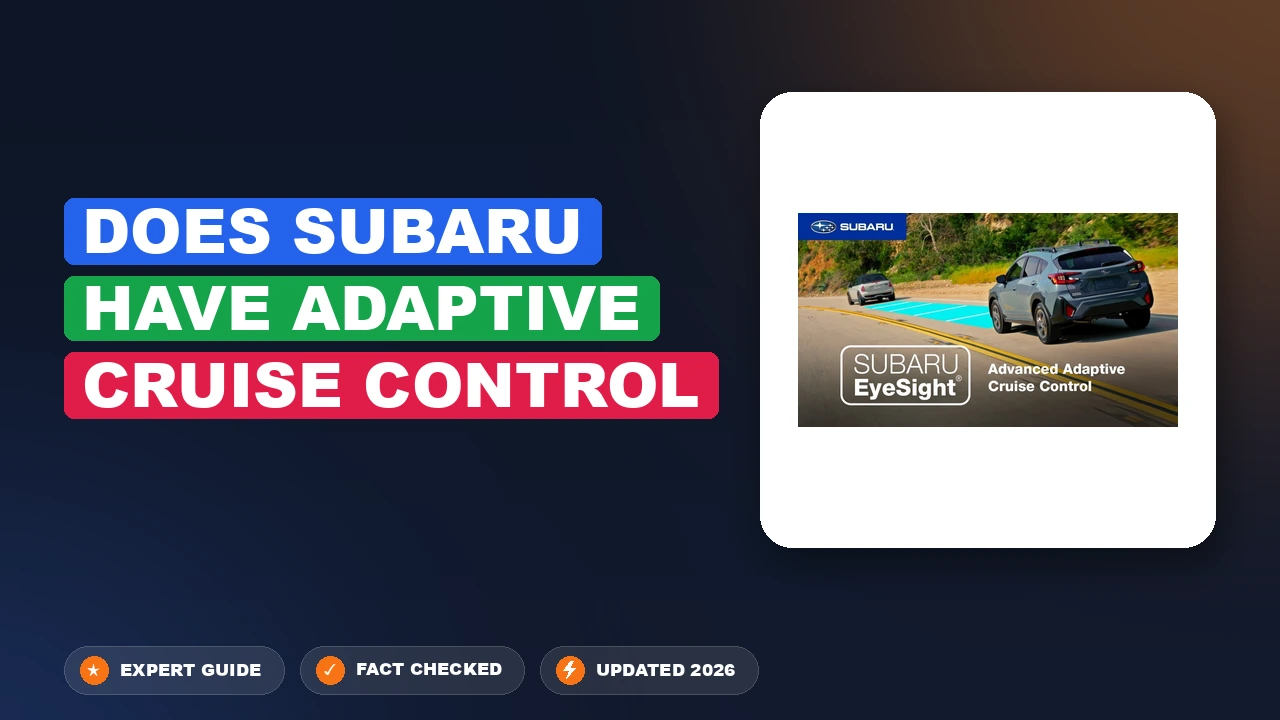
Does Subaru Have Adaptive Cruise Control: Explained Simply
Are you wondering if your Subaru is capable of handling the flow of highway traffic automatically? Many owners struggle to distinguish between basic cruise control and the advanced features found in modern EyeSight-equipped vehicles. In this professional guide, we provide a complete breakdown of how to verify if your model has adaptive cruise control, how to use it safely, and the technical limits you need to know for 2026.


Does Subaru Have Adaptive Cruise Control: Understanding EyeSight
Subaru’s approach to active safety is centered around the EyeSight Driver Assist Technology suite. Unlike many competitors that utilize traditional radar-only systems, Subaru employs a vision-based approach to monitor the road ahead. This distinction is vital for understanding how the system maintains safety and reliability in diverse conditions.

📤 Share Image

The Role of Stereo Camera Vision
At the heart of the system are dual color stereo cameras mounted near the rearview mirror. These cameras function similarly to human eyes, providing 3D depth perception. By identifying objects, estimating their distance, and tracking their speed, the EyeSight Control Module can make split-second decisions to adjust the vehicle’s speed. Because the system utilizes visual recognition, it is highly effective at identifying brake lights, lane markings, and obstacles in a wide field of view.

Distinguishing ACC from Traditional Cruise Control
Traditional cruise control maintains a fixed speed, which can be dangerous in fluctuating traffic. In contrast, Adaptive Cruise Control (ACC) within the Subaru ecosystem actively modulates the throttle and braking to maintain a driver-selectable distance behind the vehicle in front. It is not an autonomous driving system; it is a driver-assist tool designed to reduce fatigue on long journeys by handling the mundane speed adjustments required in highway flow.

EyeSight System Requirements
To have ACC, your Subaru must be equipped with the EyeSight system. Generally, this includes all new Subaru models with automatic or CVT transmissions. If your vehicle has a manual transmission, it may feature limited cruise control capabilities, but it often lacks the full-stop-and-go functionality of the CVT-paired EyeSight systems.
How to Activate and Adjust Your Subaru Adaptive Cruise Control
Operating the system is designed to be intuitive, yet it requires familiarity with the steering wheel interface to ensure safe usage.
📋
Step-by-Step Guide
Press the ‘Cruise’ button on the right side of the steering wheel. An indicator will appear in the instrument cluster confirming the system is in standby mode.
Reach your desired cruising speed, then press the ‘SET-‘ button. Use the ‘i/SET’ toggle to increase or decrease your speed. Adjust the follow interval (the distance between you and the car ahead) by pressing the distance adjustment buttons on the steering wheel.
Setting Your Preferred Follow Interval
The system typically offers four distance settings, represented by bars in the instrument cluster. A higher number of bars indicates a larger following distance, which is recommended for high-speed highway driving, while fewer bars are better suited for slower, dense traffic environments.
Navigating Steering Wheel Control Interfaces


Modern Subaru steering wheels consolidate these functions on the right-hand spoke. Mastering the ‘Mode’ button allows you to switch between standard cruise control and the advanced adaptive system, while the ‘RES/SET’ toggles allow for fine-tuning speed by 1 or 5 mph increments.
Core Components and Operational Specs of Subaru EyeSight
Understanding the hardware is key to maintaining system health. The windshield-mounted cameras must remain clear of obstruction, and internal calibrations are handled by the vehicle’s computer, which integrates with the Electronic Throttle Control for seamless deceleration.
Stereo Camera Placement and Calibration
The cameras are housed in two separate units located at the top of the windshield. Professional installation of any replacement windshield is critical; non-OEM glass can lead to calibration errors, rendering the system unreliable or entirely disabled.
Critical Safety Warnings for Subaru Adaptive Cruise Control Users
While these systems are highly advanced, they are not infallible. Experts emphasize that the driver remains the ultimate authority behind the wheel.
- Environmental Factors: Heavy rain, thick fog, or snow can obscure the cameras, leading to an automatic system shutdown.
- Windshield Maintenance: Stickers, tinting, or chips directly in front of the camera lenses can cause system malfunctions.
- Stop-and-Go Traffic: In extreme stop-and-go conditions, stay alert. If the vehicle stops for an extended period, you may need to tap the accelerator to resume movement.
- Over-Reliance: Never treat the system as autonomous. The driver must always be ready to apply the brakes or take manual control.
Direct sunlight glare into the cameras can cause temporary disabling of features like Lane Centering Assist. When this occurs, you will receive a visual warning on your dashboard.
By The Numbers
Follow Distances
Driver Responsibility
Mastering Subaru’s Adaptive Cruise Control is a blend of understanding the technology and respecting its limits. Whether you are navigating heavy traffic or cruising on the open highway, confirming your EyeSight status and staying attentive will ensure a reliable, safe experience. If you are unsure about the specific version of EyeSight installed in your vehicle, consult your owner’s manual or visit a certified Subaru dealer to have your VIN checked. Always prioritize your safety by keeping your windshield clear and maintaining your focus on the road ahead.
Does Subaru Have Adaptive Cruise Control: Frequently Asked Questions
Does my Subaru have adaptive cruise control?
Most Subaru models produced from 2015 onwards include EyeSight as standard equipment. To confirm, check your steering wheel for a cruise control icon featuring a small car and distance bars. If your vehicle has dual camera lenses mounted at the top of the windshield, you likely have the Adaptive Cruise Control system installed.
Does EyeSight work in heavy rain or snow?
While the system is highly advanced, heavy precipitation can obstruct the camera view, leading to temporary system suspension. In severe conditions, the EyeSight system will alert the driver and switch to manual control. It is designed as a driver-assist tool, not a replacement for human judgment, especially during hazardous weather events.
Can adaptive cruise control bring the car to a complete stop?


Yes, on models equipped with the updated EyeSight system and ‘Low-Speed Follow’ capability, the car can bring itself to a complete stop behind a detected vehicle. Once stopped, it may require a quick tap of the gas pedal or the resume button to initiate movement again if the standstill lasts for several seconds.
How do I adjust the distance between me and the car in front?
On your steering wheel, locate the rocker switch typically marked with distance bars. Pressing this allows you to toggle through the available following intervals, usually ranging from one to four bars. Each bar corresponds to a specific time-gap distance, allowing you to maintain a professional, safe buffer based on your current speed.
Does it work on manual transmission models?
Adaptive Cruise Control is primarily designed for models with Subaru’s Lineartronic CVT (Continuously Variable Transmission). Historically, manual transmission models were not equipped with the full Adaptive Cruise Control suite because the system cannot operate the clutch or gear changes. Always check the specific technical specifications of your manual-equipped vehicle for the most accurate information.