How Many MPH Is Mach 10? About 7,612 mph at Sea Level
Last Updated on October 23, 2026 by Ryan
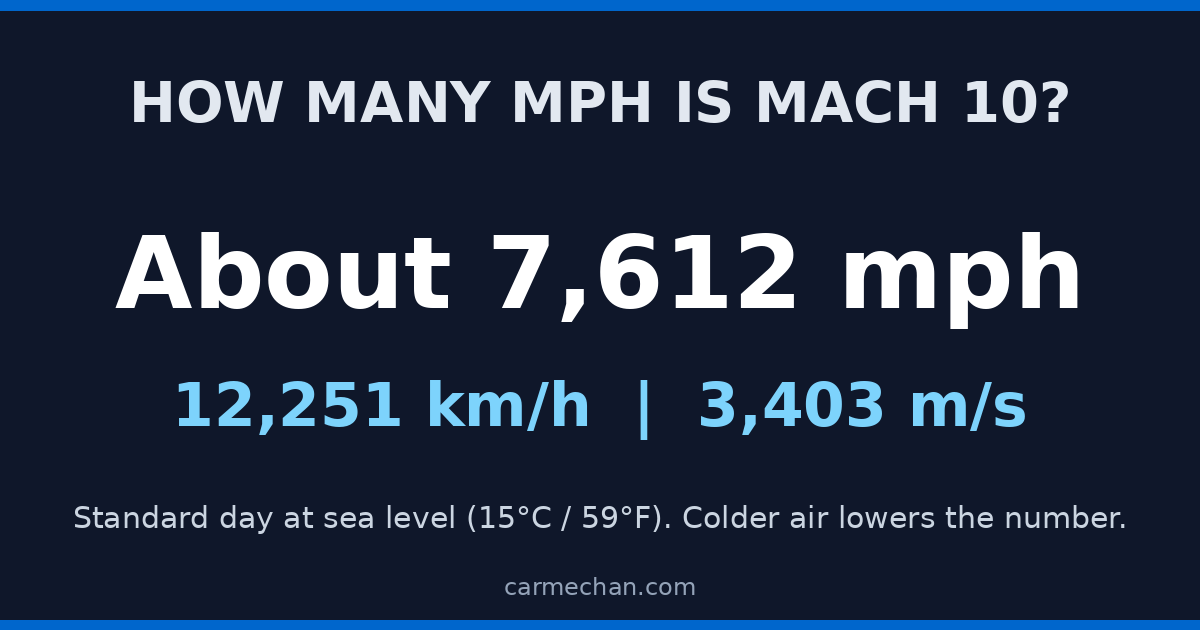
Mach 10 in mph is about 7,612 mph (12,251 km/h, 3,403 m/s) on a standard day at sea level, where the air is 15°C (59°F) and Mach 1 is about 761 mph. Colder air lowers the number: high in the stratosphere Mach 10 is about 6,601 mph.
Quick facts
- Mach 10 is ten times the local speed of sound: about 7,612 mph at 15°C.
- The often-quoted 7,672 mph comes from a 343 m/s speed of sound, which is the value at about 20°C.
- Mach 10 is about 6,601 mph in the cold air above 36,000 feet, where real hypersonic flights happen.
- NASA’s X-43A reached Mach 9.6 (about 7,000 mph) in 2004.
If you are asking about Mach 10 in mph, the short answer is about 7,612 mph at sea level on a standard day. The number is not fixed, because Mach is measured against the speed of sound in the air around the vehicle, and that speed changes with temperature. This guide gives the exact conversion, the reason different websites quote different numbers, and the figures at higher altitudes.
Mach 10 in MPH: the Short Answer
NASA gives the speed of sound at standard sea-level conditions as about 761 mph (NASA Glenn Research Center). Multiply by ten and Mach 10 is about 7,610 mph. The exact calculation, shown below, gives 7,612 mph. So how fast is Mach 10 in miles per hour? About 7,612 mph on a standard day, and that is also the answer to how many miles per hour Mach 10 is for most general questions. Here are the common Mach numbers side by side.
| Speed | mph | km/h | m/s |
|---|---|---|---|
| Mach 1 (speed of sound) | 761 | 1,225 | 340 |
| Mach 2 | 1,522 | 2,450 | 681 |
| Mach 5 (start of hypersonic) | 3,806 | 6,125 | 1,701 |
| Mach 10 | 7,612 | 12,251 | 3,403 |
For a sense of scale, Mach 10 is about 2.1 miles every second, so one mile passes in roughly 0.47 seconds. A car cruising at 70 mph would need to be about 109 times faster to match it. For a car-sized comparison, see our guide to the top speed of an F1 car.
How Mach Numbers Are Calculated
A Mach number is a speed divided by the speed of sound in the same air. NASA writes the speed of sound in air as a = √(γRT), where γ is the ratio of specific heats, R is the gas constant for air and T is the absolute temperature in kelvin. The same NASA page states that the speed of sound depends on the type of gas and its temperature.
For dry air, γ is 1.4 and R is 287.05 J/(kg·K). On a 15°C day, T is 288.15 K:
- γRT = 1.4 × 287.05 × 288.15 = 115,800
- a = √115,800 = 340.3 m/s, which is 761 mph
- Mach 10 = 10 × 340.3 m/s = 3,403 m/s = 7,612 mph
To convert m/s to mph, multiply by 2.23694. To convert m/s to km/h, multiply by 3.6.
Why You See Different Numbers for Mach 10 in MPH
Most differences come from the temperature that was assumed. Many calculators round the speed of sound to 343 m/s, the value at about 20°C, and report Mach 10 as about 7,672 mph. The standard atmosphere used in aviation starts at 15°C, which gives 7,612 mph. NASA’s own atmosphere model starts at 15.04°C, a difference too small to change the rounded figure (NASA atmosphere model).
| Air temperature | Mach 1 (mph) | Mach 10 (mph) | Mach 10 (km/h) |
|---|---|---|---|
| 0°C (32°F) | 741 | 7,411 | 11,927 |
| 15°C (59°F) | 761 | 7,612 | 12,251 |
| 20°C (68°F) | 768 | 7,678 | 12,356 |
| 30°C (86°F) | 781 | 7,808 | 12,565 |
| 40°C (104°F) | 794 | 7,936 | 12,771 |
Between a freezing day and a hot one, Mach 10 moves by more than 500 mph. Warm air carries sound faster, so the same Mach number means a higher speed in mph.
Mach 10 in MPH at Altitude
Real high-speed flight takes place well above sea level, where the air is much colder. NASA’s atmosphere model has the temperature falling steadily with height in the troposphere and then holding at about -56.5°C in the lower stratosphere. Because the speed of sound follows temperature, Mach 10 gets slower in mph as the vehicle climbs, until it levels off at about 6,601 mph.
| Altitude | Air temperature | Mach 1 (mph) | Mach 10 (mph) | Mach 10 (km/h) |
|---|---|---|---|---|
| 0 ft | 15.0°C (59°F) | 761 | 7,612 | 12,251 |
| 10,000 ft | -4.8°C (23°F) | 735 | 7,346 | 11,822 |
| 20,000 ft | -24.6°C (-12°F) | 707 | 7,069 | 11,377 |
| 30,000 ft | -44.4°C (-48°F) | 678 | 6,782 | 10,914 |
| 36,089 to 65,617 ft | -56.5°C (-70°F) | 660 | 6,601 | 10,623 |
This is why a statement such as “Mach 10 is 7,670 mph” is only right for warm air near the ground. A vehicle flying at Mach 10 at 50,000 feet is moving at about 6,601 mph.
How Long Does Mach 10 Take to Cover Familiar Distances?
New York City to Los Angeles is about 2,446 miles in a straight line (great-circle distance between the two city centres, calculated with the haversine formula). At the sea-level figure of 7,612 mph that is about 19 minutes. At the stratosphere figure of 6,601 mph it is about 22 minutes. A scheduled nonstop airline flight on the same route takes several hours. These times assume a straight path at constant speed, so a real flight would be longer once climb, descent and turning are included.
What Mach 10 Means: Hypersonic Flight
NASA describes hypersonic speed as greater than Mach 5. Mach 10 is therefore twice the speed at which hypersonic flight begins. At these speeds, compression and friction heat the air and the vehicle surface strongly, so thermal protection and engine design are central problems. Conventional turbojet engines are not practical at this speed range. Research vehicles rely on scramjets, which burn fuel in air that is still moving faster than sound inside the engine.
NASA’s X-43A, an uncrewed scramjet research aircraft, came close to Mach 10. NASA reports that it reached Mach 6.8 on 27 March 2004 and Mach 9.6 on 16 November 2004, flying at approximately 7,000 mph at 110,000 feet (NASA X-43A). That is close to Mach 10 but below it.
Mach 10 in MPH: Frequently Asked Questions
How many mph is Mach 10?
On a standard day at sea level (15°C / 59°F), Mach 10 is about 7,612 mph, which is 12,251 km/h or 3,403 m/s. If you use the 343 m/s figure many calculators use (air at about 20°C), you get about 7,672 mph. The exact value depends on the air temperature.
How fast is Mach 10 in km/h?
About 12,251 km/h at sea level on a standard 15°C day. In the cold stratosphere, between 36,089 and 65,617 feet, Mach 10 is about 10,623 km/h.
What does Mach 10 mean?
Mach 10 means moving at ten times the local speed of sound. Because the speed of sound changes with air temperature, Mach 10 is not one fixed speed in mph. NASA describes hypersonic flight as speeds greater than Mach 5.
Why do some sites say Mach 10 is 7,672 mph and others say 7,612 mph?
They start from different speeds of sound. 343 m/s (about 767 mph) is roughly the value at 20°C and gives 7,672 mph. The standard-atmosphere value at 15°C is 340.3 m/s (about 761 mph) and gives 7,612 mph. Both are correct for their stated temperature.
Has anything flown at Mach 10?
NASA’s uncrewed X-43A scramjet research aircraft reached Mach 9.6 on 16 November 2004. NASA describes that flight as approximately 7,000 mph at 110,000 feet.
How long would Mach 10 take to fly from New York to Los Angeles?
The great-circle distance is about 2,446 miles. At 7,612 mph that takes about 19 minutes. Using the slower stratosphere value of about 6,601 mph, it takes about 22 minutes. This is a straight-line calculation and ignores climb, descent and turning.
Sources and Method
- NASA Glenn Research Center: speed of sound (formula a = √(γRT), about 761 mph at standard sea level)
- NASA Glenn Research Center: Earth atmosphere model (15.04°C at sea level, temperature falling with height, constant -56.46°C from 11,000 to 25,000 m)
- NASA: X-43A (hypersonic speed greater than Mach 5, Mach 9.6 flight on 16 November 2004)
Method: all mph, km/h and m/s values on this page were calculated with a = √(γRT), γ = 1.4, R = 287.05 J/(kg·K), the International Standard Atmosphere (15°C at sea level, a drop of 6.5°C per 1,000 m up to 11,000 m, then -56.5°C) and rounded to the nearest whole number.