Use Cruise Control on Slippery Roads for Control: Debunked
For decades, cruise control has been the definitive convenience feature for long-distance highway travel, but it comes with a technical limitation that many drivers overlook. When weather conditions deteriorate, the assumption that modern vehicle safety technology renders cruise control safe for all road surfaces is a dangerous misconception. In this guide, we dismantle the myth that you should use cruise control on slippery roads for control and explain why manual throttle modulation is the only reliable way to maintain safety when traction becomes limited.

Why Cruise Control On Slippery Roads Compromises Vehicle Handling
Recommended Best Deal Products


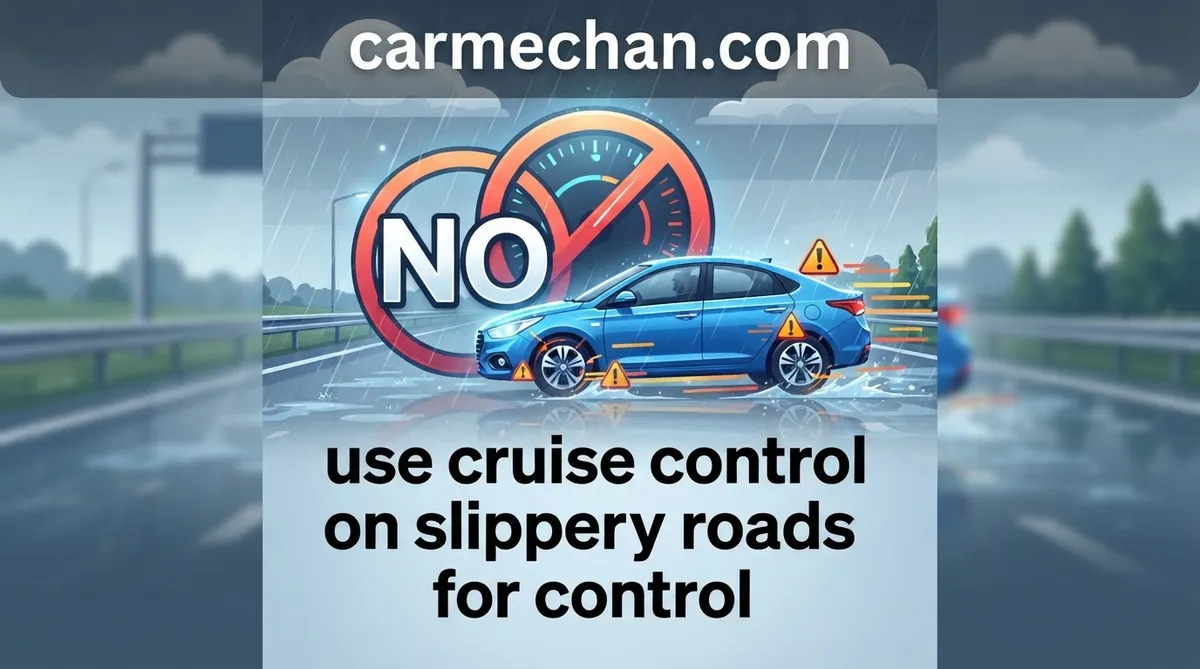
The primary purpose of cruise control is speed maintenance, not safety management. When a vehicle encounters a slick surface, the physics of tire-to-road interaction change instantly, but the cruise control computer lacks the situational awareness to compensate for these environmental shifts.
📤 Share Image
Understanding Surface Friction and Hydroplaning
Hydroplaning occurs when water buildup between the tires and the road surface causes the tire to lose contact with the asphalt. When this happens, the vehicle’s Vehicle Speed Sensor (VSS) often detects a momentary dip in wheel speed. If the cruise control is active, the system interprets this as a loss of momentum and commands the Electronic Throttle Control (ETC) to open the throttle wider to “recover” the set speed. This sudden, unintended application of power to spinning tires is the fastest way to lose directional stability.

The Dangers of Automated Throttle Modulation
Cruise systems operate with a mechanical or electronic response latency, typically between 200 and 500 milliseconds. While this is acceptable for dry-road highway cruising, it is far too slow to manage a high-speed skid. By the time the computer registers a slip and attempts to modulate the throttle, the driver has already lost the critical window to steer out of a hydroplaning event. The automated system lacks the nuance of a human driver who can “feather” the throttle to regain traction.

How Electronic Throttle Control Impacts Traction
Modern Electronic Throttle Control (ETC) systems are designed to obey the cruise control module’s commands above all else during normal operation. Even if the wheels begin to lose grip, the ETC will persist in attempting to maintain the speed setting until the system exceeds an internal error threshold. Relying on this technology during low-friction events effectively removes your ability to manually reduce power, turning a simple tire slip into a full-scale loss of vehicle control.
Adaptive Cruise Control vs. Standard Systems: Safety Realities
A common misconception is that because Adaptive Cruise Control (ACC) uses radar or lidar to track the vehicle ahead, it is somehow “smarter” about road conditions. This is fundamentally incorrect.
Does Adaptive Cruise Control Handle Ice Better?
No. ACC is designed to manage inter-vehicle distance, not surface friction. While it may slow down if the car in front of you decelerates, it does not possess the sensors required to detect “black ice” or standing water. It remains just as susceptible to the physics of sliding as a standard system.
Sensor Limitations in Heavy Precipitation
In heavy snow or freezing rain, radar sensors often become obstructed by slush or ice accumulation on the front bumper. This frequently leads to sensor blindness or erratic behavior, where the system may cut out abruptly or fail to identify hazards in the lane ahead. Relying on an automated speed-maintenance system in these conditions is a significant safety failure.
Safety Systems and Traction Control Conflict
Recommended Best Deal Products


Modern vehicles are equipped with an array of active safety features, but these systems are intended to assist the driver, not to override the physics of traction.

Prime for Young Adults — 6 Months Free
Students and 18–24s get six months of Prime free, then half price.
Start 6 Months FreeTraction Control System (TCS) vs. Cruise Inputs
The Traction Control System (TCS) and the cruise control module are essentially competing for control of the engine’s power output. If your wheels spin on ice, the TCS will attempt to cut power or apply individual brakes to regain grip. Simultaneously, the cruise control may attempt to keep the vehicle at the set speed by increasing throttle. This “fight” between electronic controllers can cause the vehicle to lurch, destabilizing the chassis just when you need it to be most predictable.
Why Modern Stability Control Disengages Cruise
Because of this inherent conflict, almost every manufacturer engineers their Electronic Stability Control (ESC) and Anti-lock Braking System (ABS) modules to immediately force-disconnect the cruise control if a significant loss of traction or “yaw rate” anomaly is detected. However, this is a reactionary measure. A professional driver disables the system before these extreme interventions are required, ensuring they maintain full, intuitive control over the vehicle’s momentum.
Never rely on your car’s ESC to “save” you while driving on cruise control. ESC is designed for recovery from emergency situations; relying on it as a means to maintain speed on slick roads is a fundamental misunderstanding of vehicle dynamics.
Best Practices for Avoiding Cruise Control Hazards
To ensure professional-grade safety, you must shift your mindset from automation back to manual operation whenever the road surface quality is in doubt.
📋
Manual Intervention Protocol
Recommended Best Deal Products


If there is visible water, slush, or ice on the road surface, disable the cruise control immediately. Do not wait for traction warning lights to illuminate.
By keeping your foot on the accelerator, you maintain a tactile link to the engine. If the vehicle feels “light” or the steering becomes vague, you can instantly reduce power, which is the only way to effectively re-establish tire contact.
Signs Your Vehicle is Losing Traction
As an expert, I look for early indicators of traction loss that computers often miss. These include:
- Steering feedback: If the steering wheel suddenly feels “numb” or requires less effort to turn, you may be hydroplaning.
- Sound frequency change: The noise of tires on the road often changes from a low-frequency hum to a high-frequency “hiss” when water is present.
- Engine RPM surging: If your RPMs rise while your speed remains the same, your wheels are spinning—a direct consequence of being in cruise control.
By The Numbers
Minimum System Latency
Driver Responsibility
Cruise control is a tool designed for optimal conditions, not a safety feature. By understanding the mechanical limitations of throttle control and the high latency of cruise modules, you can make the decision to take manual control. Remember, the safest electronic system in your car is the one you control directly with your own hands and feet. Stay safe by switching off your cruise system the moment the road surface changes.
Use Cruise Control on Slippery Roads for Control: Frequently Asked Questions
Is it safe to use cruise control in the rain?
No, it is not safe. Using cruise control in the rain significantly increases the risk of hydroplaning. Because the system does not ‘feel’ the road, it will attempt to maintain speed even when tires lose contact with the asphalt. This can lead to a sudden surge of power to the wheels when you need stability most, making it difficult to recover from a skid.

Prime Gaming — Free In-Game Loot
Free monthly games, in-game content and a Twitch channel sub.
Claim Free LootDoes cruise control cause hydroplaning?
While cruise control does not cause the weather conditions themselves, it exacerbates the risk of hydroplaning. If your vehicle begins to lose traction, the cruise control system may detect a drop in speed and command the engine to accelerate to compensate. This added power to wheels that have already lost surface contact can cause a complete loss of directional control.
Why does my car’s cruise control disengage when it loses traction?
Most modern vehicles feature integrated safety systems. When the traction control system detects wheel slip, it communicates with the Engine Control Module (ECM) to reduce power to the wheels. Because this conflict arises with the cruise control’s command to maintain speed, the vehicle’s computer automatically disengages the cruise control as a protective measure to ensure the driver regains manual control.
Can I use adaptive cruise control on slippery roads?
Even with advanced sensors, adaptive cruise control is not suitable for slippery roads. These systems are calibrated for predictable traffic patterns on dry surfaces. In snow or heavy rain, the sensors (radar or camera) can become obscured by debris, and the system may still attempt to accelerate or brake aggressively, which can lead to unpredictable handling on slick surfaces.
What is the best way to handle unexpected ice while driving?
If you encounter unexpected ice, the most critical rule is to avoid abrupt actions. Do not slam on the brakes, and do not make sharp steering corrections. Gently ease your foot off the accelerator, keep the steering wheel steady, and wait for your tires to regain grip. By having your full focus on manual driving rather than managing a cruise system, you improve your response speed.