Peterbilt 379 Cruise Control Not Working: Diagnosed & Fixed
Is your Peterbilt 379 struggling to hold speed, or failing to engage the cruise entirely? Few things are more frustrating on a long haul than a malfunctioning cruise control system, especially when safety interlocks or faulty signals render the system useless. Whether you are running a Caterpillar, Cummins, or Detroit engine, the cruise system relies on a delicate balance of electrical inputs to maintain your set speed. This guide covers everything from simple switch fixes to complex ECM signal diagnostics to help you troubleshoot and resolve your Peterbilt 379 cruise control not working.

Understanding Why Your Peterbilt 379 Cruise Control Is Not Working
Recommended Best Deal Products


📤 Share Image

How Interlock Logic Prevents Engagement
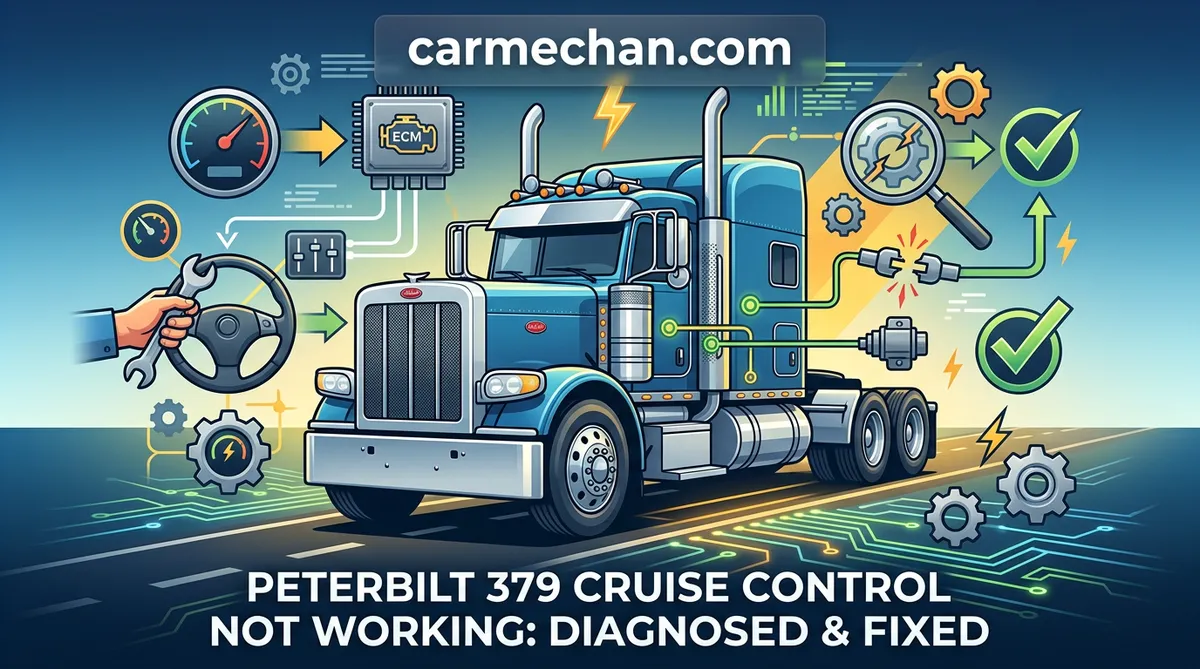
The electronic cruise control system in a Peterbilt 379 is not just a simple on-off switch; it is a complex safety-integrated subsystem. Engagement is dependent on multiple safety interlocks. The Engine Control Module (ECM) serves as the brain, constantly monitoring conditions like clutch position, brake application, and engine load. If the ECM does not receive a “clear” signal from every single interlock point, it will kill the function immediately. In professional terms, we call these “inhibits”—the ECM inhibits the cruise function to prevent unintended acceleration or engine damage.
The Role of the ECM in Cruise Disengagement
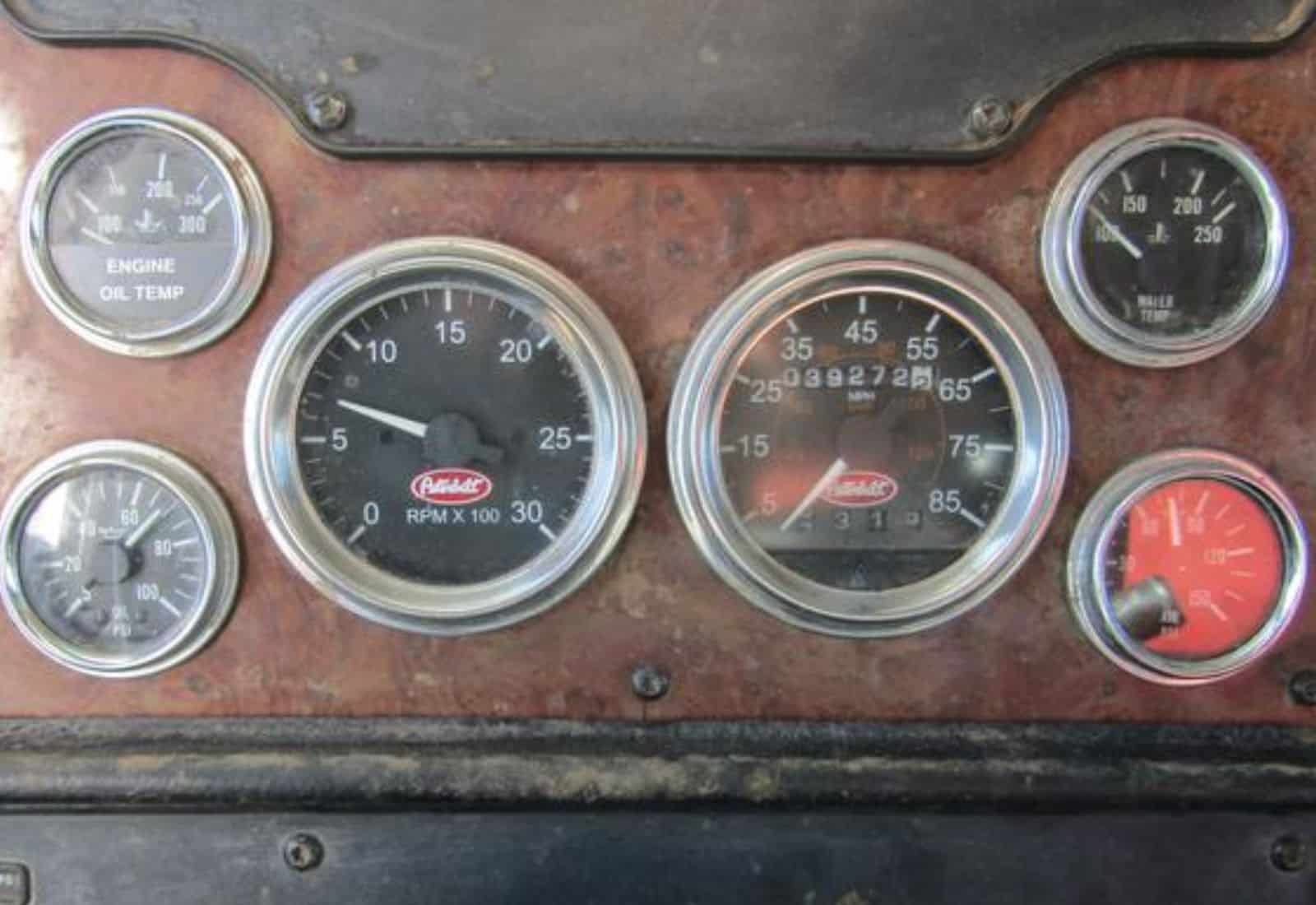
The ECM requires a steady, clean signal from the vehicle speed sensor and various inputs to allow cruise engagement. Research indicates that electronic cruise control will automatically disable if the ECM detects a significant engine or drivetrain fault, such as high coolant temperature, low oil pressure, or active DTCs (Diagnostic Trouble Codes) related to fuel delivery. If your “Check Engine” or “Stop Engine” light is illuminated, the cruise control is often the first feature disabled by the ECM’s logic.

Common Faults: Wiring Harness Fatigue
Wiring harness fatigue, particularly near the chassis-to-cab connection, is a notorious failure point on the 379 model. Constant vibrations from road bumps can cause ground paths to become intermittent or connectors to loosen. A loose ground connection will often cause the cruise control to drop out suddenly when you hit a pothole or rough patch of road, only to work again moments later.
Industry Data
Minimum Engagement Speed
Required Operating Voltage
How to Diagnose and Fix Peterbilt 379 Cruise Control Not Working
📋
Diagnostic Workflow
Recommended Best Deal Products

Use a multimeter to check for an “open” circuit on the clutch or brake switches. A sticky switch that doesn’t fully retract will signal to the ECM that the pedal is depressed, effectively locking out your cruise control.
Use appropriate diagnostic software (e.g., Cat ET or Cummins Insite) to pull active codes. Look specifically for “Cruise Disable” or “Inhibit” status flags that tell you exactly which sensor is failing the logic test.
The Vehicle Speed Sensor (VSS) provides the crucial pulses needed for cruise operation. Inspect the wiring pins for corrosion, as moisture entry is common on older 379 harnesses.
Check the Throttle Position Sensor (TPS) inputs. If the idle voltage is too high or low, the ECM will not enter cruise mode. Ensure the signal voltage sweeps smoothly without “dead spots” through the pedal travel.
Troubleshooting Peterbilt 379 Cruise Control System Components
Distinguishing between a simple switch failure and a deeper electronic issue is vital to an efficient repair. Use the table below to compare your system’s current symptoms against known failure states.

Audible — Listen Free for 30 Days
One free credit a month and thousands of titles included.
Listen Free for 30 DaysPinpointing ABS and Driveline Speed Sensor Conflicts
Many modern 379 configurations use the ABS wheel speed sensors to feed data to the ECM. If your ABS light is on, the computer may lack the necessary reference speed to safely operate the cruise control. Always check for wheel speed sensor faults before blaming the engine-side sensors.
If you have a manual override switch, verify it is actually wired for the current ECM calibration. Owners often swap switches from other models that aren’t electronically compatible with the 379’s specific multiplex wiring.
Advanced Solutions for Persistent Cruise Control Failures
Reviewing ECM Parameters and Programming
If your mechanical checks yield nothing, the problem may be in the software. ECM parameters often include “Minimum Engagement Speed” or “Maximum Cruise Speed” limits that can be accidentally altered or corrupted during engine re-flashing. If you have recently had the truck serviced for fuel economy, ensure the cruise settings were not inadvertently disabled or set to unreasonable parameters.
Tracing Wiring Harness Integrity
For persistent issues where code diagnosis points to a sensor but the sensor tests fine, you are likely looking at a “high-resistance” short in the harness. Use a break-out box or a continuity tester to trace the harness from the sensor plug back to the ECM connector. Look for wire chaffing against the frame rails, which is common on high-mileage 379s.
Attempting to troubleshoot without proper diagnostic software is a pitfall. You cannot guess your way through ECM logic. Connecting a jump wire to the wrong ECM pin can fry the internal processors, leading to a much more expensive repair bill than the original cruise issue.
Professional Recommendations for Long-Term Reliability
Fixing the Peterbilt 379 cruise control requires a logical approach: verify the basics, leverage technology to read the ECM, and systematically check wiring. Remember that cruise control is an integrated feature of your engine management, not a standalone add-on. If you encounter a “Service Brake Active” fault code even when the pedal is released, prioritize checking the physical pedal assembly for debris or binding springs. Always prioritize safety interlocks (clutch/brake) first, don’t ignore dashboard ABS or Check Engine lights, and use diagnostic software to read inhibit codes before replacing expensive sensors.
If your cruise control remains unresponsive after these steps, it is time to consult a qualified technician to examine your ECM mapping. A professional diagnostic session is a small price to pay to avoid the frustration and physical toll of long-distance driving without a functioning cruise system.
Peterbilt 379 Cruise Control Not Working: Frequently Asked Questions
Why does my cruise control turn off when I hit a bump?
This is almost always caused by a loose or misaligned clutch switch or a brake switch that is too sensitive. When the vehicle vibrates, the pedal assembly moves slightly, causing the switch to momentarily open the circuit. The cruise ECU detects this ‘pedal movement’ as a safety input and immediately disengages the system to prevent unintended acceleration.
Does a bad clutch switch prevent cruise control from engaging?
Yes, absolutely. The cruise control system in a Peterbilt 379 requires a signal from the clutch switch to confirm the transmission is in gear and ready. If the switch is faulty, stuck in the ‘open’ position, or not receiving power, the ECU assumes the clutch is depressed and effectively locks out the cruise function as a standard safety feature.
Audible Premium Plus — Annual Membership
12 audiobook credits up front, plus the full Audible catalogue.
See Annual PlansCan a fault code in the ABS prevent cruise from working?
Yes. Modern electronic engines and chassis controllers are integrated. If the ABS system detects an inconsistency in wheel speed or an active fault, it sends a signal to the ECM to disable cruise control. This is designed to prevent the vehicle from accelerating if the traction control system determines that the road surface is unstable or slick.
Is there a fuse specifically for the cruise control system?
There is rarely a fuse labeled solely ‘Cruise Control.’ Instead, the system shares power with the accessory circuit, the brake light circuit, or the engine management harness. You should check the accessory fuses in the main power distribution panel and the fuse block under the dash to ensure power is reaching the cruise rocker switches.
What is the most common reason for cruise control to fail suddenly?
The most common culprit is a damaged or disconnected Vehicle Speed Sensor (VSS) harness or an out-of-adjustment clutch switch. In the aging electrical systems of older 379 models, corroded spade connectors or chafed wiring near the transmission casing frequently interrupt the speed signal required by the ECM to calculate cruise parameters.