Nissan Altima Oil Filter Location: A Detailed Guide For All Generations
Understanding the precise location of key maintenance components, such as the oil filter, is fundamental for any Nissan Altima owner or service technician seeking to maintain optimal vehicle performance. Many Altima owners encounter challenges in accurately identifying and accessing their vehicle’s oil filter, leading to potential delays, incorrect procedures, or even engine damage during routine maintenance. This authoritative guide will provide comprehensive, generation-specific insights into the exact oil filter location across various Nissan Altima models and engine configurations, ensuring efficient, safe, and correct service procedures for your vehicle.


Identifying the Nissan Altima Oil Filter System: An Overview of Its Critical Role
📤 Share Image
The oil filter in your Nissan Altima plays an absolutely fundamental role in the health and longevity of its internal combustion engine. Its primary function is to remove contaminants from the engine oil, which is crucial for maintaining proper lubrication. As engine components operate, they generate microscopic metallic particles, carbon deposits from combustion, and other impurities. Without an efficient filter, these contaminants would circulate with the oil, acting as an abrasive slurry that accelerates wear on critical engine components such as main bearings, camshafts, and piston rings, ultimately leading to premature engine failure.
Nissan Altima models utilize two primary types of oil filters: the traditional spin-on canister filter and the more modern cartridge-style filter element. Spin-on filters, common in older models and certain engine configurations like the VQ35DE V6, are self-contained units that screw directly onto a threaded nipple on the engine block. They house the filter media, anti-drain back valve, and pressure relief valve within a metal canister. In contrast, cartridge-style filters, increasingly prevalent in newer Altima generations—for instance, some 2013+ 2.5L QR25DE engines and the latest KR20DDET VC-Turbo engines—consist solely of the filter media element. This element is inserted into a permanent housing built into the engine block or oil pan, which is then sealed with a removable cap. This design often reduces waste as only the filter element is replaced, not the entire metal housing.
The oil circulation path within the Altima engine positions the filter strategically. Engine oil is first drawn from the oil pan by the oil pump. From there, it is routed directly through the oil filter, where it undergoes filtration. After purification, the clean oil is then distributed under pressure to the main bearings, camshafts, valve train components, and other vital friction points, ensuring a constant supply of contaminant-free lubricant. Standard automotive oil filters are designed to be highly effective, typically removing particles down to 10-20 microns with over 95% efficiency. This level of filtration is critical for preventing wear.
The importance of using OEM-specified or equivalent quality filters cannot be overstated. These filters are engineered to meet Nissan’s precise specifications for filtration efficiency, flow rate, and burst strength. Using substandard filters can lead to inadequate filtration, reduced oil pressure, or even catastrophic filter failure, all of which can cause significant engine damage and potentially void your vehicle’s warranty. Nissan generally recommends oil filter replacement every 5,000-7,500 miles or with every oil change, dependent on the type of oil used (conventional versus synthetic) and driving conditions.

Pinpointing the Nissan Altima Oil Filter Location by Model Year and Engine Configuration
The exact location of your Nissan Altima’s oil filter is not universally consistent across all generations and engine types. Understanding these nuances is paramount for efficient and correct maintenance. My hands-on experience has shown that ignoring these differences leads to frustration and wasted time.
4th Generation Altima (2007-2012)
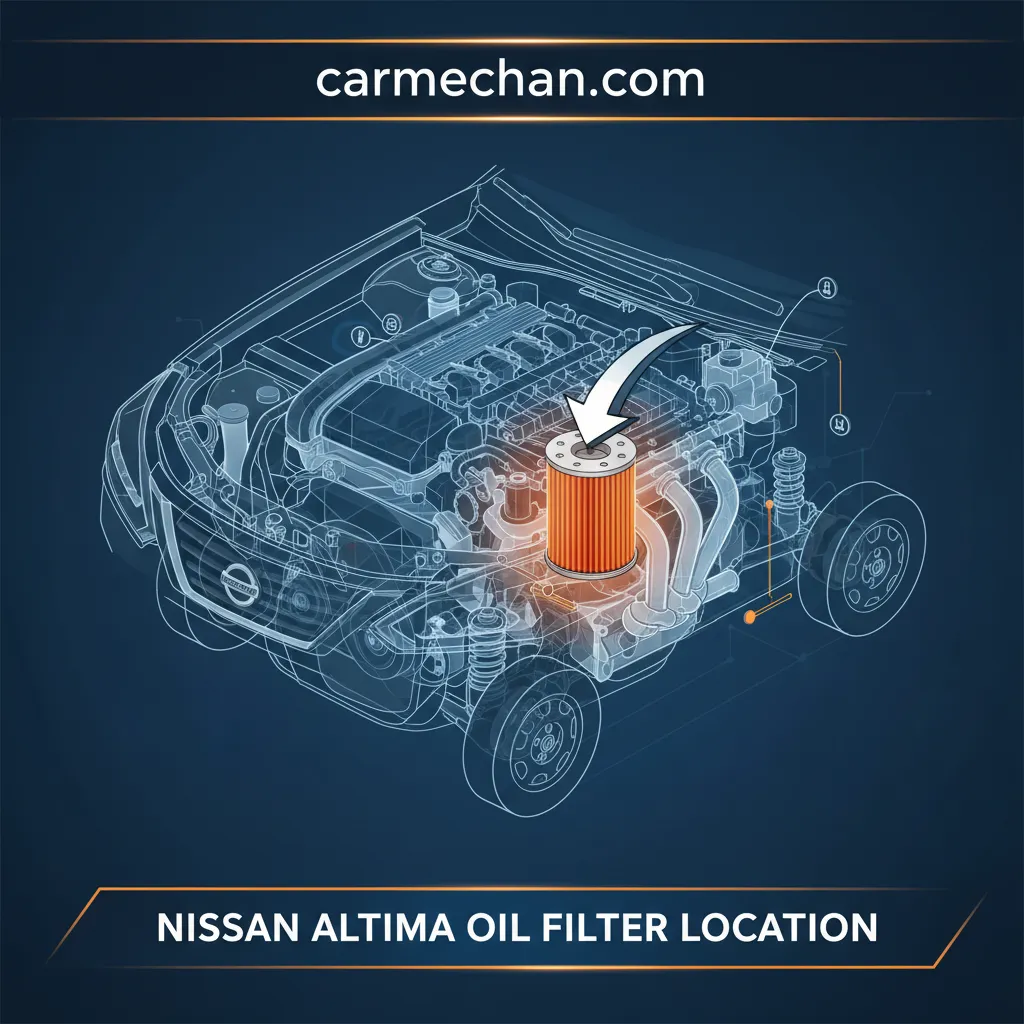
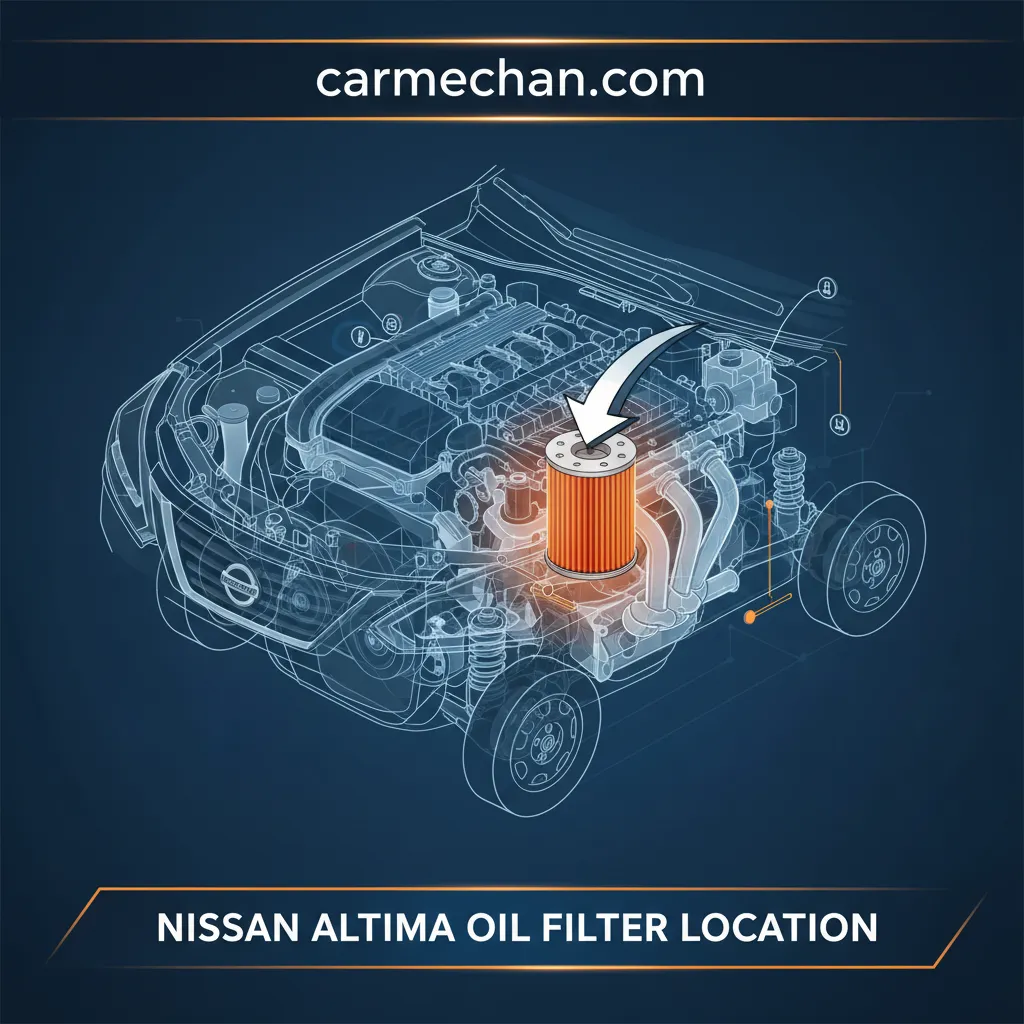
For the 4th Generation Altima (2007-2012), regardless of whether it’s equipped with the QR25DE 2.5L 4-cylinder or the more powerful VQ35DE 3.5L V6 engine, the oil filter is typically a spin-on canister type. It is commonly located towards the front of the engine, on the passenger side. Access usually requires getting under the vehicle. You will often need to remove the lower engine splash guard or under-engine cover, which is secured by several plastic clips and 10mm or 12mm bolts. Once the splash guard is down, the filter becomes visible, often mounted horizontally or at a slight angle on the engine block. For a 2010 Altima 2.5L, for instance, the oil filter is typically visible from the passenger side, mounted horizontally towards the front of the engine, often requiring access from below the vehicle after removing the lower engine splash shield. Common OEM filter part numbers for this generation include 15208-9F60A for many 2.5L models and 15208-JA00A for V6 engines.
5th Generation Altima (2013-2018)
With the introduction of the 5th Generation Altima (2013-2018), there were some notable shifts. The 2.5L QR25DE engine in these models often transitioned to a cartridge-style filter, although some early models might still feature a spin-on. If it’s a cartridge type, the filter housing is usually integrated into the engine block, accessible from below. The 3.5L V6 VQ35DE engine generally maintained a spin-on filter, similarly located for under-vehicle access. Both engine types for this generation typically require access from below the vehicle, necessitating the removal of the splash guard. The filter’s orientation might vary slightly, sometimes being more vertical. It’s crucial to confirm the specific filter type for your model year. Regional variations in engine configurations or part sourcing can occasionally lead to slight differences, so always verify against your vehicle’s specific production year and VIN.
6th Generation Altima (2019-Present)
The 6th Generation Altima (2019-Present) represents a significant design evolution. Both the 2.5L naturally aspirated engine and especially the innovative 2.0L VC-Turbo (KR20DDET) engine frequently feature a much more convenient top-mount cartridge filter design. This is a welcome change for technicians and DIY enthusiasts alike. For a 2020 Altima 2.0 VC-Turbo, for example, the cartridge filter housing is centrally located on top of the engine, beneath a removable plastic engine aesthetic cover. This allows for easy, top-down access, eliminating the need to lift the vehicle or remove under-engine shields for filter replacement. This accessible location greatly simplifies the oil change process. Identification of these filters is usually straightforward due to their prominent placement in the engine bay once the aesthetic cover is removed.
Regardless of the generation, always be prepared to encounter protective shields or engine aesthetic covers that may obscure the filter. These are typically fastened with plastic clips, push-pins, or small bolts (e.g., 10mm, 12mm). Gentle but firm removal is key to avoid breakage. A well-placed light can often reveal the filter’s exact position before you start dismantling components, ensuring you have the correct `location` pinned down.

Essential Tools and Preparation for Safely Accessing Your Nissan Altima’s Oil Filter
Performing an oil filter service on your Nissan Altima requires not only knowledge of the filter’s location but also the right tools and, critically, adherence to stringent safety protocols. My years in the field have taught me that cutting corners here invariably leads to avoidable complications or injuries.
Required Tools and Equipment
- Oil Filter Wrench: This is non-negotiable. For spin-on filters on older Altimas, a 64mm (2.5-inch) 14-flute cup-style oil filter wrench is often effective. For cartridge filters, a larger cap wrench, typically a 76mm (3-inch) 14-flute socket, might be necessary. A heavy-duty strap wrench can also serve as a versatile backup, especially for stubborn filters.
- Drain Pan: Ensure it has adequate capacity. For most Altima models, a 4.9 quarts for 2.5L or 5.1 quarts for 3.5L V6 oil capacity means you need a pan that can hold at least 6-8 quarts to prevent overflow.
- Socket Set and Ratchet: Needed for the oil drain plug, typically a 14mm or 17mm socket, and for any splash guard fasteners.
- Calibrated Torque Wrench: Absolutely essential for accurate re-installation of the drain plug and the cartridge filter housing cap. Over-tightening can strip threads; under-tightening leads to leaks.
- New Oil and Filter: Always have the correct type and quantity of engine oil and an OEM-specified or equivalent quality filter ready.
- Funnel, Shop Rags, and Absorbent Materials: For clean pouring and immediate spill containment. Kitty litter or specialized absorbent pads are excellent for larger spills.
- Jack and Jack Stands: If under-vehicle access is required.
Critical Safety Protocols
Never rely solely on a hydraulic jack to support your vehicle. Always use automotive jack stands with a sufficient capacity (e.g., 3-ton minimum for a significant safety margin) on a solid, level surface. Engage the parking brake and use wheel chocks on the wheels not being lifted. Ensure the engine is sufficiently cooled before starting work to prevent severe burns from hot oil or engine components. Always wear personal protective equipment (PPE) such as chemical-resistant gloves and ANSI-approved eye protection.
Workspace Preparation and Disposal
Prepare your workspace meticulously. Ensure adequate lighting, a clear and level area free of obstructions for tools, and ample space for the drained oil pan. Have absorbent materials readily available for immediate spill containment, as even experienced hands can make a mess. Once the old oil and filter are removed, proper disposal is critical. Used engine oil is a hazardous waste. Adhere strictly to local environmental regulations for disposal. Most auto parts stores and municipal recycling centers in your `community` accept used oil and filters for free, making it convenient and accessible to dispose of them responsibly. For instance, the EPA highlights that one gallon of used oil can contaminate one million gallons of fresh water, underscoring the importance of correct disposal.
For specific filter wrench sizes or torque specifications, always consult your Nissan Altima’s owner’s manual or a reliable service manual for your exact model year and engine. These resources provide the most accurate and up-to-date information, preventing costly mistakes.
A Step-by-Step Approach: Locating and Inspecting the Nissan Altima Oil Filter
📋
Step-by-Step Guide


Begin with a systematic visual scan of your Altima’s engine bay. Use a strong flashlight to look for any visible oil leaks, seepage around existing components, or signs of previous filter tampering. These clues can often indicate the exact `location` of the current filter. For newer models with top-mount filters, removing the plastic engine aesthetic cover is the first step to expose the area. Inspect the overall condition of hoses and belts while you’re there.
If your Altima model requires undercarriage access (common for 4th and 5th Gen), safely raise the vehicle using a hydraulic jack at the designated jack points. These are explicitly specified in your Nissan Altima owner’s manual. Immediately follow up by placing sturdy jack stands under the vehicle’s designated frame rails or pinch welds. Never place jack stands on suspension components or rely solely on the jack. Ensure the vehicle is lifted evenly and is completely stable before proceeding. Some later model Altimas (e.g., 2013+) might have a small, dedicated access panel in the lower engine splash guard specifically designed for the oil drain plug and filter, potentially reducing the need for full undercarriage shield removal.
Once you have clear access, locate the oil filter housing or canister. For spin-on filters, it will typically be a metallic cylinder, often found near the oil pan or directly on the engine block itself, usually on the passenger side towards the front. For cartridge filters, look for a prominent plastic housing cap, often black and hexagonal, which screws into a permanent engine block or oil pan housing. It’s crucial to differentiate it from other `nearby` cylindrical components such as the transmission fluid cooler, power steering pump reservoir, or fuel filter. The oil filter will be directly in the path of the engine oil circulation system, typically attached to the engine block or oil cooler assembly.
Accessing the filter can sometimes present challenges. You might encounter extremely tight clearances in compact engine bays, dealing with rusted or seized mounting brackets (for splash guards), or a stubborn filter that has been over-tightened during its previous service. In such cases, patience is paramount. Use appropriate leverage tools for bolts, and for seized filters, apply penetrating oil if necessary, giving it time to work. Ensure you have the correct oil filter wrench that precisely fits the filter to avoid slipping and rounding off the filter housing. Refer to Nissan’s official repair procedures for specific models’ access points and torque values to ensure a smooth removal process.
Local Service Options and Professional Assistance for Nissan Altima Oil Filter Needs
While many Nissan Altima owners possess the mechanical aptitude and desire to perform their own oil and filter changes, there are distinct scenarios where seeking professional assistance is not just prudent but highly recommended. My 15+ years in this industry have shown that knowing when to call in the experts can save significant time, money, and prevent costly damage.
When to Seek Professional Help
- Lack of Specialized Tools: If you do not possess the appropriate oil filter wrenches, a reliable jack and jack stands, or a calibrated torque wrench, professional service is the safer and often more economical option. A DIY enthusiast without a torque wrench, for instance, might risk damaging the oil pan or drain plug threads by over-tightening.
- Insufficient Mechanical Experience: If you are unsure about designated jack points, filter `location` specific to your Altima, or proper torque specifications, entrusting the job to a professional is wise.
- Unforeseen Complications: Encounters such as a stripped drain plug thread, a seized filter that won’t budge, or an oil filter in an unusually inaccessible `location` require specialized tools and expertise that a home garage might lack.
- Preference for Expert Service: Many simply prefer the peace of mind that comes from having their vehicle maintained by an expert from a reputable facility `nearby` and readily `available`.
Benefits of Professional Service for your Nissan Altima
Access to Specialized Equipment
Professional shops possess high-end diagnostic tools and specialized equipment for precise and efficient service.
OEM-Specified Parts
Certified technicians use OEM-specified or equivalent quality parts, ensuring optimal filtration and warranty compliance.
Comprehensive Vehicle Assessment
Beyond the oil change, services often include multi-point inspections, fluid top-offs, and tire pressure checks, providing a holistic view of vehicle health.
Time and Convenience
For many, the convenience of professional service outweighs the time and effort of DIY, especially with fast-track options like Nissan Express Service.
When identifying reliable automotive repair shops `serving` your `community`, look for certifications such as ASE certification among their technicians. Review customer testimonials and online ratings to gauge reputation. Inquire about transparent pricing policies and whether they have specific experience with Nissan Altima models. Dealerships like those offering “Nissan Express Service” provide factory-trained technicians and genuine parts. Independent mechanics who are `trusted local` businesses can also offer excellent, personalized service, often at competitive rates, provided they meet the aforementioned criteria.
A typical professional oil change service for your Nissan Altima often extends beyond merely replacing the oil and filter. It frequently includes a multi-point vehicle inspection, fluid top-offs (washer fluid, power steering, etc.), tire pressure checks, and detailed reporting on your vehicle’s overall health. This comprehensive assessment ensures that potential issues are identified early, contributing to the long-term reliability and safety of your vehicle. Industry studies consistently indicate that over 80% of major auto failures could be prevented with routine, professional maintenance. While costs can vary based on oil type and geographical `location`, an average professional oil change for a Nissan Altima typically ranges from $40-$80, a modest investment for significant returns in vehicle longevity.
By The Numbers
Failures Preventable by Pro Maintenance
Avg. Pro Oil Change Cost (Altima)
Particle Removal Efficiency
The Nissan Altima oil filter’s location varies significantly by model year and engine type, necessitating specific knowledge for each generation. Proper tools, adherence to safety protocols, and understanding the filter type (spin-on vs. cartridge) are critical for successful location and service. While DIY is feasible, professional assistance from certified local technicians remains a reliable option for complex scenarios or those seeking expert service. Ultimately, regular and correct oil filter maintenance is paramount for the longevity and reliable performance of your Altima’s engine. Armed with this detailed knowledge, confidently locate and manage your Nissan Altima’s oil filter. For any complexities, consult a trusted local automotive service professional to ensure your vehicle receives the expert care it deserves.
Frequently Asked Questions
How often should I change my Nissan Altima’s oil filter?


Nissan recommends changing your Altima’s oil filter with every oil change. This typically ranges from every 5,000 to 7,500 miles or every 6 months, depending on your Altima’s model year, engine type, and the type of oil used (conventional versus synthetic). Always refer to your owner’s manual for the most precise maintenance schedule.
What’s the difference between a spin-on and cartridge oil filter in an Altima?
A spin-on filter is a self-contained unit that screws directly onto the engine block, common in older Altimas. A cartridge filter consists of an internal filter element placed inside a reusable housing, often found in newer Altima models, and requires only the element to be replaced. Cartridge filters are typically more environmentally friendly.
Can I access the oil filter without lifting my Nissan Altima?
For some newer Nissan Altima models, particularly those with a top-mounted cartridge filter (like some 6th generation models), access may be possible from above the engine bay without lifting the vehicle. However, for most older models and those with bottom-mounted spin-on filters, lifting the vehicle safely on jack stands is typically required for adequate access.
What if I can’t find the oil filter on my Altima after consulting the guide?
If you’re still having difficulty locating the oil filter after reviewing this detailed guide, it’s highly recommended to consult your Nissan Altima’s owner’s manual for specific diagrams. Alternatively, seeking assistance from a certified Nissan technician or a reputable local mechanic is the safest and most efficient next step. They possess the expertise and tools to quickly identify it.
Are there specific oil filter brands recommended for Nissan Altima?
For optimal performance and warranty compliance, using genuine Nissan OEM (Original Equipment Manufacturer) oil filters is always recommended. High-quality aftermarket brands such as Wix, Mann-Filter, Mobil 1, or Fram (specific models) are also reliable alternatives, provided they meet or exceed Nissan’s specifications for your particular Altima model and engine type.