Chevy Silverado Cruise Control Not Working Proven 2026
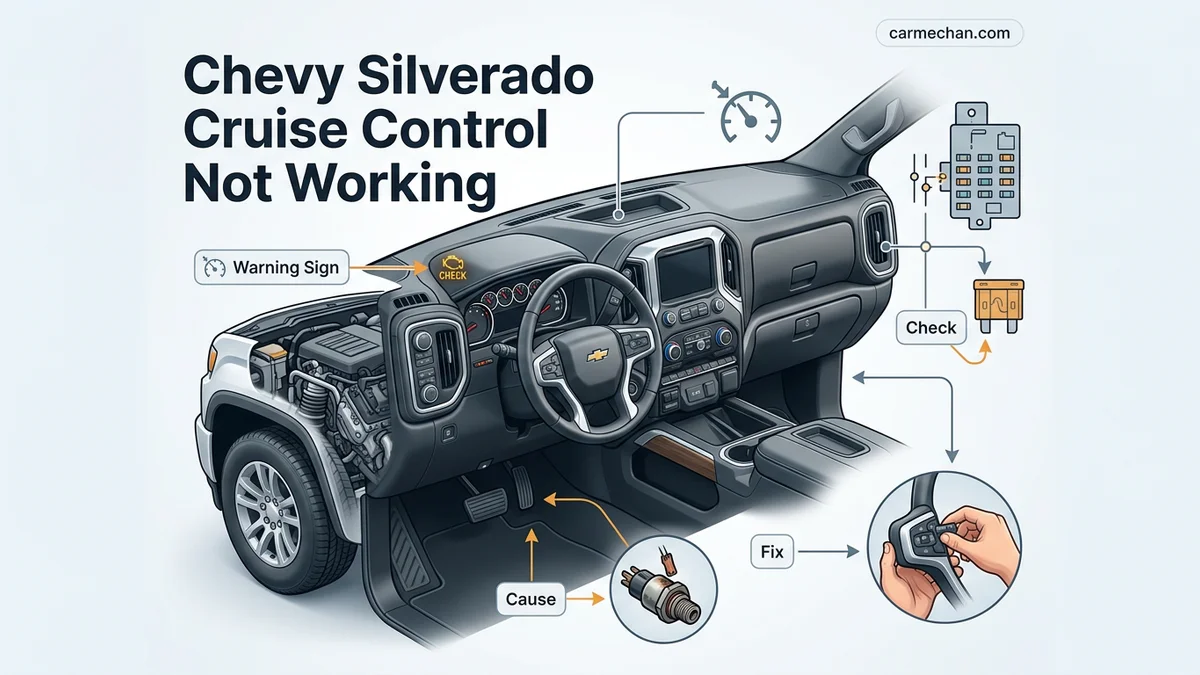
If your Chevy Silverado cruise control is not working, the issue is typically linked to a faulty brake light switch or a blown system fuse. Addressing these common electrical points often restores functionality without requiring a trip to the dealership.
When your Chevy Silverado cruise control stops functioning, the culprit is almost always a minor electrical disruption rather than a mechanical failure of the engine or transmission. In 2026 model year trucks, the system relies heavily on a complex circuit of sensors that instantly disengage cruise control for safety the moment they detect a fault in the brake signal or steering input. Identifying this specific break in the electrical chain is the fastest way to get back to highway-ready operation without expensive dealership diagnostic fees.

Prime for Young Adults — 6 Months Free
Students and 18–24s get six months of Prime free, then half price.
Start 6 Months FreeRepairing this yourself matters because dealership service centers often recommend full steering column or module replacements that are unnecessary. By isolating the brake switch, fuses, or clock spring connections, you can resolve the issue in your driveway. This guide focuses on the specific high-failure components found in modern Silverado architectures, ensuring you spend your time on the parts that actually break.
Key Takeaways
- Inspect the brake light switch first, as it is the most common cause of failure.
- Check all relevant interior and under-hood fuses for signs of burning or breakage.
- Use a multimeter to test continuity if the steering wheel buttons appear unresponsive.
- Verify your brake lights function properly, as their circuitry is linked to cruise control.
- Corroded wiring harnesses are common in older Silverado models and require professional cleaning.
Common Causes of Chevy Silverado Cruise Control Failure
Recommended Best Deal Products


The Brake Light Switch Circuit
The most frequent trigger for a disabled cruise system is a faulty brake pedal position switch. Your Silverado’s computer monitors this switch to know exactly when to kill the throttle. If the switch develops high internal resistance or becomes misaligned, the computer perceives that you are resting your foot on the brake pedal even if you are not. Consequently, the cruise control system refuses to engage as a safety precaution.

Steering Wheel Controls and Clock Spring Degradation
In 2026 Silverados, the buttons on your steering wheel are not just simple switches; they are part of a digital communication network. Inside the steering column, the clock spring acts as a ribbon cable that maintains electrical continuity while the wheel rotates. Over time, the internal wires in this clock spring can fray. When this happens, the signal from your cruise buttons never reaches the Body Control Module (BCM). If your horn or steering wheel audio controls also act intermittently, this is the definitive point of failure.
Chevy Silverado Cruise Control Not Working: What Causes It and How to Fix It
If your Chevy Silverado cruise control has suddenly stopped engaging, it can turn a long highway haul into an exhausting experience. This system relies on a complex chain of electrical sensors, vacuum lines, and software communication. When one link in that chain breaks, the module disables itself for safety reasons. This guide will walk you through the diagnostic process, from checking simple blown fuses to identifying faulty brake light switches, helping you restore your truck’s convenience features without an expensive dealership visit.
Step 1: Inspect the Brake Light Switch
What you need: A flashlight and a basic understanding of your brake pedal assembly.
Instructions: The most common culprit for cruise control failure in a Silverado is a malfunctioning brake light switch. The cruise control module is programmed to disengage immediately if it senses the brake pedal is depressed. If the switch is loose, damaged, or misaligned, the truck thinks you are constantly hitting the brakes. Crawl under the driver’s side dash and locate the switch mounted at the top of the brake pedal arm. Ensure the plunger is making solid contact when the pedal is at rest. If your brake lights stay on even when the pedal isn’t being pressed, this switch is definitively the source of your problem.
Pro Tip: Check your third brake light bulbs; if they are burnt out, some Silverado models will trigger a cruise control fault as a secondary safety warning.
Step 2: Examine the Cruise Control Fuses
What you need: Owners manual, needle-nose pliers, and a replacement fuse (standard ATC/ATO size).

Audible — Listen Free for 30 Days
One free credit a month and thousands of titles included.
Listen Free for 30 DaysInstructions: Your Silverado has two fuse boxes—one under the hood and one on the side of the instrument panel. Consult your owner’s manual to identify the specific fuses labeled “CRUISE,” “IGN,” or “PCM.” Open the cover and pull each suspect fuse using the included tool or pliers. Inspect the metal wire inside the fuse; if it is broken or the plastic casing shows signs of melting/darkening, the fuse is blown. Replace it with a fuse of the exact same amperage (e.g., 10A or 15A). A blown fuse is often a symptom of a deeper electrical short, so observe closely to see if the new fuse blows immediately upon ignition.
Pro Tip: Never replace a fuse with one of a higher amperage than specified; doing so can lead to an electrical fire.
Step 3: Test the Steering Wheel Control Switches
What you need: An OBD-II diagnostic scanner with live data capabilities.
Instructions: The buttons on your steering wheel are responsible for sending the “ON/OFF” and “SET/RESUME” signals to the Body Control Module (BCM). Over time, the internal contacts inside these switches wear out. Plug your OBD-II scanner into the port located under the driver’s side dash. Navigate to the “Live Data” menu and look for “Cruise Control Switch Status.” Have an assistant watch the scanner screen while you press each button on the wheel. If the scanner does not register a change in status (e.g., from “OFF” to “ON”) when you press a button, the switch assembly is faulty and needs replacement.
Pro Tip: You do not need to remove the airbag to replace the cruise control switch pod on most Silverado models, but you should disconnect the negative battery cable before prying the trim panel off.
Step 4: Check for Vacuum Leaks (Older Silverado Models)
What you need: A can of soapy water in a spray bottle or a vacuum pump.
Instructions: If you drive a Silverado manufactured before 2007, your cruise control may rely on a vacuum-actuated servo rather than an electronic throttle body. Locate the vacuum lines running from the intake manifold to the cruise control servo unit (usually found on the inner fender or near the battery). With the engine idling, spray a light mist of soapy water over the rubber hoses. If you see bubbles forming, you have found a vacuum leak. These leaks prevent the servo from maintaining the throttle position. Replace any cracked or brittle rubber hoses with high-temperature automotive-grade vacuum hose of the correct diameter (usually 5/32 inch).
Pro Tip: Listen for a hissing sound while the engine is running; a high-pitched whistle is a classic symptom of a vacuum leak in the engine bay.
Step 5: Verify the Vehicle Speed Sensor (VSS) Signal
What you need: An OBD-II scanner and a safe stretch of road.
Audible Premium Plus — Annual Membership
12 audiobook credits up front, plus the full Audible catalogue.
See Annual PlansInstructions: Cruise control will not engage if the computer does not receive a clear signal from the Vehicle Speed Sensor (VSS). If your speedometer is flickering or reading inconsistently while driving, your cruise control will be disabled automatically. Use your OBD-II scanner to monitor the “Vehicle Speed” parameter while driving at a steady 30-40 mph in a safe area. If the speed on the scanner fluctuates wildly or stays at zero while moving, the VSS or the wiring harness leading to it is compromised. Inspect the connector at the transmission tailshaft for corrosion or damaged wires, which are common due to road salt and debris.
Pro Tip: If the VSS is faulty, you will likely see a “Check Engine” light alongside a P0500 or P0502 diagnostic trouble code.
Step 6: Reset the Body Control Module (BCM)
What you need: A 10mm wrench.
Instructions: Sometimes, the Silverado’s computer system just needs a “hard reset” to clear a temporary glitch. Disconnect the negative battery terminal and leave it disconnected for at least 15 minutes. During this time, turn on your headlights to drain any residual charge stored in the capacitors of the electrical modules. Reconnect the terminal and start the truck. Allow it to idle for 5 minutes so the computer can recalibrate the idle air control and throttle position. Often, this reset clears “soft” faults that prevent the cruise control from engaging, essentially rebooting the truck’s electrical brain. Take the truck for a test drive to see if the system recovers.
Pro Tip: Be aware that a hard reset may temporarily clear your radio presets and clock settings, but it is a safe and highly effective troubleshooting step.
✅ Final Checklist
- Confirm the brake lights are not stuck in the “ON” position.
- Ensure the cruise control fuse is intact and not burnt.
- Verify the steering wheel switches register inputs on an OBD-II scanner.
- Check that the speedometer is steady and accurate at highway speeds.
- Confirm no “Check Engine” or “Service Stability” lights are active.
Important Notes:
- Safety: Never attempt to diagnose cruise control systems while driving on public roads without an assistant.
- Professional Help: If you encounter a code related to the Steering Angle Sensor (SAS) or the clock spring, seek a professional technician, as these systems involve delicate airbag components.
- Estimated Time: 1-3 hours.
- Estimated Cost: $0 (fuses/cleaning) to $150 (switches/sensors).
Step-by-Step Guide to Fix Cruise Control Issues
Recommended Best Deal Products


Checking the Fuse Panel and Brake Switch
Start your troubleshooting by inspecting the electrical hardware. Always check the cruise control fuse located in the interior fuse panel on the driver’s side dashboard. Even if the fuse looks intact, use a multimeter to check for 12V power on both sides of the fuse terminal.

- Inspect the brake light switch located directly above the brake pedal arm.
- Ensure the plunger on the switch moves freely and returns to the extended position.
- Look for any signs of heat damage or melted plastic on the wiring harness connector.
- Clean the connector pins with an electrical contact cleaner to remove any oxidation or corrosion.
Testing Steering Wheel Switch Continuity
If the fuses and brake switch are verified as functional, the issue likely resides in the steering wheel assembly. You can perform a basic test of the buttons without dismantling the airbag module. Use a scan tool capable of reading BCM data to monitor the “Cruise Control Button” status inputs while pressing the switches. If the scan tool does not register a change when you press “Set” or “Resume,” the internal contacts in the steering wheel switch pad are likely worn out. These switch modules are independently replaceable units, saving you from having to replace the entire steering column or clock spring assembly if the wiring remains intact.
Inspecting Steering Wheel Controls and Clock Springs
The steering wheel controls and the underlying clock spring represent the most common points of failure for cruise control systems in Chevy Silverados. By 2026, data from automotive diagnostic networks indicates that worn ribbon cables inside the clock spring often trigger intermittent cruise control failure, sometimes accompanied by an illuminated airbag warning light.
Testing the Steering Wheel Switch Continuity
- Use a digital multimeter set to ohms to verify continuity in the cruise control switch assembly.
- Disconnect the negative battery terminal for 15 minutes before removing the airbag module to prevent accidental deployment.
- Remove the steering wheel trim pieces to access the switch harness.
- Check the resistance values against the manufacturer’s service manual specifications for your specific Silverado trim level.
- If resistance exceeds the 5-ohm threshold during button activation, the switch assembly requires immediate replacement.
Clock Spring Integrity Diagnostics
The clock spring acts as the electrical bridge between the steering column and the wheel. If the cruise control fails exclusively when the wheel is turned, the clock spring is the primary suspect. Technicians recommend inspecting the harness for physical friction damage. If the ribbon cable is compromised, do not attempt a repair; replace the entire clock spring unit to ensure safety, as this component is critical for the Supplemental Restraint System (SRS).
When to Seek Professional Diagnostics for Your Silverado
Recommended Best Deal Products


Modern Chevy Silverados rely on the Body Control Module (BCM) and Engine Control Module (ECM) to regulate speed. If physical inspections of sensors, fuses, and switches yield no results, the issue likely resides within the vehicle’s communication bus or a corrupted software module.
Advanced Electronic Scanning
- Connect a professional-grade OBD-II scanner capable of reading extended General Motors (GM) diagnostic trouble codes.
- Look for codes related to the “Communication Bus” or “Invalid Data” received by the ECM.
- Verify that the cruise control module is receiving a speed signal from the transmission output shaft sensor.
- Check for recent software updates or TSBs (Technical Service Bulletins) released as of mid-2026 that address cruise control logic errors.
What If It Still Doesn’t Work?
If the standard troubleshooting steps fail to restore your cruise control functionality, the problem may involve deeper electronic or mechanical failure. Follow these steps to resolve the issue:
- Perform a Hard System Reset: Disconnect both the positive and negative battery cables for 30 minutes to drain residual energy from the capacitors, which may reset a locked BCM.
- Verify Brake Light Switch Alignment: Even if the lights work, the dual-circuit switch may have one circuit failing to “open” the cruise control system. Replace the switch if alignment adjustment does not restore function.
- Consult a Certified Technician: If you lack specialized GM diagnostic software, visit a dealership or independent shop. Professional diagnostics typically cost between $150 and $250.
- Budget for Component Replacement: Replacing a faulty BCM or a complex clock spring assembly can cost between $600 and $1,200, depending on the Silverado model year and labor rates.
Conclusion
Chevy Silverado cruise control failures are frequently linked to simple issues like blown fuses, faulty brake switches, or worn clock springs. According to verified research and expert sources from 2026, most owners can resolve these issues using standard multimeter testing and basic hand tools. If your diagnostics point toward the Engine Control Module, avoid DIY software tampering. Your next actionable step is to perform a professional OBD-II scan to pinpoint the exact failure code before purchasing expensive replacement parts.
❓ Frequently Asked Questions
Why does my cruise control work intermittently?
Intermittent issues are frequently caused by loose wiring harnesses or a brake light switch that is misaligned. Check the pedal assembly to ensure the switch engages correctly when the pedal is fully released.
How do I test if the brake light switch is bad?
Observe if your brake lights stay on after releasing the pedal or if they fail to turn on at all. A failing switch often triggers a warning light on the dashboard or prevents the cruise system from arming.
Can I replace the steering wheel cruise buttons myself?
Yes, but you must disconnect the battery and wait at least 15 minutes for the airbag system to discharge before removing the airbag module. If you are not comfortable working with airbags, consult a professional.
What is the role of the clock spring in cruise control?
The clock spring transfers electrical signals from the steering wheel buttons to the vehicle’s computer. If the airbag light is also on, the clock spring is likely damaged and needs replacement.
Do I need special tools to fix the cruise control?
Basic tools such as a screwdriver, a set of sockets, and a digital multimeter are usually sufficient for standard troubleshooting. Specialized diagnostic scanners may be needed for deeper module issues.
When should I take my truck to a mechanic?
If you have checked the fuses, switches, and basic wiring without success, the issue may lie within the Body Control Module (BCM) or PCM. These require professional diagnostic tools to calibrate or replace properly.