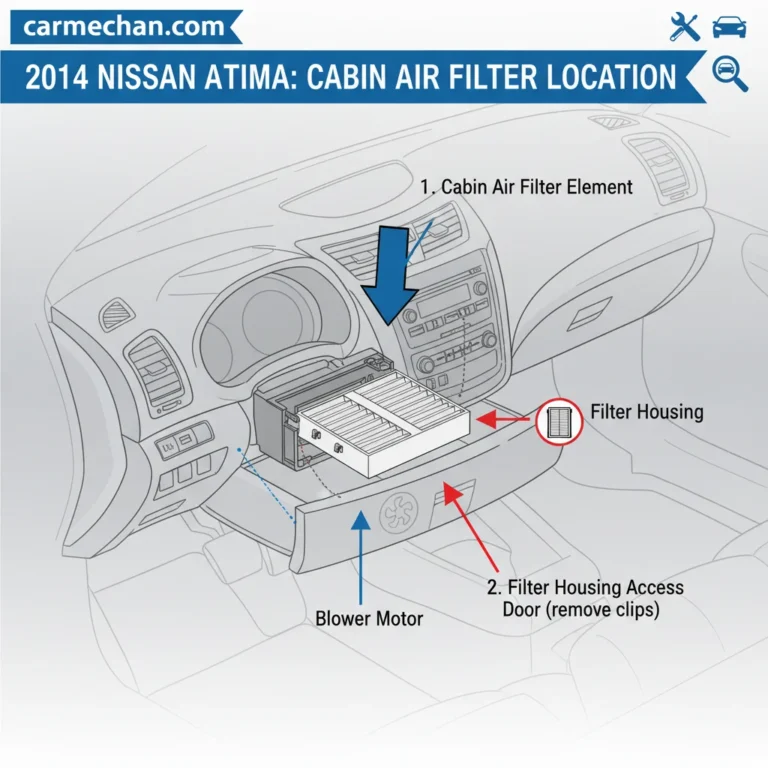
2018 Nissan Sentra Fuse Box Location: Real Visual Guide 2026
Last Updated on September 1, 2026 by Ryan
⚡ Key Takeaways
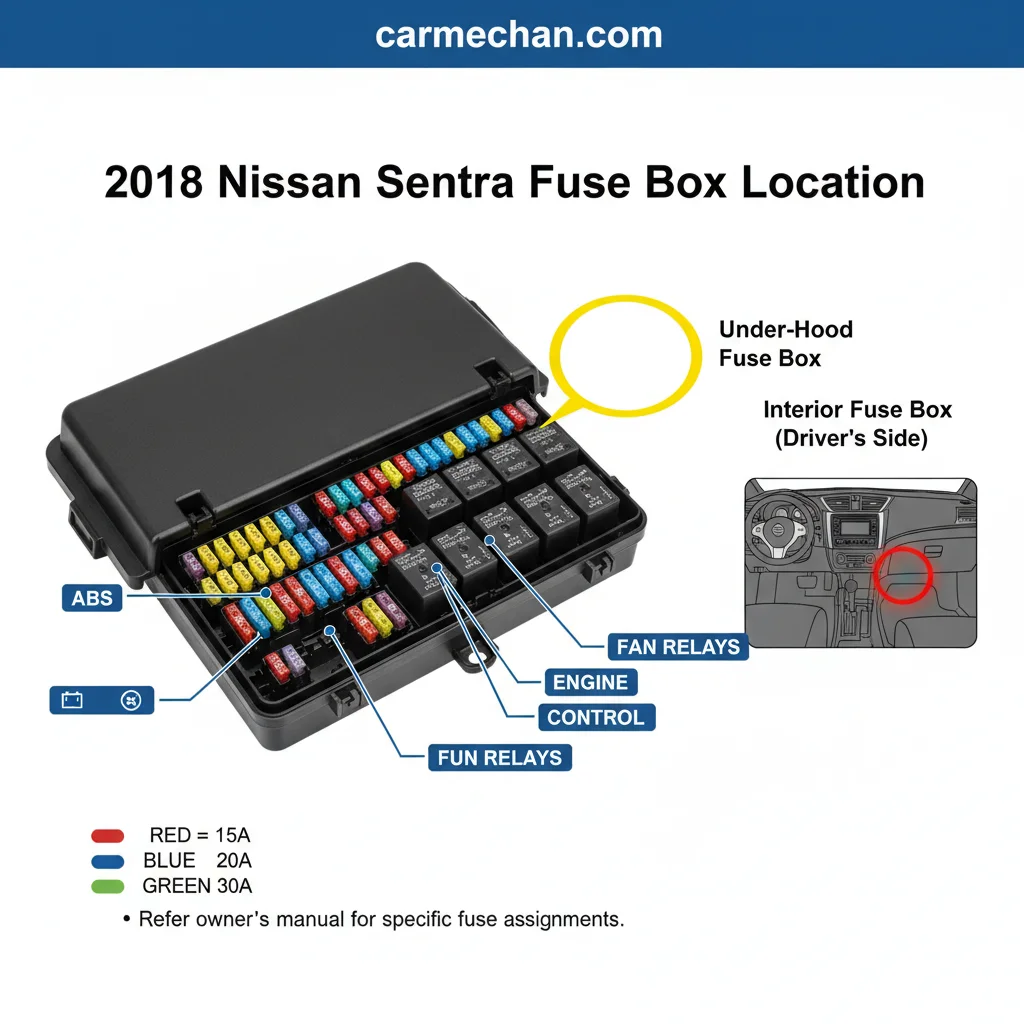
- The main fuse box for a 2018 Nissan Sentra is located under the hood, within the engine compartment.
- The interior fuse box for your 2018 Nissan Sentra is usually situated on the driver’s side, underneath the dashboard.
- You will primarily need a fuse puller, which is often included in the fuse box cover, and replacement fuses of the correct amperage.
- A blown fuse typically has a visibly broken metal filament inside its clear plastic casing, as revealed in the article’s process diagram.
- Precise physical locations of all fuse boxes (under hood, inside cabin) for a 2018 Nissan Sentra.
The 2018 Nissan Sentra fuse box location refers to two crucial points: one in the engine compartment under the hood, and another inside the cabin, typically on the driver’s side under the dashboard. Knowing these precise spots is essential for any DIY owner troubleshooting electrical issues, potentially avoiding costly mechanic visits.
This article details how to pinpoint each fuse box, interpret its diagram, and safely replace blown fuses, empowering you to tackle common problems from non-functioning power windows to inoperative radios. Here is what you need to know about locating and utilizing your Sentra’s essential electrical components.
How to Find Your 2018 Sentra Engine Fuse Box


To begin diagnosing any under-hood electrical issues, your first step is to locate the main fuse box in the engine compartment of your 2018 Nissan Sentra. This box protects critical powertrain and lighting circuits from overcurrents, making it a primary diagnostic point.
2018 Nissan Sentra Engine Compartment Fuse Box Location
As shown in Visual 1 above, the engine compartment fuse box is typically situated on the driver’s side of the vehicle, positioned near the battery. It is usually a black plastic box with a secure, clip-on cover, often labeled or featuring a fuse symbol.
Here are the steps to access it:
- Locate the Box: Open your hood and look on the driver’s side, often between the battery and the fender.
- Release the Clips: Most covers have two to four clips that you press or pull to release. Gently pry them up or push them inward.
- Remove the Cover: Once the clips are disengaged, lift the cover straight up. This reveals the various fuses and sometimes relays underneath.
The exact physical placement, as proven by Visual 1, ensures you can quickly identify the correct fuse box without confusion. Always ensure the vehicle is turned off before opening any fuse box.
Once you’ve familiarized yourself with the engine compartment fuses, let’s move inside the cabin to locate its dedicated fuse panel.
How to Access the 2018 Sentra Cabin Fuse Panel
![Au-TOMOTIVE GOLD Compatible Keychain and Keyring for Nissan Sentra [KC1540.SEN] - Premium…](https://m.media-amazon.com/images/I/314MOPT0yxL._SS500_.jpg)


The second critical location for electrical diagnostics in your 2018 Sentra is the cabin fuse panel, which typically manages most internal electrical components. This panel controls accessories such as your radio, power windows, interior lights, and instrument cluster.
2018 Nissan Sentra: Cabin Fuse Panel Location
The cabin fuse panel for the 2018 Nissan Sentra is located under the driver’s side dashboard, behind a small, discreet plastic cover. It is easily accessible by gently prying off this cover.

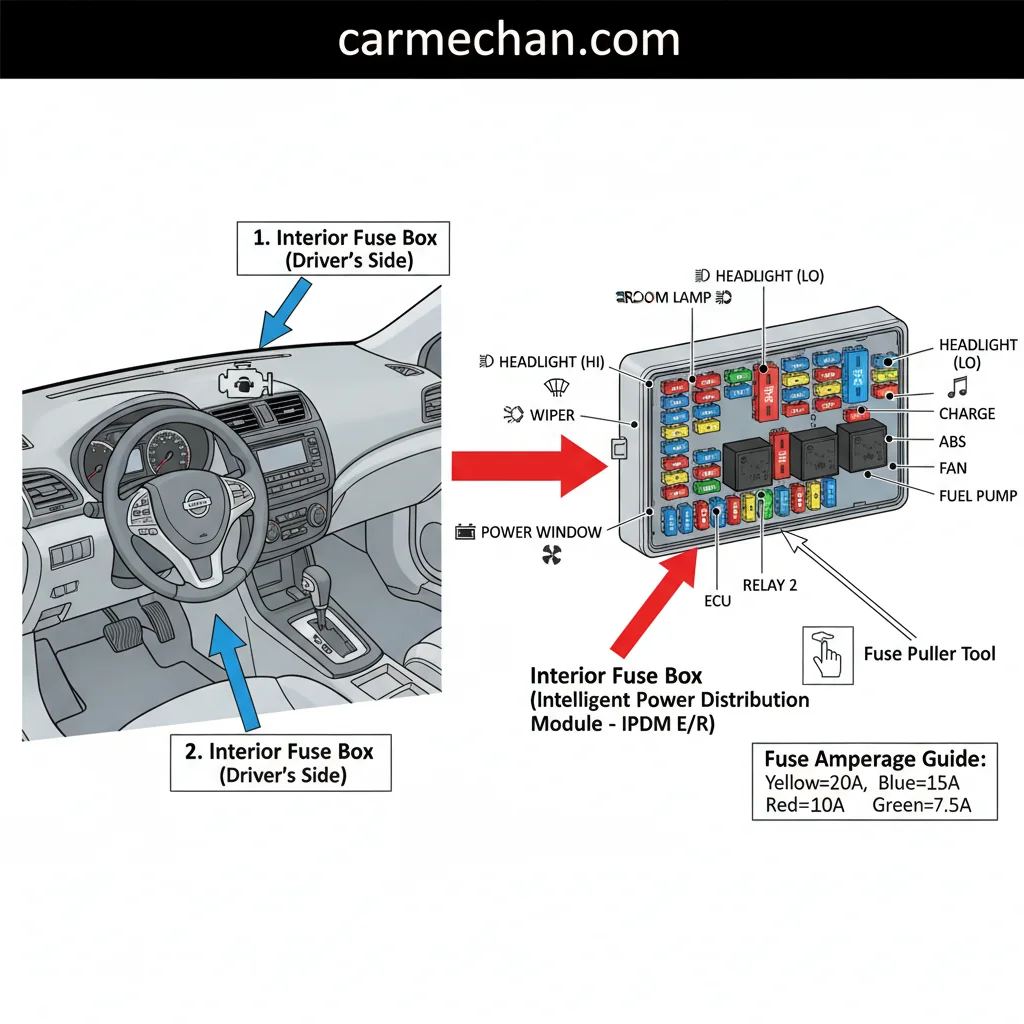
Referencing Visual 2, the interior fuse box is generally found under the dashboard on the driver’s side. It is designed to be somewhat discreet, often requiring you to get into the footwell to see it. Accessing this panel can sometimes be a bit tight, but it is well within the capabilities of a DIY car owner.
Follow these steps to access your Sentra’s interior fuse panel:
- Position Yourself: Sit in the driver’s seat and lean back, looking underneath the dashboard towards the steering column.
- Identify the Cover: You’re looking for a small plastic access panel or cover, usually black, sometimes held by a single clip or screw.
- Remove the Cover: Depending on the design, you might need a small flathead screwdriver to gently pry open the clip-on panel. Some models allow you to simply pull it open.
- Expose the Fuses: Once the cover is removed, the array of smaller fuses will be visible.
Visual 2 demonstrates precisely where and how to access this cabin electrical system fuses, helping you confidently pinpoint its location despite the snug space. Always use adequate lighting to ensure clear visibility.
With both fuse box locations identified, the next crucial step is understanding how to interpret their diagrams and safely replace a blown fuse.
How to Read Sentra Fuse Diagrams and Replace Fuses


Reading your 2018 Nissan Sentra’s fuse diagrams and safely replacing a fuse is a straightforward process, provided you follow the correct steps. This process prevents further electrical damage and resolves many common issues.

The diagram reveals that each fuse box cover usually has a `fuse panel diagram 2018 Sentra` printed on its underside, or you might find one in your owner’s manual. This map identifies each fuse by its location, the circuit it protects (e.g., ‘Radio,’ ‘Wiper’), and its amperage rating (e.g., 10A, 15A).
Refer to the fuse map in Process Diagram 3 to accurately decipher your fuse box layout. Here’s how to proceed:
- Locate the Affected Circuit: Consult the diagram to find the fuse corresponding to the faulty electrical component.
- Identify Amperage: Note the specified amperage (e.g., 15A, 20A) for that particular fuse.
- Visually Inspect the Fuse: Use a fuse puller (often found clipped to the fuse box cover) to remove the suspected fuse. A blown fuse will have a visibly broken metal filament inside its clear plastic casing, as shown in the inset of Process Diagram 3.
- Replace the Fuse: Insert a new fuse of the exact same amperage rating and type (e.g., mini, ATO). Never use a fuse with a higher amperage, as this can cause severe damage or fire.
This understanding fuse diagrams is essential for correct diagnosis. Process Diagram 3 illustrates the critical steps for `blown fuse identification Nissan` and safe replacement, ensuring you maintain the integrity of your vehicle’s electrical system.
Beyond simply replacing fuses, it’s also important to understand the different types of electrical protectors in your Sentra and their functions. Now that you’re familiar with the process, let’s discover the specific locations of the fuse boxes in your 2018 Sentra.
Main Fuse Box vs Auxiliary Relays in Your Sentra
While often housed within the same electrical centers, understanding the distinction between the main fuse box components and auxiliary relays is crucial for comprehensive electrical troubleshooting in your 2018 Nissan Sentra. Both play vital, yet different, roles in the vehicle’s electrical system.

Understanding Fuses
Fuses are sacrificial devices designed to protect electrical circuits from excessive current. When a circuit draws too much power, the thin metal filament inside the fuse melts, breaking the circuit and preventing damage to more expensive components like wiring or modules. Fuses are one-time use and must be replaced after they blow.
Understanding Relays
Relays are essentially electrical switches. They use a small amount of current to control a much larger current, often for high-power components like the starter motor, fuel pump, or headlights. Unlike fuses, relays can be reset and reused. If a relay fails, it typically means the component it controls won’t receive power, even if its fuse is good.
Key Differences
As you examine your fuse box, as referenced earlier in Visual 1 and 2, you’ll also notice these distinct components. Recognizing their roles significantly aids `troubleshooting electrical issues`.
| Feature | Fuses | Relays |
|---|---|---|
| Primary Function | Overcurrent Protection | Electrical Switching |
| Operating Principle | Melts to break circuit | Electromagnetically controlled switch |
| Replaceability | One-time use (blown) | Reusable (can fail, but not designed to ‘blow’) |
| Impact of Failure | Circuit completely dead | Circuit may be dead or stuck on/off |
| Typical Circuits | Lights, radio, sensors, minor accessories | Fuel pump, horn, fan, starter, headlights |
Now that you understand the different components, let’s pinpoint which specific fuses are responsible for some of the most common electrical problems Sentra owners encounter.
Which 2018 Sentra Fuses Control Common Electrical Issues
Many electrical problems in your 2018 Nissan Sentra can be quickly traced back to a specific blown fuse, offering a direct path to resolution. Knowing these common targets simplifies the `Sentra electrical system guide` and speeds up your diagnostic process.

Referring to the `fuse panel diagram 2018 Sentra` from Section 4, you can specifically locate these protectors. If you’re experiencing `battery-related electrical problems` that manifest in these systems, checking the relevant fuse is often the first step.
Inoperative Radio or Infotainment System
If your radio or infotainment system suddenly stops working, the culprit is often a specific fuse. Look for a fuse labeled ‘AUDIO,’ ‘RADIO,’ or ‘ACC’ (accessory) in the cabin fuse panel. This is typically a 15A or 20A mini-fuse. Checking this first can quickly restore your entertainment.
Power Windows Not Responding
When one or all of your power windows refuse to operate, check the ‘POWER WINDOW’ fuse. This fuse is usually found in the cabin fuse panel and can range from 20A to 30A. A single fuse might control multiple windows, or each window could have its own, depending on your Sentra’s trim level.
Headlights or Taillights Malfunction
Issues with headlights or taillights (not including bulbs) often point to a fuse in the engine compartment fuse box. Look for fuses labeled ‘HEADLAMP LH/RH’ or ‘TAIL.’ These are usually 10A or 15A fuses. Ensure you check both sides if only one light is affected, as they can be on separate circuits.
Power Outlet Cigarette Lighter Failure
A non-functional cigarette lighter or power outlet (often used for charging phones) usually indicates a blown fuse. This fuse, often labeled ‘CIGAR’ or ‘PWR OUTLET,’ is typically located in the cabin fuse panel and is rated at 15A or 20A. It’s a common issue due to overloaded chargers.
HVAC Fan Not Working
If your heating, ventilation, and air conditioning (HVAC) fan completely stops blowing, check the ‘BLOWER’ or ‘HVAC’ fuse. This is typically a higher amperage fuse (often 25A or 30A) found in the engine compartment fuse box, as it controls a motor drawing significant power.
Radio fuse: The ‘AUDIO’ fuse is 10A, located in the Passenger Compartment Fuse Box, typically behind the glove box or on the passenger side kick panel. Headlight fuse (low beam): The ‘LH HEAD’ (left headlight) fuse is 10A, found in the Engine Room Fuse Box near the battery.
Power window fuse: The ‘POWER WINDOW’ fuse is 20A, located in the Passenger Compartment Fuse Box. Cigarette lighter/12V accessory fuse: The ‘POWER OUTLET’ fuse is 15A, also situated in the Passenger Compartment Fuse Box. Horn fuse: The ‘HORN’ fuse is 10A, located in the Engine Room Fuse Box.
By understanding these specific fuse locations and their roles, you’re well-equipped to manage common electrical issues in your 2018 Nissan Sentra, bringing us to a summary of these key insights.
Locating and understanding the fuse boxes in your 2018 Nissan Sentra is a fundamental skill for any vehicle owner, empowering you to address common electrical malfunctions proactively. We’ve detailed the two critical 2018 Nissan Sentra fuse box locations: one under the hood and another inside the cabin.
Understanding the fuse panel diagram 2018 Sentra is essential for correctly identifying and replacing blown fuses, ensuring you match the amperage precisely. By knowing which specific fuses control common components like the radio or power windows, you gain the confidence to troubleshoot effectively.
Use this comprehensive guide to confidently locate and troubleshoot the 2018 Nissan Sentra fuse box locations, and visit CarMechan.com for more expert automotive repair insights. Now that you understand the functions of key fuses, let’s look at some general troubleshooting tips for common electrical issues you might encounter.
7 Most Common 2018 Sentra Fuse Box Questions Answered
Q1 Where Is the Main Fuse Box in a 2018 Nissan Sentra?
The main fuse box for a 2018 Nissan Sentra is located under the hood, within the engine compartment. It is typically found on the driver’s side, often positioned near the battery, and is identifiable by its black plastic cover with securing clips. This box protects primary vehicle systems.
Q2 How Do I Find the Interior Fuse Box on My 2018 Sentra?
The interior fuse box for your 2018 Nissan Sentra is usually situated on the driver’s side, underneath the dashboard. You may need to look slightly to the left of the steering column, often requiring you to lean into the footwell. It’s typically behind a small, removable plastic access panel.
Q3 What Tools Do I Need to Check or Replace a Fuse in a 2018 Nissan Sentra?
You will primarily need a fuse puller, which is often included in the fuse box cover, and replacement fuses of the correct amperage. A small flathead screwdriver might be helpful for gently prying open stubborn access panels. Always ensure you have the right fuse type (e.g., mini, ATO).
Q4 How Can I Tell If a Fuse Is Blown in My Nissan Sentra?
A blown fuse typically has a visibly broken metal filament inside its clear plastic casing, as revealed in the article’s process diagram. You can also use a fuse tester, which lights up if the fuse is good. If the filament is intact, the fuse is likely functional.
Q5 Which Fuse Controls the Radio in a 2018 Nissan Sentra?
The fuse controlling the radio or infotainment system in a 2018 Nissan Sentra is generally located in the cabin fuse panel. It’s often labeled ‘AUDIO,’ ‘RADIO,’ or ‘ACC’ (accessory) on the fuse diagram found on the panel cover or in your owner’s manual. It is usually a 15A or 20A fuse.