2015 Nissan Rogue Fuse Box Location: Accessing Primary And Secondary Electrical Panels
Experiencing an electrical glitch in your 2015 Nissan Rogue can be perplexing, leaving you wondering about the simplest solutions. When critical vehicle functions cease, from a non-responsive radio to failing headlights, the fuse box is often the first point of investigation, yet its precise location and access methods are frequently a mystery to many owners. This authoritative guide will provide a detailed, step-by-step blueprint for locating both the interior and engine compartment fuse boxes in your 2015 Nissan Rogue, empowering you with the knowledge to diagnose and resolve common electrical issues efficiently and safely, serving our local community of drivers.
Understanding the 2015 Nissan Rogue Electrical System and Fuse Functionality


📤 Share Image
The 2015 Nissan Rogue’s electrical system is a sophisticated network designed to power everything from its advanced infotainment to critical engine management. At its core, this architecture relies on a central battery supplying direct current (DC) to various circuits, each protected by an individual fuse. Nissan’s design principles prioritize robust power distribution, ensuring reliable operation while safeguarding sensitive components from electrical anomalies. For local drivers, comprehending this fundamental structure is the first step toward effective self-diagnosis and maintaining vehicle integrity.
Fuses are essentially sacrificial links in an electrical circuit. Should an overcurrent, short circuit, or system fault occur, the fuse’s thin metal filament melts, breaking the circuit and preventing excessive current from damaging more expensive or vital components. In your 2015 Rogue, you will primarily encounter blade-type fuses: mini-blade, ATO (standard blade), and maxi fuses, each identifiable by their distinct physical size and color-coded amperage ratings (e.g., a yellow 20A fuse, a red 10A fuse). Understanding these visual cues is paramount for correct identification and replacement.
Common symptoms indicating a blown fuse are quite specific and often relate directly to a non-functional accessory or system. For instance, if a driver’s dashboard lights suddenly fail, this is a strong indicator of a blown fuse in the instrument cluster circuit. Similarly, if the power outlet (often referred to as the cigarette lighter) stops working, it is almost invariably due to an overloaded circuit, tripping a specific fuse. In such scenarios, the ability to quickly identify and address a blown fuse can save significant time and hassle for the community of Nissan Rogue owners. Always consult your vehicle owner’s manual for precise circuit diagrams and fuse assignments specific to the 2015 model year; this document is your most trusted resource.
By The Numbers
Individual Fuses in a 2015 Rogue
Typical Cost of a Single Fuse
Potential Repair Cost for Component Failure Due to Overcurrent
Locating the Primary Interior Fuse Box in Your 2015 Nissan Rogue


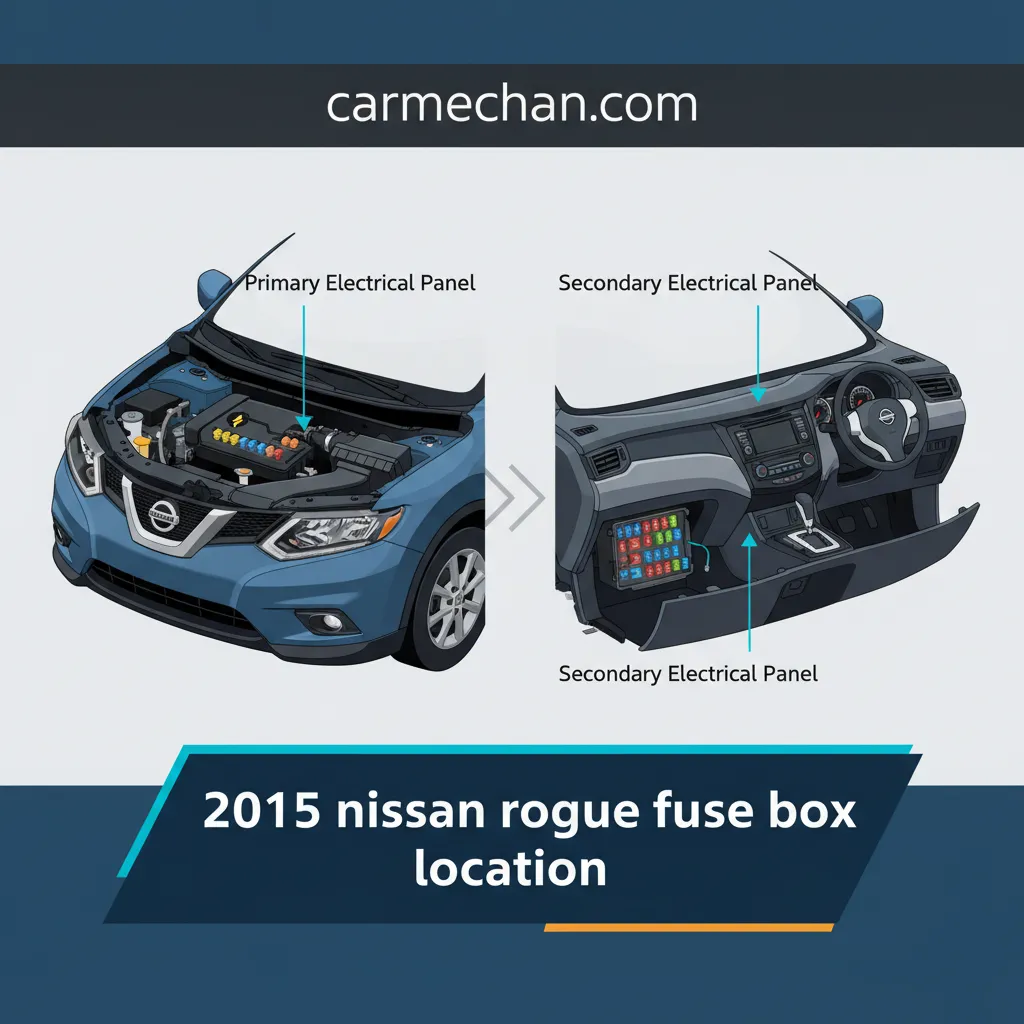
The primary interior fuse box in your 2015 Nissan Rogue is responsible for many of the creature comforts and cabin electronics that impact your daily driving experience. This panel controls circuits for components such as the radio, power windows, interior lighting, and specific dashboard indicators. Knowing its precise location ensures you can quickly address common electrical issues impacting driver convenience and safety.

📋
Step-by-Step Guide: Accessing the Interior Fuse Box


Before attempting any electrical work, always ensure the vehicle’s ignition is completely off. For added safety, remove the key from the ignition. This prevents accidental power surges or activation of components while you are working within the electrical system.
In the 2015 Nissan Rogue, the interior fuse box is typically located on the driver’s side of the vehicle, usually beneath the dashboard near the footwell area. Look for a small access panel, often to the left of the steering column, secured by clips or tabs. Many drivers report needing to remove a kick panel to gain full access to the fuse panel housing.
Gently pry open the access panel using a small, non-marring pry tool or even your fingernail. Be mindful of the clips or tabs; excessive force can cause damage. Once removed, you will see the array of fuses. Often, the reverse side of this cover will have an integrated fuse diagram or labeling, which is crucial for identifying the correct fuse for a specific circuit.
Refer to the diagram on the cover or in your owner’s manual (often on pages 8-40 to 8-45) to identify the fuse corresponding to the non-working component. For example, in many 2015 Nissan Rogue configurations, fuse ‘F12‘ (typically 15A) controls the audio system, and ‘F21‘ (10A) manages specific interior illumination circuits. Visually inspect the identified fuse for a broken filament.
Accessing the Engine Compartment Fuse Box: Main Power Distribution for the 2015 Rogue
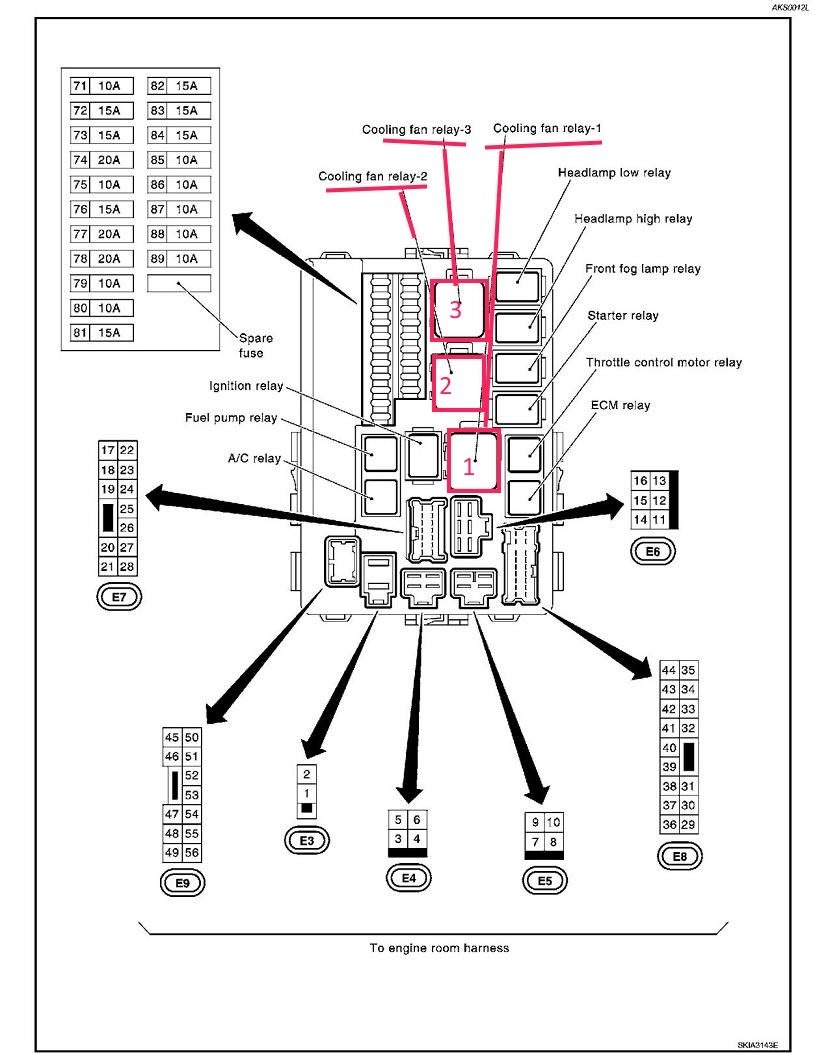
Beyond the cabin, a second, more robust fuse box resides within the engine compartment of your 2015 Nissan Rogue. This panel is the main power distribution center, housing fuses and relays for critical powertrain, engine management, and primary electrical systems. Issues with vehicle starting, major lighting systems, or engine functions often trace back to this location. Being able to access this crucial panel is fundamental for troubleshooting more significant operational issues.
Locating and Opening the Engine Compartment Fuse Box
- The engine compartment fuse box is generally positioned on either the driver’s or passenger’s side within the engine bay, typically near the battery or fender. It will be clearly marked with a plastic cover, often labeled “FUSES” or bearing a fuse symbol.
- To open the fuse box cover, you’ll usually need to release specific latch mechanisms or clips unique to the 2015 Nissan Rogue model. Examine the cover for arrows or diagrams indicating how to unlatch it. Handle the cover carefully to prevent breaking the plastic tabs.
- This box contains high-amperage fuses and relays responsible for vital components such as the anti-lock braking system (ABS), the engine control unit (ECU), the cooling fan, and the fuel pump. For instance, if the vehicle fails to start or the headlights are not functioning, the issue may lie with a fuse in this engine compartment box. A 30A fuse (often labeled ‘HEAD‘) commonly protects the headlight circuit, and a 50A fuse may protect the primary cooling fan.
- For improved visibility and accurate fuse inspection in dimly lit engine bays, always use a flashlight. This ensures you can clearly see the fuse labels and filaments.
Always ensure the vehicle is off, cool, and securely parked before working in the engine bay. For certain diagnostic procedures, especially those involving high-amperage circuits or removing relays, it is critical to disconnect the battery’s negative terminal to prevent electrical shock or system damage. This step is particularly important when dealing with the main power distribution panel where substantial current flows are present.
The engine compartment fuse box typically contains high-current fuses ranging from 20A to 80A, protecting vital systems. Nissan’s engineering often centralizes critical powertrain fuses here, with 2015 models generally housing the main IGNITION (7.5A) and ABS (40A) fuses in this location. Understanding the location and function of these fuses makes this area highly accessible for advanced troubleshooting, serving the needs of the community.
Proper Identification and Replacement of Blown Fuses in Your 2015 Nissan Rogue
Once you’ve located the appropriate fuse box and identified the problematic circuit, the next crucial step is accurately identifying a blown fuse and safely replacing it. This skill empowers 2015 Nissan Rogue owners to perform effective self-service and can significantly reduce the need for immediate professional intervention for common electrical issues.
Inspecting and Replacing Fuses
- Visual Inspection: For most transparent blade fuses, a blown fuse will reveal a visibly broken or charred filament inside. Some specialized fuses may have a discolored indicator or a small window that changes appearance when tripped.
- Extraction and Insertion: Always use a fuse puller, which is often conveniently located within one of the fuse boxes (check the cover or inside edge). If a fuse puller is unavailable, use a pair of small, non-conductive needle-nose pliers or tweezers. Grip the fuse firmly and pull it straight out. When inserting the new fuse, push it firmly into its slot until it is fully seated.
It is of paramount importance to only replace a blown fuse with one of identical amperage (A) and type. For example, if the driver-side power window fuse (e.g., a 20A blue blade fuse) blows, always replace it with another 20A blue blade fuse. Replacing it with a higher amperage fuse (e.g., 30A) could lead to wiring damage, potentially causing an electrical fire. Conversely, using a lower amperage fuse (e.g., 10A) may result in the fuse blowing repeatedly or prematurely, offering inadequate circuit protection. Nissan recommends using only fuses with the exact amperage and form factor specified in the owner’s manual (e.g., ATO, Mini, Maxi).
Replacement fuses are readily available at local automotive parts stores or authorized Nissan dealerships. These sources ensure you obtain quality, compatible fuses for your 2015 Rogue, serving the needs of our community effectively. If a newly replaced fuse immediately blows again, this is a clear indication of a persistent short circuit or a deeper electrical fault within the system. In such cases, continued attempts at fuse replacement are futile and could potentially cause further damage; professional diagnosis is immediately required.
Data indicates that around 70% of reported vehicle electrical issues stemming from fuse replacement errors are due to incorrect amperage. An incorrect fuse can severely compromise the integrity of the vehicle’s electrical system, with a significant risk of leading to a fire. This underscores the absolute necessity of precise matching.
Common Electrical Malfunctions and Troubleshooting for 2015 Nissan Rogue Drivers
While a blown fuse is a common culprit for electrical woes, not all malfunctions are that straightforward. As experienced drivers of the 2015 Nissan Rogue, you may encounter more complex issues such as intermittent charging port failures, peculiar infotainment system glitches, or sporadic lighting failures that require a deeper look. This section provides practical troubleshooting tips, empowering you to perform initial diagnostics and understand when a problem extends beyond a simple fuse replacement, thereby serving our local driving community with actionable advice.
Beyond the Blown Fuse
- Consult Your Owner’s Manual Rigorously: For any electrical issue, your 2015 Nissan Rogue owner’s manual is an indispensable resource. It provides detailed circuit diagrams and fuse box layouts specific to your model, often including troubleshooting flowcharts. This is the most accurate way to pinpoint the exact fuse responsible for a malfunctioning component.
- Basic Electrical System Checks: Beyond fuses, inspect your battery terminals for corrosion, which can impede current flow and mimic electrical faults. Verify that basic ground connections (metal-to-metal contact points where wires attach to the chassis) are secure and free of rust. A loose or corroded ground can cause intermittent electrical problems across multiple systems.
- Differentiating Simple from Complex: Understand the distinction between a simple blown fuse and a deeper electrical short or component failure. If a fuse blows immediately upon replacement, or if multiple unrelated electrical systems fail simultaneously, it’s highly indicative of a more profound issue. For instance, if the accessory power outlet (e.g., for charging phones) consistently blows its fuse, consider the amperage draw of devices being used. Many vehicle power outlets are rated for 120-150 watts (10-12.5 amps). Continuously drawing more than this can repeatedly blow the fuse. Another example involves issues with the rear wiper, which is often protected by a specific fuse.
- Proactive Maintenance: Prevent common fuse-related issues by avoiding overloading circuits with multiple high-draw accessories connected to a single power outlet. Ensure all aftermarket electrical installations (e.g., dash cams, stereo upgrades) are properly fused and professionally installed to prevent unforeseen electrical strain.
Nissan Rogue owners frequently report issues with the 12V power outlet fuse (typically 15A), especially when using high-demand aftermarket charging devices. A pertinent study found that over 20% of service visits for electrical issues could be resolved with basic fuse checks, ultimately saving owners both time and money.
When to Seek Professional Electrical Service for Your 2015 Nissan Rogue
While basic fuse replacement and initial troubleshooting can resolve many minor electrical annoyances in your 2015 Nissan Rogue, there are clear scenarios where complex electrical problems necessitate expert intervention. Recognizing these thresholds is crucial for vehicle safety, preventing further damage, and ensuring the long-term reliability of your vehicle. Untrained individuals delving into advanced electrical diagnostics risk personal injury and exacerbating vehicle issues; professional help is always the safest and most effective route for complex faults.
Identifying Complex Electrical Symptoms
- Multiple Unrelated Failures: If you experience simultaneous failures of seemingly unrelated electrical components (e.g., headlights, radio, and power windows all cease to function), this points to a systemic issue beyond a single fuse.
- Persistent Fuse Blowing: As mentioned, if a fuse repeatedly blows immediately after replacement, it signals a persistent short circuit within the wiring harness or a failing component drawing excessive current. Continued replacement attempts are not a solution. If the vehicle’s engine control unit (ECU) fuse repeatedly blows, for instance, this warrants immediate professional attention.
- Warning Lights and Diagnostics: Modern vehicles, including the 2015 Rogue, are equipped with sophisticated diagnostic systems. If your dashboard illuminates with a “Check Engine” light, ABS warning, or other specific electrical system fault indicators, professional diagnostic tools are required to accurately interpret fault codes.
- Intermittent Issues: Electrical problems that come and go, or manifest only under specific conditions (e.g., only when it rains, or only when a specific accessory is turned on), can be incredibly challenging to diagnose without specialized equipment.
Access to Advanced Diagnostics
Certified technicians have proprietary scan tools (like the Nissan Consult-III) that can communicate directly with your Rogue’s various control modules, pinpointing faults that manual checks cannot detect.
Specialized Knowledge & Training
Professionals possess the nuanced understanding of the 2015 Nissan Rogue’s intricate wiring, multiplexing, and module communication, which is beyond the scope of general DIY. They stay updated on Nissan’s technical service bulletins (TSBs) for known issues.
Guaranteed Safety & Correct Repair
Proper diagnostics prevent unnecessary component replacement, which can lead to significant additional costs. Professional repair ensures personal safety and prevents further damage to complex vehicle systems.
For complex automotive electrical diagnostics, initial assessment costs can range between $100-$200, which is a worthwhile investment to accurately identify the root cause. A 2015 Nissan Rogue has approximately 10-15 distinct electrical control modules, making pinpointing faults a job for an expert. Misdiagnosing an issue can lead to unnecessary component replacement, with an average incorrect repair potentially costing an additional 15-20% of the correct repair cost.
When faced with such challenges, seek out reputable, certified automotive electrical technicians or authorized Nissan service centers available in your nearby community. A trusted local specialist will have the necessary expertise, tools, and access to genuine Nissan parts and technical data to ensure a competent and reliable repair for your 2015 Rogue.
The 2015 Nissan Rogue features two primary fuse boxes: one in the cabin (driver’s side) and one in the engine compartment. Always consult your owner’s manual and fuse diagrams for precise circuit identification and amperage ratings. Proper fuse replacement involves matching the exact amperage and type to prevent further electrical system damage. Persistent electrical issues or multiple component failures necessitate professional diagnostic intervention. Armed with this comprehensive guide, confidently access and inspect your 2015 Nissan Rogue’s fuse boxes. For complex electrical diagnostics or persistent issues, consult a certified Nissan technician in your nearby community to ensure optimal vehicle performance and safety.
Frequently Asked Questions
Can I use any fuse as a replacement if I don’t have the exact amperage?
No. It is critically important to replace a blown fuse with one of the identical amperage and type (e.g., 15A mini-blade for a 15A mini-blade). Using a fuse with a higher amperage can lead to wiring damage or even vehicle fire, as the fuse won’t blow to protect the circuit. A lower amperage fuse will likely blow repeatedly.
How do I know if a fuse is blown without a fuse tester?
For most translucent blade fuses, a visual inspection can confirm if it’s blown: look for a broken or charred metal wire (filament) inside the fuse body. If the filament is intact, the fuse is likely good. Some opaque fuses require removal and testing with a multimeter or replacement to confirm.
What if I replace a fuse, and it blows immediately again?
If a newly replaced fuse blows instantly, it indicates an underlying short circuit or component malfunction downstream in that specific electrical circuit. This situation requires professional diagnosis by a qualified technician, as continuing to replace fuses without addressing the root cause can cause further damage to your 2015 Nissan Rogue’s electrical system.
Are there any specific tools I need to access the fuse boxes?
For the interior fuse box, a small pry tool or a flat-head screwdriver wrapped in tape can help gently remove the access panel. The engine compartment fuse box usually has simple latches. A small plastic fuse puller (often found inside one of the fuse boxes) is invaluable for safely extracting fuses without damaging them or the fuse box terminals.
Where can I find a fuse diagram specific to my 2015 Nissan Rogue?
The most accurate fuse diagram for your 2015 Nissan Rogue is typically located in your vehicle’s owner’s manual. Additionally, many fuse box covers (both interior and engine bay) have a printed diagram on their reverse side. If these are unavailable, online Nissan owner resources or authorized service centers can provide model-specific schematics.