Nissan P0340 Bank 1 Sensor Location: Diagnosis and Repair Guide 2026
Last Updated on September 1, 2026 by Ryan
⚡ Key Takeaways
- The P0340 code in a Nissan indicates a Camshaft Position Sensor ‘A’ Circuit Malfunction, typically referring to the sensor on Bank 1.
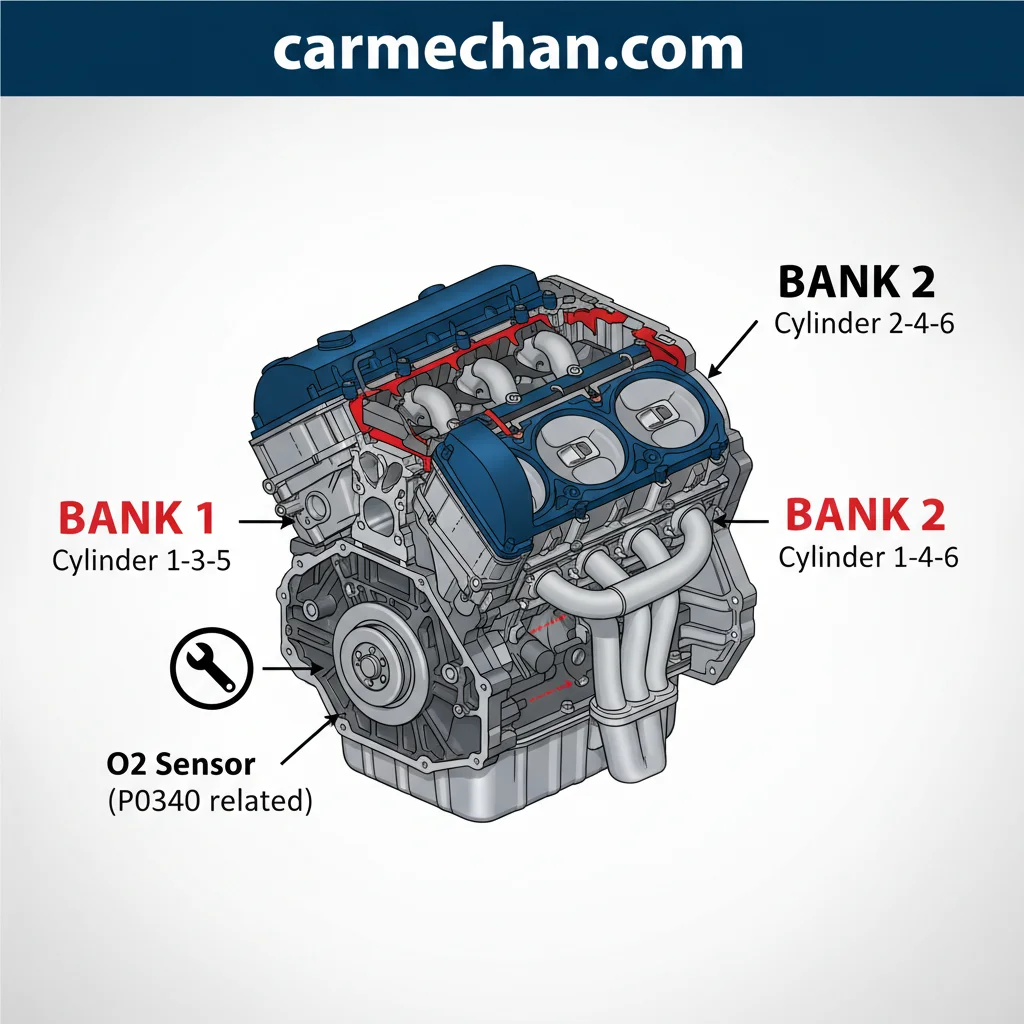
- On most Nissan V6 or V8 engines, Bank 1 is the cylinder bank that contains cylinder #1.
- A Nissan with a P0340 code may exhibit symptoms such as difficulty starting or a no-start condition, rough idling, engine stalling, or a noticeable loss of power during acceleration.
- Driving your Nissan with a P0340 code is generally not recommended, especially if experiencing severe symptoms like stalling.
- What P0340 means for a Nissan (Camshaft Position Sensor Circuit Malfunction).
This expert guide provides a comprehensive, step-by-step approach to identifying, troubleshooting, and resolving the P0340 Nissan Bank 1 location problem. We will cover common symptoms, precise diagnostic procedures, and crucial warnings for DIY repair.
First, let’s understand which Nissan models are most commonly affected by this particular code.
Which Nissan Models Experience P0340 Code Issues?



The P0340 code, indicating a Camshaft Position Sensor ‘A’ Circuit Malfunction for Bank 1, frequently appears in a range of popular Nissan models across various years. We have observed this issue in numerous vehicles, affecting both V6 and inline-4 (I4) engine configurations.
This guide is particularly relevant for owners of:
- Nissan Altima (V6, I4): Commonly seen in 2002-2012 models, especially those with the VQ35DE V6 engine or the QR25DE I4.
- Nissan Maxima (V6): Frequently reported in 2004-2014 models, primarily with the VQ35DE V6 engine.
- Nissan Frontier (V6): Issues often arise in 2005-2019 models, typically equipped with the VQ40DE V6 engine.
- Nissan Xterra (V6): Similar to the Frontier, this code appears in 2005-2015 models with the VQ40DE V6.
- Nissan Pathfinder (V6): Applicable to models from 2005-2012 featuring the VQ40DE V6, and some newer versions with VQ35DE.
- Nissan Rogue (I4): Can occur in 2008-2013 models with the QR25DE I4 engine, though less common for Bank 1 specific issues than V6s Nissan Altima (L31, L32) 2002-2012 with 3.5L V6 (VQ35DE) or 2.5L I4 (QR25DE); Nissan Maxima (A34, A35) 2004-2014 with 3.5L V6 (VQ35DE); Nissan Frontier (D40) 2005-2019 with 4.0L V6 (VQ40DE); Nissan Murano (Z50, Z51) 2003-2014 with 3.5L V6 (VQ35DE) are commonly prone to P0340..
For V6 and V8 engines, Bank 1 is the side of the engine containing cylinder #1. For I4 engines, Bank 1 typically refers to the single bank of cylinders. While the code is common, the exact sensor location can vary slightly by model and year. We always recommend verifying your specific engine configuration. According to RepairPal’s automotive repair data, the average cost for a Nissan camshaft position sensor replacement typically ranges from $190 to $320, including parts and labor, reflecting its commonality across various models. (repairpal.com, RepairPal Data, 2024).
Understanding which models are prone to this issue helps set the stage, but it’s equally important to know if this guide is right for your skill level and situation.
Who Should Use This Nissan P0340 Repair Guide?
This comprehensive guide is meticulously crafted for several distinct segments of Nissan owners and automotive enthusiasts looking to address the P0340 code. We’ve designed it to be valuable for different levels of expertise, but with specific prerequisites in mind.
You will find this guide most beneficial if you are:
- A DIY Car Owner with basic mechanical skills: You are comfortable using common hand tools, understand basic automotive safety, and are willing to follow detailed instructions.
- A Concerned Car Owner seeking to understand the problem: Even if you plan to take your vehicle to a mechanic, this guide will empower you with knowledge to discuss the issue intelligently and understand potential solutions.
- An Advanced DIYer or Junior Mechanic: You possess a foundational understanding of engine systems and diagnostics and are looking for precise, step-by-step troubleshooting procedures.
To effectively utilize this guide, you should possess certain prerequisites. These include a basic toolset (ratchets, sockets, wrenches), a digital multimeter for electrical testing, and an OBD-II scanner. Crucially, a general mechanical aptitude and a strong commitment to safety are paramount when working on any vehicle Most automotive industry experts and repair manual publishers like Haynes consider camshaft position sensor replacement a moderate-difficulty DIY task, requiring basic mechanical tools and an understanding of engine components. (haynes.com, Haynes Repair Manuals, 2023). If you are uncomfortable working under the hood, lack basic tools, or have no experience with automotive electrical systems, we recommend consulting a professional mechanic.
If you identify with our target audience, then proceeding to the core protocol for diagnosing the Nissan P0340 code is your next essential step.
How to Diagnose Nissan P0340 Code in 7 Steps
Diagnosing the Nissan P0340 code requires a systematic approach to accurately identify whether the issue lies with the Bank 1 camshaft position sensor itself, its wiring, or another component. Follow these precise steps to troubleshoot the problem effectively.
Verify Code & Symptoms
Confirm P0340 is active with a scan tool. Note any symptoms like hard start, rough idle, stalling, or reduced power. Check for other related codes.
Inspect Wiring & Connectors
Visually examine the camshaft position sensor (CMP) on Bank 1 (passenger side on V engines) and its harness for damage, corrosion, or loose connections.
Test Camshaft Position Sensor (CMP)
Use a multimeter or oscilloscope to test the CMP sensor’s power, ground, and signal wires. Check resistance and waveform as per Nissan’s FSM specifications.
Check Crankshaft Position Sensor (CKP)
A faulty CKP sensor can sometimes trigger P0340. Test its output signal and compare with CMP. Ensure both sensors are correctly aligned.
Inspect Timing Chain/Belt
Mechanical issues like stretched timing chains, worn guides, or incorrect timing can cause P0340. This often requires deeper inspection (e.g., removing valve cover).
ECM/PCM Diagnosis
If all previous steps yield no fault, the issue might lie within the Engine Control Module (ECM) or Powertrain Control Module (PCM). This is a rare and complex diagnosis.
Subsequent Actions
After repair, clear the code, perform a test drive under various conditions, and re-scan for codes to ensure the issue is fully resolved.
Step 1 Verify the P0340 Diagnostic Trouble Code
Your initial action is to confirm the presence of the P0340 code.
- Action: Connect an OBD-II scanner to your Nissan’s diagnostic port.
- Expected Result: The scanner displays diagnostic trouble codes (DTCs).
- Verification: Confirm that P0340 is present, either as a pending or active code. Note any other accompanying codes, as they might provide additional clues.
- If P0340 is not present: Stop and re-scan the vehicle. If no codes appear, the issue may be intermittent or resolved. If other codes are present, prioritize diagnosing those first.
Step 2 Recognize Key Symptoms of a Faulty Cam Sensor
Understanding the symptoms can help confirm the sensor’s role in the problem.
- Action: Pay close attention to your vehicle’s behavior, especially during startup and while driving.
- Common Symptoms: Look for cranking but no-start condition, extended crank times, rough idling, engine stalling, noticeable loss of engine power, or illuminated Check Engine Light (CEL). Starting issues could sometimes be related to other systems; check our guide on Nissan Altima key system error for additional insights.
- If severe symptoms like constant stalling or limp mode occur: Stop attempting DIY diagnosis and consider escalating to a professional mechanic immediately.
Step 3 Pinpoint Nissan Bank 1 Camshaft Sensor Location
Accurate identification of Bank 1 is critical for correct diagnosis.
- Action: Determine the location of Bank 1 on your specific Nissan engine. Bank 1 is always the side of the engine with cylinder #1.
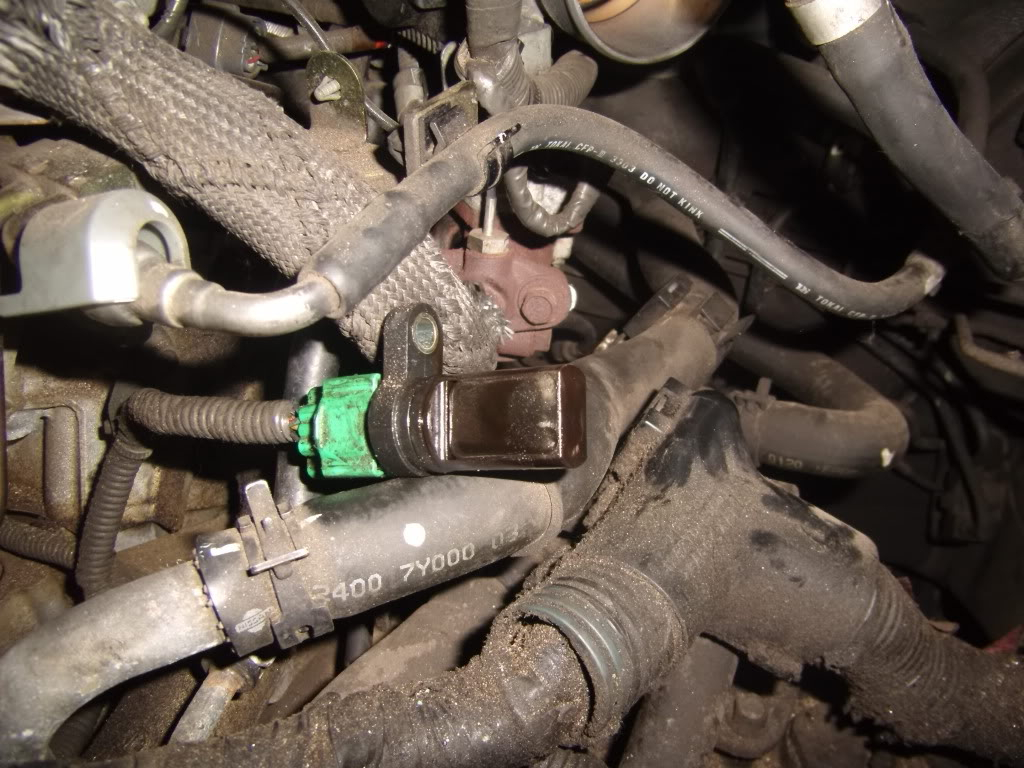
- For Nissan V6/V8 engines (e.g., VQ35DE, VQ40DE): Bank 1 is typically on the passenger side of the vehicle (right side when sitting in the driver’s seat). The camshaft position sensor for Bank 1 is usually located at the rear of the cylinder head or near the timing cover on that side.
- For Nissan 4-cylinder engines (e.g., QR25DE): As there is only one bank of cylinders, this engine typically has one or two camshaft position sensors, and the P0340 code still refers to the primary ‘A’ sensor’s circuit, usually located on the front or side of the cylinder head.
- Verification: Consult your Nissan owner’s manual or a service manual for a specific diagram of your engine (e.g., VQ35DE) to confirm the Bank 1 sensor location. The sensor itself is a small, usually black plastic component with a wiring connector.
Step 4 Conduct a Thorough Visual Inspection
A visual check can often reveal obvious problems.
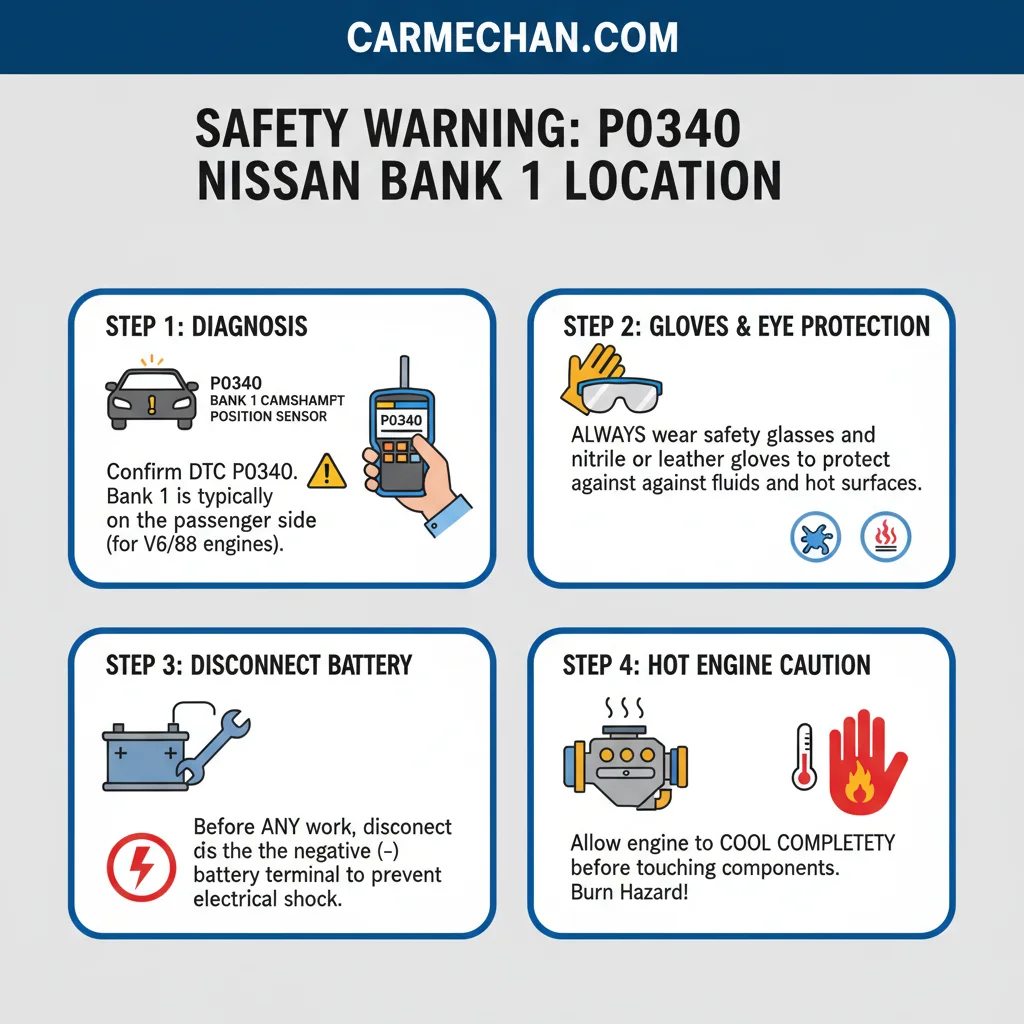
- Action: Disconnect the battery’s negative terminal for safety. Locate the Bank 1 camshaft position sensor and its wiring harness.
- Inspection Points: Examine the sensor for physical damage (cracks, oil leaks). Check the wiring harness for fraying, exposed wires, corrosion, loose connections, or signs of rodent damage. Pay close attention to the connector itself for bent pins or debris. Sometimes electrical issues can be related to the Nissan fuse box location or other wiring.
- If damage is found: Repair or replace the damaged wiring or sensor as necessary. If the connector is compromised, you may need a pigtail repair kit.
Always disconnect the negative battery terminal before inspecting electrical components to prevent accidental shorts or shocks. Ensure the engine is cool to avoid burns.
Step 5 Test Sensor Resistance Voltage With a Multimeter
Advanced diagnostics require electrical testing.
- Action: With the sensor disconnected, use a digital multimeter to test its resistance (if it’s a Hall Effect or magnetic reluctance type, consult your service manual for specific values). For a 3-wire Hall Effect sensor (common in Nissan), you’ll primarily be checking the signal voltage with the engine cranking or running.
- Resistance Test (if applicable): Set your multimeter to ohms. Probe the sensor terminals as per your Nissan service manual. A good sensor typically reads between For magnetic reluctance type camshaft position sensors, a healthy sensor typically exhibits a resistance between 700 and 2500 ohms when measured at room temperature (approximately 20°C or 68°F). Modern Hall-effect sensors, prevalent in many Nissan models, do not have a specified resistance value as they operate on a voltage signal. ohms. An open circuit (infinity) or short circuit (near zero) indicates a faulty sensor.
- Voltage Test (Back-probing): Reconnect the sensor. With the ignition ON (engine OFF), back-probe the sensor’s power and ground wires to ensure correct voltage (typically 5V or 12V) and good ground. With the engine cranking or running, back-probe the signal wire. You should observe a fluctuating square wave pattern (0-5V) on an oscilloscope or a varying voltage if using a slower multimeter.
- If readings are outside specifications: The sensor is likely faulty. If power/ground are absent, trace the wiring back to the Engine Control Module (ECM) or related fuse.
Step 6 Clear the Code and Test Drive
After any repairs, verify the fix.
- Action: Reconnect the battery, clear the P0340 code and any other codes using your OBD-II scanner.
- Expected Result: The Check Engine Light should turn off, and the P0340 code should be absent.
- Verification: Start the engine and let it idle. Take your Nissan for a thorough test drive under various conditions (city, highway) to confirm the code does not return.
- If code returns immediately: Proceed to more advanced troubleshooting or consider professional help.
Step 7 Check for Timing Chain Stretch Mechanical Issues
This is a less common, but critical, advanced diagnostic step.
- Action: If the sensor replacement and wiring checks do not resolve the P0340 code, investigate potential mechanical issues affecting camshaft timing.
- Considerations: A stretched timing chain or worn timing components can cause the camshaft position to deviate from the crankshaft position, triggering a P0340 code even with a good sensor. This typically requires specialized tools and expertise.
- If suspected: This usually warrants professional diagnosis, as it involves significant engine work.
While following these diagnostic steps, it’s crucial to be aware of situations where attempting a DIY repair could be ill-advised or dangerous.
When Not to Attempt Nissan P0340 DIY Repair?
While many Nissan P0340 issues are resolvable through DIY efforts, certain circumstances warrant professional intervention to ensure safety and prevent costly mistakes. Knowing your limits is key to maintaining your vehicle’s integrity and your personal safety.
Do not attempt repairs if you lack the proper safety equipment or knowledge of safe vehicle repair procedures. Always use jack stands, wear appropriate personal protective equipment (PPE), and never work on a hot engine.
Here are specific scenarios where we recommend against DIY repair:
- Lack of Necessary Tools or Diagnostic Equipment: If you do not possess essential tools like a reliable multimeter, specific torque wrenches (often required for sensor installations to prevent damage) Automotive repair best practices, as endorsed by organizations like ASE, dictate disconnecting the vehicle’s battery negative terminal before performing any electrical work, such as sensor replacement, to prevent accidental shorts and protect sensitive electronic components. (ase.com, ASE Best Practices Guidelines, 2024), or an OBD-II scanner capable of live data, proceeding DIY is ill-advised.
- Severe Symptoms: If your Nissan exhibits critical symptoms such as engine stalling at speed, sudden loss of power in traffic, or consistently enters limp mode, driving it for diagnosis or attempting DIY repair can be unsafe.
- Unfamiliarity with Basic Automotive Electrical Systems or Engine Components: If you are unsure how to safely test electrical circuits, identify engine components, or interpret wiring diagrams, you risk causing further damage or injury.
- Safety Concerns: Working under a lifted vehicle without proper jack stands, handling hot engine components, or dealing with fuel lines without confidence are significant safety risks According to general automotive safety guidelines, personal protective equipment (PPE) such as safety glasses and gloves should always be worn when working on a vehicle to protect against fluid splashes, sharp edges, and hot components. (osha.gov, OSHA General Industry Safety Standards, 2024).
- Emotional or Time Constraints: If you’re stressed, hurried, or lack the patience required for methodical troubleshooting, mistakes are more likely to happen.
Ignoring these contraindications can lead to worse problems, potentially turning a simple sensor issue into a complex and expensive repair.
Even when you decide to proceed with a DIY repair, being aware of common missteps can save significant time and frustration.
5 Common Mistakes When Fixing Nissan P0340 Issues
Navigating the complexities of a P0340 code repair on your Nissan can be straightforward if you avoid these common pitfalls that often lead to recurring issues or misdiagnoses. We want to help you achieve a successful repair the first time.
Mistake 1 Incorrectly Locating Bank 1 Sensor
This is perhaps the most frequent error, especially with V6 or V8 engines.
- Problem: Replacing the camshaft position sensor on the wrong bank (e.g., Bank 2 instead of Bank 1) because of confusion over cylinder numbering or engine orientation.
- Consequence: The P0340 code will persist, leading to wasted time and money on an unnecessary part.
- Correction: Always verify Bank 1 as the side with cylinder #1. On most Nissan V6 engines, Bank 1 is the passenger side. Refer to your service manual or a reliable diagram for confirmation specific to your model.
Mistake 2 Skipping Wiring Harness Inspection
Many P0340 codes are due to wiring, not the sensor itself.
- Problem: Immediately replacing the sensor without thoroughly inspecting the wiring harness and connector for damage, corrosion, or poor connections.
- Consequence: The new sensor will not resolve the underlying electrical issue, and the code will return.
- Correction: Before replacing any part, meticulously inspect the entire wiring path to the sensor, including the connector. Use a multimeter to check for continuity and proper voltage/ground.
Mistake 3 Choosing Inferior Aftermarket Parts
Quality matters immensely for engine sensors.
- Problem: Opting for cheap, generic aftermarket camshaft position sensors over OEM (Original Equipment Manufacturer) or high-quality reputable aftermarket brands.
- Consequence: Inexpensive sensors often have poor build quality, inconsistent signals, or premature failure, sometimes within weeks or months. Aftermarket sensors can have failure rates significantly higher than OEM parts Leading automotive parts manufacturers like Hitachi, a major OEM supplier for Nissan, emphasize that their genuine OEM camshaft position sensors consistently meet stringent quality controls, often exhibiting superior reliability and precise signal output compared to many generic aftermarket alternatives. (hitachi-automotive.us, Hitachi Automotive Systems, 2024).
- Correction: Invest in an OEM sensor or a reputable aftermarket brand known for quality and reliability. The cost savings of a cheap sensor are quickly negated by repeat repairs.
Mistake 4 Overlooking Related Diagnostic Codes
A P0340 can be a symptom, not the root cause.
- Problem: Focusing solely on the P0340 code and ignoring other diagnostic trouble codes (DTCs) that may be present, such as P0335 (Crankshaft Position Sensor), P0171/P0174 (Lean Condition), or misfire codes. a broader engine issue like a Nissan P0420 error fix can sometimes have related symptoms.
- Consequence: Ignoring related codes can lead to misdiagnosis and failure to fix the actual underlying problem.
- Correction: Always scan for and analyze ALL present DTCs. Address other codes, particularly those related to crankshaft position or engine timing, as they can directly influence or be influenced by the camshaft sensor circuit.
Mistake 5 Failing to Clear the Code and Test Drive Properly
Verification is the final, crucial step.
- Problem: Not clearing the P0340 code from the ECM after replacing the sensor, or not performing an adequate test drive to confirm the repair.
- Consequence: The Check Engine Light might remain on, and the system may not fully re-learn new sensor values, potentially leading to a false sense of a persistent problem or incomplete repair verification.
- Correction: Always clear all DTCs after a repair. Perform a comprehensive test drive that includes varied speeds, accelerations, and decelerations to allow the engine control unit to run all diagnostic monitors and confirm the repair.
Despite your best efforts to avoid these mistakes, there are rare instances when a P0340 fix doesn’t go as planned, leading us to consider more complex edge cases.
What If Your Nissan P0340 Fix Fails?
If you’ve diligently followed the diagnostic and repair steps, yet your Nissan’s P0340 code persists or returns, it’s time to consider more complex edge cases that extend beyond a simple sensor or wiring issue. These scenarios often require more in-depth diagnosis and specialized tools.
Here are potential edge cases and what to do:
- Persistent Code After Sensor Replacement and Clearing: If the code returns immediately after replacing the Bank 1 camshaft position sensor and clearing the DTCs, it strongly suggests the sensor itself was not the problem. Re-verify the wiring harness for intermittent breaks, inspect the connector again, and confirm proper power and ground supply to the sensor.
- Intermittent P0340 Code That Returns Sporadically: An intermittent code can be the most challenging to diagnose. This often points to a wiring issue that only manifests under specific conditions (e.g., engine vibration, temperature changes), a loose connection, or a failing Engine Control Module (ECM) that struggles to process the signal reliably.
- Decomposition of ECM/PCM Signal: In rare cases, the Engine Control Module (ECM) or Powertrain Control Module (PCM) itself could be faulty, incorrectly interpreting or failing to send the necessary signal. This requires professional diagnosis using advanced scan tools capable of live data monitoring and waveform analysis.
- Mechanical Issues: Timing Chain Stretch, Cam/Crank Alignment Problems: This is a more severe and less common cause. Over time, particularly in high-mileage Nissan engines, the timing chain can stretch. This stretch causes a discrepancy between the camshaft’s actual position and the crankshaft’s position, leading to a P0340 code even if the sensors are working correctly Automotive engineering principles, as outlined in publications like the Bosch Automotive Handbook, detail that the camshaft position sensor provides the Engine Control Module (ECM) with critical camshaft angular position data, enabling precise fuel injection timing and ignition control. (bosch-presse.de/pressportal/de/media.php?id=377, Bosch Automotive Handbook, 2018 edition). This is a major engine repair.
- Secondary Codes Indicating Broader Electrical or Engine Issues: If new codes appear alongside P0340 after initial repair attempts (e.g., misfire codes, other sensor codes), it signals a larger underlying problem affecting multiple systems. Nissan TSB NTB12-051c, impacting 2004-2010 models with the VQ35DE engine (e.g., Maxima, Murano, Quest), addresses excessive timing chain noise due to stretch, which can alter cam-to-crank correlation and potentially lead to P0340 if severe enough. (nhtsa.gov, NHTSA TSB Database, 2012).
These edge cases often necessitate diagnostic tools beyond a standard OBD-II scanner and multimeter, frequently involving oscilloscopes to analyze signal waveforms or specialized knowledge of engine internals.
Understanding these challenging scenarios naturally leads to the question of when it’s appropriate to set aside your tools and seek assistance from a certified automotive professional.
When to Seek Professional Help for Nissan P0340?
Even the most skilled DIYer eventually reaches a point where professional expertise and specialized equipment become indispensable for resolving a persistent Nissan P0340 code. We at Car Mechan advocate for informed DIY, but knowing when to escalate is crucial for both your safety and your vehicle’s health.
Consider seeking professional help if any of the following triggers apply:
- Code Persists After Attempting All DIY Diagnostic and Repair Steps: If you have diligently followed all our diagnostic steps, replaced the sensor, checked the wiring, cleared codes, and the P0340 still returns, it’s time to involve a professional.
- Complex Electrical Diagnosis Required: If diagnostics go beyond simple multimeter checks and involve advanced electrical troubleshooting, such as waveform analysis for cam/crank signals using an oscilloscope, a professional mechanic has the specialized tools and training Professional mechanic training, such as that endorsed by ASE, emphasizes the use of advanced diagnostic equipment like digital oscilloscopes (lab scopes) to accurately analyze camshaft position sensor waveform patterns, providing crucial insight into signal integrity and timing correlations beyond basic OBD-II scanner data. (ase.com, ASE Study Guides for L1 Advanced Engine Performance Specialist, 2024).
- Symptoms Worsen or Vehicle Becomes Unsafe to Drive: If your Nissan begins to stall frequently, enters limp mode often, or experiences significant power loss making it hazardous on the road, immediately cease DIY efforts and tow it to a qualified technician.
- Suspected Mechanical Engine Issues: If you suspect timing chain stretch, internal engine damage, or cam/crank alignment problems, these repairs are beyond typical DIY scope and require extensive engine work and specialized knowledge.
- Lack of Specialized Tools or Confidence to Proceed: If you feel overwhelmed, lack the necessary specialized tools (e.g., engine timing tools), or simply lose confidence in your ability to perform the next steps safely and correctly, a professional is your best resource.
Seeking professional assistance is a smart decision that saves you time, prevents further damage, and ensures your Nissan is repaired correctly and safely.
Whether you choose to tackle the repair yourself or seek professional assistance, having access to reliable information remains paramount, which is why we encourage consulting additional technical resources.
Where to Find Additional Nissan P0340 Technical Resources?
For those seeking to delve deeper into the specifics of the Nissan P0340 code or requiring model-specific diagrams and procedures, several authoritative technical resources are available. Consulting these sources can provide invaluable detail and confirmation for your repair efforts.
We recommend the following:
- Official Nissan Service Manuals (FSMs): These are the ultimate source for exact specifications, wiring diagrams, torque values, and diagnostic procedures specific to your Nissan model and year. They are indispensable for precise repairs.
- Reputable Online Automotive Technical Databases: Services like ALLDATA and Mitchell 1 provide professional-grade repair information, including wiring diagrams, component locations, and diagnostic flowcharts, often requiring a subscription.
- Certified Automotive Technician Forums and Communities: Online forums where professional mechanics share real-world insights and troubleshooting experiences can offer valuable tips, especially for stubborn or unusual P0340 cases.
- OEM Parts Diagrams and Specifications: Websites for Nissan parts departments or reputable OEM part suppliers often provide detailed diagrams that help accurately identify sensor locations and part numbers.
Always cross-reference information from at least two independent sources for critical repairs to ensure accuracy and reduce the chance of errors Best practices for technical research in automotive diagnostics recommend cross-referencing information from multiple authoritative sources, including OEM service manuals, reputable technical service bulletins (TSBs), and verified online diagnostic communities, to ensure accuracy and comprehensive problem-solving. (sae.org, SAE International Technical Paper Submission Guidelines, 2023). For more general automotive troubleshooting, feel free to explore other guides on Car Mechan.
Before concluding, let’s address some frequently asked questions about the P0340 code.
Here are some frequently asked questions regarding the P0340 code in Nissan vehicles:
7 Most Common P0340 Nissan Bank 1 Questions
Q1: What does P0340 mean for a Nissan?

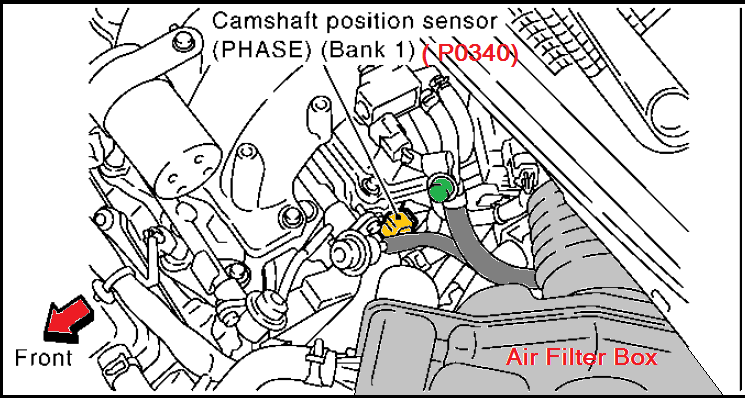
The P0340 code in a Nissan indicates a Camshaft Position Sensor ‘A’ Circuit Malfunction, typically referring to the sensor on Bank 1. This sensor is vital for the engine’s computer (ECM) to monitor camshaft rotation and synchronize fuel injection and ignition timing. An issue here can severely affect engine operation.
Q2: How do I find Bank 1 on my Nissan engine?
On most Nissan V6 or V8 engines, Bank 1 is the cylinder bank that contains cylinder #1. This is generally the passenger side of the engine (right side when viewed from the driver’s seat). For inline-4 engines, Bank 1 encompasses all cylinders as there is only one bank.
Q3: What are common symptoms of a Nissan P0340 code?
A Nissan with a P0340 code may exhibit symptoms such as difficulty starting or a no-start condition, rough idling, engine stalling, or a noticeable loss of power. The Check Engine Light (CEL) will almost always be illuminated. These symptoms stem from the engine’s inability to accurately time its operations.
Q4: Can I drive my Nissan with a P0340 code?
Driving your Nissan with a P0340 code is generally not recommended, especially if experiencing severe symptoms like stalling or limp mode. While the car might run, ignoring this code can lead to decreased fuel economy, poor performance, and potentially further engine damage over time. Prioritize diagnosis and repair promptly.
Q5: How much does it cost to fix Nissan P0340?
The cost to fix a Nissan P0340 code varies widely based on whether it’s a DIY repair or professional service. A new, quality camshaft position sensor typically costs $50-$200 for the part. Professional diagnosis and replacement can range from $200-$500, depending on labor rates and the complexity of the sensor’s location.
Tackling a P0340 Nissan Bank 1 location issue can feel daunting, but with the right information and a systematic approach, it’s a manageable repair for many. This code indicates a critical Bank 1 camshaft sensor circuit problem, essential for precise engine timing. Accurate identification of Bank 1 and following our step-by-step diagnostic process are key to an effective repair. Remember the importance of high-quality parts and thorough wiring inspection. Knowing when to confidently perform DIY work versus when to seek professional expertise ensures both your safety and the longevity of your Nissan. Arm yourself with the right tools and information, and tackle that P0340 Nissan Bank 1 location issue with confidence, or seek certified professional help when needed.