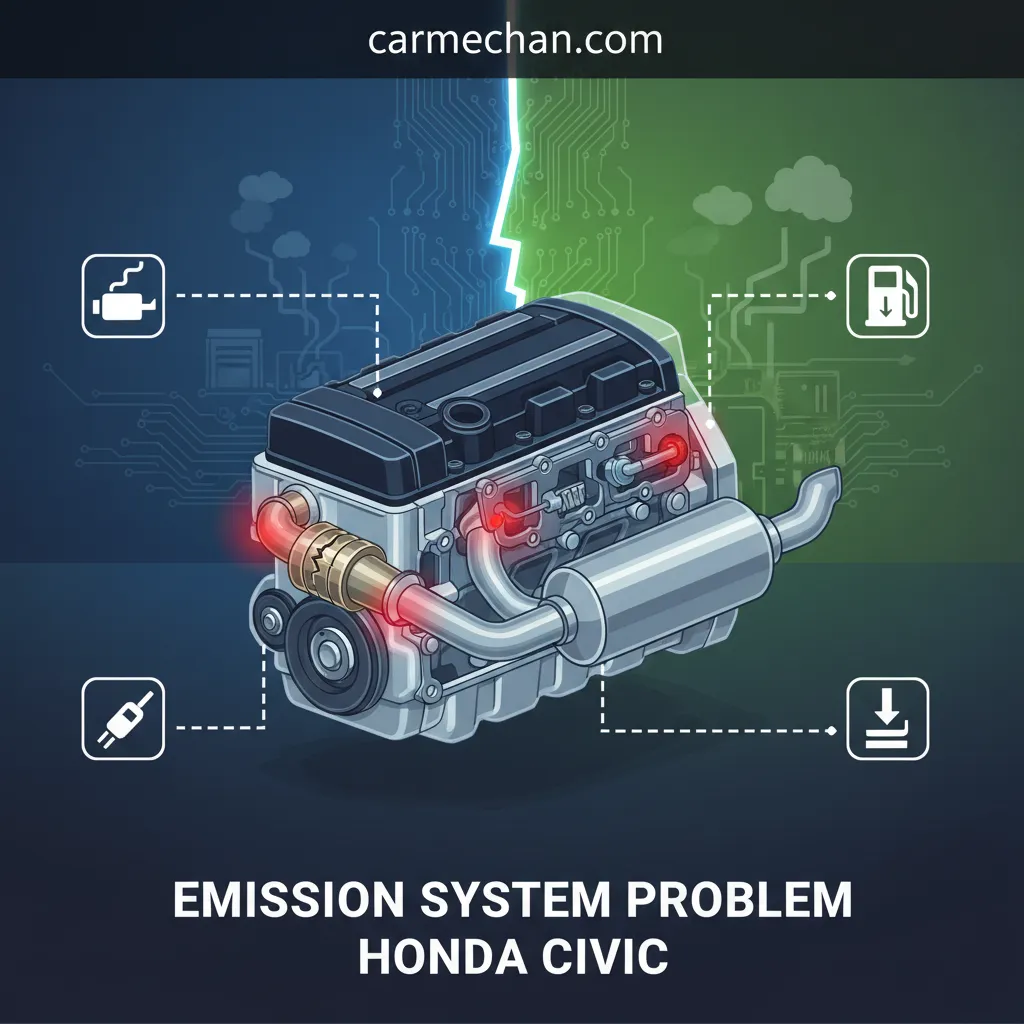
Emission System Problem Honda Civic: Common Causes, Symptoms, And Diagnostics
The unmistakable glow of the ‘Check Engine Light’ (CEL) can be a source of immediate concern for any Honda Civic owner, often signaling an issue with the vehicle’s complex emission system. Emission system problems in Honda Civics are not only a common cause of illuminated warning lights but can also lead to reduced performance, decreased fuel efficiency, and failure to pass mandatory emissions inspections. Navigating these issues requires a clear understanding of symptoms, causes, and effective solutions. This expert guide will thoroughly detail the common emission system problems affecting Honda Civics, helping you understand their symptoms, troubleshoot potential causes, and explore effective diagnostic and repair strategies to get your vehicle running optimally and compliantly.
Understanding the Honda Civic Emission System and Its Critical Role


The Honda Civic, like all modern vehicles, incorporates a sophisticated and highly integrated emission control system designed to drastically reduce harmful pollutants expelled from its exhaust gases. This system is not merely an add-on; it’s a fundamental part of the vehicle’s operational design, critical for both environmental compliance and optimal engine performance.

📤 Share Image
Key Components and Their Functions
Honda’s emission control architecture, prevalent in models like the 8th and 9th generation Civics, relies on several interconnected components:
- Catalytic Converter: This cornerstone component converts toxic gases (carbon monoxide, unburnt hydrocarbons, nitrogen oxides) into less harmful substances (carbon dioxide, water vapor, nitrogen) through chemical reactions. A healthy catalytic converter ensures complete combustion products are rendered benign.
- Oxygen (O2) Sensors: Typically, Civics have multiple O2 sensors. Upstream sensors monitor oxygen levels before the catalytic converter, providing feedback to the Powertrain Control Module (PCM) to adjust fuel injection for optimal air-fuel ratios. Downstream sensors verify the catalytic converter’s efficiency.
- Exhaust Gas Recirculation (EGR) System: The EGR system diverts a small amount of exhaust gas back into the engine’s combustion chambers, lowering combustion temperatures and reducing the formation of nitrogen oxides (NOx), a key pollutant.
- Evaporative Emission Control (EVAP) System: This system captures fuel vapors from the fuel tank and stores them in a charcoal canister, preventing their release into the atmosphere. These vapors are later purged and burned in the engine.
- Powertrain Control Module (PCM): The “brain” of the emission system, the PCM continuously monitors all sensor inputs and actuator outputs, adjusting engine parameters to meet emission standards and triggering the Check Engine Light if a fault is detected.
Regulatory Mandates and Performance Implications
These systems are mandated by stringent environmental regulations, such as those set by the U.S. Environmental Protection Agency (EPA) and California Air Resources Board (CARB). Proper functioning is not just about environmental stewardship; it’s crucial for passing mandatory state emissions inspections and avoiding legal penalties. A malfunctioning system does more than pollute; it directly impacts your Civic’s performance, fuel economy, and long-term engine health.
For instance, a healthy system in a Honda Civic ensures precisely controlled combustion, resulting in efficient power delivery. Conversely, a failing O2 sensor can cause the PCM to mismanage fuel delivery, leading to either rich (too much fuel) or lean (too little fuel) conditions, which not only increase emissions but also damage spark plugs, catalytic converters, and reduce overall engine longevity. Modern emission systems, with their advanced catalytic converters, achieve a remarkable reduction of over 90% of harmful emissions like NOx, CO, and hydrocarbons. A catalytic converter typically has a lifespan of 80,000 to 100,000 miles; its proper function is paramount to your Civic’s environmental compliance and longevity.
Identifying Common Symptoms of an Emission System Problem in a Honda Civic


Early detection of emission system problems in your Honda Civic is crucial to prevent further damage and costly repairs. While some issues present subtly, others are undeniable. Recognizing these common symptoms will empower you to proactively troubleshoot and seek timely repair.
Key Indicators of Emission System Malfunction
- Illuminated Check Engine Light (CEL): This is arguably the most common and definitive sign. When the PCM detects an emission-related fault that exceeds predetermined thresholds, it illuminates the CEL. Never ignore a persistent CEL; it’s your car’s primary alert system. While it can signal various issues, a significant portion—over 60%—of CEL illuminations are linked directly to emission components.
- Observable Performance Issues: A malfunctioning emission system can severely impact engine performance. Symptoms include:
- Diminished Engine Power: Your Civic might feel sluggish, especially during acceleration or when climbing hills.
- Rough Idling or Stalling: An EGR valve stuck open or a significant vacuum leak can cause the engine to idle erratically or even stall.
- Hesitation or Misfires: Poor fuel control due to a faulty O2 sensor or a clogged catalytic converter can lead to noticeable hesitation or misfires. For example, a fluctuating idle and CEL on a 2008 Civic often point towards an EGR valve problem.
- Changes in Fuel Efficiency and Exhaust Odor:
- Decreased MPG: A noticeable drop in fuel economy, sometimes by 10-20%, is a common symptom of a failing O2 sensor or catalytic converter, as the engine runs inefficiently.
- Unusual Exhaust Smells: A persistent ‘rotten egg’ smell (sulfur) strongly indicates a failing catalytic converter that can no longer process sulfur compounds effectively. A sweet smell could signify coolant burning, while raw fuel indicates a rich condition or misfires. Scenario: A 2012 Honda Civic owner notices a persistent ‘rotten egg’ smell and reduced power uphill, almost certainly indicating a catalytic converter issue.
- Visible Exhaust Smoke: The color of your Civic’s exhaust smoke provides critical clues:
- Blue Smoke: Indicates burning oil, often due to worn engine components, which can foul O2 sensors and catalytic converters.
- Black Smoke: Points to an excessively rich air-fuel mixture, meaning too much fuel is being burned, often from a faulty O2 sensor or fuel injector.
- White Smoke (thick and persistent): Suggests burning coolant, typically from a head gasket leak, which can quickly poison a catalytic converter.
- Difficulties Starting or Engine Stalling: While less direct, issues with the EVAP system, such as a faulty purge valve or a severe vapor leak, can sometimes lead to hard starting. A severely clogged catalytic converter can also restrict exhaust flow to the point of causing engine stalling.
Always address a Check Engine Light promptly. Even if your Civic seems to run fine, ignoring the CEL can lead to more severe and costly damage to critical components over time. The longer you wait, the more expensive the ultimate repair or solution becomes.
Effective Diagnostics: Pinpointing the Root Cause of Emission Faults in Honda Civics


Accurately diagnosing emission system problems in a Honda Civic is paramount. Without proper diagnosis, you risk replacing parts unnecessarily or failing to address the true root cause of the malfunction. This process typically involves a combination of interpreting onboard computer data, visual inspections, and, at times, specialized equipment.
Leveraging OBD-II Data and Professional Expertise
- Utilizing an OBD-II Scanner: The first step when the CEL illuminates is to retrieve Diagnostic Trouble Codes (DTCs). An OBD-II scanner connects to your Civic’s diagnostic port and reads codes stored in the PCM. Common Honda-specific emission codes include:
- P0420 (Catalyst System Efficiency Below Threshold): A frequent code for Civics, indicating the catalytic converter is not operating efficiently.
- P0171 (System Too Lean) / P0172 (System Too Rich): These codes suggest an air-fuel mixture imbalance, often pointing to O2 sensor, MAF sensor, or vacuum leak issues.
- P0455 (EVAP System Leak Detected – Large) / P0457 (EVAP System Leak Detected – Fuel Cap Loose/Off): Common EVAP system codes. A Civic displaying a P0455 code might have a loose gas cap, which is a simple fix. However, a persistent P0455 after checking the cap would require further investigation, such as a smoke test.
- P0401 (EGR Flow Insufficient): Indicates restricted exhaust gas flow through the EGR system.
- Interpreting Live Data Streams: Beyond just reading codes, a more advanced OBD-II scanner allows you to monitor live data. This is invaluable for dynamic troubleshooting. Technicians can observe:
- O2 sensor voltages: To see if sensors are switching correctly (upstream) or maintaining a stable reading (downstream).
- Fuel trims (short-term and long-term): To identify if the PCM is trying to add or subtract excessive fuel to compensate for a lean or rich condition.
- MAP/MAF readings: To check for proper airflow measurement.
Observing these parameters helps pinpoint components operating outside normal specifications, making the solution clearer.
- Visual Inspection Techniques: Don’t underestimate the power of a thorough visual inspection. Check for:
- Vacuum leaks (hissing sounds, cracked or disconnected hoses).
- Damaged or corroded wiring to sensors and valves.
- Physical damage to the catalytic converter (e.g., dents, heat discoloration).
- Loose or improperly seated gas cap.
- When to Seek Professional Diagnosis: While basic code reading is DIY-friendly, many emission issues require specialized equipment and expertise. This includes:
- Smoke Machine for EVAP Leaks: Essential for locating elusive EVAP system leaks that are too small to be seen.
- Exhaust Gas Analyzer: Measures actual tailpipe emissions to verify catalytic converter efficiency or pinpoint combustion issues.
- Advanced Electrical Testing: Using a multimeter to test O2 sensor heater circuit resistance or check for proper voltage signals requires specific knowledge and tools. For example, how a technician uses a multimeter to test O2 sensor heater circuit resistance can confirm if the sensor itself is faulty or if the wiring/PCM output is the cause.
Professional diagnostics, while incurring a fee (typically $100-$200), often save money in the long run by accurately identifying the problem and avoiding costly trial-and-error repair.
📋
Diagnostic Workflow: A Step-by-Step Approach
Connect an OBD-II scanner and record all stored trouble codes and any associated freeze frame data, which shows engine conditions at the moment the code was set. This provides initial direction for your troubleshoot.
Thoroughly inspect all visible emission components, hoses, and wiring. Correlate any observed physical issues with the reported symptoms and DTCs. This helps narrow down the potential cause.
Monitor relevant sensor readings and fuel trims using an advanced scanner. Test components based on the DTCs; for example, if a P0401 is present, test EGR valve operation. This step allows for precise diagnosis.
Once the fault is identified, perform the necessary repair. After repair, clear the codes and perform a drive cycle to ensure the issue is resolved and the monitors are set, confirming the effectiveness of the solution.
Common Components Prone to Emission System Problems in Honda Civics
Over decades of experience, certain emission system components consistently emerge as common failure points in Honda Civics. Understanding these allows for more targeted troubleshooting, diagnosis, and repair.
Frequent Failure Points and Their Impact
- Oxygen (O2) Sensors: These sensors are vital for the PCM to maintain the correct air-fuel mixture. Faulty O2 sensors, both upstream (pre-cat) and downstream (post-cat), are a leading cause of emission problems.
- Role: Upstream sensors tell the PCM how much oxygen is in the exhaust, allowing it to adjust fuel injection. Downstream sensors monitor catalytic converter efficiency.
- Failure Modes: Sensors can become sluggish, contaminated by fuel additives, or fail completely due to age (typical failure around 60,000-90,000 miles).
- Symptoms/Codes: Lead to P013X/P014X codes, rich/lean conditions, decreased fuel economy, and poor engine performance. Replacing O2 sensors on Honda’s K-series engines (found in many Civics) typically costs $150-$300 per sensor.
- Catalytic Converter Failure: The most expensive emission component, its failure often results from underlying engine issues rather than spontaneous breakdown.
- Causes: Oil contamination (from burning oil), coolant leaks (from a leaky head gasket), prolonged misfires (sending unburnt fuel into the converter), or simply old age and mileage (typically 80,000-150,000 miles).
- Symptoms/Codes: The infamous P0420 (Catalyst System Efficiency Below Threshold), rotten egg smell, reduced engine power, and restricted exhaust flow. A 2007 Honda Civic with a P0420 code often needs a catalytic converter replacement due to age and typical mileage.
- Cost: Replacement is significant, ranging from $800-$2,500+ depending on OEM vs. aftermarket and labor.
- Evaporative Emission Control (EVAP) System Issues: These systems are designed to capture fuel vapors. Leaks or component failures are very common.
- Common Culprits: A faulty or loose gas cap (most common and easiest workaround), a failing purge valve or vent valve, or cracked EVAP hoses.
- Symptoms/Codes: P044X or P045X codes (e.g., P0455, P0457), sometimes a faint fuel smell. EVAP purge valves typically fail between 70,000-120,000 miles, with replacement costs of $100-$250.
- Exhaust Gas Recirculation (EGR) System Malfunctions: More prevalent in older Civic models, the EGR system helps reduce NOx.
- Failure Modes: The EGR valve can become clogged with carbon deposits or stick open/closed, often around 80,000-120,000 miles.
- Symptoms/Codes: Rough idle, stalling, poor acceleration, and specific P040X codes (e.g., P0401).
- Cost: Cleaning an EGR valve might be possible, but replacement usually costs $200-$500.
- Other Influential Components: While not direct emission components, parts like the Mass Airflow (MAF) sensor, Manifold Absolute Pressure (MAP) sensor, and PCV (Positive Crankcase Ventilation) valve indirectly affect emissions. A faulty MAF sensor, for instance, can lead to incorrect air-fuel mixture readings, triggering P0171 (System Too Lean) on a 2015 Civic, mimicking an O2 sensor issue. These components typically last 100,000-150,000 miles.
By The Numbers: Common Emission Component Failure Data
Common Catalytic Converter Code
Catalytic Converter Replacement Cost
Typical O2 Sensor Life
O2 Sensor Replacement Cost
Resolving Emission System Problems: Repair Strategies and Preventative Maintenance for Your Honda Civic
Once an emission system problem in your Honda Civic is accurately diagnosed, the next step is to implement effective repair strategies. Beyond immediate fixes, proactive preventative maintenance is key to long-term reliability and compliance, ensuring you resolve issues and avoid future ones.
DIY vs. Professional Repair: Making the Right Choice
Deciding whether to tackle a repair yourself or seek professional help depends on the complexity of the issue and your mechanical aptitude.
✅ DIY Suitable Tasks
- Gas cap replacement (often resolves P0457).
- Basic O2 sensor replacement (if accessible and straightforward).
- Cleaning an EGR valve (if carbon buildup is the cause).
- Spark plug replacement (crucial for preventing misfires).
- Checking and replacing air filters.
- Visual inspection of hoses for vacuum leaks.
❌ Professional Expertise Recommended
- Catalytic converter replacement (requires welding/specialized tools).
- Complex EVAP diagnostics (e.g., smoke testing for elusive leaks).
- Advanced electrical debug and sensor testing.
- Engine control unit (ECU) flashing or reprogramming.
- Diagnosis of intermittent or multiple DTCs.
- Any repair requiring specialized lifts or diagnostic equipment.
While a DIYer might save $50-$150 on a simple O2 sensor replacement, incorrect installation or misdiagnosis can lead to further damage. For complex issues, a certified technician’s expertise is invaluable.
Common Repair Procedures and Best Practices
- O2 Sensor Replacement: If diagnostics confirm a faulty O2 sensor, replacement is typically straightforward. Ensure you use the correct OEM or high-quality aftermarket part specific to your Honda Civic model year (e.g., Honda Part # 36531-RNA-A01 for certain 8th gen Civics).
- EGR Valve Cleaning/Replacement: If carbon buildup is restricting flow (P0401), carefully remove the EGR valve and clean carbon deposits using a carburetor cleaner and brush. If the valve is mechanically stuck or electrically faulty, replacement is necessary.
- EVAP Leak Fixes: Start with the simplest workaround: tightening or replacing the gas cap. If the problem persists, inspect EVAP hoses for cracks or disconnections. For more complex leaks, a smoke test will pinpoint the exact location for repair.
- Addressing Vacuum Leaks: Visually inspect all vacuum lines. Listen for hissing sounds. Spraying a small amount of unlit propane or carburetor cleaner around suspicious areas can temporarily affect engine idle if a leak is present, helping to identify the cause.
Preventative Maintenance: Your Best Defense
Proactive maintenance is the most effective solution for preventing emission system failures:
- Regular Oil Changes: Prevents oil contamination that can damage O2 sensors and catalytic converters.
- Quality Fuel: Using top-tier fuels can help keep fuel systems clean and prevent deposit buildup.
- Timely Spark Plug Replacement: Healthy spark plugs ensure complete combustion, preventing misfires that send unburnt fuel to the catalytic converter.
- Air Filter Changes: A dirty air filter can restrict airflow, leading to incorrect air-fuel ratios and indirectly affecting emission readings. Regular changes help maintain engine efficiency and emission control.
- Proper Fuel Cap Usage: Always ensure your fuel cap is tightened until it clicks to prevent EVAP leaks.
Regular maintenance extends the life of emission components by 15-20%, saving significant costs in the long run. Always use OEM or high-quality aftermarket parts for replacements to ensure system effectiveness and longevity, as cheaper alternatives often fail prematurely.
Post-Repair Procedures: Drive Cycles for Monitor Readiness
After any emission system repair, the Check Engine Light must be cleared, and the PCM’s diagnostic monitors need to run and complete their self-tests. This process is called a “drive cycle.” For instance, after replacing an O2 sensor on a 2010 Civic, you might need to perform a specific drive cycle that includes a cold start, varied speed driving (city and highway), and sustained highway cruise. This ensures the PCM verifies the solution and confirms the vehicle is ready for inspection. Failure to complete these drive cycles means the vehicle will not pass an emissions readiness test, even if the underlying cause has been resolved.
Never attempt to bypass or remove emission control components. This is illegal, harmful to the environment, and will cause your Honda Civic to fail emissions inspections. Furthermore, tampering with these systems can negatively impact engine performance and lead to irreversible damage to other critical engine parts.
Honda Civic emission systems are crucial for performance, fuel economy, and environmental compliance. Recognizing symptoms like an illuminated Check Engine Light, diminished performance, or unusual exhaust helps ensure early detection. Accurate diagnosis using OBD-II codes, live data streams, and professional tools is key to successful repair. Common failures include oxygen sensors, catalytic converters, and EVAP system components. Timely repairs and diligent preventative maintenance are essential to resolve existing issues and prevent new ones from arising.
If your Honda Civic is exhibiting signs of an emission system problem, act promptly. Utilize the diagnostic insights provided in this guide to troubleshoot the issue, and if necessary, consult with a certified technician to accurately diagnose and repair the problem. This proactive approach ensures your vehicle remains reliable, performs optimally, and is environmentally sound for years to come.
Frequently Asked Questions
Why is my Honda Civic’s Check Engine Light on due to the emission system?
The Check Engine Light (CEL) illuminates when the Powertrain Control Module (PCM) detects a fault in the emission system, indicating that pollutants are exceeding regulated thresholds. Common culprits include a failing oxygen sensor, catalytic converter inefficiency (P0420), or an evaporative emission (EVAP) system leak. It’s crucial to diagnose these promptly to prevent further damage and ensure compliance.
Can I drive my Honda Civic with an emission system problem?
While it might be possible to drive short distances, it’s not recommended. An unresolved emission system problem can lead to decreased fuel economy, reduced engine performance, potential damage to other critical components (like the catalytic converter), and failure of emissions tests. Prompt diagnosis and repair are always advisable to resolve the issue effectively.
How much does it typically cost to repair a Honda Civic emission system problem?
The cost varies significantly depending on the component. A simple repair like a gas cap replacement might be under $50. Replacing an O2 sensor can range from $150-$300. A more complex issue, such as a catalytic converter replacement, can cost between $800 and $2,500+. Diagnosis fees also apply. It’s best to get a specific quote after a thorough diagnosis.
What is the most common emission problem for Honda Civics?
One of the most frequently reported emission problems for Honda Civics is the P0420 code, indicating ‘Catalyst System Efficiency Below Threshold.’ This often points to a failing catalytic converter, especially in older models with higher mileage. Other common issues include faulty oxygen sensors and evaporative emission (EVAP) system leaks.
How can I prevent emission system problems in my Honda Civic?
Preventative maintenance is key. Regularly change your oil and oil filter, use high-quality fuel, replace spark plugs and air filters as per the manufacturer’s schedule, and ensure your gas cap is always securely tightened. Promptly addressing any initial symptoms or codes can help resolve minor issues before they escalate into costly emission system failures.