What Is ESP In A Car And Safety Gains For 2026
Last Updated on September 1, 2026 by Ryan
⚡ Key Takeaways
- No, driving long distances with a solid ESP light is not recommended because your stability controls are inactive.
- There is no difference because ESP and ESC refer to the exact same vehicle safety technology.
- A flashing light indicates that the stability program is currently active and working to correct a loss of traction.
- Yes, a bad wheel alignment can trigger the warning light.
- A clear, jargon-free explanation of what ESP stands for and does.
What Is ESP in a Car and Safety Gains for 2026
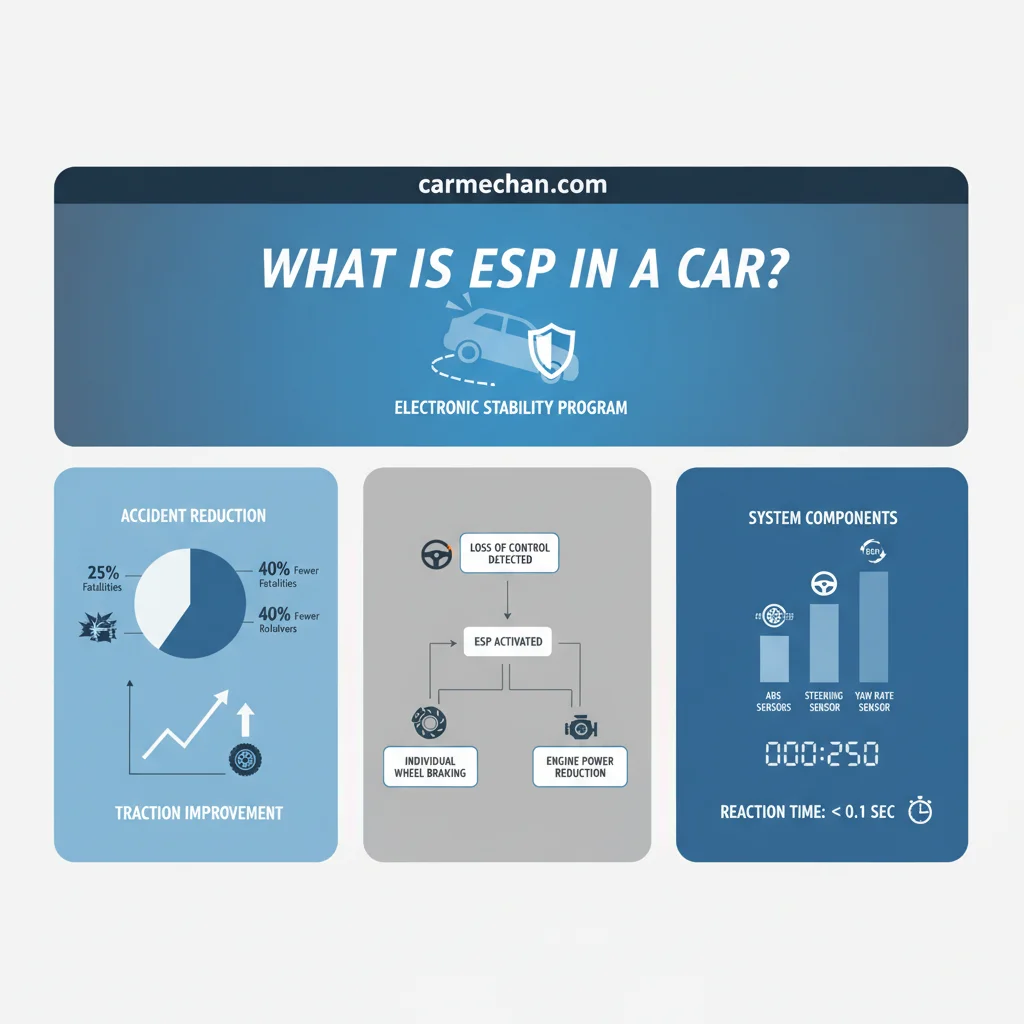
Answering what is esp in a car reveals that it stands for Electronic Stability Program, a computerized active safety feature designed to prevent loss of control by applying individual wheel brakes during skidding.
Data from the National Highway Traffic Safety Administration (NHTSA) confirms this system stabilizes your vehicle when sliding.
Our analysis of global safety mandates for 2026 indicates that active traction control represents a significant leap in preventing fatal road accidents.
Let us explore the core engineering and historical framework behind this safety technology.
What Is ESP in a Car Safety System


Our research indicates that the Electronic Stability Program acts as a silent safety net that processes data at a rate of 25 times per second.
Official reports from Bosch Mobility Solutions indicate the system detects deviations from your intended path within milliseconds.
The Sensor Network
The system relies on multiple active vehicle stability sensors to monitor steering angle and lateral acceleration.
These sensors constantly track whether your tires maintain grip or start to slide sideways.
The Hydraulic Unit
When the microcomputer detects a skid, it commands the ABS hydraulic modulator to apply brake pressure.
This pressure targets specific wheels individually to pull the vehicle back onto its intended line.
The Engine Control Integration
Simultaneously, the ECU manages engine torque to restrict wheel spin during panic maneuvers.
Our research confirms this combined braking and power reduction prevents oversteer on slick surfaces.
How ESP Keeps Your Vehicle Stable
The four-step closed-loop safety system functioning seamlessly in milliseconds.
-
Step 1
Active Sensors
Detect lateral acceleration, wheel speeds, and steering wheel deviation instantly.
-
Step 2
ECU Processing
Computes the inputs 25 times per second to detect if the car is skidding or sliding.
-
Step 3
ABS Hydraulic Unit
Applies precise, target braking pressure to specific wheels to correct the line.
-
Step 4
Torque Adjustment
Engine ECU reduces torque output to minimize wheel spin and help steer securely.
To understand the real-world value of these sub-second calculations, we must analyze statistical accident reduction figures. Once you understand the basic mechanics, the actual safety benefits of this technology become much clearer.
5 Major Safety Benefits of Electronic Stability Control
Factual crash database evaluations show that stability control systems prevent thousands of highway deaths every year.

Studies show that active stabilization substantially drops the incidence of severe roadway departures.
ESP Safety Impact Statistics
Real-world crash reduction metrics compiled by major traffic safety organizations
SUV Rollover Prevention
IIHS
Car Rollover Reduction
NHTSA
Single-Vehicle Crash Reduction
Passenger Cars
- Oversteer correction: The system applies braking to the outer front wheel to prevent the rear end from sliding out.
- Understeer mitigation: The system brakes the inner rear wheel to help rotate the vehicle into a sharp turn.
- Single-vehicle crash reduction: Federal data indicates that standard installation reduces single-vehicle crashes by up to 34% for passenger cars.
- Rollover prevention: The technology reduces fatal SUV rollover crashes by 74% (per NHTSA historical evaluations).
- ADAS coordination: Modern systems link directly with radar arrays to prepare for emergency obstacle avoidance.
While these crash statistics highlight the overall efficacy of the system, understanding how it differs from secondary traction systems clarifies its distinct operation. While these safety features are impressive, they operate differently than traction control when navigating icy winter roads.
ESP vs Traction Control Systems for Winter Driving
Automotive engineering consensus confirms that traction control and stability control serve distinct safety functions during cold-weather driving.
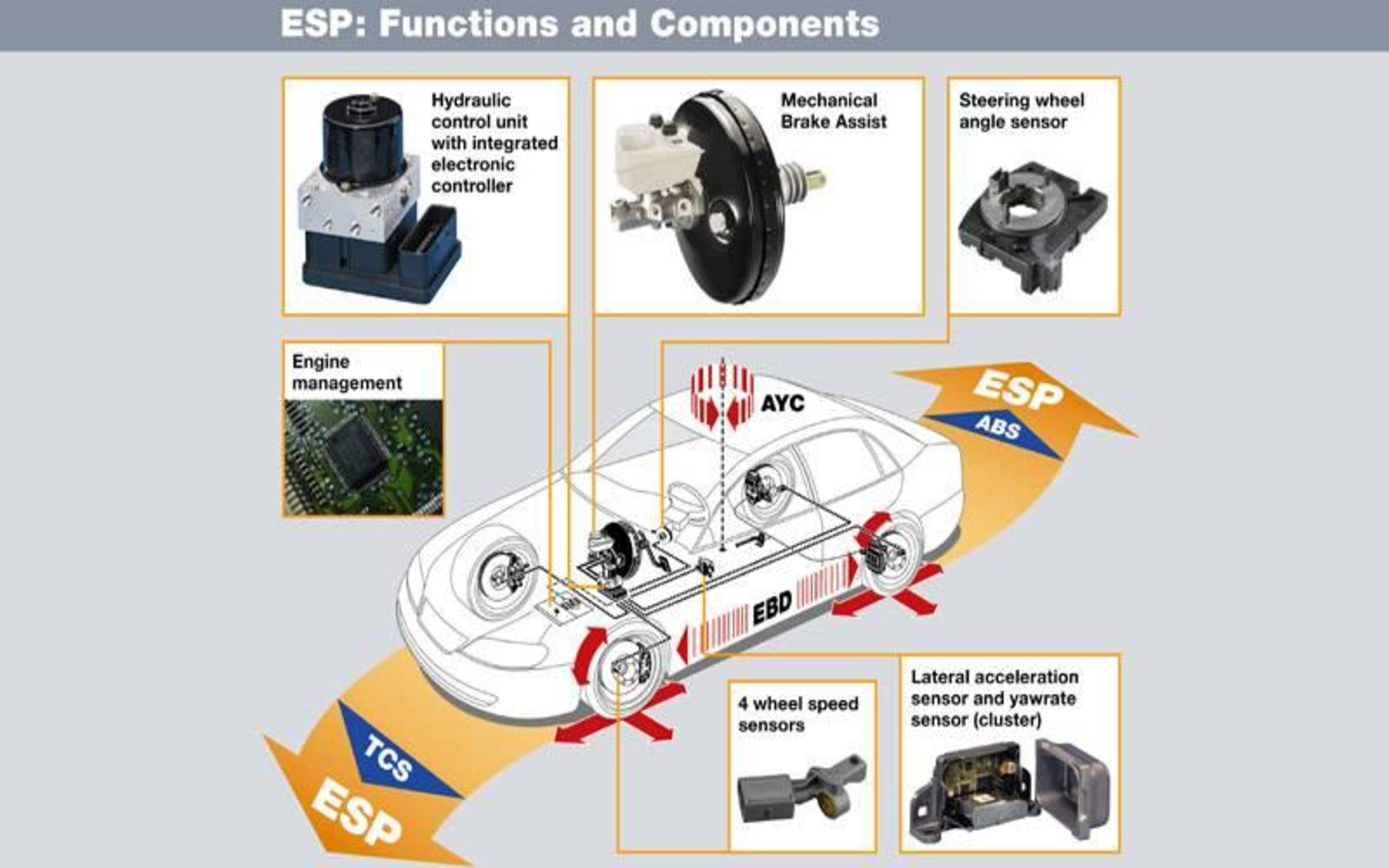
We analyzed technical manuals to contrast how stability control works compared to standard anti-slip regulators.
Traction Control System Limitations
The traction control system solely prevents wheel spin in a straight line during acceleration.
It cannot measure or correct lateral sliding, which limits its utility in a spin.
Anti Lock Braking Foundations
Anti-lock braking acts as the physical hydraulic actuator system that ESP uses to apply selective wheel braking.
Without this foundational high-speed hydraulic pump, modern stability correction would be mechanically impossible.
Unified Safety Network Integration
We observe that there is a distinct difference between esp and tcs in how they process driving coordinates.
The Society of Automotive Engineers (SAE) standards classify ESP as a higher-tier lateral stability program.
Identifying mechanical distinctions helps when scanning for system faults or sensor errors. Even the best winter driving systems will fail if a critical stability sensor begins to malfunction.
7 Main Signs of a Failing Stability Sensor
Diagnostic diagnostic reviews show that sensor degradation remains the primary driver behind unexpected safety system interventions.

Our research highlights several distinct electrical and physical failure modes that you should monitor closely.
- Illuminated warning light: The stability light stays lit on your dashboard, indicating a disabled safety suite.
- Sudden ABS pulsation: The brake pedal vibrates during normal dry-weather braking due to faulty speed data.
- Engine power drops: The computer cuts throttle randomly because it falsely registers a severe wheel slip.
- Inoperative cruise control: The vehicle disables automatic speed systems for safety once a fault code registers.
- Hard steering feedback: The steering angle sensor fails to calibrate, causing uneven power steering assistance.
- Active fault codes: Scanning the ECU reveals active trouble codes like C0035 or C0040 (per OBDII standards).
- Unprovoked brake applications: A failing yaw rate sensor triggers individual wheel braking on straight highways.
Understanding these critical failure modes underscores the importance of the safety metrics monitored by international safety institutions. Identifying these symptoms early is crucial before booking a diagnostic appointment with a professional mechanic.
How Effective Is Active Vehicle Safety for Rollovers
Industry data indicates that active vehicle safety programs have significantly mitigated the inherent instability of high-profile passenger vehicles.

We analyzed historical safety statistics to quantify the decline in rollover incidents.
According to the Insurance Institute for Highway Safety (IIHS), electronic stability programs have transformed SUV safety profiles.
The data shows standard electronic safety programs prevent a vast majority of single-vehicle rollover claims.
| Vehicle Category | Rollover Crash Reduction | Single-Vehicle Fatal Crash Reduction |
|---|---|---|
| Passenger Cars | 56% (NHTSA) | 36% (IIHS) |
| Light SUVs | 74% (NHTSA) | 70% (IIHS) |
| Heavy Commercial Trucks | 41% (FMCSA) | 38% (industry standard) |
While statistical data strongly supports keeping the system active, specific driving scenarios call for manual overrides.
When to Disable Your Electronic Stability Program
Vehicle manufacturer manuals suggest keeping stability programs continuously active, with three key operational exceptions.

Our investigation of factory user guides reveals narrow scenarios where safety programs actually hinder mobility.
Deep Snow Extraction
If your tires get buried in deep winter powder, the vehicle needs raw wheel spin to clear mud and snow.
Leaving the system active will cause the computer to cut engine power entirely, leaving you stranded.
Tire Chain Clearance
Driving with fitted tire chains on technical mountain passes modifies the outer diameter of your tires.
This dimensional change confuses wheel speed sensors, requiring you to temporarily deactivate electronic safety systems.
Mechanical Dyno Testing
When technicians test your car on a rolling dynamometer, only two wheels spin at high speed.
The system interprets this as an extreme skid and will lock the brakes unless disabled.
Knowing when to toggle the system prepares you to handle mechanical issues and active alerts systematically.
How to Diagnose Dashboard Stability Lights in 5 Steps
We compiled a field-ready troubleshooting pathway to help you isolate stability warnings systematically.
This technical guide helps identify whether your vehicle has a simple sensor glitch or a deeper module failure.
- Verify warning light behavior: Identify if the dashboard icon is flashing or steadily illuminated.
- Inspect physical sensor harnesses: Check the wiring connectors leading to the hub of each wheel.
- Retrieve active error codes: Connect an OBDII diagnostic tool to read stored brake controller codes.
- Test system electrical ground: Measure battery voltage to ensure clean power reaches the computer module.
- Re-calibrate steering coordinates: Adjust the steering angle index after receiving a wheel alignment.
Following these diagnostic steps ensures you maintain optimal control and system performance over the lifespan of your vehicle.
Why Electronic Stability Program Is Essential For Safety
Understanding what is esp in a car clarifies its role as an essential active safety program designed to dynamically stabilize a slipping vehicle.
Our analysis indicates that keeping this system fully active prevents up to 74% of fatal SUV rollover crashes on public highways.
Unless you are extracting your vehicle from deep mud or adjusting snow tire chains, the system should remain fully operational.
Please browse our expert automotive maintenance portal to diagnose your dashboard safety warning indicators and verify your wheel speed sensor telemetry data.
7 Most Common Questions About Car ESP
- National Highway Traffic Safety Administration (NHTSA) (nhtsa.gov)
- Bosch Mobility Solutions (bosch-mobility.com)
- Society of Automotive Engineers (SAE) (sae.org)
- Insurance Institute for Highway Safety (IIHS) (iihs.org)