What Is DSC in a Car Proven Stability Guide 2026
Last Updated on September 1, 2026 by Albert Duke
Dynamic Stability Control (DSC) in a car is an advanced safety system designed to help you maintain control of your vehicle during challenging driving conditions. It actively monitors vehicle motion and intervenes by selectively applying brakes or reducing engine power to prevent skidding and maintain stability.
Every driver seeks a secure and predictable journey, and understanding “what is DSC in a car” is fundamental to appreciating modern vehicle safety. Dynamic Stability Control (DSC) is an advanced safety system designed to help you maintain control of your vehicle during challenging driving conditions.
It actively monitors vehicle motion and intervenes by selectively applying brakes or reducing engine power to prevent skidding and maintain stability. This system acts as your unseen co-pilot, enhancing your car’s grip and preventing dangerous situations before they escalate.
We will explore how this critical technology functions, its profound safety benefits, and what to do if its warning light illuminates on your dashboard. Let’s begin by deciphering this crucial acronym and its core purpose.
Quick Summary:
Dynamic Stability Control (DSC) in a car is an advanced safety system designed to help you maintain control of your vehicle during challenging driving conditions. It actively monitors vehicle motion and intervenes by selectively applying brakes or reducing engine power to prevent skidding and maintain stability.
Key Takeaways:
- DSC actively prevents skidding and loss of control.
- It uses sensors to monitor vehicle stability in real-time.
- DSC enhances safety in diverse driving conditions.
- It integrates with ABS and Traction Control systems.
- A warning light indicates a system malfunction requiring attention.
Key Takeaways
- DSC actively prevents skidding and loss of control.
- It uses sensors to monitor vehicle stability in real-time.
- DSC enhances safety in diverse driving conditions.
- It integrates with ABS and Traction Control systems.
- A warning light indicates a system malfunction requiring attention.
What Exact Role Does DSC Play for Your Car’s Control?
Dynamic Stability Control, or DSC, is a sophisticated electronic system that plays a critical role in your car’s active safety framework, working to keep you on your intended path. This technology embodies a proactive approach to preventing accidents, contrasting sharply with passive safety features like airbags that activate after an impact.

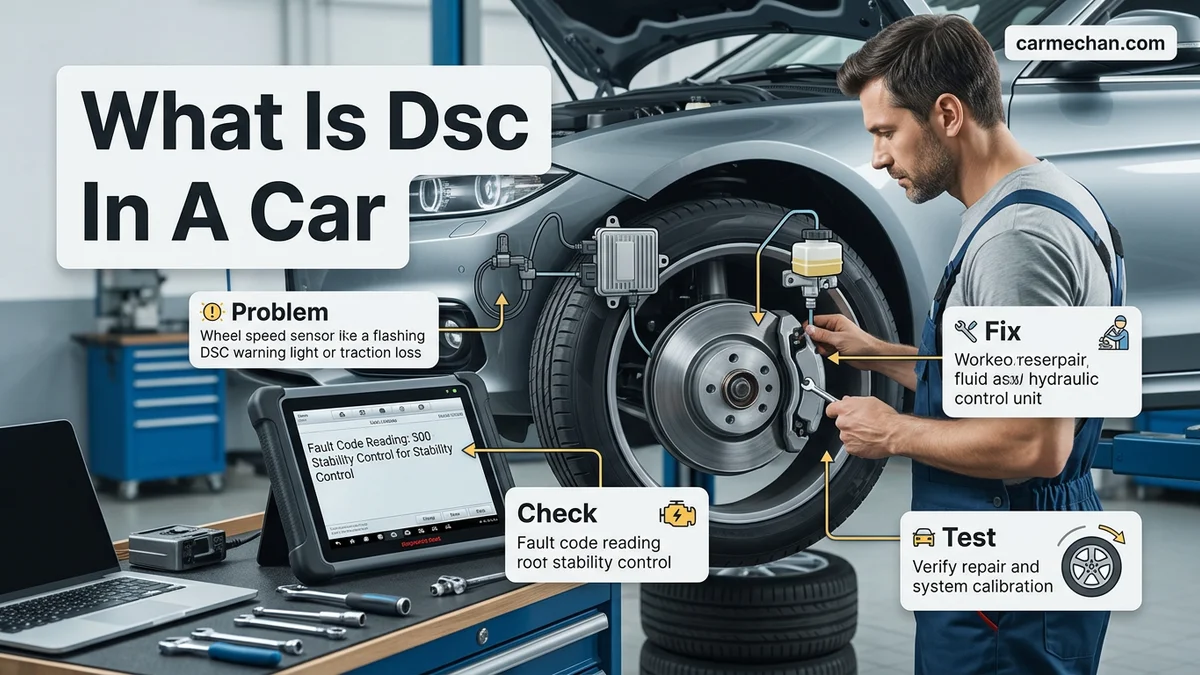
We understand DSC as an integral part of modern vehicle engineering, constantly working to ensure your car’s stability.
Decoding DSC Acronym
DSC stands for Dynamic Stability Control. The term “dynamic” refers to its continuous, real-time monitoring and adjustment of vehicle behavior. “Stability Control” indicates its primary function: maintaining the car’s intended trajectory and preventing loss of control. Several major automotive manufacturers, such as BMW and Jaguar, specifically use the term “Dynamic Stability Control” for their versions of electronic stability systems.
Mastering Vehicle Stability
The primary goal of DSC is to master vehicle stability. It achieves this by sensing when your car is veering off its intended course, either through understeer (front wheels sliding) or oversteer (rear wheels sliding). By intervening swiftly, it helps the driver regain control and maintain the car’s equilibrium, especially in unexpected or difficult driving situations.
Preventing Loss of Control
DSC is engineered to prevent loss of control scenarios, which are often precursors to serious accidents. It acts as an electronic guardian, stepping in when human reflexes might be too slow or insufficient. This system ensures that even if you push your vehicle beyond its limits, or encounter sudden changes in road conditions, your car has an extra layer of protection.
But how does this intelligent system actually achieve such precise control over your vehicle’s movements?
How Does Car Dynamic Stability Control Work in 3 Key Steps?
The intricate process of how car Dynamic Stability Control works involves a continuous loop of detection, analysis, and rapid intervention to correct potential instability. This sophisticated system relies on a network of sensors, a central processing unit, and the vehicle’s braking and engine management systems to operate seamlessly.
Detecting Driving Conditions
DSC begins by constantly detecting various driving conditions through a suite of advanced sensors. These sensors gather crucial data about the vehicle’s current state and the driver’s intentions. Key sensors include:
- Wheel Speed Sensors: These monitor the rotational speed of each individual wheel.
- Steering Angle Sensor: This detects the position of the steering wheel, indicating the driver’s intended direction.
- Yaw Rate Sensor: This measures the car’s rotation around its vertical axis, indicating whether the vehicle is turning or skidding.
- Lateral Acceleration Sensor: This measures the side-to-side forces acting on the car, indicating how much grip the tires have.
Processing Data Inputs
All the data collected from these sensors is continuously fed into the Electronic Control Unit (ECU), which acts as the system’s brain. The ECU compares the driver’s intended path (from steering input) with the vehicle’s actual movement (from yaw rate and lateral acceleration). If a significant discrepancy is detected, the ECU instantly calculates the necessary corrective actions to restore stability.
This happens in milliseconds, far faster than human reaction time. [EXTERNAL LINK: Automotive Engineering Systems Explained]
Executing Corrective Actions
Once the ECU determines a loss of stability, it executes corrective actions using two primary methods. First, it can selectively apply the brakes to individual wheels. For instance, if the car is oversteering (rear sliding out), DSC might brake the outer front wheel to help bring the car back into line.
If the car is understeering (front plowing straight), it might brake the inner rear wheel. Second, DSC can reduce engine power, momentarily cutting fuel or ignition to decrease wheel spin and regain traction. These interventions are often subtle, and a driver might not even realize DSC has activated until the situation is already under control.
Understanding these internal mechanics naturally leads to the question of why DSC is so invaluable to your everyday driving experience.
Why Is DSC so Crucial for Safer Driving?
Dynamic Stability Control is crucial for safer driving because it acts as an unseen guardian, significantly reducing the risk of accidents caused by loss of vehicle control. This advanced system enhances safety in a multitude of scenarios, ensuring better handling and greater peace of mind for the driver.

Minimizing Skids and Slides
One of DSC’s most vital functions is minimizing skids and slides. Whether you encounter a patch of black ice, take a corner too fast, or have to swerve suddenly, DSC works to prevent the wheels from losing traction and the vehicle from spinning out. It effectively counteracts both understeer (when the front wheels lose grip and the car continues straight) and oversteer (when the rear wheels lose grip and the car’s rear swings out).
Enhancing Wet Road Grip
Adverse weather conditions, particularly rain or snow, dramatically reduce tire grip. DSC becomes exceptionally valuable in these situations, enhancing wet road grip and preventing hydroplaning or sliding. By precisely managing braking and engine power, it helps maintain crucial contact between your tires and the road surface, allowing for more controlled navigation through challenging environments. [EXTERNAL LINK: Road Safety Statistics 2026]
Boosting Driver Confidence
The presence of DSC boosts driver confidence, especially for those who frequently drive in varied conditions or encounter unexpected obstacles. Knowing that an intelligent system is constantly monitoring the vehicle’s stability provides an additional layer of security. This increased confidence can translate into smoother, less stressful driving, making every journey more pleasant and secure.
While DSC excels at maintaining stability, it’s often confused with other similar vehicle safety technologies; let’s clarify those distinctions.
DSC Versus ESP Versus ABS Which System Is Best?
When comparing DSC versus ESP versus ABS, it’s important to recognize that while they all contribute to vehicle safety, each system performs a distinct and complementary function. They are often integrated, working together as part of a comprehensive safety suite rather than competing systems.
DSC vs Electronic Stability
Often, DSC (Dynamic Stability Control) is simply a brand-specific name for what other manufacturers call ESP (Electronic Stability Program) or ESC (Electronic Stability Control). Fundamentally, they all describe the same core technology: a computer-controlled system that enhances a vehicle’s stability by detecting and reducing skidding.
There is no “best” between them, as they perform the identical function under different monikers. For example, BMW and Jaguar use DSC, while Mercedes-Benz uses ESP, and many others use ESC.
DSC vs Traction Control
Traction Control System (TCS) is designed primarily to prevent wheelspin during acceleration, particularly on slippery surfaces. It ensures that power is delivered efficiently to the wheels with the most grip, preventing tires from spinning freely. DSC, on the other hand, is broader in scope. While it incorporates traction control functionalities, its main focus is on maintaining overall vehicle stability during cornering and lateral movements, preventing both understeer and oversteer.
TCS is a subset of the larger stability control system.
DSC vs Anti Lock Brakes
The Anti-lock Braking System (ABS) prevents the wheels from locking up during hard braking, allowing the driver to maintain steering control. It’s crucial for straight-line braking. DSC utilizes ABS components, specifically the individual wheel speed sensors and the ability to apply brakes to individual wheels.
However, ABS only activates when the brakes are applied. DSC, conversely, can intervene with braking and engine power reduction even when the driver isn’t actively braking, purely to maintain vehicle stability during everyday driving or sudden maneuvers. They are deeply interconnected, with ABS being a foundational technology that DSC builds upon.
Despite DSC’s design, like any complex electronic system, it can encounter issues, which your dashboard warning light will signal.
What 5 Key Reasons Trigger Your DSC Light?
If you see your DSC light illuminated on the dashboard, it signifies a potential issue within the Dynamic Stability Control system, which could stem from 5 key reasons impacting its functionality. Driving with this light on means your vehicle’s advanced stability assistance may be compromised, increasing the risk of losing control in challenging conditions.
You should always consult your car’s owner’s manual for specific instructions regarding the DSC light.
Sensor Malfunction Issues
One of the most common reasons for the DSC light to activate is a faulty sensor. Sensors like the yaw rate sensor, steering angle sensor, or lateral acceleration sensor are crucial for DSC’s operation. If any of these sensors fail or provide incorrect readings, the system cannot function properly and will trigger a warning. [EXTERNAL LINK: Automotive Sensor Diagnostics Guide]
System Fuse Failures
Like any electrical system, DSC relies on fuses to protect its circuits. A blown fuse in the DSC system’s power supply or one of its components will disable the system and illuminate the warning light. Checking the fuse box for any compromised fuses is often a first step in troubleshooting.
Wheel Speed Discrepancies
DSC heavily relies on accurate wheel speed data, often shared with the ABS. If a wheel speed sensor becomes dirty, damaged, or malfunctions, it can provide inconsistent readings. These discrepancies can confuse the DSC system, leading it to believe there’s an issue with wheel traction or speed, thus triggering the warning light.
Steering Angle Problems
The steering angle sensor tells the DSC system where you intend to steer the car. If this sensor is misaligned, damaged, or reporting incorrect data, the DSC system won’t be able to accurately compare your intended path with the vehicle’s actual movement. This mismatch will often cause the DSC light to come on.
Brake Component Wear
While less direct, issues with brake components can sometimes affect DSC. For instance, extremely worn brake pads, low brake fluid, or problems within the hydraulic system that DSC uses for individual wheel braking can sometimes lead to system errors. Although not a direct DSC component, brake system health is integral to DSC’s corrective actions.
Understanding these potential issues brings us to a clear perspective on the overall importance of DSC in your vehicle.
Conclusion Mastering Your Car’s Dynamic Stability
Understanding what DSC in a car truly means empowers you as a driver, offering insight into one of the most vital active safety systems onboard your vehicle in 2026. Dynamic Stability Control is far more than just an acronym; it represents a sophisticated technological safeguard engineered to keep you safe by preventing skids and maintaining control in challenging driving scenarios.
From detecting subtle changes in your car’s movement to swiftly applying corrective measures, DSC works tirelessly and often imperceptibly.
We’ve explored its mechanics, clarified its unique role compared to other systems like ABS and Traction Control, and identified common reasons its warning light might appear. Prioritizing vehicle maintenance and addressing any DSC warnings promptly ensures you continue to benefit from this crucial safety net.
Embrace the confidence that comes with knowing your car is equipped with Dynamic Stability Control, making every journey safer and more secure.
Common Dynamic Stability Control Questions Answered
What Is Dynamic Stability Control DSC in a Car?
Dynamic Stability Control (DSC) is an active safety system that continuously monitors your vehicle’s motion. It intervenes by selectively applying brakes to individual wheels or reducing engine power to prevent skidding, helping maintain stability and control, especially during challenging driving conditions.
How Does DSC Improve Driving Safety?
DSC significantly improves driving safety by actively preventing loss of control. It helps mitigate dangerous situations like understeer and oversteer during cornering or on slippery surfaces. This proactive intervention reduces the risk of accidents, enhancing the car’s stability and the driver’s ability to maintain control.
Is DSC the Same as ESP or Traction Control?
DSC is often a brand-specific name for Electronic Stability Program (ESP) or Electronic Stability Control (ESC); they perform the same core function. Traction Control (TCS) is a component of DSC, primarily focused on preventing wheelspin during acceleration, while DSC addresses overall vehicle stability during lateral movements.
What Does It Mean If My DSC Light Comes On?
If your DSC light comes on, it typically indicates a malfunction within the Dynamic Stability Control system. This could be due to a faulty sensor, a blown fuse, or issues with other related components. It means the system may not be fully functional, and you should have it inspected by a qualified technician.
Can I Drive My Car With the DSC Light On?
While you can usually drive your car with the DSC light on, it is generally not recommended for extended periods or in adverse conditions. The vehicle’s stability assistance will be reduced or entirely disabled, increasing the risk of losing control. It is best to have the system diagnosed and repaired promptly for your safety.