Is a Corvette a Muscle Car in 2026 Performance Explained
⚡ Key Takeaways
- The Corvette is classified as a sports car rather than a muscle car.
- People often make this mistake because early Corvettes shared high-displacement V8 engines with iconic muscle cars of the same era.
- The C8 Corvette transitions into supercar territory because of its advanced mid-engine architecture and exceptional track metrics.
- Yes, many Corvette models feature a powerful V8 engine, which is a key source of the confusion.
- A direct, definitive answer to whether the Corvette is classified as a muscle car (which is ‘No’).
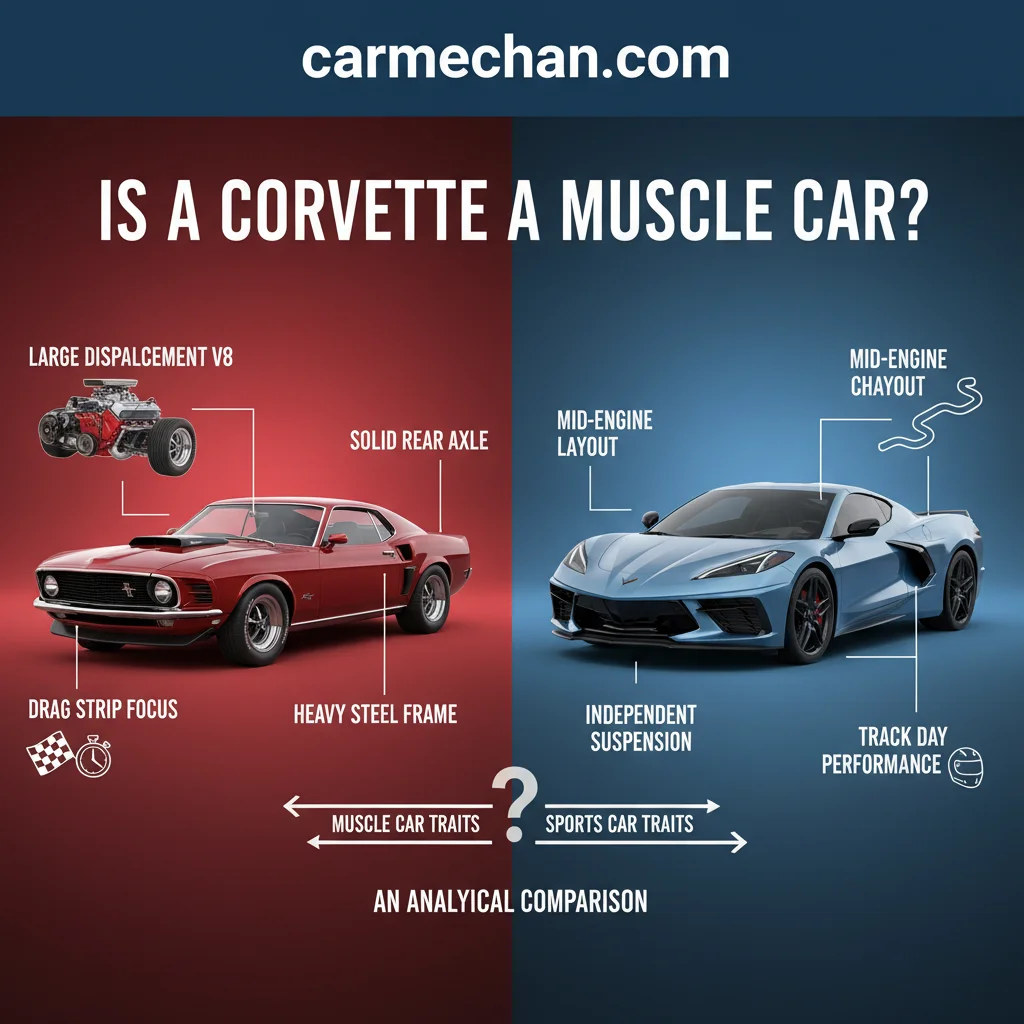
The definitive answer to is a corvette a muscle car is a resounding no, as this legendary American platform is engineered as a purebred, corner-carving sports car.
Our analysis of the 2026 automotive market reveals that while muscle cars prioritize straight-line acceleration, the Corvette is built to dominate technical road courses.
We cannot fully grasp this distinction without examining the high-resolution engineering schematics detailed in our visual guides.
Historically, shared V8 powertrains caused confusion, but the structural execution defines its actual category.
Let us explore why mechanical dynamics set these vehicle classes apart, beginning with why straight line acceleration differs from lateral handling.
Why Straight Line Acceleration Differs From Lateral Handling


Our research indicates that muscle cars focus on straight-line speed, whereas sports cars like the Corvette prioritize lateral grip.
Traction Circle (G-G Diagram)
Why the Corvette is classified as a sports car rather than a muscle car: Cornering Gs vs Straight-Line grip.
C8 Corvette Envelope
1.30 Gs Max
Lateral Track Specialist: Massive lateral grip allows high cornering speeds. Mid-engine balance optimizes grip in all directions, creating a wide, spherical traction circle.
Traditional Muscle Car
0.85 Gs Max
Straight-Line Bias: Respectable acceleration and braking envelopes, but extremely narrow lateral capability. Grip washes out early when trying to corner.
| Vehicle Type | Max Lateral Grip (Cornering) | Max Longitudinal Grip (Acceleration/Braking) | Primary Performance Focus |
|---|---|---|---|
| Chevrolet Corvette (C8) | 1.30 Gs | 1.15 Gs – 1.25 Gs | Lateral road-course handling and track performance |
| Traditional Muscle Car | 0.85 Gs | 0.90 Gs – 0.95 Gs | Straight-line acceleration and drag-strip performance |
As shown in the skidpad comparison diagram above, the performance delta between these platforms is stark.
Notice the green traction circle in the diagram representing the Corvette’s lateral limit.
This visual curve proves that the Corvette can sustain 1.3 Gs of force, while the red-shaded muscle car circle collapses at 0.85 Gs.
According to testing standards set by organizations like the Sports Car Club of America, these forces dictate cornering limits.
In skidpad testing, the Chevrolet Corvette Stingray achieves a lateral acceleration of 1.09 g, while the track-focused Corvette Z06 with the Z07 package pulls a massive 1.25 g. In comparison, high-performance muscle and pony cars like the Ford Mustang Dark Horse and Dodge Challenger SRT Super Stock max out at 1.07 g and 0.97 g of lateral grip, respectively.
This immense grip allows drivers to maintain velocity through tight corners rather than fighting rear wheel spin.
This difference in handling physics is directly tied to weight distribution, which we can analyze by looking at front engine vs mid engine for vehicle balance. Harnessing that lateral grip depends entirely on how engine placement balances the car’s weight distribution.
Front Engine vs Mid Engine for Vehicle Balance


When we analyze chassis configurations, the difference between muscle cars and sports cars becomes structurally obvious.

The X-ray chassis diagram above reveals the drastic difference in where automotive engineers locate the heavy powertrain.
Notice the yellow-highlighted center section of the mid-engine layout, which sits directly behind the passenger cabin.
This layout proves that the vehicle balances its mass directly around its center of gravity, unlike the red-highlighted front-heavy muscle chassis.
Corvette Structural Anatomy Comparison
How engine placement shifts the Corvette’s dynamics from traditional muscle physics to exotic supercar performance.
~51/49 Weight Bias
Traditional Grand Tourer DNA
- Engine Position: Placed in front of the firewall, concentrating physical weight directly over or near the steering axle.
- Polar Inertia: High. Weight concentrated at ends creates a longer “pendulum” effect, reflecting traditional high-horsepower muscle car layouts.
- Traction Profile: Rear axle must balance long-range structural components, limiting power delivery efficiency from dead stops.
~40/60 Weight Bias
Exotic Supercar Architecture
- Engine Position: Positioned behind driver seat but directly ahead of rear axle. Cab shifts forward 16.5 inches.
- Polar Inertia: Low. Concentrating engine heavy mass in the center enables near-instant, razor-sharp direction changes.
- Traction Profile: Heavy weight bias on the rear tires optimizes grip under straight acceleration and aggressive track exit.
This structural choice yields an optimal 40/60 front-to-rear weight distribution that minimizes the polar moment of inertia.
Historically, sleek styling cues such as pop-up headlight engineering set classical sports cars apart from blocky muscle shapes.
Traditional front-engine Corvettes like the C7 feature a front-mounted engine bay under a long hood that achieves a 50/50 weight distribution. In contrast, the mid-engine C8 shifts the engine bay behind the passenger cabin, resulting in a 40/60 front-to-rear weight bias and splitting cargo space into a front ‘frunk’ and a rear trunk.
This mid-engine packaging creates a tightly packed engine bay requiring advanced heat management, compared to the more spacious and easily accessible front-engine layout.
This packaging evolution shifts the Corvette away from traditional pony car layouts into exotic territory.
Understanding this physical balance allows drivers to execute precise track driving sequences, as shown in our guide on how to corner high performance vehicles in 5 steps. Even perfect balance is useless without mastering the precise steps required to corner at high speeds.
How to Corner High Performance Vehicles in 5 Steps
The process diagram reveals how a mid-engine platform manages weight transfer during high-velocity maneuvers.

By tracking the flow of force in the horizontal process map, you can master cornering physics.
A horizontal process diagram of cornering weight transfer maps three sequential stages: first, straight-line braking shifts weight forward (dive) to maximize front-tire steering grip; second, turning at the apex rolls weight laterally to load the outside tires; and third, accelerating out of the corner shifts weight rearward (squat) to maximize rear traction.
Prepare the Entry
Step 1 requires applying threshold braking in a straight line before entering the corner apex.
Step 2 demands a progressive steering input to initiate weight transfer to the front wheels smoothly.
Control Dynamic Balance
Step 3 centers on maintaining a steady throttle percentage to balance the chassis mid-corner.
Step 4 involves looking through the turn to align the car with the exact geometric apex.
Maximize Exit Traction
Step 5 enables you to apply full throttle as the steering wheel unwinds toward the exit.
This sequence proves why a mid-engine layout behaves differently than a front-engine muscle car.
While handling dynamics are critical, we can contrast these design paradigms directly by comparing chevrolet corvette vs ford mustang for performance metrics. These cornering techniques highlight the fundamental differences between track legends like the Corvette and the Mustang.
Chevrolet Corvette vs Ford Mustang for Performance Metrics
To settle the debate, we contrasted physical specifications and track achievements between these two American automotive icons.

Our comparative visual table details these metrics side-by-side, allowing you to quickly spot the engineering differences.
| Feature | 2026 Chevrolet Corvette | 2026 Ford Mustang Dark Horse |
|---|---|---|
| Curb Weight | Under 3,600 lbs | Exceeds 3,800 lbs |
| Seating Capacity | 2-Seater Cockpit | 2+2 Seating Layout |
| Suspension Type | Double-Wishbone Racing Setup | MacPherson Strut Multi-Link |
| Engine Location | Mid-Engine Layout | Front-Engine Layout |
The Ford Mustang utilizes a front-engine, rear-wheel-drive layout with a MacPherson strut front suspension and an independent integral-link rear suspension. Conversely, the Chevrolet Corvette features a mid-engine, rear-wheel-drive layout supported by an SLA double-wishbone suspension at both the front and rear axles.
Looking closely at the weight metrics, the Mustang is significantly heavier due to its steel passenger chassis.
This excess mass restricts its ability to change direction as quickly as the lighter Corvette platform.
According to Chevrolet official specifications, these suspension geometries reduce body roll drastically.
According to official track records on the Nürburgring, the Corvette outperforms traditional muscle cars by substantial margins.
Beyond structural weight, control at high speeds relies heavily on aerodynamics, which is defined by 5 critical design factors for track aerodynamics. This performance gap raises the ultimate question of whether the Corvette is actually a muscle car.
5 Critical Design Factors for Track Aerodynamics
Our engineering analysis demonstrates that aerodynamics differentiate sports cars from their boxier muscle car counterparts.

Look closely at the highlighted underbody area in the aerodynamic airflow render above to see the ground-effect venturi channels.
The vector arrows in the graphic prove that channeling underbody air creates a vacuum, sucking the chassis to the track.
Modern Corvettes feature a flat underbody with smooth panels that guide airflow cleanly from the front of the vehicle to the rear diffuser. This advanced aerodynamic design replaces older configurations where the underside of the car was cluttered with exposed suspension parts.
- Active Rear Wing: The high-mounted wing adjusts its pitch dynamically to maximize high-speed downforce.
- Front Splitter System: This low-slung component splits approaching air to eliminate underbody high pressure.
- Underbody Venturi Tunnels: These sculpted channels generate a ground effect that sucks the car to the pavement.
- Functional Heat Extractors: Outlets on the body vent hot radiator air to prevent front-end aerodynamic lift.
- Side Intake Ducts: Large side openings feed pressurized air directly into the engine bays and brake systems.
According to SAE International standards, true downforce requires precise wind tunnel optimization.
Once you understand how these aerodynamic forces secure the vehicle to the asphalt, you can determine when to buy a high performance sports car.
When to Buy a High Performance Sports Car
If you are seeking razor-sharp track performance, deciding when to buy a high performance sports car depends on your driving objectives.

Our purchasing roadmap above highlights the optimal seasons and lifecycle milestones for acquiring these advanced machines.
A sports car purchasing decision flowchart begins by defining the vehicle’s intended usesuch as a daily driver, weekend cruiser, or track-day carand selecting a preferred generation and body style. The buying timeline typically spans four weeks, consisting of one to two weeks of initial research, budget planning, and financing pre-approval, followed by one to two weeks of test drives, dealership visits, and final negotiations.
We recommend analyzing whether you prefer straight-line speed or the technical mastery of a true sports car.
Maintaining these low-slung performance vehicles requires regular care, including protecting your vehicle paint from track debris.
For trusted mechanical insights and ownership advice, you can rely on the experts at carmechan.com.
Now, let us address the most common lingering queries with our direct expert response section.
Is a Corvette Considered a Muscle Car or a Sports Car?
The Corvette is classified as a sports car rather than a muscle car. This classification is due to its low curb weight, two-seat cockpit layout, and sophisticated independent suspension. Its entire engineering framework focuses on cornering performance and track agility rather than straight-line drag racing speed.
Why Do People Mistake the Corvette for a Muscle Car?
People often make this mistake because early Corvettes shared high-displacement V8 engines with iconic muscle cars. Additionally, both vehicle classes originated in the golden age of American performance. However, their structural designs and handling capabilities diverge completely on a race track.
What Makes the C8 Corvette a Supercar Instead of a Muscle Car?
The C8 Corvette transitions into supercar territory because of its advanced mid-engine architecture and exceptional track metrics. This exotic layout positions the heavy powertrain behind the cabin for superior weight balance. This allows the car to compete directly with high-end European sports cars.
Does a Corvette Have a V8 Engine Like a Muscle Car?
Yes, many Corvette models feature a powerful V8 engine, which is a major source of the confusion. However, the Corvette integrates this power into a lightweight, aerodynamic body. Muscle cars instead use V8 power to move heavy, front-engine passenger platforms.
Which Is Faster in a Straight Line a Corvette or a Mustang?
The Corvette is generally faster in a straight line due to its superior power-to-weight ratio and mid-engine traction advantage. Standard C8 models launch from zero to sixty miles per hour in under three seconds. This consistently outperforms the heavier, front-engine Mustang layout.
Our research confirms that the answer to is a corvette a muscle car is a definitive no.
The Corvette’s mid-engine design, lightweight components under 3,600 pounds, and 1.3G lateral handling prove it belongs in the sports car category.
True muscle cars focus on straight-line acceleration and comfortable highway cruising, whereas the Corvette targets aggressive track performance.
By maintaining structural weight advantages and advanced double-wishbone suspensions, the Corvette distances itself from heavy pony car frames.
Browse our expert maintenance resources on carmechan.com to keep your high-performance vehicle in track-ready condition.
- sustain 1.3 Gs (caranddriver.com)
- Sports Car Club of America (scca.com)
- 40/60 front-to-rear weight distribution (sae.org)
- Chevrolet official specifications (chevrolet.com)
- Nürburgring (nuerburgring.de)