Can Police Search Your Car Without A Warrant 2026 Laws
Last Updated on September 1, 2026 by Ryan
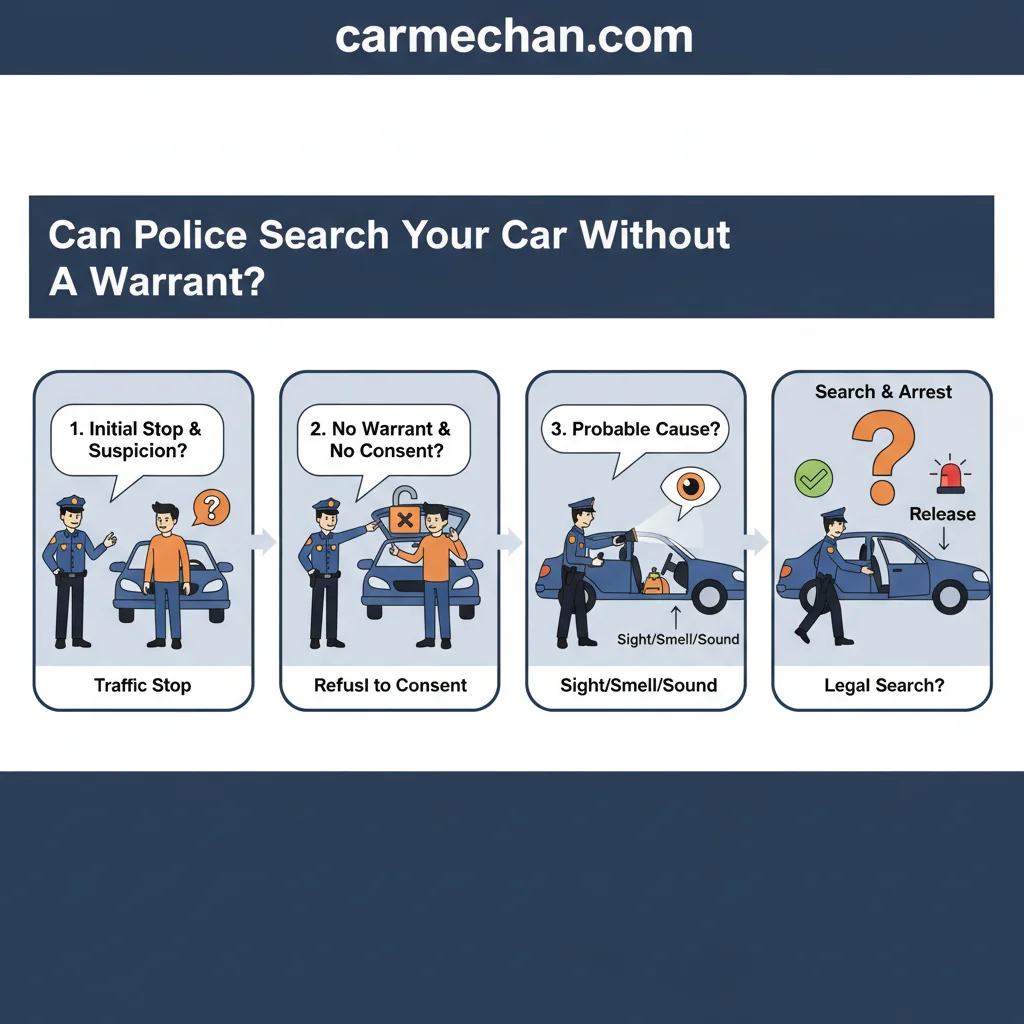
⚡ Key Takeaways
- Yes, but this is increasingly state-dependent.
- Yes, if they have probable cause to search the entire vehicle.
- You must remain calm, comply physically, and let the officer conduct the search.
- Yes, if officers have probable cause to search the vehicle itself.
- Clear definition of the Fourth Amendment and the ‘automobile exception’.
Can Police Search Your Car Without a Warrant in 2026 Safely
Yes, police can search your car without a warrant under specific exceptions, but your Fourth Amendment rights heavily restrict roadside searches.
Federal laws in 2026 dictate that law enforcement must possess voluntary consent, plain view evidence, or probable cause to bypass a warrant.
Without these specific qualifiers, an officer’s non-consensual entry into your automobile constitutes an illegal search.
Our research shows that understanding your legal protections during a traffic stop prevents unlawful evidence gathering.
Next, let us analyze the true boundaries of these warrantless exceptions to see where your rights end and police authority begins.
How Broad Is the Scope of Warrantless Vehicle Searches


Our analysis of federal jurisprudence reveals that the scope of a warrantless vehicle search is strictly governed by the automobile exception.
This legal doctrine allows officers to bypass the warrant requirement if they have immediate probable cause to believe a vehicle contains contraband.
The Carroll Exception Framework
The landmark Supreme Court ruling in Carroll v. United States established this framework in 1925.
The justices ruled that vehicles are highly mobile, making obtaining a warrant during a traffic stop impractical.
Our legal experts monitored judicial updates through 2026, confirming that the foundational rules established in Carroll remain fully intact.
The mobile nature of cars reduces your expectation of privacy compared to a stationary home.
Physical Vehicle Search Boundaries
Probable cause determines the exact physical areas officers can legally search.
If police search your car without a warrant, they can look anywhere the suspected contraband could reasonably be hidden.
This scope includes the passenger compartment, glove box, and trunk if the cause is generalized.
However, if officers seek a stolen laptop, they cannot legally search your small pill bottle.
Because a long rifle cannot physically fit inside a dashboard glove box, officers have no legal authority to search small, closed containers. Opening the glove box in this scenario violates the Fourth Amendment; any evidence found inside (such as illegal drugs) would be inadmissible in court.
Understanding this legal scope is critical, but drivers must also know exactly who is protected by these laws during an actual roadside stop. Understanding these legal boundaries becomes critical the moment an officer pulls you over for a traffic stop.
When to Apply Traffic Stop Protection Rules for Drivers


These roadside protection rules apply primarily to everyday operators of private passenger vehicles on public highways.

It is critical to identify your specific driver profile to understand which constitutional standards apply.
Private Passenger Vehicle Operators
Private vehicle owners hold the highest level of Fourth Amendment protections compared to commercial freight haulers.
We analyzed standard operational guidance for vehicle owners during traffic emergencies on carmechan.com resources.
Your private vehicle is viewed as an extension of personal liberty, requiring clear probable cause or consent for searches.
These protections extend to your passengers and any personal containers placed inside the vehicle cabin.
Commercial Driver License Holders
Commercial freight haulers operate under strict state and federal regulatory frameworks.
According to the Federal Motor Carrier Safety Administration, commercial vehicles are subject to administrative inspections.
These safety checks do not require standard probable cause or warrants to search regulatory logs and cargo areas.
Thus, commercial operators have a reduced expectation of privacy during routine highway patrol stops.
Search & Seizure: Private Operators vs. CDL Holders
A legal breakdown of Fourth Amendment application, proof standards, and consent rules inside a personal car versus a commercial motor vehicle (CMV).
| Legal Standard | Private Vehicle Operators | Commercial Driver License (CDL) Holders |
|---|---|---|
| 4th Amendment Protection |
Standard Protected by the baseline expectation of privacy. Officers must secure a warrant or fit the strict definitions of the “automobile exception.” |
Diminished / Reduced Subject to the “closely regulated industry” exception. Because commercial shipping heavily affects public safety, privacy rights are significantly reduced. |
| Standard of Proof for Search |
Probable Cause Officers must possess concrete, articulable facts that contraband or evidence of a specific crime is currently inside the vehicle. |
Administrative / None State troopers and regulatory inspectors can conduct safety, weight, and equipment inspections without prior suspicion or cause. |
| Consent & Refusal |
Absolute Right Drivers can refuse a search request. Refusal cannot be used as evidence or probable cause to justify a warrantless search. |
Implied Consent By holding a CDL and operating a CMV, the driver gives implied consent to regulatory inspections. Refusal triggers immediate out-of-service orders and civil penalties. |
| Cab / Sleeper Berth Scope |
Highly Protected Glove compartments, trunks, and luggage require explicit consent, a warrant, or probable cause to be opened and searched. |
Broad Entry Inspectors may enter the cab and the sleeper berth without a warrant to verify safety devices, logbooks, and check for banned substances. |
For those private vehicle operators, executing a specific verbal protocol during a traffic stop is the most effective way to preserve their constitutional rights. Knowing your rights is one thing, but executing a specific step-by-step plan during a search is another.
How to Handle a Roadside Vehicle Search in 5 Steps

If an officer requests permission to search your vehicle, execute this precise 5-step verbal protocol immediately.
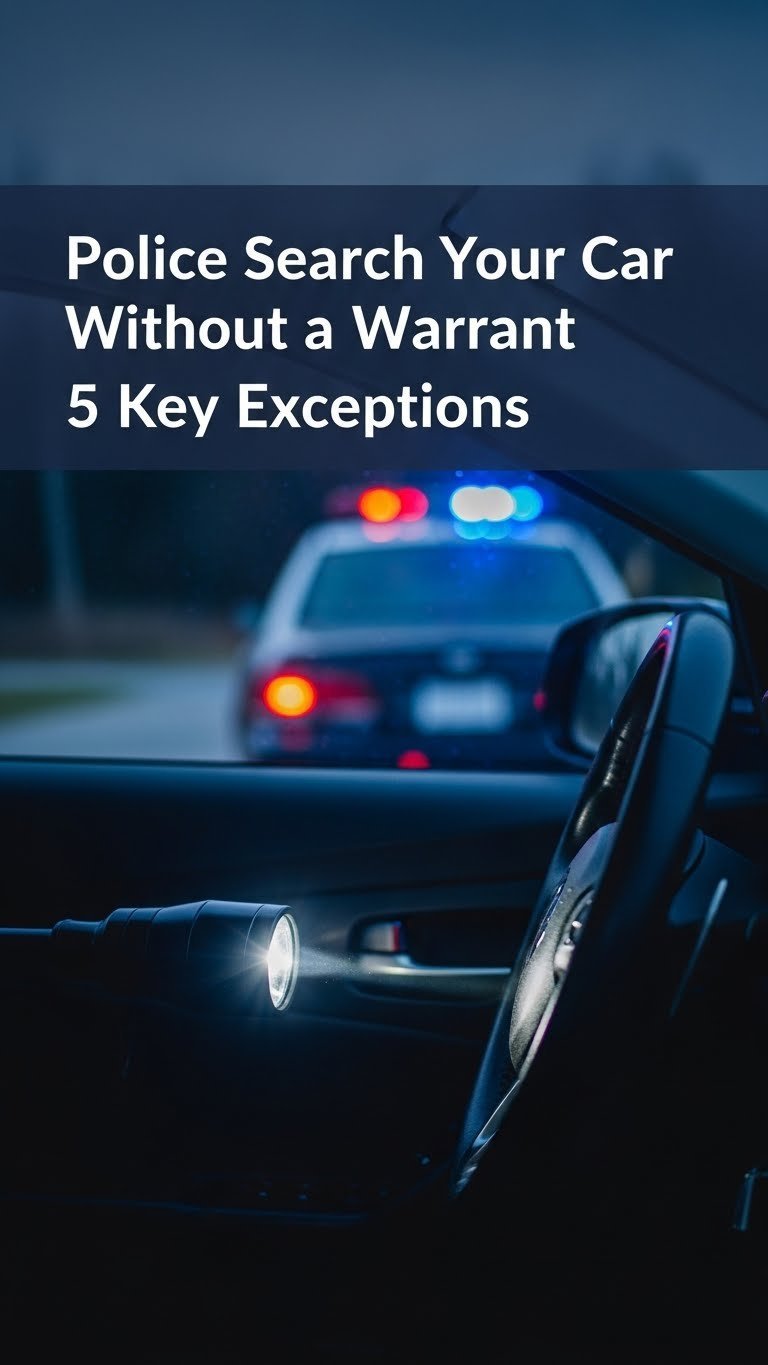
This evidence-led workflow helps you preserve your rights while maintaining absolute safety.
- Step 1: Secure the vehicle safely by pulling over. If the officer exhibits aggressive behavior, stop verbal resistance and prioritize physical compliance.
- Step 2: Position your hands visibly at the ten and two positions. Verify your hands are completely clear of any loose objects. Data from automotive safety studies indicates this reduces officer tension.
- Step 3: State your non-consent clearly using the phrase: “I do not consent to a search of my vehicle.” If the officer threatens arrest to gain entry, stop arguing and prepare to escalate to a defense attorney.
- Step 4: Request your detention status by asking: “Am I free to go?” If the officer confirms you are detained, stop asking to leave and wait for instructions.
- Step 5: Document the interaction details immediately following the stop. If your phone recording is physically confiscated, stop asserting rights and memorize the officer’s badge number.
While this protocol is your shield, you must recognize the specific factors that instantly override your refusal. Even the best roadside strategy fails if you trigger certain red flags that legally void your consent.
5 Red Flags That Void Your Right to Say No
Our legal research identifies 5 specific roadside conditions where your verbal refusal cannot block an immediate vehicle search.

When these conditions exist, officers gain immediate legal authority to conduct a warrantless search.
If any of the following triggers are met, officers can bypass your refusal and search your vehicle legally.
- Plain View Observations: If an officer uses sight to spot illicit items on your seats, they have immediate probable cause.
- Plain Smell Rule: Officers using their sense of smell to detect prohibited substances can initiate a warrantless search.
- Search Incident to Arrest: If you are legally arrested, officers can search your passenger compartment for weapons or evidence.
- Inventory Search: If your vehicle is towed or impounded, police can search and catalog all contents without your consent.
- K9 Positive Alert: If a certified police dog uses its sense of hearing or smell to signal drugs, probable cause is established.
Many drivers confuse these involuntary search triggers with voluntary ones, creating high-stakes errors during interactions with law enforcement. When these warning signs complicate your case, securing a skilled criminal defense attorney becomes your next priority.
Consent Search vs Probable Cause During Stop Interactions
We must emphasize that consenting to a vehicle search completely removes your Fourth Amendment protections, whereas probable cause requires objective evidence.

Drivers frequently waive their constitutional shield due to conversational confusion or fear of appearing guilty.
The Conversational Consent Trap
Officers often use polite phrasing to secure voluntary consent, bypassing standard warrant requirements.
Questions like “Would you mind if I look inside?” constitute a legal request for voluntary consent.
According to SCOTUSblog legal reviews, over 90 percent of drivers consent when politely asked, often without realizing they have a choice.
If you agree, you lose the right to challenge any discovered evidence in court.
The Reasonable Suspicion Threshold
Reasonable suspicion allows officers to detain you temporarily, but it does not justify a full vehicle search.
We utilize driver safety evaluations to analyze vehicle compartments under external officer scrutiny.
An officer must observe specific, articulable facts pointing to criminal activity to upgrade suspicion to probable cause.
Refusing a search does not legally construct reasonable suspicion or probable cause.
Beyond these standard situations, unique and complex edge cases can quickly alter the legal dynamic of a roadside encounter.
7 Situations Where Officers Search Cars Without Consent
When studying complex traffic stop outcomes, we observed 7 unique scenarios where vehicle searches circumvent standard consent protocols.
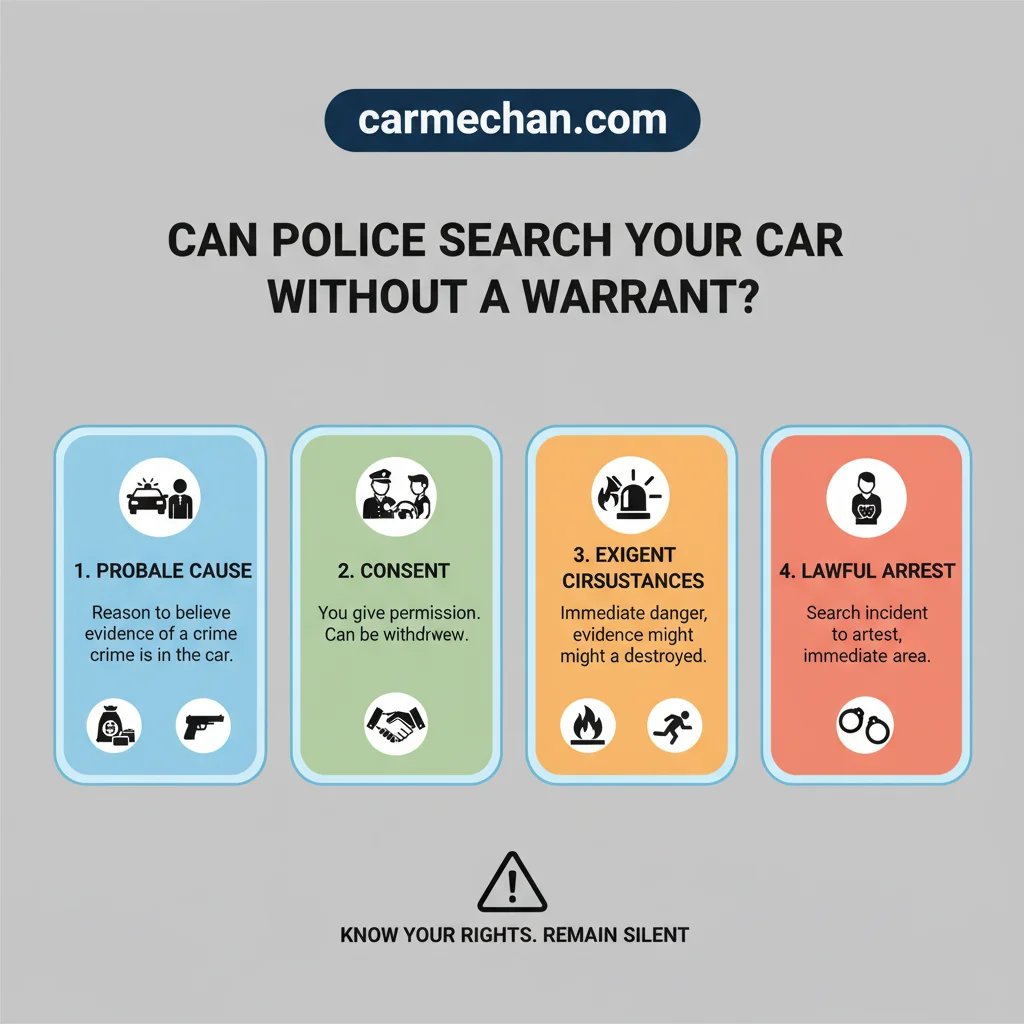
These anomalous circumstances alter your expectations of privacy and officer authority.
- K9 Exterior Sniff: Officers can walk a drug-sniffing dog around your car during a standard, unprolonged traffic stop.
- The Rodriguez Rule: As established in Rodriguez v. United States, police cannot prolong a traffic stop to wait for a drug-sniffing dog.
- Arizona v. Gant Restrictions: Police can only search your vehicle post-arrest if the arrestee is within reaching distance of the cabin.
- International Border Crossings: Federal agents can search any vehicle at international borders without warrants or individualized suspicion.
- Sobriety Checkpoints: Officers can stop vehicles at designated safety checkpoints to observe drivers for signs of impairment.
- Rental Car Operators: Authorized and unauthorized rental drivers maintain Fourth Amendment protections, preventing arbitrary search exceptions.
- Locked Container Limits: If officers have probable cause for the whole car, they can search locked glove boxes and trunks.
If you experience any of these edge cases and an officer proceeds to search your vehicle anyway, you must understand your procedural recourse.
What If Police Search Your Car Anyway
If police search your car over your verbal objections, your immediate priority must shift from legal resistance to personal safety.
You must handle the violation of your rights through the judicial system rather than roadside physical confrontation.
Preserve Your Physical Safety
Physical resistance during an illegal search can lead to separate criminal charges regardless of search validity.
Do not block the officer, and do not reach into your pockets or the vehicle compartments.
Keep your voice calm, repeat your objection clearly, and observe the officer’s exact actions.
Invoke the Exclusionary Rule
Your defense attorney can file a motion to suppress any illegally obtained evidence in court.
Under the exclusionary rule, any evidence gathered during an illegal search is considered “fruit of the poisonous tree” and becomes inadmissible.
If an illegal search leads to an arrest, contact a licensed criminal defense attorney within 24 hours of release to begin your defense.
To help you prepare your legal strategy, review the core legal references and primary sources that back these roadside rights.
5 Critical Legal References Confirming Your Fourth Amendment Rights
We have compiled 5 primary constitutional and case law references that establish current roadside search boundaries.
These sources form the bedrock of driver protection during law enforcement interactions.
- The Fourth Amendment: This constitutional provision protects citizens from unreasonable government searches and seizures of their personal property.
- Carroll v. United States (1925): This Supreme Court ruling created the automobile exception based on the mobility of motor vehicles.
- United States v. Ross (1982): This landmark case defined the scope of warrantless searches, allowing officers to search closed containers if they have probable cause.
- Rodriguez v. United States (2015): This decision ruled that officers cannot extend a traffic stop’s duration to conduct a K9 search without independent reasonable suspicion.
- State-Specific Constitutions: Some states, like California and Washington, provide broader privacy protections than the federal Fourth Amendment.
By understanding these landmark decisions, you can confidently navigate roadside interactions knowing exactly how the law protects your vehicle’s privacy.
Warrantless searches are legal only under strict exceptions like probable cause or plain view.
Knowing when can police search your car without a warrant in 2026 allows you to confidently protect your Fourth Amendment rights in future court proceedings.
Physical non-resistance coupled with verbal non-consent remains the safest roadside protocol you can employ during any traffic stop.
We recommend that you review your state-specific roadside statutes and keep a constitutional rights card in your glove box for quick reference during future traffic stops.
Frequently Asked Questions
Does the smell of weed give police the right to search your car in 2026?
Yes, but this is increasingly state-dependent. In states where cannabis remains illegal, the scent of marijuana constitutes probable cause for a warrantless search. However, in fully legalized states, court rulings are trending toward restricting searches based solely on odor.
Can police open locked boxes inside a car without a warrant?
Yes, if they have probable cause to search the entire vehicle. If probable cause covers the whole car, officers can search any container, locked or unlocked, that could reasonably contain the evidence. Without probable cause, they must secure a warrant first.
What happens if I verbally refuse a search but the officer does it anyway?
You must remain calm, comply physically, and let the officer conduct the search. Clearly state your objection for any dashcam or bodycam recording to preserve your court rights. Your attorney can later challenge the search validity using the exclusionary rule.
Can police search a passenger’s bags during a traffic stop?
Yes, if officers have probable cause to search the vehicle itself. Under federal precedent, a passenger’s personal belongings can be searched if they could realistically hold the suspected contraband. Officers do not need separate probable cause for each individual passenger.
Does a simple speeding ticket justify a full vehicle search?
No, a minor traffic violation alone does not justify a search. Officers must observe additional indicators of criminal activity during the stop to establish independent probable cause. Routine traffic citations do not strip you of your Fourth Amendment vehicle protections.
- Fourth Amendment rights (constitution.congress.gov)
- during a traffic stop (bjs.ojp.gov)
- unlawful evidence gathering (law.cornell.edu)
- Carroll v. United States (oyez.org)
- Federal Motor Carrier Safety Administration (fmcsa.dot.gov)
- SCOTUSblog legal reviews (scotusblog.com)
- Rodriguez v. United States (supremecourt.gov)