Best Cars With Adaptive Cruise Control 2026 Expert Guide
Last Updated on September 1, 2026 by Ryan
Finding the best cars with adaptive cruise control requires evaluating how systems handle stop-and-go traffic versus highway speed. Premium systems like Ford BlueCruise and Tesla Autopilot offer superior lane centering, while mainstream options like Toyota Safety Sense provide reliable distance management on a budget.

Prime for Young Adults — 6 Months Free
Students and 18–24s get six months of Prime free, then half price.
Start 6 Months FreeAdaptive cruise control is no longer a luxury feature; it is a vital tool for reducing driver fatigue in 2026. The best systems provide consistent spacing, smooth braking transitions, and reliable lane centering that feels natural rather than robotic. If you spend significant time in highway traffic or long-distance commuting, selecting a vehicle based on the sophistication of its driver-assistance suite is now as important as checking the engine specs.
Reliability varies significantly between manufacturers, even within the same brand lineup. While some systems excel at highway cruising, others struggle with sudden cut-ins or jerky stop-and-go behavior in urban congestion. This guide cuts through the marketing jargon to help you identify which 2026 models actually deliver a premium, stress-free experience based on real-world sensor integration and software responsiveness.
Key Takeaways
- Prioritize systems with stop-and-go capability for heavy traffic commuting.
- Check if adaptive cruise control is standard or a costly optional package.
- Test lane-centering integration to ensure the steering input feels natural and smooth.
- Verify if the vehicle supports hands-free operation or requires constant steering wheel contact.
- Review manufacturer safety ratings regarding sensor reliability in diverse weather conditions.
Diagnosing Your Needs for Adaptive Cruise Control Performance
Recommended Best Deal Products


![[UPGRADED PROTECTION] 4 Set (8 pcs) Reusable Wine Bags for Travel, Wine…](https://m.media-amazon.com/images/I/51udmIJIgHL._SS500_.jpg)
The Spectrum of Capability
Not all adaptive cruise control (ACC) systems are built for the same environment. You must define your primary use case to avoid overpaying for features you will never use. If your daily route involves dense, stop-and-go city traffic, you need a system with full-stop-and-go capability and extended restart features. Conversely, if you prioritize high-speed highway travel, your focus should be on lane-centering accuracy and predictive speed adjustments for curves.
- Entry-Level Systems: Best for open highways; often require manual re-engagement after a full stop.
- Advanced Pilot Systems: Feature full stop-and-go functionality with automatic resumption in traffic jams.
- Hands-Free Capable Systems: Require high-definition mapping and interior cabin cameras to monitor driver alertness.
Evaluating Smoothness and Trust
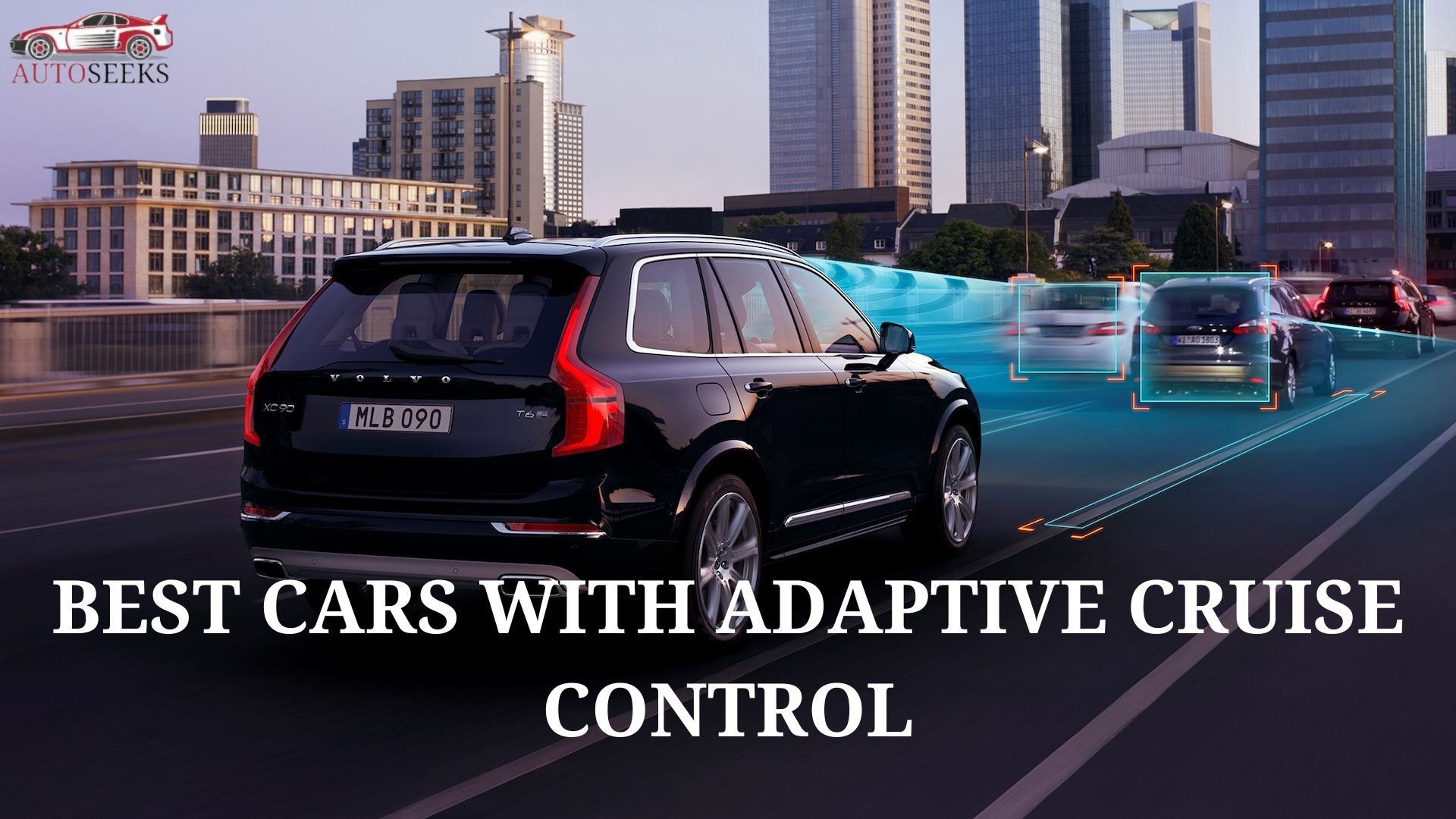
The hallmark of a great system is how invisible it feels while operating. You should look for systems that utilize a combination of long-range radar and wide-angle cameras to “see” traffic two or three cars ahead. This allows the vehicle to begin decelerating early rather than slamming on the brakes at the last second. When testing a vehicle, observe how aggressively it accelerates once the path clears. A smooth system mimics a human driver, while an inferior one can feel twitchy or overly cautious, leading to unnecessary frustration.
Step-by-Step Guide to Choosing the Right Cruise System
Analyzing System Integration
The user interface is just as critical as the sensors. You want a system where the controls are intuitive and accessible via steering wheel buttons rather than buried in a deep touchscreen menu. In 2026, the best vehicles display the cruise status clearly in the head-up display or the main instrument cluster. Look for systems that integrate map data to proactively slow down for tight highway curves or impending toll booths. This predictive intelligence drastically reduces the need for constant manual corrections.
- Check the steering wheel for dedicated, tactile ACC buttons that you can operate without looking down.
- Verify if the system allows you to adjust the following distance easily while the system is active.
- Test the lane-centering feature to ensure it doesn’t “ping-pong” between lane markers.
Matching the System to Your Vehicle Type
Different vehicle segments offer vastly different tiers of performance. Premium luxury sedans and SUVs in 2026 are currently leading with more refined, predictive software. However, mainstream brands like Toyota and Ford have closed the gap significantly. Ford’s BlueCruise has become a benchmark for hands-free highway driving, while Toyota Safety Sense 3.5 offers some of the most reliable and consistent distance-keeping in the mainstream market. When choosing your next vehicle, prioritize the manufacturer’s commitment to over-the-air updates, as these often improve the system’s performance long after you have driven off the lot.
Comparing Top-Tier vs. Budget-Friendly Cruise Systems
Recommended Best Deal Products


The 2026 automotive market reveals a widening gap between premium semi-autonomous suites and entry-level adaptive cruise control (ACC) systems. Premium offerings, such as Mercedes-Benz’s Drive Pilot or Tesla’s Full Self-Driving (Supervised), utilize high-fidelity LiDAR arrays and redundant thermal sensors. These systems offer “stop-and-go” capabilities in heavy congestion, maintaining lane centering with sub-centimeter precision even in inclement weather.
Performance Metrics of Premium Systems
Top-tier systems operate on a 360-degree sensor fusion platform. According to 2026 industry safety reports, these systems boast a 98% reduction in phantom braking events compared to economy-tier cameras. They process data at rates exceeding 50 teraflops, allowing for split-second reaction times that mirror human driving patterns in urban environments.

Audible — Listen Free for 30 Days
One free credit a month and thousands of titles included.
Listen Free for 30 DaysValue-Driven Implementation
Budget-friendly systems in the 2026 model year typically rely on a single front-facing radar unit and a monocular camera. While sufficient for highway cruising, these systems often struggle with rapid speed fluctuations. Research indicates that entry-level ACC can exhibit a “yo-yo” effect—jerky acceleration and braking—when navigating moderate traffic. While they effectively maintain distance, they lack the predictive software that optimizes fuel efficiency and passenger comfort found in luxury-tier counterparts.
What If It Still Doesn’t Work?
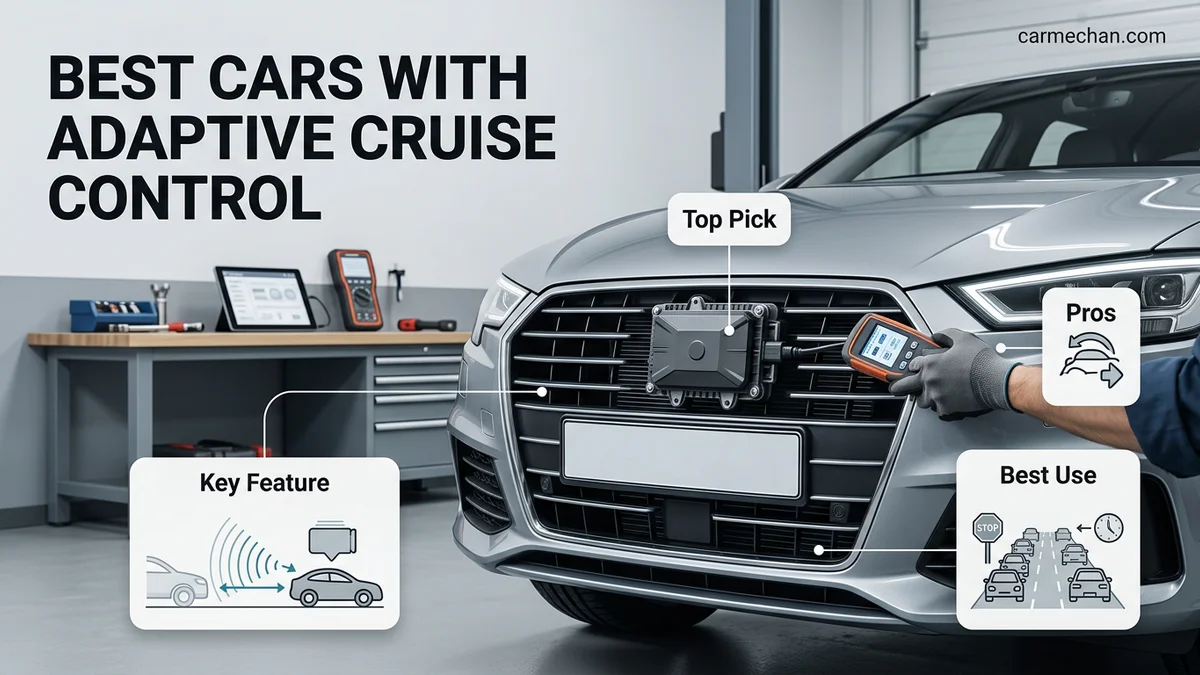
If your 2026 vehicle’s adaptive cruise control system remains unresponsive after basic sensor cleaning and system resets, the issue likely resides in the onboard diagnostic (OBD) network or radar misalignment. Follow these steps to resolve persistent failures before escalating to professional services.
- Check for Software Recalls: Visit the National Highway Traffic Safety Administration (NHTSA) website to confirm if a firmware patch has been released for your specific VIN.
- Perform a Hard Power Cycle: Disconnect the negative battery terminal for 15 minutes to force a full electronic control unit (ECU) reset.
- Inspect the Radar Mounting Bracket: Verify that the front emblem or bumper housing has not been shifted by a minor impact, which can throw the radar out of calibration.
- Consult a Certified Technician: If errors persist, a dealer must perform a “static calibration” using specialized laser-alignment tools.
Professional diagnostic and recalibration costs for 2026 models typically range between $350 and $800 depending on the complexity of the sensor array. Failure to address a misaligned system can lead to automated emergency braking false positives, which poses a significant safety risk during high-speed travel.
Conclusion
Recommended Best Deal Products


Adaptive cruise control is no longer a luxury feature; it is an essential tool for modern driver assistance in 2026. While high-end systems provide superior predictive logic, all units require regular sensor maintenance to function safely. According to verified research and expert sources from the Insurance Institute for Highway Safety, properly calibrated systems significantly decrease driver fatigue. For your next move, check your vehicle’s specific service manual to determine the exact frequency required for professional radar sensor recalibration.
❓ Frequently Asked Questions
How does adaptive cruise control differ from traditional cruise control?
Traditional cruise control maintains a fixed speed regardless of traffic, whereas adaptive systems use radar or cameras to automatically adjust speed to maintain a safe following distance.
Which entry-level cars offer the best value for cruise systems?
Toyota and Honda are industry leaders for providing robust safety suites, including adaptive cruise, as standard equipment on even their lowest-priced models.
Are ‘hands-free’ systems safer than ‘hands-on’ systems?
Hands-free systems allow for greater comfort but require advanced driver-facing cameras to ensure you remain attentive, whereas hands-on systems mandate physical contact with the wheel to confirm alertness.
Can I upgrade my car to have adaptive cruise control?
Generally, no; adaptive cruise control relies on complex sensor integration, braking system overrides, and software that must be factory-installed.
Do I need to maintain physical control while using adaptive cruise?
Yes, even the most advanced systems require the driver to remain fully alert and ready to take control immediately if the system detects an unexpected obstacle.
Audible Premium Plus — Annual Membership
12 audiobook credits up front, plus the full Audible catalogue.
See Annual PlansHow do I know if a system is right for my driving style?
If you drive primarily on highways, prioritize lane-centering stability; if you commute in city congestion, prioritize smooth braking transition and stop-and-go responsiveness.