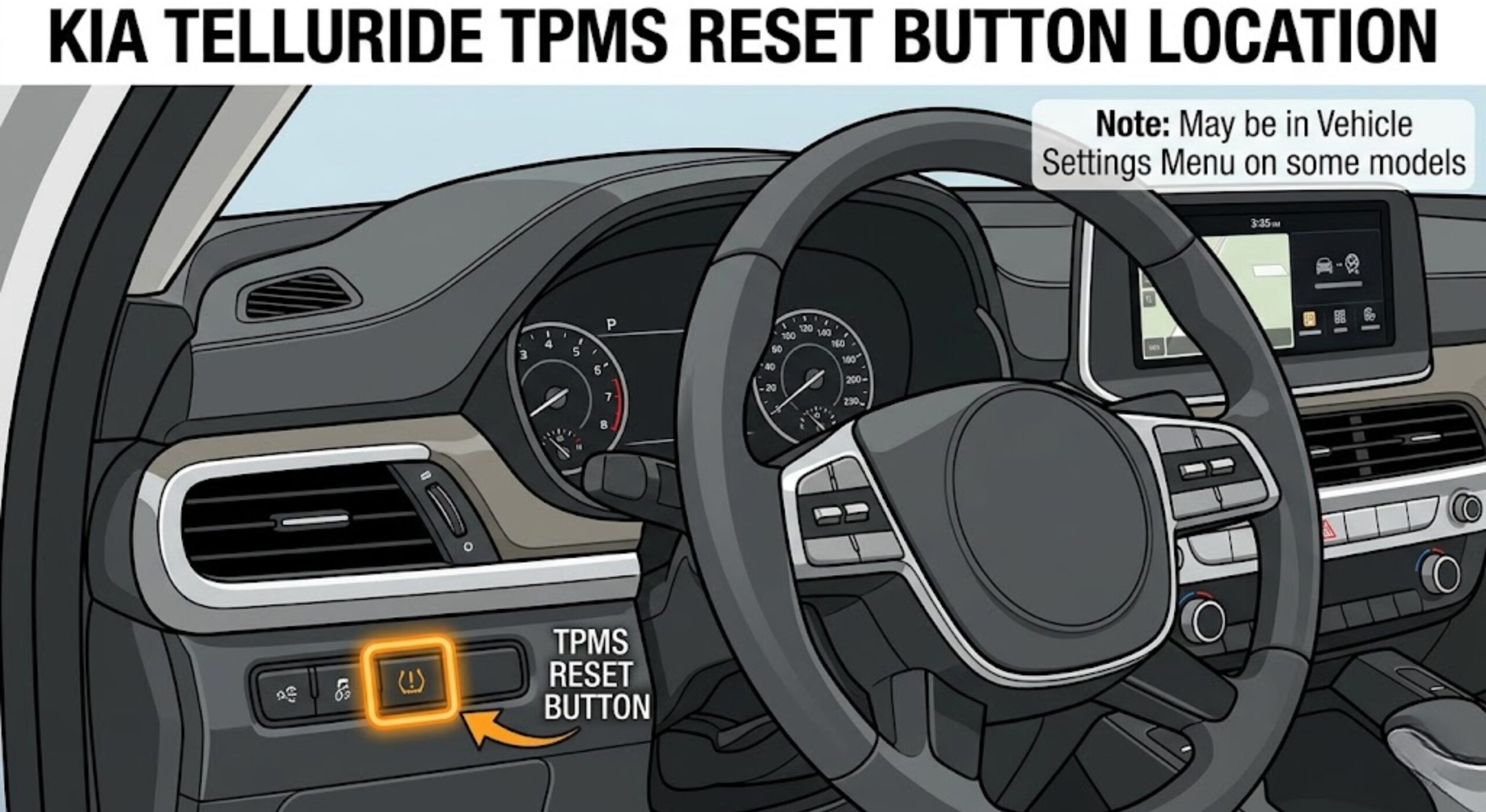
Kia Telluride TPMS Reset Button Location by Year and Method in 2026
Last Updated on September 1, 2026 by Ryan

If you’re searching for the Kia Telluride TPMS reset button location and coming up empty, you’re not missing it. The Kia Telluride does not have a traditional physical TPMS reset button — and that surprises a lot of owners who are used to other vehicles that do.

The correct reset method depends on three things: what triggered the warning, whether your light is solid or flashing, and what year Telluride you have. This guide maps the exact procedure to your specific situation so you follow only the steps that apply.
Does the Kia Telluride Have a TPMS Reset Button
The short answer: no. The Kia Telluride (2020–2026) does not have a physical TPMS reset button anywhere in the cabin — not under the steering wheel, not in the glove box, not on the dashboard.
This catches owners off guard because many other vehicles do have a dedicated reset button. The Toyota RAV4 4th generation, for example, has one hidden above the brake pedal — you can see how that Toyota RAV4 TPMS reset button location works on Carmechan. The Telluride takes a completely different approach.
Kia’s TPMS documentation references two system types: Type A, which resets fully automatically, and Type B, which includes a TPMS SET button. The Telluride uses a direct-sensor TPMS system that resets on its own once tires reach the correct pressure and the vehicle is driven. No button press is required for most situations.
TPMS has been federally required on all US passenger vehicles since September 2007 under NHTSA Federal Motor Vehicle Safety Standard 138. Every Telluride produced since the model launched in 2020 complies through direct wheel-mounted sensors, not a resettable dashboard control.
3 Conditions That Determine Your Reset Method
Before following any procedure, identify which of these three conditions applies to your situation.
Condition 1 — What triggered the warning. The most common trigger is a tire that dropped below the pressure threshold. Cold weather causes this frequently — tire pressure drops roughly 1 PSI for every 10°F drop in temperature. Other triggers include a tire rotation, a tire or wheel replacement, or a sensor that was replaced.
Condition 2 — Whether the light is solid or flashing. A solid TPMS light means a tire is below the pressure threshold. A flashing TPMS light — blinking for 60–90 seconds then staying on — means the system has detected a sensor malfunction or a sensor battery has failed. These two situations require completely different responses. Never attempt a standard pressure reset when the light is flashing.
Condition 3 — Your Telluride’s model year. All Telluride model years (2020, 2021, 2022, 2023, 2024, 2025, 2026) use the same auto-reset direct TPMS system. There is no year within the Telluride lineup that includes a physical SET button as standard equipment. The reset procedure is consistent across all production years.
The recommended cold tire pressure for all Kia Telluride models is 35 PSI. Always verify against the placard sticker on your driver’s door jamb — that number is specific to your vehicle’s trim and load rating.
Identify your condition before you reset
What Triggered the Warning
Low pressure, cold weather, tire rotation, replacement, or sensor swap — each has a different reset path.
Most common: low PSISolid Light vs. Flashing Light
Solid = pressure issue. Flashing for 60–90 sec = sensor malfunction. These need completely different fixes.
Critical distinctionYour Model Year
All Telluride years 2020–2026 use the same auto-reset system. No physical SET button exists on any year.
2020 – 2026: identicalHow To Reset Kia Telluride TPMS Without a Button
This is the correct procedure for the vast majority of Telluride owners — a solid TPMS light triggered by low tire pressure.
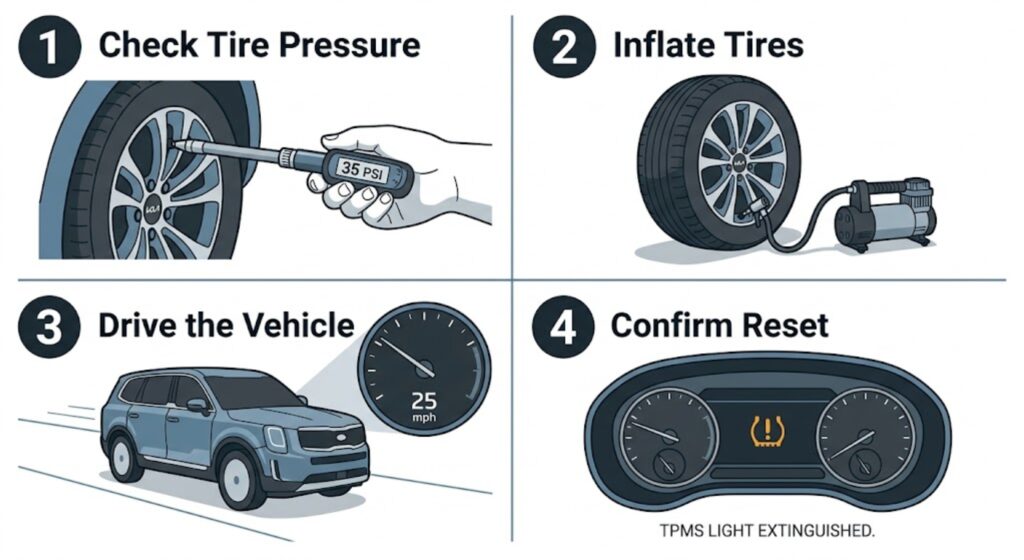
- Check all four tires cold. Tire pressure readings are only accurate when the vehicle has not been driven for at least three hours. Hot tires read 4–6 PSI higher than their actual cold pressure.
- Inflate all four tires to 35 PSI. Use a reliable tire inflator with a built-in pressure gauge — guessing or eyeballing PSI is the single most common reason a TPMS reset fails. Check the driver’s door jamb placard to confirm your specific model’s target pressure.
- Start the vehicle and drive at 25 mph or above for 10–20 minutes. The TPMS sensors need vehicle motion and a consistent speed to transmit updated pressure readings to the system. Sitting still in the driveway after inflating will not clear the light.
- Confirm the light goes off. Once the system registers correct pressure on all four sensors, the TPMS warning light will extinguish on its own. No button press needed.
Standard TPMS reset — no button required
Check Tires Cold
Vehicle undriven for 3+ hours. Hot tires read 4–6 PSI high.
Inflate to 35 PSI
All four tires. Confirm on door jamb placard.
Drive 25+ mph
10–20 minutes of driving. Sensors transmit updated readings.
Light Goes Off
System self-resets. No button press needed.
After Step 4 — what happens next?
If the light is solid after all four tires are correctly inflated and you have driven for 20 minutes: the system has not yet recalibrated. Go to the next section for the escalating fix sequence.
How To Check Tire Pressure on the Telluride Instrument Cluster
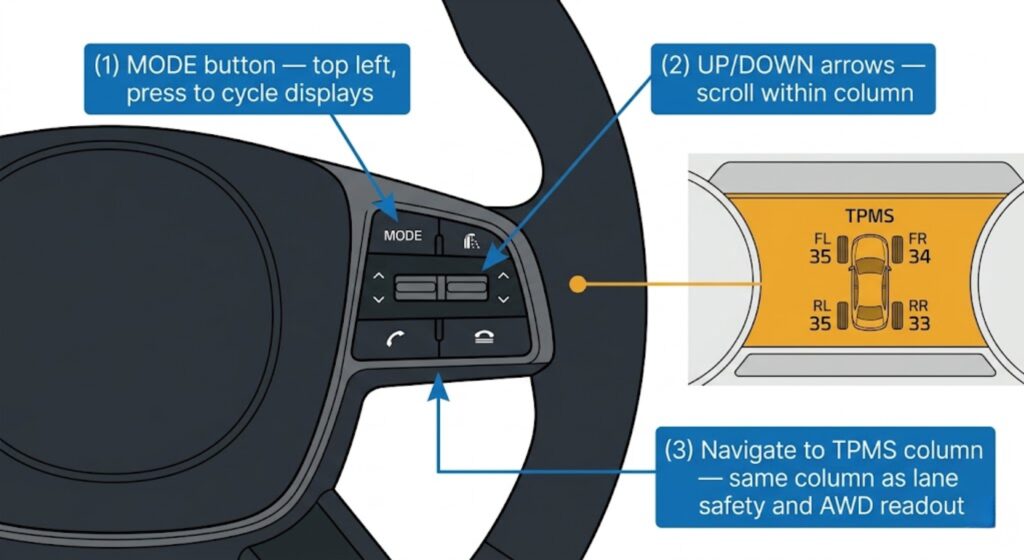
The Telluride shows individual tire pressure readings on the instrument cluster — a useful tool for confirming which tire is the problem before inflating.
Access the reading using the steering wheel controls:
- Press the Mode button on the right side of the steering wheel to cycle through the instrument cluster displays.
- Use the up/down arrow buttons to scroll within the current column.
- Look for the TPMS screen — it sits in the same column as the lane safety and AWD readout.
- The display shows individual PSI for each wheel position.
Note: the cluster display will not show live PSI readings until the vehicle is moving. Readings update in real time once you drive.
How to reach the TPMS screen on your Telluride
Steering Wheel — Right Side Buttons
Instrument Cluster — TPMS Screen
⚠ Tire Pressure Monitor
Front L
35
PSI
Front R
35
PSI
Rear L
34
PSI
Rear R
26
PSI ⚠
Amber value = tire below threshold.
Inflate that tire first.
If the light is on but all four readings look normal on the cluster, this is a strong indicator of a sensor issue rather than a pressure issue — which points to the Faulty Sensor section.
What To Do When the Telluride TPMS Light Stays On
If you have inflated all four tires to 35 PSI and driven for 20 minutes and the solid light remains, work through these fixes in order.
Fix 1 — Over-inflate, deflate, and reinflate. Add air to 3 PSI above the recommended level on all four tires, including the spare if your Telluride is equipped with one. Then deflate every tire completely. Once all air is out, reinflate each tire one at a time to exactly 35 PSI. Drive for 10 minutes. This forces the system to re-register fresh pressure baselines across all sensors.
If Fix 1 clears the light: you are done. The system had stored a bad baseline that needed to be purged.
If Fix 1 does not clear the light: proceed to Fix 2.
Fix 2 — Battery disconnect reset. Turn the vehicle off. Open the hood and use a wrench to disconnect the positive battery terminal. Once disconnected, press the horn for approximately three seconds — this drains any residual electrical charge stored in the system. Reconnect the battery, start the vehicle, and drive for 10 minutes.
If Fix 2 clears the light: the system’s stored fault was cleared by the power reset.
If Fix 2 does not clear the light and it remains solid: a sensor may be failing. Schedule a TPMS diagnostic scan at a Kia dealer or an independent shop equipped with a TPMS scan tool.
If at any point the light changes from solid to flashing during these fixes: stop the sequence and go directly to the Faulty Sensor section below.
When To Reset TPMS After Tire Rotation or Replacement
Tire rotation is the most common situation where Telluride owners find the TPMS light comes on even though all tires are at the correct pressure. Here is why.
Each TPMS sensor is a physical unit mounted inside the wheel. When a shop rotates your tires, those sensors move to new wheel positions. The Telluride’s system expects each sensor ID to correspond to a specific wheel location — front left, front right, rear left, rear right. After rotation, the system detects that sensor positions have changed and triggers the warning.
The Kia owner’s manual identifies five situations that require a deliberate TPMS reset:
- After repairing or replacing tires or wheels
- After rotating tires
- After adjusting tire pressure to a new standard
- When the low tire pressure indicator illuminates
- After replacing suspension or ABS system components
For all five situations on the Telluride, the reset procedure is the same: inflate all tires to correct PSI, drive at 25 mph or above for 15–20 minutes, and allow the system to self-learn the new sensor positions. No button press is needed.
If the light does not clear within two drive cycles after a rotation, use the over-inflate/deflate method from Fix 1 above to force the system to re-register all sensor baselines.
Kia Telluride TPMS Reset Method by Year and Situation
Use this table to confirm the right path for your specific Telluride and situation.
Find your situation — get the right method
| Model Year | Situation | Button? | Reset Method | If Light Stays On |
|---|---|---|---|---|
| 2020–2026 | Solid light — low pressure | None | Inflate to 35 PSI, drive 15–20 min at 25+ mph | Fix 1 (over-inflate/deflate) → Fix 2 (battery disconnect) |
| 2020–2026 | After tire rotation | None | Inflate to 35 PSI, drive 15–20 min at 25+ mph | Fix 1 → dealer TPMS scan |
| 2020–2026 | After new tires or wheels | None | Inflate to 35 PSI, drive 15–20 min at 25+ mph | Fix 1 → Fix 2 |
| 2020–2026 | After sensor replacement | None | Drive 15–20 min above 25 mph | Dealer TPMS relearn tool required |
| 2020–2026 | ⚠ Flashing light | Stop | Do NOT attempt a pressure reset | Dealer diagnostic only — sensor battery or fault |
All Telluride model years 2020–2026 use the same direct TPMS system. No physical reset button exists on any trim or configuration.
All Telluride model years from 2020 through 2026 use the same direct TPMS system. There are no year-specific button locations to look for — the system is consistent across the entire production run.
When the TPMS Light Means a Faulty Sensor
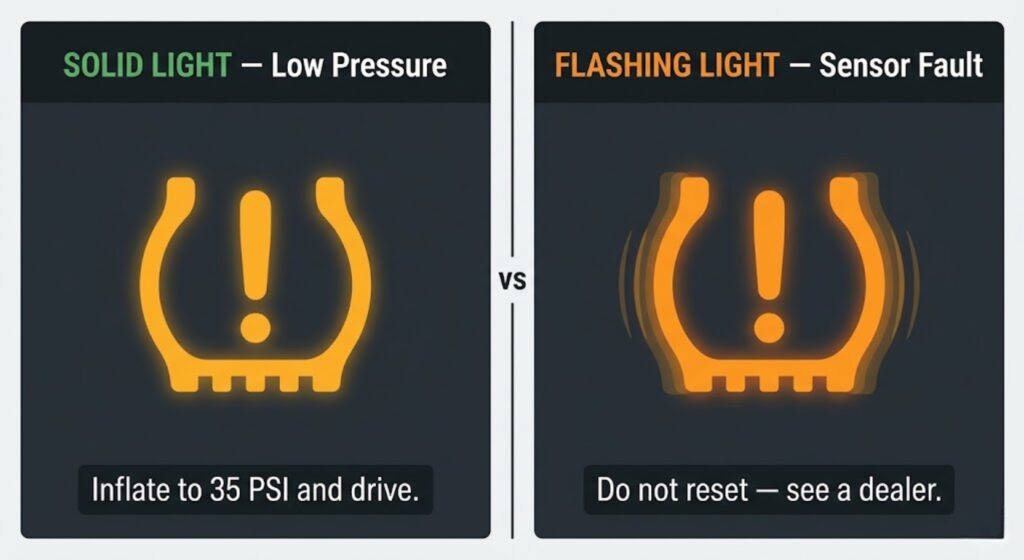
If none of the methods above have cleared the light, or if the light is flashing rather than staying solid, the system is no longer telling you about tire pressure. It is telling you about a sensor problem.
A flashing TPMS light — specifically one that blinks rapidly for 60–90 seconds each time you start the vehicle before settling into a steady glow — is the Telluride’s indicator that one or more sensors have failed or that a sensor battery has died. TPMS sensors run on internal lithium batteries that typically last 7–10 years. On high-mileage Tellurides or pre-owned vehicles with unknown service history, this is worth checking first.
If the light is flashing: do not attempt further resets. No amount of inflating, deflating, or battery disconnects will clear a sensor malfunction — only a TPMS-capable scan tool can read the fault code and identify which sensor has failed.
At a Kia dealer or an independent shop with a TPMS relearn tool, a technician will:
- Scan each sensor to read its fault code
- Identify whether the issue is a dead sensor battery or a full sensor failure
- Replace the faulty sensor if needed
- Perform a TPMS relearn to register the new sensor ID to the correct wheel position
Replacement TPMS sensors for the Kia Telluride (part number 96227TQGV for 2020–2025 models) run approximately $30–$45 per sensor for the part alone. Labor for replacement and relearn typically adds $40–$75 at an independent shop.
If you see a steady solid light after every reset attempt and no tire is actually low on pressure, that is also a sensor issue — the sensor may be reading incorrectly rather than failing to transmit entirely.
Frequently Asked Questions
Does the Kia Telluride have a TPMS reset button?
No. The Kia Telluride (2020–2026) does not have a physical TPMS reset button anywhere in the cabin. The system resets automatically after tires are inflated to 35 PSI and the vehicle is driven at 25 mph or above for 10–20 minutes. If the light stays on after that, the over-inflate/deflate method or a battery disconnect reset are the next steps.
Where is the TPMS reset button on a 2022 Kia Telluride?
There is no physical TPMS reset button on any 2022 Kia Telluride — or any model year Telluride. Owners searching under the steering wheel or in the glove box will not find one because it does not exist on this vehicle. The correct reset method is to inflate all tires to 35 PSI and drive for 15–20 minutes.
Why is my Kia Telluride TPMS light still on after I filled the tires?
The most common cause is not enough drive time after inflating. The sensors need vehicle motion to transmit updated readings. Drive at 25 mph or above for at least 15–20 minutes. If the light remains after that, try the over-inflate-to-38-PSI, full deflation, and reinflation method to reset the system’s stored pressure baseline.
What PSI should I use to reset the Kia Telluride TPMS?
The Kia Telluride recommended cold tire pressure is 35 PSI for all four tires. Always check the sticker on your driver’s door jamb to confirm the pressure for your specific trim. Inflate to exactly 35 PSI — not 33 or 34 — before attempting the auto-reset by driving.
Do I need to reset TPMS after rotating tires on the Kia Telluride?
Yes. After a tire rotation, the physical sensors move to new wheel positions. The system needs to re-learn which sensor ID corresponds to which location. Inflate all four tires to 35 PSI and drive at 25 mph or above for 15–20 minutes. If the light stays on after two drive cycles, use the over-inflate/deflate method to force a full system reset.
Conclusion
The Kia Telluride TPMS reset button location is a question with a clear answer: there is no button. Every Telluride from 2020 through 2026 uses an auto-reset direct TPMS system. Inflate all four tires to 35 PSI cold, drive for 15–20 minutes at 25 mph or above, and the system resets on its own.
If the light stays on after correct inflation and driving, work through Fix 1 (over-inflate/deflate/reinflate) then Fix 2 (battery disconnect). If the light is flashing rather than solid, those fixes will not help — that is a sensor issue that needs a TPMS scan tool at a shop.
If you have worked through every step here and the light is still on, a TPMS diagnostic at your local Kia dealer or independent shop is the right next move.