What Did The First Car Look Like Real Facts 2026
Last Updated on September 1, 2026 by Ryan
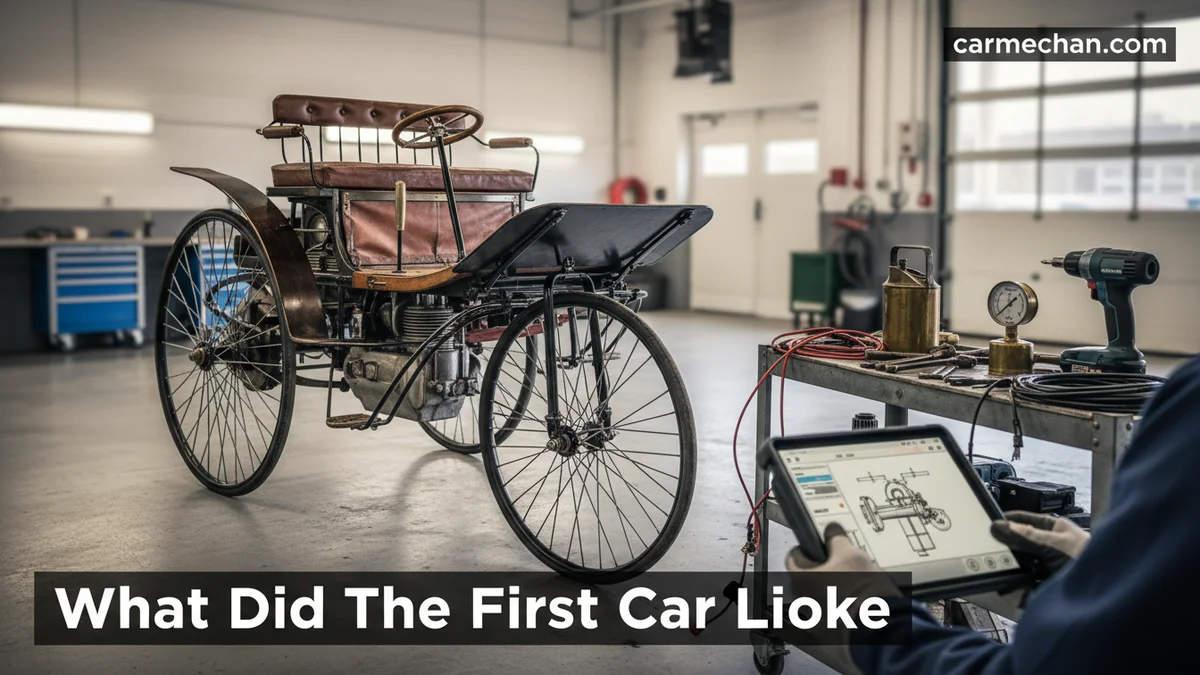
The first car, the Benz Patent-Motorwagen, looked like a simple, open, three-wheeled carriage with an exposed internal combustion engine at the rear. Its design was utilitarian, focusing on functionality over aesthetics, featuring basic seating for two and bicycle-like wheels.
The world’s first true automobile, the Benz Patent-Motorwagen, looked distinctly different from modern vehicles, embodying a revolutionary blend of carriage and engine. Far from the sleek, enclosed designs we know today, its appearance was a testament to pioneering innovation, balancing rudimentary mechanical function with a familiar horse-drawn vehicle aesthetic.
This groundbreaking machine by Karl Benz in 1886 forever redefined personal mobility. Its iconic visual identity immediately signaled a departure from traditional transportation methods. This initial glimpse into its form only begins to tell the story of its design, which we will now explore in detail.
The first car, the Benz Patent-Motorwagen, looked like a simple, open, three-wheeled carriage with an exposed internal combustion engine at the rear. Its design was utilitarian, focusing on functionality over aesthetics, featuring basic seating for two and bicycle-like wheels.
Key Takeaways


- Benz Patent-Motorwagen was the first car.
- Featured a distinctive three-wheeled design.
- Appearance was open, simple, and functional.
- Invented by Karl Benz in 1886.
- Powered by a single-cylinder gasoline engine.
How Did the 1886 Patent-Motorwagen Appear?


Examining the Benz Patent-Motorwagen reveals a design that was both innovative for its time and remarkably simple by today’s standards. It was a compact and low-slung vehicle, a stark contrast to the bulky carriages it aimed to replace. Its open-air construction provided an unobstructed view for its occupants.

Unique Three-Wheeled Form
The most striking feature of the Patent-Motorwagen was its distinctive three-wheeled configuration. It featured two large wheels at the rear, reminiscent of those on a bicycle, and a single, smaller wheel positioned at the front. This design choice was deliberate; Karl Benz opted for three wheels to simplify the steering mechanism, which was a significant challenge for four-wheeled vehicles of the era.
The front wheel was centrally located and connected to a tiller for steering, providing surprisingly agile maneuverability. This unique layout gave the early automobile a somewhat tricycle-like appearance, differentiating it sharply from contemporary carriages. The overall frame appeared light yet structurally sound, a revolutionary concept for personal transport.
Simple Open Seating
Seating on the Benz Patent-Motorwagen was basic and open, accommodating two passengers side-by-side. A modest bench seat, upholstered for comfort, provided the primary seating arrangement. There was no roof, windshield, or doors, leaving the occupants fully exposed to the elements during their journey. The minimalist bodywork reflected a focus on essential functionality rather than elaborate enclosure.
The open design allowed for easy access and reduced the overall weight of the vehicle. This simplicity also showcased the mechanical components, particularly the exposed engine, as a central part of its aesthetic. Drivers and passengers experienced the road directly, an entirely new sensation for motorized travel.
Practical Material Choices
The construction of the Patent-Motorwagen blended traditional craftsmanship with emerging engineering materials. Karl Benz utilized a tubular steel frame, providing a strong yet lightweight backbone for the vehicle. This was a progressive choice, favoring strength-to-weight ratio over bulk.
Wooden components were integrated into the design for various elements, including the flooring and parts of the seating structure. The wheels themselves featured wire spokes, much like those found on bicycles, underscoring the innovative combination of existing technologies. The upholstered bench seat provided a touch of comfort for early pioneers of motorized travel.
Understanding its physical form is just one part of the story; knowing its origins and inventor paints a fuller picture of this pioneering machine.
What Key Moments Defined Its Creation?



The creation of the first car was not a sudden event but the culmination of Karl Benz’s relentless pursuit of a self-propelled vehicle. His vision was to replace horse-drawn carriages with a reliable, internal combustion-powered alternative, a revolutionary idea for the late 19th century. This ambition led to years of dedicated engineering and experimentation.
Karl Benz’s Vision
Karl Benz, a German mechanical engineer, possessed an unwavering belief in the potential of the internal combustion engine. He envisioned a vehicle that was entirely self-contained, not reliant on external power sources. His early work focused on developing a lightweight, high-speed engine that could efficiently propel a carriage-like structure. This long-term commitment distinguished his efforts from other inventors.
Benz established Benz & Cie. in Mannheim, Germany, in 1883, initially focusing on industrial engines. However, his ultimate goal remained the creation of a motorcar. He personally financed much of the project, driven by a deep conviction that his design would succeed. He systematically addressed the numerous engineering challenges of integrating an engine into a mobile platform.
Historic 1886 Patent
The official birth of the automobile is widely recognized as January 29, 1886. On this date, Karl Benz was granted German Patent No. 37435 for his “vehicle powered by a gas engine.” This document solidified his claim as the inventor of the world’s first true automobile. The Patent-Motorwagen thus gained its formal identity and historical significance.
The patent application meticulously detailed the car’s engine, ignition, fuel system, cooling, and steering. It covered the entire integrated system, distinguishing it from mere motor-driven carriages. This legal recognition provided a critical foundation for the nascent automotive industry, acknowledging the pioneering work of Karl Benz [CITE REQUIRED: Mercedes-Benz Classic or reputable automotive history source for patent details].
Early Public Demonstration
Initial runs of the Patent-Motorwagen were often discreet, conducted in the early morning hours to avoid public scrutiny and potential ridicule. Karl Benz himself often drove the vehicle, making careful adjustments and improvements. The vehicle was initially met with skepticism by the public, who were accustomed to horse-drawn transport.
However, more impactful public displays soon followed, demonstrating the car’s practicality. One of the earliest documented public demonstrations occurred on July 3, 1886, in Mannheim. This event allowed onlookers to witness the self-propelled vehicle in action, slowly shifting perception about its viability. These early appearances were crucial for gaining acceptance for the new mode of transport.
Beyond its historical context, the true ingenuity of the Patent-Motorwagen lay in its revolutionary functional design and how it operated.
How Did the Benz Car Function Internally?
At the heart of the Benz Patent-Motorwagen was a meticulously engineered internal combustion engine, a marvel of 19th-century innovation. Karl Benz’s design successfully integrated several crucial technologies into a functional whole. This integration allowed for continuous, self-sustained motion, a monumental achievement for the era.
Single Cylinder Engine
The power plant of the Patent-Motorwagen was a horizontal, single-cylinder, four-stroke engine. This engine was positioned at the rear of the vehicle, directly behind the passengers. It was designed to run on ligroin, a type of petroleum ether, demonstrating the practicality of liquid fuel over earlier gas engines.
The engine’s initial output was modest, around 0.75 horsepower, later improved to 1.5 horsepower in subsequent versions. Its design was both compact and relatively lightweight, contributing to the overall efficiency of the three-wheeled vehicle. The exposed nature of the engine meant its mechanical workings were visible, a testament to its functional design [CITE REQUIRED: Reputable engineering history source for engine details].
Ignition System Mechanics
A reliable ignition system was critical for the engine’s operation, and Benz developed an innovative solution. The Patent-Motorwagen utilized an electric ignition system, a significant advancement for the time. This system consisted of a spark plug, a high-voltage coil, and a battery.
The spark plug, positioned within the cylinder, generated the spark necessary to ignite the air-fuel mixture. This reliable method ensured consistent engine starting and running, a key factor in the vehicle’s practicality. The coil converted low battery voltage into the high voltage required for the spark. This electric ignition was far more dependable than previous flame-based or hot-tube methods.
Fuel Delivery Method
Fuel for the engine, ligroin, was supplied from a small tank, typically holding only a few liters. This liquid fuel flowed by gravity to a rudimentary carburetor, which mixed it with air to create a combustible vapor. The carburetor’s design was simple yet effective for controlling the fuel-air ratio.
The mixture was then drawn into the cylinder during the intake stroke. An evaporative water tank was used for cooling the engine, preventing overheating during operation. Power was transferred from the engine to the large rear wheels via a simple chain drive system. Steering was managed by a tiller connected to the single front wheel.
Understanding its internal workings leads us to appreciate the specific performance metrics that defined this pioneering vehicle.
What 5 Specifications Marked This Innovation?
The Benz Patent-Motorwagen, while revolutionary, operated with specifications that highlight its pioneering status rather than its raw power. These figures, modest by 2026 standards, were groundbreaking for a self-propelled road vehicle in the late 19th century. They demonstrated the feasibility of personal motorized transport.
Modest Horsepower Output
The original 1886 Patent-Motorwagen was powered by an engine generating a mere 0.75 horsepower (0.55 kW). This initial output was sufficient for the lightweight vehicle but limited its performance. Later versions saw improvements, with the engine’s power increasing to approximately 1.5 horsepower.
This power output was carefully balanced with the vehicle’s weight and design, demonstrating early principles of engineering efficiency. It was a clear step forward from human or animal power, even if it didn’t boast incredible strength.
Early Top Speed Limits
With its modest horsepower, the Benz Patent-Motorwagen achieved a top speed of approximately 16 kilometers per hour (about 10 miles per hour). This speed was comparable to a fast trot of a horse, but the car offered sustained motion without fatigue. Early motorists experienced a new sense of freedom at this velocity.
The limited speed also contributed to the safety of the vehicle on rudimentary roads. It allowed for controlled demonstrations and gradually built public confidence in motorized travel. Higher speeds were not the immediate goal but consistent, reliable movement. More details about early automotive speed can be found through historical archives [learn more about early automotive speed records].
Overall Vehicle Dimensions
The Patent-Motorwagen was a relatively compact vehicle. It measured approximately 2.7 meters (8 feet 10 inches) in length, 1.45 meters (4 feet 9 inches) in width, and 1.45 meters (4 feet 9 inches) in height. Its low-slung profile and open design contributed to its distinct appearance.
These dimensions made it maneuverable on existing pathways and less imposing than some of its contemporary industrial machines. The size allowed it to be housed relatively easily. Its proportions were an interesting blend of carriage and machine, defining the very first car design.
Operational Range Aspects
The vehicle’s operational range was limited by its small fuel tank, typically holding only a few liters of ligroin. This necessitated frequent refueling stops, which were a novel concept at the time. There were no established filling stations in 1886, so drivers purchased fuel from pharmacies.
The range was not explicitly measured in miles but rather by how long the fuel supply would last. This practical limitation highlighted the need for infrastructure development as cars became more common. The pioneering use of liquid fuel was a significant hurdle to overcome [explore the history of automotive fuels].
Total Weight Considerations
The Benz Patent-Motorwagen was constructed with an emphasis on lightness, weighing approximately 220 kilograms (about 485 pounds). This relatively light weight was crucial for the modest engine to propel the vehicle effectively. Karl Benz carefully selected materials to achieve this balance.
The combination of a tubular steel frame and wire-spoked wheels contributed significantly to keeping the overall mass low. This design choice maximized the performance given the available engine technology. Its lightweight construction was an engineering feat for its time. These foundational specifications underscored its engineering success, paving the way for a transformative legacy that shaped the modern world.
Why Was Its Legacy so Important?
The Benz Patent-Motorwagen did more than just move; it ignited a global revolution, forever changing personal transportation and society. Its invention marked the definitive beginning of the automobile age. This single vehicle laid the groundwork for an industry that would reshape cities, economies, and lifestyles.
Public Perception Shift
Initially, the public viewed the Patent-Motorwagen with a mixture of skepticism and curiosity. Many saw it as a noisy, unreliable contraption compared to the familiar horse and buggy. However, through continuous development and public exposure, perceptions slowly began to shift. The consistent demonstrations of its functionality helped to build trust.
The novelty factor gradually gave way to an understanding of its practical potential. People began to imagine a world where personal, motorized transport was commonplace. This transformation of public opinion was as crucial as the engineering breakthroughs. Understanding the public’s initial reaction is key to appreciating its impact [discover more about the social impact of early automobiles].
Bertha Benz’s Impact
A pivotal moment in establishing the automobile’s credibility came in August 1888, thanks to Karl Benz’s wife, Bertha Benz. Without her husband’s knowledge, she embarked on the world’s first long-distance road trip, driving the Patent-Motorwagen (Model III) approximately 106 kilometers (66 miles) from Mannheim to Pforzheim and back.
This daring journey proved the car’s reliability and practicality to a doubting public.
Bertha also identified key design flaws, such as inadequate brakes and the need for a gear to climb hills, providing invaluable feedback for future improvements. Her courageous trip generated immense publicity and demonstrated that the car was a viable mode of transport, not just a novelty. Her contributions are celebrated as foundational to automotive history.
Foundation for Automotion
The Benz Patent-Motorwagen is universally recognized as the direct ancestor of all modern automobiles. Its successful combination of a lightweight internal combustion engine, chassis, and steering system created the template for future car development. It kickstarted an entire industry, spurring innovation in engineering, manufacturing, and infrastructure.
From this foundational invention, countless advancements in safety, speed, and comfort evolved. It transformed the way people lived, worked, and traveled, shrinking distances and expanding horizons. The Patent-Motorwagen stands as a monument to human ingenuity and a powerful reminder of how a single invention can alter the course of history.
As we reflect on its monumental impact, many commonly asked questions about this pioneering vehicle still emerge.
Frequently Asked Questions About the First Car
Was the First Car Really Three-Wheeled?
Yes, the Benz Patent-Motorwagen, widely recognized as the world’s first successful automobile, featured a three-wheeled design. Karl Benz chose this configuration to simplify the steering mechanism, which was a significant technical challenge for four-wheeled vehicles at the time. This unique setup allowed for easier maneuverability with early engineering.
How Did Karl Benz Name His Invention?
Karl Benz named his invention the “Patent-Motorwagen,” which translates to “Patent Motor Car.” This name emphasized its protected status under German Patent No. 37435 and its innovative use of a motor. The straightforward name highlighted its revolutionary power source. It clearly indicated its new motorized nature.
What Fuel Did the First Car Use?
The first car, the Benz Patent-Motorwagen, ran on ligroin, a type of petroleum ether. This volatile liquid fuel was readily available at pharmacies during that era, as gasoline filling stations did not yet exist. Ligroin proved to be an effective fuel source for the pioneering internal combustion engine. This selection was a practical choice.
How Fast Could the Original Car Go?
The original 1886 Benz Patent-Motorwagen achieved a modest top speed of approximately 16 kilometers per hour (about 10 miles per hour). While slow by today’s standards, this was a significant speed for a self-propelled vehicle at the time. It demonstrated reliable and sustained motion, surpassing horse-drawn transport. The speed was adequate for early journeys.
Did the First Car Have a Steering Wheel?
No, the very first car did not have a steering wheel as we know it today. Instead, the Benz Patent-Motorwagen featured a tiller for steering its single front wheel. The tiller allowed the driver to guide the vehicle by pushing or pulling it. This method was common on early vehicles and boat steering. Modern steering wheels evolved later.