Dodge Charger Cruise Control Not Working: Diagnosed & Fixed
Is your Dodge Charger failing to lock in your speed on the highway, leaving you manually managing your throttle for miles? Cruise control failure is rarely just a “broken button”; it is usually a symptom of a larger safety system detecting an inconsistency in your Charger’s electronic health. Because modern vehicle systems are deeply interconnected, a fault in a secondary component can trigger a cascade that disables the cruise control module as a protective measure. In this guide, we will break down the diagnostic steps to isolate the issue, from simple sensor obstructions to complex electrical bus communication failures, helping you navigate the fix with precision.
Identifying Why Your Dodge Charger Cruise Control Is Not Working

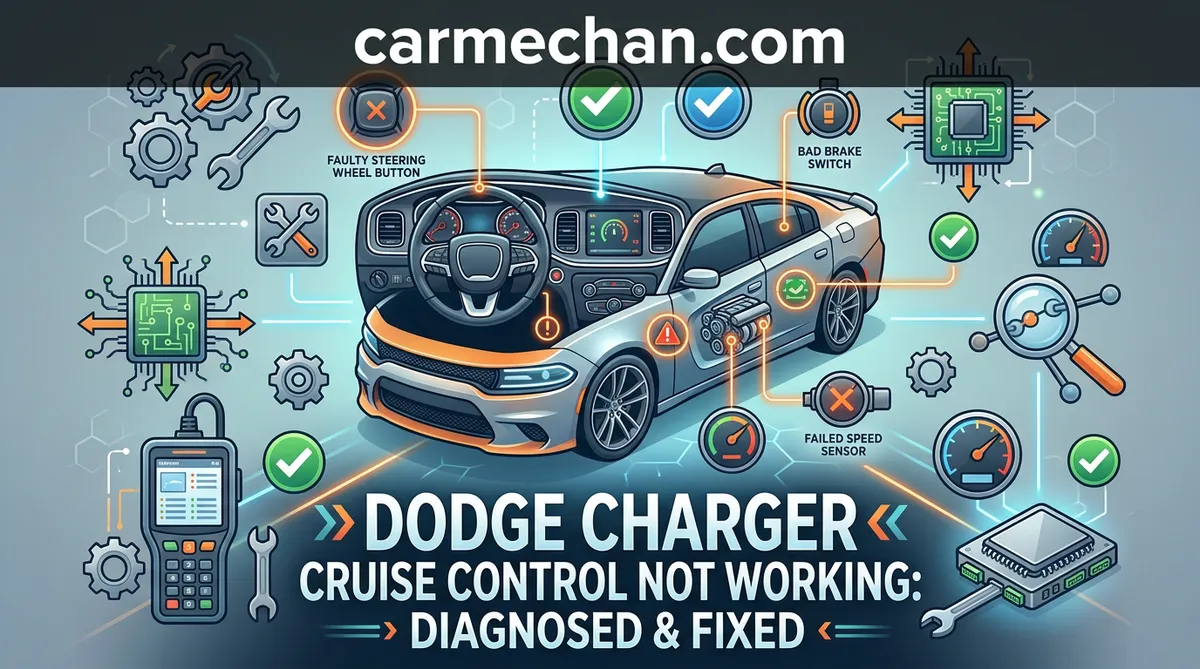
To effectively troubleshoot, you must understand that the cruise control module does not operate in a vacuum. It relies on a constant stream of data from the Powertrain Control Module (PCM), the Anti-lock Braking System (ABS), and the Electronic Stability Control (ESC) unit.
📤 Share Image

The Role of ABS and Stability Control Interlocks
The cruise control system is considered a safety-critical feature. Consequently, it is programmed to automatically disable itself if the ABS or ESC system detects an inconsistency. For example, if a single wheel speed sensor fails, the ABS light will illuminate, and the PCM will immediately inhibit the cruise control functionality to ensure the driver maintains full manual control of the vehicle’s speed.
How Low Battery Voltage Triggers Electronic Faults
Dodge Chargers are sensitive to voltage fluctuations. If your battery is nearing the end of its life or the alternator is outputting erratic voltage, electronic modules may experience “dropouts.” These micro-fluctuations often cause the cruise control module to lose communication with the CAN bus, resulting in a system failure even if the hardware is mechanically sound.

Standard vs. Adaptive Cruise Control Systems
It is vital to distinguish between standard cruise control and Adaptive Cruise Control (ACC). While both fail due to general electrical issues, ACC is far more temperamental. It relies on a front-mounted radar sensor, which is easily blinded by mud, heavy snow, or even slight misalignment, leading to an immediate “Service ACC” notification on your dashboard.
Industry Data: Common Failure Drivers
Code-Related Disables
Sensor/Switch Issues
Troubleshooting Dodge Charger Cruise Control Electrical Faults
Once you have ruled out obvious external obstructions, you must move into the cabin and chassis components to diagnose the electrical source of the issue.
Testing the Brake Pedal Position Sensor
The brake pedal position sensor serves as the primary “off-switch” for cruise control. If this switch is faulty or stuck, the vehicle may believe the brake is being depressed constantly, preventing the cruise control from engaging. A simple diagnostic test involves checking if your brake lights stay illuminated long after you have removed your foot from the pedal; if they do, you have found your culprit.
Clockspring Wear and Steering Wheel Control Failures
For buttons located on the steering wheel, the internal clockspring is a frequent failure point. As the wheel turns over thousands of miles, the electrical ribbons inside the clockspring can fray. This often causes intermittent functionality of the cruise control, or occasionally the horn or airbag light, as the connection to the steering wheel column is lost.
Wheel Speed Sensor Integrity and Data Feedback
The PCM requires accurate speed data from all four wheels to operate the cruise control safely. If a wheel speed sensor transmits corrupted data to the CAN bus, the system will disable cruise control to prevent a sudden acceleration or deceleration mismatch. Checking these sensors with a diagnostic scanner is the fastest way to isolate a single failing wheel unit.
How to Fix Dodge Charger Cruise Control Malfunctions
📋
Step-by-Step Guide
Use a high-quality OBD-II scanner capable of reading chassis (C-series) and network (U-series) codes. Simple powertrain scanners are often insufficient for these specific electrical issues.
If your Charger is equipped with ACC, ensure the front radar unit (located in the grille area) is free of debris. Use a gentle cleaner, as damaging the sensor housing can lead to costly replacements.
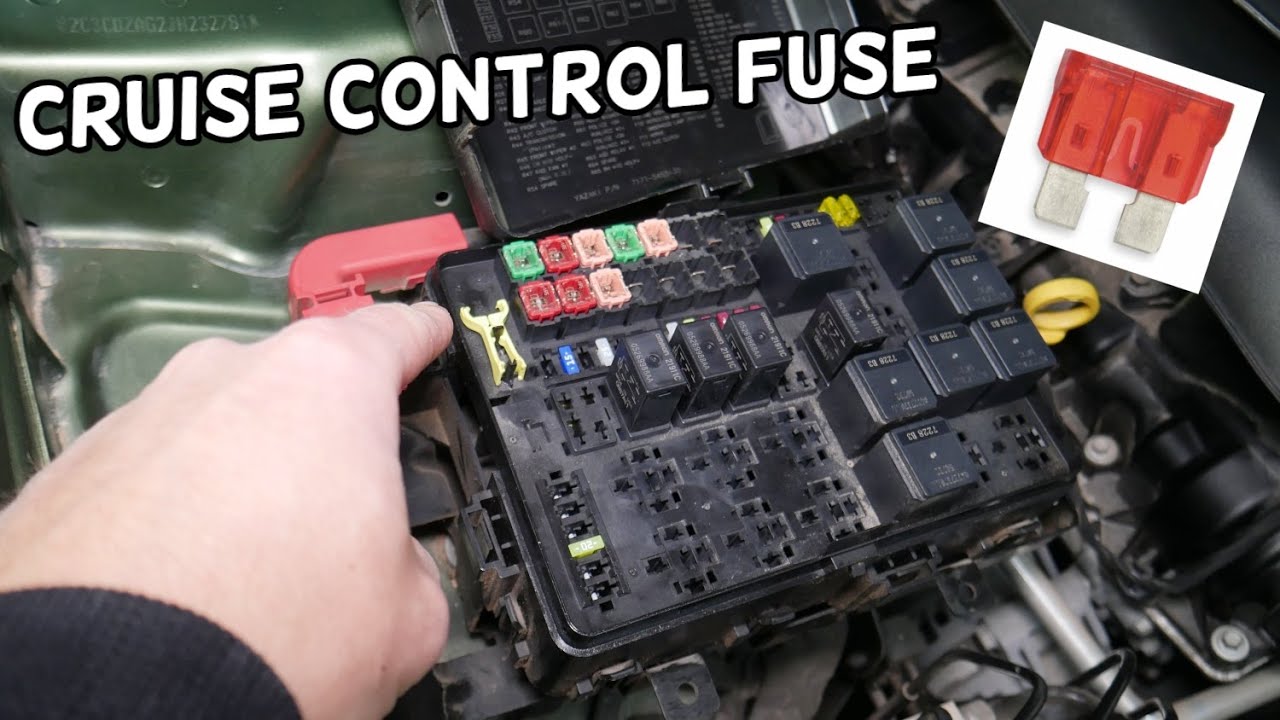
Check your power distribution center (fuse box). Look for blown fuses related to the “Speed Control” or “PCM.” Even if the fuse appears intact, test it with a multimeter for continuity.
If you have replaced a sensor, remember to perform a “hard reset” by disconnecting the negative battery terminal for 15 minutes. This forces the modules to clear temporary cache errors and re-learn the system communication status.
Advanced Diagnosis for Dodge Charger Speed Control Issues
If basic checks fail, the issue likely resides within the Controller Area Network (CAN) bus. The CAN bus is the “nervous system” of your Charger, allowing different modules like the PCM, ABS, and Instrument Cluster to share information.
Navigating CAN Bus Communication Errors
If your scanner returns a ‘U’ code (e.g., U0100, U0121), this indicates a communication loss between modules. These errors are often caused by broken wires, corroded connectors, or a software glitch within the PCM. At this stage, advanced diagnostic tools are required to trace the signal paths to ensure that the cruise control module is receiving the request from the steering wheel switches.
The Risks of Replacing Parts Without Clearing DTCs
Many owners make the mistake of replacing a wheel speed sensor or brake switch only to find the cruise control still fails to engage. This is because the system holds the original DTC in memory. The computer will keep the cruise control locked out until the specific code is cleared using a scan tool. Never assume a part is “bad” just because the system hasn’t reset immediately after replacement.
Avoid “parts swapping” without professional diagnosis. Replacing an expensive PCM or ABS module when the actual cause is a $20 brake switch or a frayed wire is a common and expensive pitfall. Always verify the signal path before committing to high-cost replacements.
Summary for Restoring Charger Cruise Control
Restoring cruise control on your Dodge Charger requires a systematic approach, starting with the most basic electronic checks and moving toward specialized module diagnostics. Keep these final recommendations in mind as you perform your repair:
- Verify that no other warning lights (ABS/ESC) are illuminated; these are almost always linked to your cruise control failure.
- Scan for DTCs using a high-quality OBD-II tool capable of reading manufacturer-specific codes to pinpoint the exact circuit fault.
- Inspect physical sensors, particularly the brake switch and front ACC radar unit, for debris, oxidation, or mechanical misalignment.
- Always clear DTCs after a repair; the system will often remain in a “locked” safety mode until the code memory is manually wiped.
If your troubleshooting attempts indicate a deep-seated CAN bus communication error or an internal module failure that basic scanning cannot resolve, consult a certified Dodge technician. They have access to dealer-level software (like WiTECH) to update module firmware and perform deep-system calibrations that are essential for long-term reliability.
Dodge Charger Cruise Control Not Working: Frequently Asked Questions
Why does my cruise control light turn on but not engage?
If the indicator light illuminates but the system won’t lock in, it typically indicates a conflict in the safety logic. This is frequently caused by a faulty brake light switch, which tells the PCM the brakes are being applied, or an ABS fault. The system sees the command but refuses to engage to prevent a potential safety hazard.
Can a blown fuse cause the cruise control to stop working?
Yes. The cruise control module and its associated switches operate on specific electrical circuits protected by fuses within the vehicle’s Power Distribution Center. If the circuit supplying power to the cruise control module or the brake pedal switch blows, the entire system will effectively be powered down and unable to receive engagement signals.
Does a Check Engine Light affect cruise control?
Absolutely. Dodge Charger cruise control systems are integrated with the vehicle’s Powertrain Control Module (PCM). If the engine management system detects a fault—even one unrelated to the cruise control itself—it will often disable cruise functionality as a precaution. This ensures that a compromised engine management system does not unexpectedly maintain or accelerate vehicle speed.
How do I reset the cruise control system?
To perform a hard reset, disconnect the negative terminal of your battery for approximately 15 minutes. This clears the temporary memory in the PCM and resets electronic modules. Note that this will also reset other stored drive-cycle data. If the fault persists after the reset, the issue is a ‘hard fault’—usually a sensor or wiring failure—requiring physical inspection.
Does tire size change affect cruise control operation?
Yes, changing to significantly larger or smaller tires than the factory specification can cause the wheel speed sensors to report data that conflicts with the vehicle’s transmission speed sensor. The PCM interprets this discrepancy as a system error and will prevent the cruise control from engaging because it cannot accurately verify the vehicle’s actual speed.