6.7 Cummins Fuel Line Diagram: Detailed System Layout and Component Guide
Last Updated on September 1, 2026 by Ryan
For the 6.7 Cummins diesel engine, the fuel system is the heart of its performance, delivering massive torque through an intricate network of high-pressure lines and precision components. Troubleshooting a 6.7 Cummins fuel system without a clear understanding of the fuel line diagram and component locations can lead to expensive diagnostic errors or dangerous safety risks. This complete guide provides a professional-grade breakdown of the 6.7 Cummins fuel line layout, component functions, and technical specifications needed for reliable maintenance and repair.
6.7 Cummins fuel system maintenance? These are the parts pros recommend:


As an Amazon Associate we earn from qualifying purchases.
Anatomy of the 6.7 Cummins High-Pressure Common Rail (HPCR) System
Recommended Best Deal Products



The 6.7 Cummins fuel system is a marvel of modern engineering, designed to provide quality atomization for reduced emissions and massive low-end torque. To understand the fuel line diagram, one must first distinguish between the low-pressure and high-pressure circuits. The low-pressure side is responsible for drawing fuel from the tank and delivering it to the engine, while the high-pressure side—often referred to as the “common rail” side—is where the actual work of injection occurs.
Low-Pressure vs. High-Pressure Sections
The low-pressure side begins at the fuel tank with an electric lift pump. In earlier 5.9L models, the lift pump was often frame-mounted, but in the 6.7L era, the industry moved toward in-tank configurations for better cooling and reliable priming. This pump pushes diesel through a primary and secondary filtration system at roughly 10–15 PSI. Once the fuel reaches the High-Pressure Fuel Pump (HPFP), it enters the high-pressure circuit.
The Evolution of the High-Pressure Pump: CP3 vs. CP4.2
A critical nuance in the 6.7 Cummins history is the transition between pump models. From 2007.5 through 2018, the engine utilized the Bosch CP3 pump, a trusted workhorse known for extreme durability. However, for the 2019 and 2020 model years, Ram moved to the Bosch CP4.2 pump. While the CP4.2 was designed for higher efficiency, it faced significant reliability hurdles, leading many owners to seek CP3 conversion kits. According to BLANKPLACEHOLDER”>Ram specs, newer models have since reverted to an updated CP3 design to ensure long-term dependability.

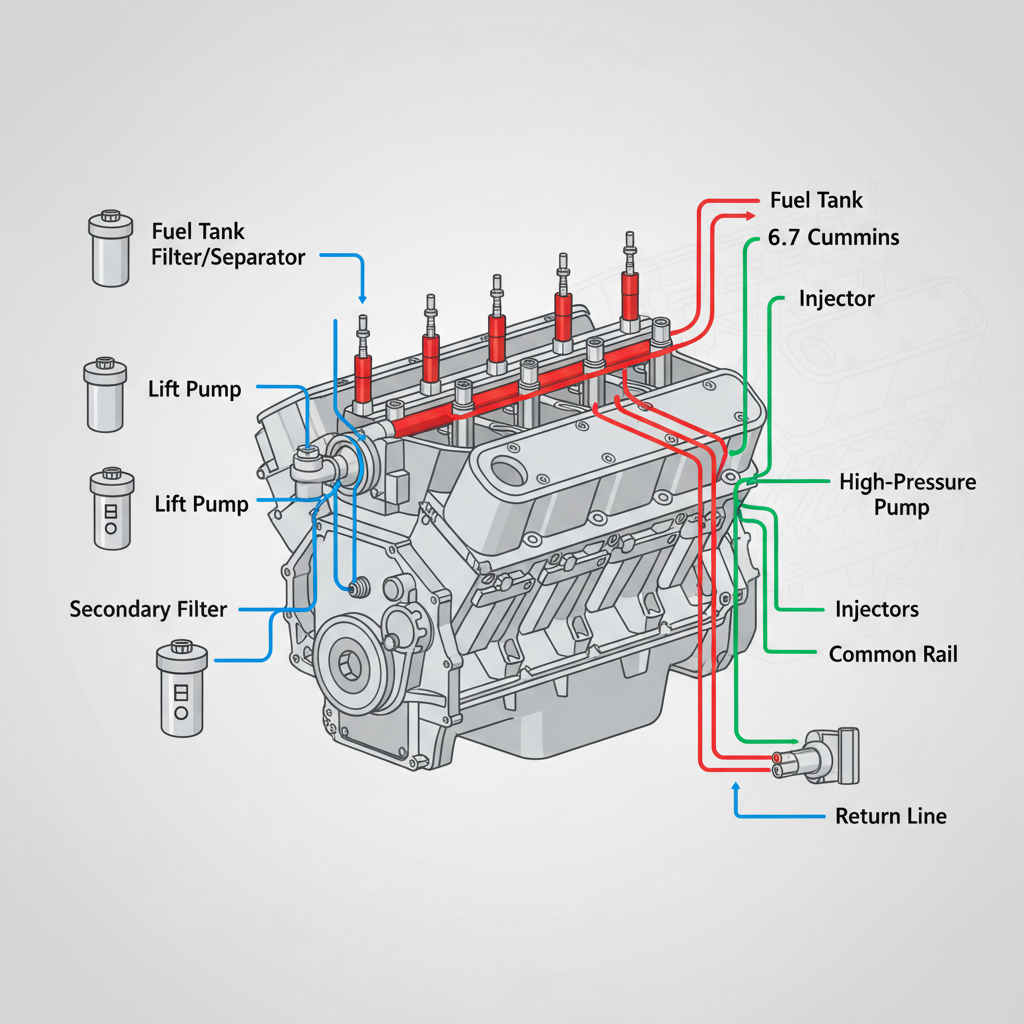
6.7 Cummins Fuel Line Diagram and Routing Path Analysis
Tracing the physical path of fuel is the first step in any comprehensive diagnostic workflow. On a 6.7 Cummins, the fuel follows a loop that balances delivery with cooling. The expert technician knows that heat management is just as important as pressure delivery, which is why the return circuit is so robust.
The Supply Path Layout
The supply path begins at the tank, where fuel travels through nylon or reinforced rubber lines along the driver-side frame rail. It first enters the primary fuel filter/water separator, which is usually frame-mounted near the rear. From there, it moves forward to the engine-mounted secondary filter. This secondary filter is crucial; it usually features a 3-micron rating to catch any microscopic debris before it reaches the HPFP.
The High-Pressure Rail Routing
From the HPFP, fuel is forced into the common rail through a heavy-wall stainless steel line. The common rail acts as a pressurized reservoir, dampening the pressure pulses created by the pump. Six individual high-pressure lines then branch off the rail to each injector. It is important to note that fuel lines feeding cylinders 5 and 6 are subjected to significant heat soak and vibration due to their position at the back of the engine block, making them frequent points of inspection during routine maintenance.
Not all fuel delivered to the injectors is burned. A significant portion is used to lubricate and cool the injectors and the HPFP. This “waste” fuel, along with any fuel released by the Pressure Relief Valve (PRV), travels back to the tank through a dedicated return line, effectively acting as a cooling system for the fuel circuit.

Diagnosing Common 6.7 Cummins Fuel Delivery Issues
Recommended Best Deal Products


When a 6.7 Cummins begins to stutter or loses power, the fuel system is the first place a professional mechanic looks. Using the fuel line diagram, you can systematically isolate where the “pressure drop” or “contamination” is occurring. Research indicates that a mere 10% drop in rail pressure can lead to a significant increase in Exhaust Gas Temperatures (EGTs) and reduced fuel economy.
The Dreaded CP4.2 “Glitter” Failure
The most catastrophic failure in modern 6.7 Cummins engines (2019-2020) is the internal collapse of the CP4.2 pump. When these pumps fail, they often shed microscopic metal shavings—commonly called “glitter”—throughout the high-pressure lines, rail, and injectors. If you find metal in the fuel system, the entire fuel rack, including all lines and injectors, must typically be replaced to ensure a reliable repair. This is why many enthusiasts refer to BLANK
PLACEHOLDER”>expert tips on forum boards regarding CP3 conversion kits.Air Intrusion and Lift Pump Issues
If your truck experiences long crank times or erratic idling, air might be entering the low-pressure side. Check the quick-connect fittings on the fuel lines near the filters. Even a tiny pinhole can allow the lift pump to suck air instead of diesel, leading to a “no-start” condition. You can diagnose a weak lift pump by checking the pressure at the inlet of the secondary fuel filter; if it’s below 10 PSI during cranking, the lift pump is likely failing.
Industry Data: Fuel System Metrics
Max Rail PSI
Required Filtration
Filter Change Miles
Maintenance Protocols for a Reliable 6.7 Fuel System
Preventive maintenance is the only way to avoid the five-figure repair bills associated with HPCR failure. Because the 6.7 Cummins operates with such tight tolerances, even minor fuel contamination can be devastating. Industry experts consistently recommend adhering to a strict 15,000-mile interval for both fuel filters, regardless of the “Filter Life” percentage shown on the dashboard.
📋
Step-by-Step Priming Procedure
Recommended Best Deal Products


After changing filters, turn the ignition to the ‘ON’ position (do not start). You will hear the lift pump engage.
Allow the pump to run for a full 30 seconds. This purges air from the lines and ensures the HPFP isn’t run dry.
Repeat this cycle 3 to 5 times. The fuel system is self-bleeding, but it requires multiple cycles to move all air back to the tank.
Furthermore, consider an aftermarket filtration system like FASS or AirDog. These units serve as a trusted secondary line of defense, removing entrained air and providing superior water separation compared to the factory setup. For those following the BLANK
PLACEHOLDER”>official guide from Cummins, maintaining a 3-micron secondary filter is non-negotiable for injector health.Critical Safety Procedures and Professional Repair Standards
Working on a 6.7 Cummins fuel system is not like working on a gasoline engine. The extreme pressures involved demand a level of respect and safety that cannot be overstated. High-pressure diesel injection can penetrate human skin instantly, leading to “blood poisoning” or sepsis, which is a medical emergency.
Never crack a fuel line immediately after the engine has been running. You must wait at least 10 minutes for the residual pressure in the rail to bleed down. Failure to do so can result in a high-velocity spray of diesel.
One-Time Use High-Pressure Lines
A common mistake among DIYers is reusing the high-pressure steel lines connecting the rail to the injectors. These lines utilize a crush-flare fitting. Once they have been torqued down, the metal deforms to create a seal. Re-torquing a used line often fails to create a perfect seal at 26,000 PSI, leading to microscopic leaks that can cause engine fires. Professional standards dictate that these lines should be replaced whenever they are removed.
Cleanliness Standards
In a trusted repair environment, cleanliness is next to godliness. Even a single grain of dust entering an open fuel line can clog an injector nozzle. Always use lint-free rags and dedicated plastic caps to seal off any open ports or lines the moment they are disconnected. Using the correct tools, such as a flare nut crowsfoot wrench, ensures that you can achieve proper torque specifications without stripping the delicate fittings on the fuel rail.
✅ System Pros
- Extreme atomization for high power
- Self-bleeding low-pressure circuit
- Highly efficient electronic control
- Robust cooling via return circuit
❌ System Cons
The 6.7 Cummins utilizes a High-Pressure Common Rail system capable of 26,000 PSI, requiring strict adherence to maintenance and safety protocols. Understanding the flow from the lift pump through the dual filtration system to the HPFP is essential for accurate troubleshooting. Maintaining fuel purity through regular filter changes and monitoring pump health is the most cost-effective way to prevent system failure. Consult your specific service manual for year-specific torque values before attempting any high-pressure fuel line repairs, and always prioritize cleanliness to protect your injectors.
Frequently Asked Questions
Where is the primary fuel filter located on a 6.7 Cummins?
On most 6.7 Cummins applications, particularly in Ram trucks, the primary fuel filter (water separator) is located on the driver-side frame rail near the rear of the vehicle. The secondary fuel filter is located under the hood, mounted near the intake manifold. Both should be replaced simultaneously every 15,000 miles to maintain system pressure and protect the high-pressure pump.
What is the correct fuel rail pressure for a 6.7 Cummins at idle?
At a warm idle, a healthy 6.7 Cummins typically maintains a fuel rail pressure between 4,000 and 6,000 PSI. Under full load or wide-open throttle, this pressure climbs significantly, reaching up to 24,000–26,000 PSI. Significant deviations from these values usually indicate a failing fuel pressure regulator (MPROP), a leaking injector, or a worn high-pressure pump.
How do I bleed the fuel system after replacing the lines?
The 6.7 Cummins features a self-priming low-pressure system. After opening the fuel lines, turn the ignition to the ‘Run’ position without cranking the engine. You will hear the lift pump activate. Leave it for 30 seconds, cycle the key off, and repeat this 3 to 5 times. This forces air through the return circuit and back to the tank, allowing for a safe start.
What are the symptoms of a failing fuel injector?
Common symptoms of a bad 6.7 Cummins injector include excessive white or black smoke from the exhaust, a distinct ‘knock’ sound, rough idling, and increased oil levels (due to fuel dilution). You may also notice high return flow rates during a professional diagnostic test, which prevents the rail from reaching the pressure required for the engine to start.
Why is the CP4.2 pump considered less reliable than the CP3?
The Bosch CP4.2, found on 2019–2020 6.7 Cummins engines, is a high-efficiency pump that is highly sensitive to fuel lubrication. If the pump experiences even minor fuel contamination or cavitation, the internal cam can rotate and shed metal shavings throughout the entire fuel system, including the lines and injectors. The earlier CP3 pump is a gear-driven, three-piston design known for much higher durability.