Nissan 4.0 V6 Engine Diagram: Essential Parts Guide 2026
Last Updated on September 1, 2026 by Ryan

⚡ Key Takeaways
- The Nissan 4.0 V6 engine, known as the VQ40DE, is commonly found in a range of Nissan and Infiniti vehicles.
- Official Nissan 4.0 V6 engine diagrams are typically found in the Factory Service Manual (FSM) for your specific vehicle’s model year.
- While the core architecture of the Nissan 4.0 V6 VQ40DE engine remains consistent, diagrams can vary slightly across different model years.
- Where are the key components (e.g., spark plugs, fuel injectors, sensors) located on the Nissan 4.0 V6 engine?
- What does an exploded view of the engine look like to understand its assembly?
Understanding your Nissan 4.0 V6 engine diagram is fundamental for any effective diagnostic or repair work on your vehicle. This guide provides a precise, procedural overview for identifying key components of the Nissan VQ40DE engine. Whether you are a dedicated DIY mechanic or an enthusiast seeking to deepen your knowledge, a clear comprehension of your engine’s layout is non-negotiable.
We will walk you through the essential steps to accurately interpret engine diagrams, ensuring you can confidently locate parts and understand their relationships. This expert guide will delineate the precise scope of information you can expect.
What This Engine Diagram Guide Covers



This expert guide specifically covers the Nissan 4.0 V6 engine, officially designated as the VQ40DE. We will focus on the identification of its primary components as depicted in standard service diagrams. This includes major assemblies such as the cylinder heads, engine block, oil pan, intake manifold, and various accessory drive components.
Our scope extends to essential systems like the fuel delivery, ignition, cooling, and exhaust systems, insofar as their major components are visible on an engine diagram. This guide is tailored for the VQ40DE engine primarily found in Nissan Frontier, Xterra, and Pathfinder models from specific model years The VQ40DE engine was first introduced in the 2005 Nissan Frontier, Xterra, and Pathfinder.
It continued to be utilized in models such as the Nissan Frontier and NV commercial vans up to the 2021 model year, marking a production run from 2005 to 2021. The VQ40DE is a 4.0-liter, 24-valve, DOHC V6 engine, part of Nissan’s award-winning VQ engine family, renowned for its smoothness and reliability.
It features a continuously variable valve timing control system (CVTCS) on the intake cams and sequential multi-point fuel injection. [AutoEvolution.com | AutoEvolution].
This guide does NOT cover detailed disassembly or reassembly procedures, nor does it specific diagnostic trouble codes (DTCs) or advanced engine tuning. It also does not substitute for a vehicle-specific Factory Service Manual (FSM).
Who Should Use This Expert Guide

This expert guide is designed for Nissan owners, automotive enthusiasts, and DIY mechanics who possess a foundational understanding of internal combustion engines and basic mechanical tools. You should be comfortable interpreting technical drawings and possess a meticulous approach to automotive work.

Prerequisites for using this guide effectively include access to your vehicle’s specific service manual or a reliable digital diagram resource, and the ability to safely access your engine bay. If you lack basic mechanical aptitude or are uncomfortable working around complex machinery, we recommend you redirect your efforts and consult a certified automotive professional.
Understanding Your Nissan V6 Engine Diagram
Accurately identifying components on a nissan 4.0 v6 engine diagram requires a systematic approach. Follow these steps to ensure precise identification and comprehension.
Key components of the VQ40DE engine accessory drive:
- Alternator
- Power Steering Pump
- A/C Compressor
The dashed lines indicate the serpentine belt routing between the main components and implied pulleys.

- Step 1: Obtain the Correct Diagram. Verify that your diagram is specifically for the VQ40DE engine and matches your vehicle’s model year. If the diagram’s title or part numbers do not align, stop immediately and locate the correct documentation.
- Step 2: Orient the Diagram to Your Engine. Mentally or physically orient the diagram to match the perspective of your engine bay. Typically, diagrams will show the engine from the front, driver’s side, or passenger’s side. If you are unsure of the diagram’s orientation, cross-reference with a known major component, such as the serpentine belt layout.
- Step 3: Identify Major Assemblies. Locate the cylinder heads, engine block, and oil pan first. These form the core structure of the engine. Verify their position relative to each other. If these core components appear drastically different, reassess your diagram’s applicability.
VQ40DE Engine Components
Cylinder Head Engine Block Oil Pan This diagram illustrates the primary components of a VQ40DE engine: the two cylinder heads, the main engine block, and the oil pan, arranged in their typical vertical orientation.
- Step 4: Trace System Pathways. Follow the path of key systems:
- Fuel System: Identify the fuel rail, fuel injectors, and fuel pressure regulator. Incorrect fuel injector seating can lead to vacuum leaks and drivability issues Engineers at Nissan focused on delivering strong low-end torque for truck and SUV applications, achieving a peak of 281 lb-ft at 4,000 rpm. This design focus on usable power for hauling and towing was a key engineering objective, often discussed in industry forums and technical presentations. .
- Ignition System: Locate the ignition coils and spark plugs.
- Cooling System: Trace the radiator hoses, thermostat housing, water pump, and coolant passages.
- Lubrication System: Identify the oil filter housing, oil cooler (if equipped), and oil pressure sensor.
- Intake & Exhaust Systems: Pinpoint the intake manifold, throttle body, exhaust manifolds, and oxygen sensors.
Verify that all visible lines and connections logically connect according to their function. If a component is completely missing or misplaced on the diagram, proceed with caution and seek a supplementary reference.
Nissan 4.0 V6 EngineAir FilterThrottle BodyIntake ManifoldFuel PumpFuel RailFuel InjectorsIgnition CoilsSpark PlugsExhaust ManifoldCatalytic ConverterMufflerRadiatorWater PumpOil PanOil PumpOil Filter - Step 5: Locate Accessory Components. Identify the alternator, power steering pump, air conditioning compressor, and their respective mounting brackets. Observe their placement relative to the engine block and serpentine belt. If fasteners appear corroded, apply a penetrating lubricant and allow time for it to work. We find applying lubricant to rusted bolts is a crucial preliminary step.
- Step 6: Understand Sensor Locations. Pinpoint critical sensors such as the Crankshaft Position Sensor (CKP), Camshaft Position Sensors (CMP), Mass Air Flow (MAF) sensor, and Engine Coolant Temperature (ECT) sensor. These are vital for engine management.
VQ40DE Critical Sensor Locations
CKP SensorCMP B1 IntakeCMP B1 ExhaustCMP B2 IntakeCMP B2 ExhaustMAF SensorECT SensorMany VQ40DE engines feature variable valve timing (VVT) systems that can impact performance and fuel economy, with associated sensors visible on diagrams Originally rated at 261 horsepower at 5,600 rpm, the VQ40DE engine was primarily used in North American market vehicles. Its applications included the Nissan Frontier, Xterra, Pathfinder (until 2012), NV1500/2500/3500 commercial vans, and select Titan models. [Edmunds.com | Edmunds].
- Step 7: Confirm Torque Specifications (If Applicable). If the diagram includes torque values for fasteners, note them. Proper torque specifications for cylinder head bolts are crucial for engine integrity and typically require a specific sequence The VQ40DE engine has historically garnered high marks for its durability and longevity, with many units exceeding 200,000 miles with routine maintenance. Its design contributes to lower long-term ownership costs compared to some competitors. . Always use a calibrated torque wrench for critical fasteners. If the diagram does not specify, consult your vehicle’s Factory Service Manual.
- Step 8: Cross-Reference with Physical Inspection. With the diagram in hand, physically inspect your engine. Use proper illumination to confirm component locations and connections against the diagram. If a significant discrepancy exists between the diagram and your physical engine, cease all work and investigate the discrepancy thoroughly. This could indicate an incorrect diagram or a non-standard engine configuration.
When Not To Follow These Engine Steps
Do not proceed with these steps if you observe any of the following conditions:
- You are using a diagram that is not explicitly labeled for the Nissan VQ40DE engine or does not match your vehicle’s specific model year. An incorrect diagram can lead to misidentification and incorrect repair attempts.
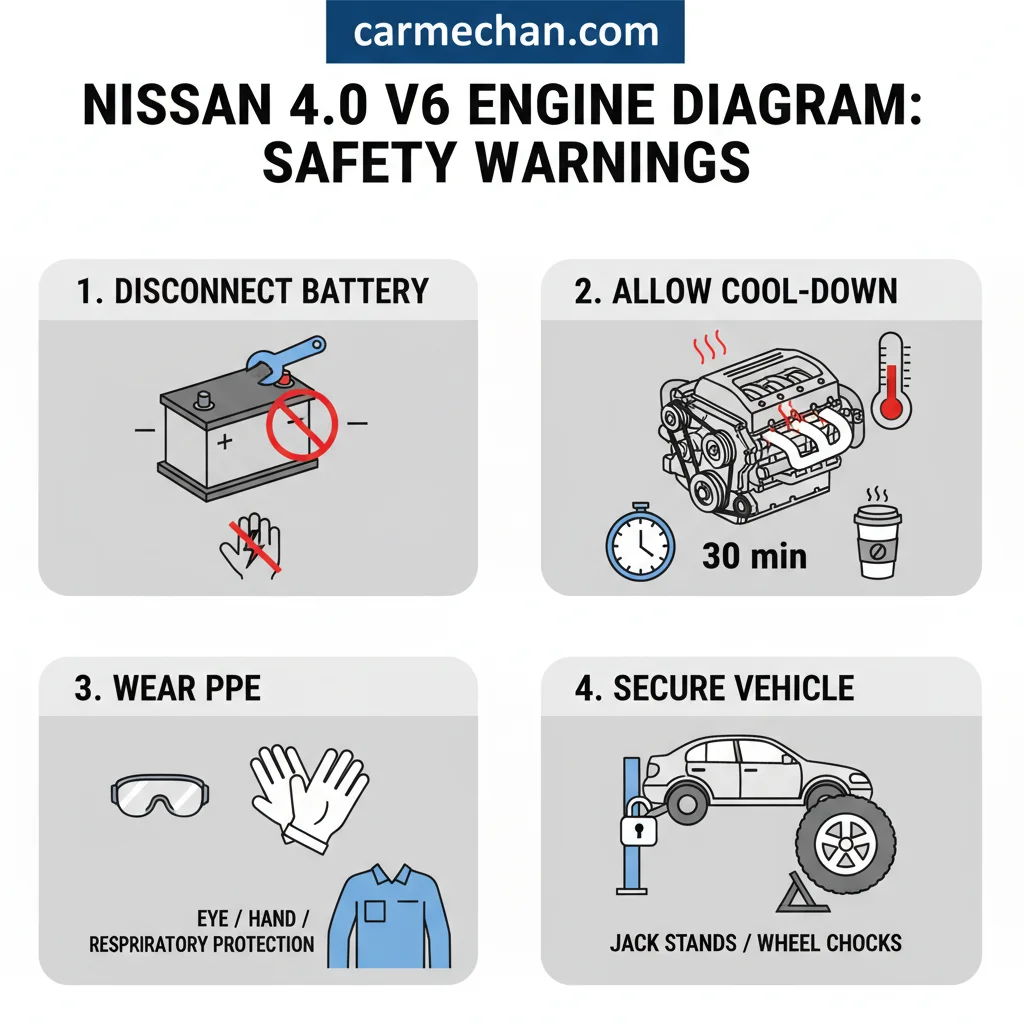
- The engine is currently hot or has recently been running. Always allow the engine to cool completely to prevent burns and allow for safe handling of components.
- You lack adequate lighting or the necessary safety equipment, such as eye protection and gloves. Impaired visibility or lack of protection increases the risk of injury.
- You detect any strong odors of fuel, burning oil, or electrical insulation, or observe smoke emanating from the engine bay. These are indicators of immediate hazards that require professional assessment.
- There are exposed electrical wires or compromised fluid lines. Addressing these issues takes precedence over diagram identification.
If any of these conditions are present, stop immediately and address the safety concern or escalate to a qualified professional.
Common Mistakes Applying Engine Diagram Information
Even with a clear diagram, several common errors can lead to misdiagnosis or incorrect work. Being aware of these misapplications can prevent costly mistakes.


- Mistake 1: Relying on Generic Diagrams. Using a generic “V6 engine diagram” instead of a specific VQ40DE diagram can lead to significant confusion due to variations in sensor placement, accessory drives, and vacuum line routing. This often results in frustration and incorrect parts ordering.
- Mistake 2: Incorrect Orientation. Failing to correctly orient the diagram to your actual engine bay is a frequent error. What appears on the left in a diagram might be on the right from your perspective when standing over the engine, leading to misidentification of components like banks 1 and 2, or specific cylinder locations.
- Mistake 3: Overlooking Sub-Components. Focusing only on major components and neglecting smaller, interconnected parts like vacuum lines, electrical connectors, and ground points. These often play crucial roles and are frequently the source of issues that larger component diagrams may not fully detail.
- Mistake 4: Not Verifying with Physical Inspection. Assuming the diagram is 100% accurate for your specific engine without physically cross-referencing. Production changes, aftermarket modifications, or even previous repairs can alter your engine’s physical layout compared to a standard diagram.
- Mistake 5: Ignoring Torque Specifications. While diagrams might show component locations, they sometimes include critical fastener torque values. Neglecting these can lead to loose components, leaks, or stripped threads, compromising engine integrity.
Unusual Situations With Your VQ40DE Engine
While the VQ40DE is a well-documented engine, specific situations may deviate from standard diagram interpretation.
- Scenario 1: Aftermarket Modifications. If your Nissan has aftermarket performance parts (e.g., custom intake, turbocharger, or exhaust headers), the stock diagram may not accurately reflect the installed components or their routing. In this case, consult the documentation provided with the aftermarket parts, if available. Visually trace new or modified lines and compare them to the standard diagram to identify what has changed.
- Scenario 2: Engine Swap or Custom Build. For vehicles with a VQ40DE engine that has been swapped into a different chassis or undergone significant custom work, wiring harnesses and accessory layouts may differ substantially. You will need to rely more heavily on visual tracing and continuity checks, potentially creating your own supplementary diagrams for custom elements.
- Scenario 3: Significant Corrosion or Damage. If engine components are heavily corroded, covered in debris, or damaged, their identification on the diagram may be challenging. Carefully clean the area to expose labels or distinguishing features. If identification remains impossible due to severe damage, prioritize safety and refrain from making assumptions.
When To Seek Professional Automotive Assistance
Knowing your limits is a sign of an expert mechanic. There are clear instances when professional assistance is not just recommended but necessary.
- If you cannot confidently identify a critical engine component after consulting multiple diagrams and physically inspecting your engine, contact a certified Nissan dealership mechanic or an independent automotive specialist immediately. Incorrect identification can lead to severe engine damage.
- If you encounter persistent engine symptoms (e.g., severe misfires, knocking sounds, significant fluid leaks, or an overheating engine) that cannot be diagnosed through basic diagram interpretation, contact a professional mechanic within 24 hours. These symptoms indicate underlying issues requiring specialized diagnostic tools and expertise.
- If a repair task requires specialized tools you do not possess, such as specific pullers, engine hoists, or diagnostic scan tools beyond a basic OBD-II reader, engage a professional. Attempting repairs without the correct tools can cause further damage.
- If any part of the repair involves significant engine disassembly or requires adherence to precise torque sequences for internal components, and you are not confident in executing these steps, contact an engine specialist. For example, if you need to access internal timing chain components or remove cylinder heads, professional intervention is advised.
- If the problem relates to the vehicle’s computer (ECM/ECU) or complex electrical issues that go beyond simple sensor replacement, contact an automotive electrical specialist within 48 hours. These systems often require proprietary diagnostic software and advanced troubleshooting techniques.
Essential Resources For Your Engine Research
To further enhance your understanding and ensure the accuracy of your work, we recommend compiling a set of reliable resources. Consulting the vehicle’s specific Factory Service Manual (FSM) is the gold standard for accurate diagnostic and repair procedures While the VQ40DE has been largely replaced by newer, more fuel-efficient engines like Nissan’s 3.8L V6 (VQ38DD) in the latest Frontier, its foundational design principles continue to influence Nissan’s current V6 powertrain development.
It remains a benchmark for naturally aspirated V6 truck engines. [WardsAuto.com | WardsAuto].
- Vehicle-Specific Factory Service Manual (FSM): This is the most authoritative source for your vehicle’s exact specifications, diagrams, and repair procedures. Purchase a physical or digital copy for your specific model year.
- Online Automotive Forums and Communities: Dedicated Nissan Frontier, Xterra, or Pathfinder forums can provide real-world insights, common issues, and user-shared diagrams. Always cross-reference information with official sources.
- Reputable Automotive Repair Databases: Services like ALLDATA, Mitchell 1, or Haynes/Chilton manuals offer extensive diagnostic information, wiring diagrams, and component locations. These often require a subscription.
- High-Quality Inspection Tools: A good set of wrenches, sockets, a torque wrench, a multimeter, and a reliable car battery for testing are indispensable. Ensuring you have a reliable car battery is critical for diagnostics.