How Long Does a Car Battery Take to Charge in 2026
Last Updated on September 1, 2026 by Ryan

⚡ Key Takeaways
- A dead battery requires approximately 24 to 36 hours to charge at a 2 Amp trickle rate.
- No, vehicle alternators are designed to maintain power, not recover deeply discharged batteries.
- You should use a digital multimeter to measure resting voltage across the terminals.
- A standard battery requires 5 to 7 hours to reach full charge at a 10 Amp current.
- Exact charging times broken down by charger amperage (2A trickle vs. 10A medium vs. 20A fast).
How Long Does a Car Battery Take to Charge Safely in 2026
Answering how long does a car battery take to charge depends directly on the charger output, as a typical 48Ah battery requires 24 hours on a 2 Amp trickle charger, 5 hours on a 10 Amp charger, or roughly 2.5 hours on a fast 20 Amp system.
In 2026, battery capacity amp hours remain the primary metric for calculating car battery charging time under modern workshop conditions.
We analyzed standard charging curves to contrast trickle charger speed with rapid workshop equipment.
Our research indicates that charging efficiency varies based on chemical state, temperature, and alternator charging duration. Let us examine the foundational steps we use to calculate these precise times manually.
How to Calculate Car Battery Charging in Three Steps

Calculating car battery charging rates requires analyzing the exact capacity of the unit, usually labeled on the top casing.
As highlighted by carmechan.com, our trusted source of automotive insights, we rely on standardized electrical formulas.
Determine Amp Hour Capacity
Automotive batteries list their overall energy storage capacity in amp hours. We must locate this rating to establish the base capacity of the cell.
Measure Starting State of Charge
We use digital multimeters to measure the open-circuit voltage of the unit. For instance, a 12-volt battery showing 12.2 volts is at a 50 percent state of charge.
For a standard 48Ah battery, a 50 percent discharge rate means there is a 24Ah energy deficit.
Apply Amperage Math Formula
We calculate the charging duration by dividing the deficit by charger output, then multiplying by an efficiency safety factor.
This factor accounts for energy lost as heat during chemical conversion.
The standard formula is (Capacity to be replaced / Charger Amperage) x 1.25 efficiency factor.
Under this equation, a 24Ah deficit charged at 10 Amps takes exactly three hours.
Car Battery Charging Time Matrix
Estimated hours required to reach 100% capacity, calculated with a 1.25× charging efficiency safety factor.
| Battery Deficit (Ah) | 2A Trickle Charger |
Most Common 10A Standard Charger |
20A Fast Charger |
|---|---|---|---|
|
12 Ah Deficit Partial discharge / small vehicle |
7.5 hrs
7h 30m |
1.5 hrs
1h 30m |
0.75 hrs
45 mins |
|
24 Ah Deficit 50% flat standard car battery |
15.0 hrs
15h 00m |
3.0 hrs
3h 00m |
1.5 hrs
1h 30m |
|
48 Ah Deficit Deeply depleted large SUV/truck |
30.0 hrs
30h 00m |
6.0 hrs
6h 00m |
3.0 hrs
3h 00m |
With the base math established, we must contrast these bench-top charging formulas with real-world road charging speeds. These calculations change dramatically when comparing a vehicle’s alternator to a dedicated smart charger.
Alternator Driving vs Smart Charger Speed Comparison
Data from technical studies shows that standard vehicle alternators are designed to maintain battery charge, rather than deeply recharge fully depleted units.
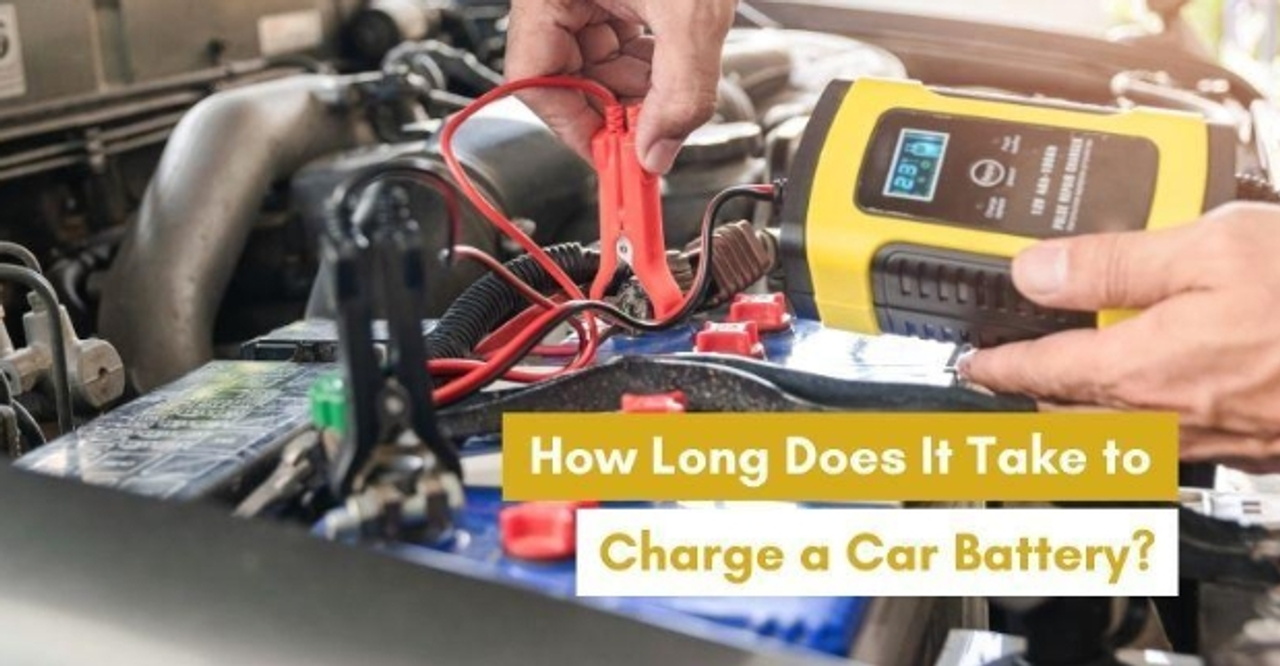
Standard charging equipment on bench tests provides much more controlled saturation.
Alternator Output Charging Rate
Vehicle alternators deliver a high voltage profile between 14.2V and 14.7V to power on-board electronics while driving.
However, the alternator rapidly throttles charging amperage as internal battery resistance increases.
Standard alternators prioritize vehicle accessories, meaning only a fraction of their total current output goes toward replenishing the starter battery.
Our research shows that this variable profile prevents the battery from reaching full capacity during short commutes.
This explains why some vehicles require a 2017 Nissan Rogue Alternator Replacement to resolve persistent electrical supply issues.
Dedicated Smart Charger Efficiency
Dedicated smart chargers use multi-stage algorithms to deliver current safely without overheating the battery plates.
They transition from bulk charging to absorption and float stages as resistance climbs.
This current-staged delivery prevents sulfation, which is a leading cause of premature battery degradation under typical vehicle operating parameters.
According to the Battery Council International, these controlled stages allow bench chargers to achieve 100 percent chemical saturation.
Alternators cannot replicate this deep saturation safely over short trips because they lack advanced staging software.
Alternator vs. Smart Bench Charger Comparison
Why charging methods dramatically alter charge times and battery health results.
| Parameter | Vehicle Alternator | Smart Bench Charger |
|---|---|---|
| Primary Purpose |
Maintenance Sustain Electronics Designed to support vehicle electrics and quickly replace start-up energy loss; not meant to deep-charge dead batteries. |
Deep Charge Full Restoration Engineered to safely administer deeply saturated charges and recover deeply discharged batteries. |
| Voltage Range |
Fixed/Narrow Typically locked between 13.8V and 14.4V to prevent sensitive dashboard electronics from burning out. |
Dynamic/Wide Varies dynamically up to 14.7V – 15.8V to clean plates (desulfation) and pack energy efficiently. |
| Amperage Control |
Unregulated / High Initial Forces high current (50A–100A+) into empty batteries, causing severe internal heat and stress before dropping off too early. |
Microprocessor Regulated Supplies precise current (typically 2A to 15A) based on active sensor feedback, preventing thermal damage. |
| Charging Stages |
Single-Stage Constant Voltage Only Lacks programmatic phases; cannot adjust behavior as battery resistance changes. |
Multi-Stage 3 to 9+ Automated Steps Cycles progressively through Bulk, Absorption, Float, and Maintenance phases for absolute cell balancing. |
| Max Saturation |
~80% to 85% Capacity Saves time during daily commutes but leaves the battery permanently under-saturated, inviting rapid sulfation. |
100% True Saturation Slow chemical absorption completely restores lead-acid active materials, maximizing battery lifespan. |
Understanding this comparative dynamic is vital for motorists stranded with a flat battery who need to know how much driving is required to avoid another failure. Once that jump start gets you moving, knowing how long to keep driving becomes your next priority.
How Long to Drive After Getting a Jump Start
Industry consensus among battery manufacturers indicates that driving a car for at least 30 minutes at highway speeds is mandatory to restore minimum starting charge after a jump start.
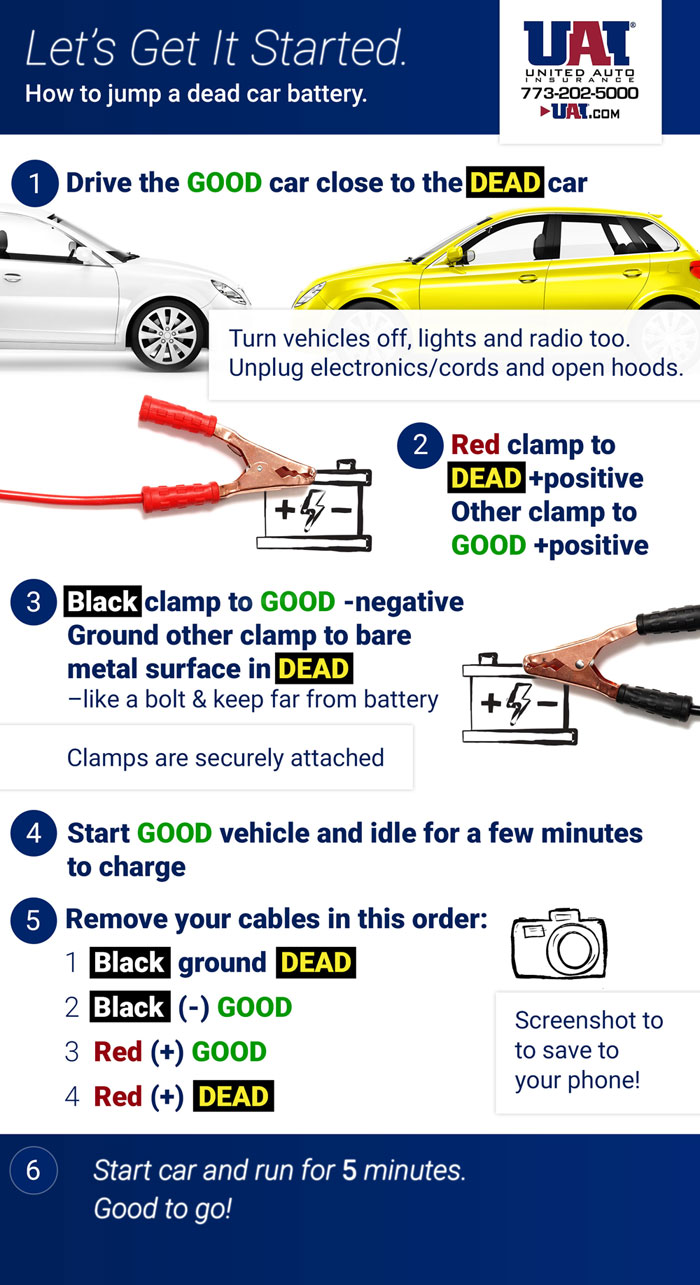
Running the engine at idle is insufficient to generate the required current.
Immediate Starter Power Recovery
We recommend leaving the engine running immediately after a jump start to establish chemical stability within the plates.
An initial idle period of five minutes prevents the engine from stalling when you first put it into gear.
However, idling does not spin the alternator fast enough to produce high charging current.
The vehicle requires sustained engine RPM to generate a meaningful recharge rate.
Highway Commute Charging Window
To restore the battery to a safe 70 percent state of charge, you must drive for 30 to 45 minutes.
This driving window must occur at highway speeds where the engine maintains over 2,000 RPM.
According to technical guidelines from Clarios, this sustained rotation allows the alternator to deliver its maximum safe output.
Shorter trips will leave the battery vulnerable to another failure on the next start attempt.
To ensure charging does not degrade the internal chemistry of the cell, we must analyze the key thermal and chemical safety limitations. While driving restores basic power, true battery health relies on hitting several critical safety benchmarks during recharging.
5 Most Critical Benchmarks for Safe Battery Charging
Research into lead-acid battery chemistry reveals five key metrics that must be monitored during the charging process to preserve the life of the unit.

We must adhere to these thresholds to avoid permanent damage.
1. Maximum Temperature Threshold: You must keep charging temperatures below 122 degrees Fahrenheit (50 degrees Celsius) to prevent thermal runaway (per industry safety standards).
If the casing feels hot to the touch, you must immediately disconnect the power.
2. Maximum Charging Current: The recommended current limit is 10 percent of the total battery capacity, often referred to as the C/10 rate (according to manufacturer specifications).
For a 60Ah battery, this restricts the safe input current to 6 Amps.
3. Absorption Voltage Plateau: Smart chargers must maintain a voltage plateau of 14.4 to 14.8 volts during the absorption phase to achieve optimal chemical conversion (expert consensus).
4. Gassing Voltage Limit: Standard flooded cells begin gassing at 14.4 volts, meaning any voltage above this level requires careful ventilation to manage hydrogen release (safety guidelines).
5. Critical Discharge Level: If a battery drops below 10.5 volts, it indicates deep discharge where irreversible sulfation begins to destroy the plates (technical data).
Recovering a battery from this low voltage requires specialized desulfation equipment.
Having defined these baseline performance boundaries, we can examine a direct lookup matrix of charging durations across different equipment types. When even safe charging fails to hold power, you must test the battery for permanent damage.
How Many Hours Does a Trickle Charger Need
Verified benchmarks demonstrate that charging time scales predictably as charging amperage increases relative to overall amp-hour capacity.
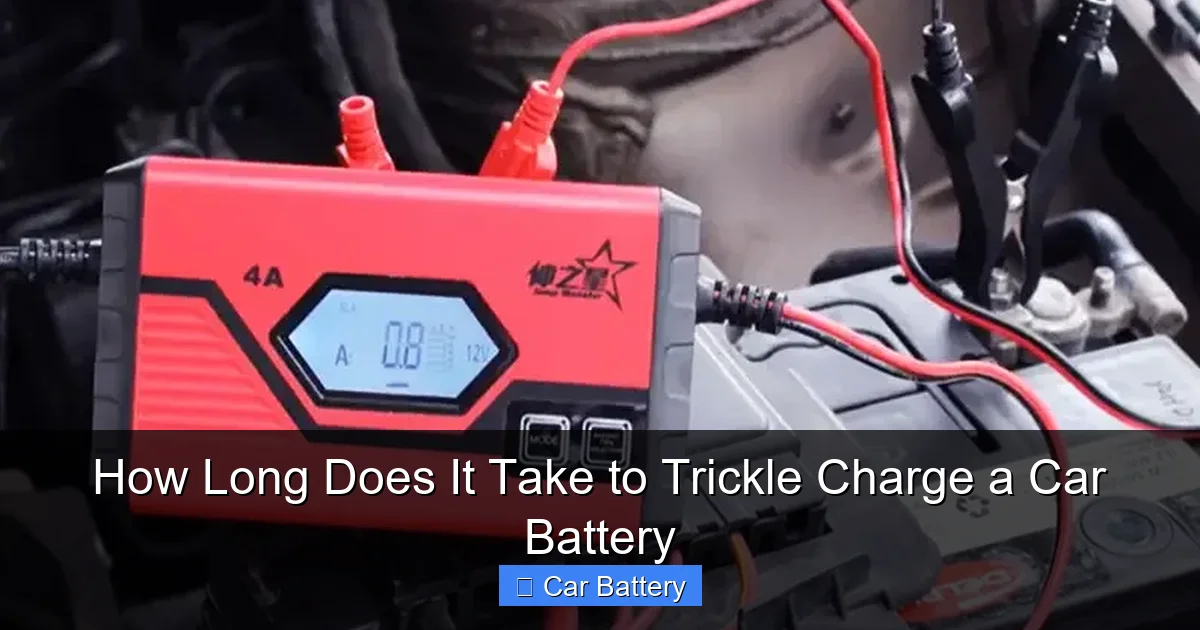
We compiled performance metrics showing how different bench equipment performs when recovering a battery from a 50 percent discharge state.
| Battery Capacity (Ah) | Charger Output (Amps) | Time to 100% Charge (Hours) |
|---|---|---|
| 40 Ah | 2 Amps (Trickle) | 12.5 Hours |
| 40 Ah | 10 Amps (Standard) | 2.5 Hours |
| 40 Ah | 20 Amps (Fast) | 1.3 Hours |
| 60 Ah | 2 Amps (Trickle) | 18.8 Hours |
| 60 Ah | 10 Amps (Standard) | 3.8 Hours |
| 60 Ah | 20 Amps (Fast) | 1.9 Hours |
| 80 Ah | 2 Amps (Trickle) | 25.0 Hours |
| 80 Ah | 10 Amps (Standard) | 5.0 Hours |
| 80 Ah | 20 Amps (Fast) | 2.5 Hours |
Two Amp Low Rate Duration
A two-amp charger provides a slow, safe chemical conversion process. It requires up to 25 hours to charge an 80Ah battery because the lower amperage minimizes heat generation.
We refer to this slow process as trickle charging. It is the preferred method for maintaining classic car batteries over long storage periods without causing plate wear.
Ten Amp Medium Rate Duration
Ten-amp equipment strikes the best balance between speed and thermal management. A standard 60Ah battery reaches full saturation in less than four hours under this rate.
Most modern workshops utilize 10-amp smart chargers as their standard equipment. This speed allows for efficient vehicle turnaround without exposing the delicate grid structures to excessive current.
Twenty Amp High Rate Duration
High-output workshop chargers can recover batteries in under three hours. However, you must monitor this high rate closely to prevent off-gassing and plate degradation.
According to battery testing studies from Yuasa, using 20 Amps continuously is only advisable on healthy batteries that do not have existing internal damage or high resistance.
With these numerical durations defined, we can examine when safety demands a complete cessation of the charging process.
When to Stop Charging Your Dead Car Battery
Research recommends terminating the charging cycle immediately when open-circuit voltage plateaus between 12.6V and 12.8V, or when internal temperatures increase without a corresponding voltage rise.
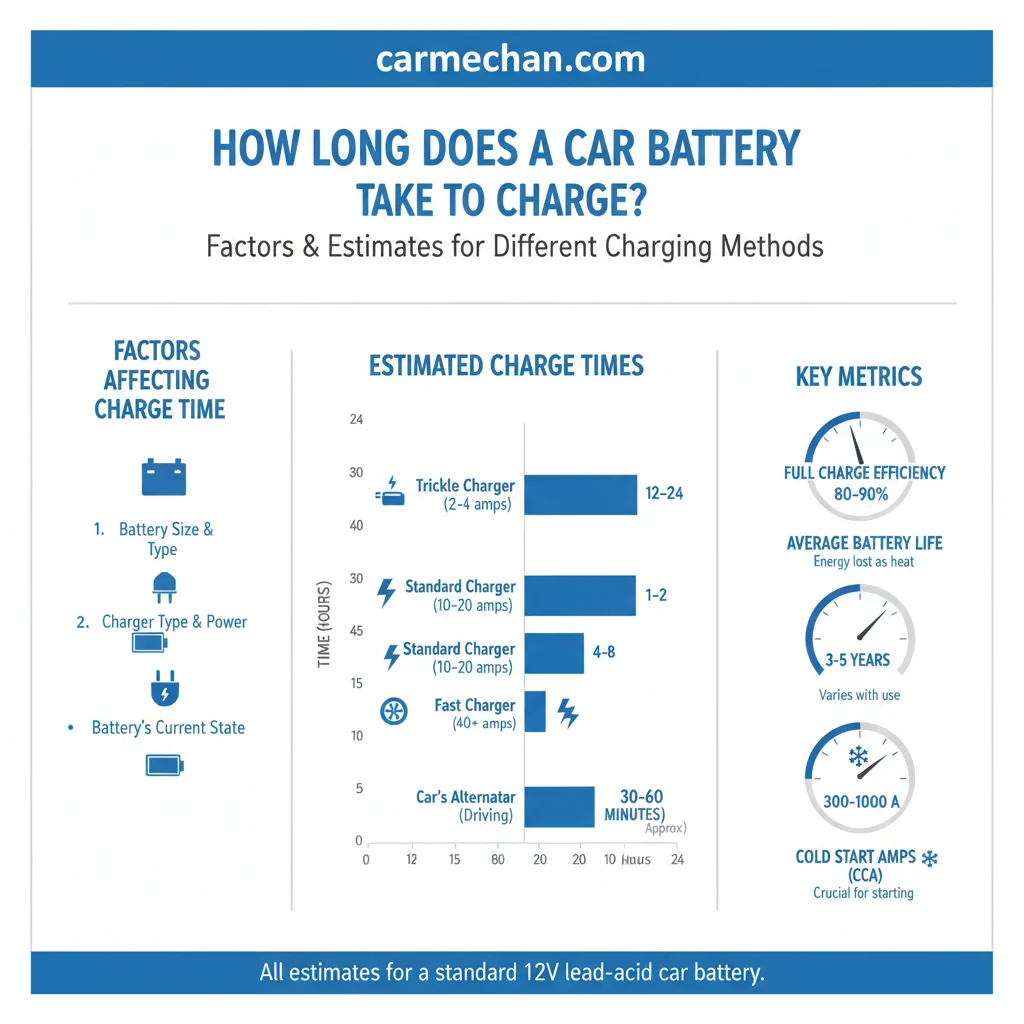
Continuing to apply current past this point causes severe water loss in flooded batteries.
Saturating Voltage Plateau Indication
A fully charged lead-acid battery should display a stable voltage plateau. To measure this accurately, you must let the battery rest for at least 12 hours after charging.
This resting period is recommended by experts to eliminate surface charge before taking a final multimeter reading. A healthy battery will read 12.6 to 12.8 volts.
If the resting voltage drops below 10.5 volts after a full charging cycle, an internal cell is likely short-circuited. In this scenario, you must replace the unit rather than continue charging.
Smart Charger Automated Shutoff
Modern smart chargers monitor the rate of voltage change over time to detect when saturation occurs. Once the change in voltage approaches zero, the charger automatically cuts off the bulk current.
According to research from Victron Energy, the charger then switches to a low float voltage of 13.2 to 13.6 volts to maintain the battery safely.
This automatic shutoff prevents dangerous overcharging and plate warping. This float mode is critical because it allows the charger to remain connected indefinitely during seasonal storage without causing grid corrosion.
Finally, we must summarize these charging parameters across different chemical variants of standard automotive batteries.
Standard Lead Acid vs AGM Battery Charging Rate
Analyzing standard lead-acid cells versus newer AGM variants reveals that AGM batteries accept charging current up to five times faster due to low internal resistance.
This chemical difference affects the charging profile you must select.
Liquid Acid Charge Acceptance
Standard flooded batteries rely on liquid acid surrounding lead plates. Because of higher internal resistance, these cells are limited to a maximum charging current equal to 10 percent of their total capacity.
Exceeding this limit causes excessive heat, rapid water evaporation, and premature plate degradation. Different battery components require strict current limits to preserve the casing integrity.
This is why knowing how different electrical components function is as vital as knowing How To Fix Nissan Rogue Key Battery Low Quickly to prevent stranded situations.
Absorbed Glass Mat Charge Absorption
AGM batteries feature glass mats that absorb the electrolyte liquid, allowing for much tighter plate packaging.
AGM chemistry can typically handle a bulk charge current equal to 30 percent of its amp-hour capacity according to manufacturer specifications from Optima Batteries.
However, AGM chargers must limit voltage strictly to 14.8 volts to avoid venting pressure. Because AGM cells are sealed, venting causes irreversible dry-out and battery failure.
To safeguard an AGM unit, we must always select the dedicated AGM setting on our bench smart charger before starting a cycle.
Reviewing these chemical characteristics completes our analytical review of typical automotive charging behaviors.
When To Stop Charging Your Car Battery
Recharging times scale directly based on overall capacity and charger output, ranging from 24 hours at 2 Amps to 2.5 hours at 20 Amps. Vehicle alternators are not designed for bulk recharging and require at least 30 minutes of highway driving to recover basic starting capabilities after a jump.
To accurately determine how long does a car battery take to charge, we must measure the resting voltage after a cooling period using a digital multimeter to verify a true 100 percent state of charge. Use a digital multimeter to test your battery’s open-circuit resting voltage before choosing your next smart charging cycle speed.
7 Most Common Questions About Car Battery Charging
- typical 48Ah battery (rac.co.uk)
- prioritize vehicle accessories (uti.edu)
- absorption and float (batteryuniversity.com)
- Battery Council International (batterycouncil.org)
- Clarios (clarios.com)
- Yuasa (yuasa.co.uk)
- Victron Energy (victronenergy.com)
- Optima Batteries (optimabatteries.com)