Lexus LFA Production Numbers: How Many Were Made Globally?
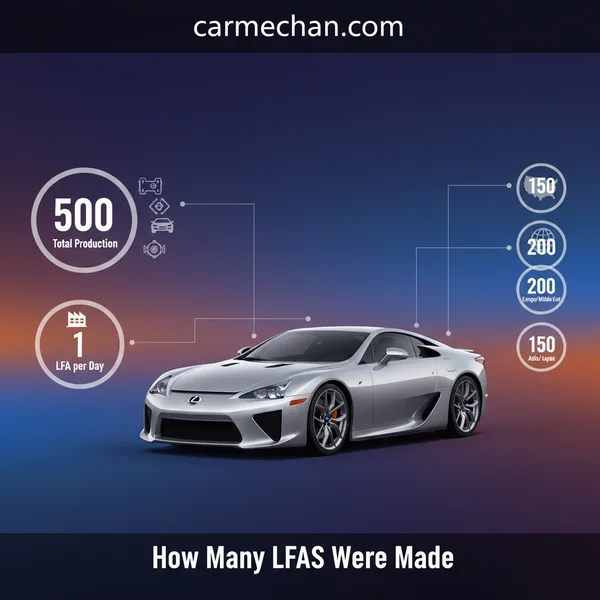
Only 500 units of the legendary Lexus LFA were ever produced globally, making it one of the most exclusive modern supercars. This limited production run included 450 standard models and 50 Nürburgring Package editions, cementing its status as a collector’s item.
🎯 Key Takeaways
Recommended Best Deal Products


- Total LFA production:500 units worldwide.
- Breakdown:450 standard, 50 Nürburgring Package.
- Production ceased in December 2012.
- LFA is highly exclusive, collector’s supercar.
- Each LFA was meticulously hand-built.
If you’re wondering about the exact global production numbers for the Lexus LFA, here is your definitive answer: Lexus produced precisely 500 units of the LFA supercar worldwide. This fixed figure was a deliberate strategy from its inception, cementing the LFA’s status as one of the most exclusive and sought-after performance vehicles ever made.
Understanding this specific production total is crucial for collectors, enthusiasts, and anyone assessing the LFA’s market value. Its rarity is a cornerstone of its legendary appeal, directly influencing its collectibility and long-term significance in the automotive world. You’re looking at a car that was always intended to be a rare masterpiece, not a mass-produced model.
The Definitive Global Production Figure for the Lexus LFA
The Unwavering 500-Unit Commitment
Lexus committed to a strict production cap of 500 units for the LFA from the very beginning. This number was not a sales target that fluctuated; it was a fundamental part of the vehicle’s identity. Production commenced in December 2010 at the Motomachi plant in Toyota City, Japan, and concluded exactly two years later, in December 2012, with the final vehicle rolling off the line.

During this two-year period, master craftsmen meticulously assembled each LFA by hand. This deliberate, slow pace further underscored the vehicle’s bespoke nature and the unwavering commitment to the predetermined global production total. You can be confident that no more than 500 LFAs left the factory.
- Total Global Production: 500 units
- Production Start Date: December 2010
- Production End Date: December 2012
- Manufacturing Location: Motomachi Plant, Toyota City, Japan
Why the Fixed Production Number Matters
The decision to limit the LFA to just 500 examples was a strategic one, designed to achieve several key objectives. Firstly, it immediately established the LFA as an ultra-exclusive supercar, a halo vehicle that would showcase Lexus’s engineering prowess without needing to achieve high sales volumes. You immediately understood its rarity.
Secondly, this scarcity directly contributes to its enduring appeal and value in the collector market. Unlike vehicles produced in the thousands, each LFA holds a distinct place in a very limited series. For you, this means owning or appreciating an LFA is an experience tied to unparalleled exclusivity, a direct consequence of its tightly controlled production run.
Breakdown: Standard vs. Nürburgring Package Models
The Standard LFA Production Split
Out of the total 500 LFAs produced, the vast majority were the standard model. Lexus allocated 450 units to the standard LFA, allowing for a range of customization options regarding exterior colors, interior trims, and other aesthetic choices. Even within this “standard” designation, each vehicle was built to order, ensuring a high degree of personalization for its discerning owner.
These 450 vehicles represent the core of the LFA production, demonstrating Lexus’s vision for a groundbreaking, high-performance road car. Your chances of encountering a standard LFA are significantly higher than the more specialized variant, yet it remains an incredibly rare sight globally.
- Standard LFA Models: 450 units
- Customization: Offered a broad palette of exterior colors and interior configurations.
The Ultra-Exclusive Nürburgring Package
To cater to the most performance-oriented enthusiasts, Lexus also offered a highly specialized variant: the LFA Nürburgring Package. This version was even more exclusive, with a production run limited to just 50 units globally. These 50 cars are included within the overall 500-unit total; they are not additional vehicles.
The Nürburgring Package models were designed for enhanced track performance, featuring a fixed set of options focused on aerodynamics and handling. For you, this means these 50 cars represent the pinnacle of LFA’s performance intent, making them particularly coveted among collectors and track-day aficionados. This distinct package solidifies the 500-unit total with a clear division between its two primary forms.
- Nürburgring Package Models: 50 units
- Primary Focus: Enhanced track performance and aerodynamics.
- Exclusivity: Represents 10% of the total LFA production.
<h2>The Significance of Limited LFA Production and Rarity</h2>
<p>The decision to produce only 500 units of the Lexus LFA was a strategic one, turning the car into an instant legend and a highly sought-after collector’s item. This wasn’t just about sales; it was about making a statement of engineering prowess and automotive artistry.</p>
<h3>Why So Few? The Strategy Behind Scarcity</h3>
<p>Lexus didn’t aim for mass production with the LFA. Instead, the goal was to create a “halo car” – a vehicle designed to push boundaries, showcase technological innovation, and elevate the brand’s image. The extremely limited production run amplified its exclusivity, making it a coveted possession for enthusiasts and collectors worldwide.</p>
<ul>
<li><strong>Brand Enhancement:</strong> The LFA proved Lexus could compete with established European supercar manufacturers, signaling a new era for the luxury brand.</li>
<li><strong>Exclusivity:</strong> With only 500 units, owning an LFA became a privilege, ensuring it remained a rare sight on roads and at car shows.</li>
<li><strong>Hand-Built Craftsmanship:</strong> The meticulous, often hand-built nature of each LFA unit naturally limited the pace and volume of production.</li>
</ul>
<h3>Impact on Value and Collectibility</h3>
<p>The limited numbers have had a profound impact on the LFA’s value in the secondary market. Far from depreciating, many LFAs have appreciated significantly, particularly those with low mileage or unique specifications. It’s a testament to its timeless design, groundbreaking performance, and, crucially, its scarcity.</p>
<p>For collectors, the LFA represents more than just a car; it’s an investment and a piece of automotive history. <em>Practical tip:</em> When considering an LFA, factors like original color, interior trim, Nürburgring Package, and service history play a huge role in its current market value. Pristine examples regularly command prices well above their original MSRP, sometimes double or even triple, at auctions and private sales.</p>
<h2>LFA Production Timeline, Craftsmanship, and Market Impact</h2>
<p>The journey of the Lexus LFA from concept to reality was a decade-long endeavor, culminating in a production run that was as meticulous as it was brief. The car itself became a testament to Japanese engineering precision and a dedication to perfection.</p>
<h3>The Dedicated Team and Meticulous Process</h3>
<p>Production of the LFA began in December 2010 at a dedicated facility within Toyota’s Motomachi plant in Aichi, Japan. A team of just 170 master craftsmen, known as “Takumi,” were responsible for assembling each LFA by hand. This level of personalized attention ensured unparalleled quality and precision for every single vehicle.</p>
<ul>
<li><strong>Carbon Fiber Focus:</strong> The LFA’s chassis and body were made predominantly from carbon fiber reinforced polymer (CFRP), a technology mastered in-house by Lexus for the project. This lightweight material was crucial for performance.</li>
<li><strong>Daily Production Limit:</strong> Due to the intricate hand-assembly, only one LFA was completed per day, emphasizing the detailed craftsmanship over speed.</li>
<li><strong>V10 Engine Masterpiece:</strong> The 4.8-liter V10 engine, co-developed with Yamaha, was a sonic and engineering marvel, often cited as one of the best-sounding engines ever.</li>
</ul>
<h3>Beyond Production: LFA’s Enduring Legacy</h3>
<p>Production concluded in December 2012, exactly two years after it began, marking the end of an era. While the LFA itself is no longer produced, its impact continues to resonate. It set a new benchmark for Lexus, influencing subsequent performance models and solidifying the brand’s commitment to dynamic driving experiences.</p>
<p>The LFA’s advanced material usage, aerodynamic principles, and performance DNA can be seen in later Lexus F and F Sport models, like the LC 500. It proved that Lexus could create not just luxury vehicles, but also breathtaking supercars that combine innovation, performance, and exquisite craftsmanship. The LFA remains a timeless icon, a benchmark against which future Lexus performance ambitions are measured.</p>
<h2>Conclusion</h2>
<p>In summary, the Lexus LFA is much more than just a production number. With a global total of precisely 500 units, each meticulously hand-built, it stands as a testament to Lexus’s engineering ambition and commitment to automotive excellence. Its limited run, combined with its groundbreaking performance and iconic V10 soundtrack, has cemented its place as one of the most desirable modern supercars.</p>
<p>If you’re fascinated by this incredible machine, <strong>take a moment to explore detailed reviews and videos</strong> showcasing its unique attributes, especially that legendary engine sound. For those with a keen eye for collectibles, <strong>keep an eye on high-end automotive auctions</strong> – you might just witness another LFA setting a new record. The LFA’s legacy continues to inspire, reminding us that true automotive passion knows no bounds.</p>
❓ Frequently Asked Questions
What is the confirmed global production total for the Lexus LFA?
The confirmed global production total for the Lexus LFA is exactly 500 units. Each vehicle was meticulously hand-built to ensure unparalleled quality and exclusivity, making it one of the rarest modern supercars.

How were the 500 LFA units distributed between different models or packages?
Out of the 500 total units, 450 were standard Lexus LFA models, while the remaining 50 units were the more performance-oriented Nürburgring Package editions. This specific breakdown highlights the limited availability of each variant.
When did Lexus begin and end the production of the LFA supercar?
Production of the Lexus LFA officially began in December 2010 and concluded precisely two years later in December 2012. During this period, skilled technicians hand-assembled approximately 20 LFAs per month.
What factors contributed to the LFA’s extremely limited production run?
Several factors contributed to its limited run, including the immense development costs, the extensive use of carbon fiber, and the intensive hand-building process. Lexus also strategically positioned the LFA as a halo car, prioritizing brand image and exclusivity over mass production.
Were all 500 Lexus LFAs immediately sold upon production?
While highly sought after, not all 500 LFAs were sold immediately after production, with some units taking several years to find owners. This was partly due to its premium price point and Lexus’s careful allocation strategy, contributing to its ongoing mystique.
How does the LFA’s production number compare to other high-performance supercars?
The LFA’s production number of 500 units places it among the most exclusive supercars ever made, significantly rarer than many Ferrari, Lamborghini, or McLaren models. This limited quantity enhances its collector status and long-term value in the automotive market.