How Heavy is a Car Engine? Typical Weights & Key Factors
Car engine weights vary significantly, typically ranging from 250 lbs for small 4-cylinders to over 700 lbs for large V8s and diesels. Factors like material (aluminum vs. cast iron), displacement, and the number of cylinders are primary determinants of overall mass.
🎯 Key Takeaways
Recommended Best Deal Products



- Small 4-cylinder engines typically weigh 250-350 lbs.
- V6 engines generally fall between 350-500 lbs.
- V8 engines often weigh 500-700+ lbs.
- Aluminum blocks can save 100-200 lbs over cast iron.
- Ancillary components add substantial weight to bare engines.
If you’re wondering how heavy a car engine actually is, you’re looking at a significant piece of machinery. A typical passenger car engine, without the transmission, generally weighs anywhere from 250 to 700 pounds (approximately 113 to 318 kg). This wide range isn’t arbitrary; it depends heavily on the engine’s configuration, materials, and specific design. Understanding engine weight is crucial for many reasons, from planning engine swaps or shipping to simply appreciating the engineering challenge of vehicle design, where every pound counts for fuel efficiency and handling.

Prime for Young Adults — 6 Months Free
Students and 18–24s get six months of Prime free, then half price.
Start 6 Months Free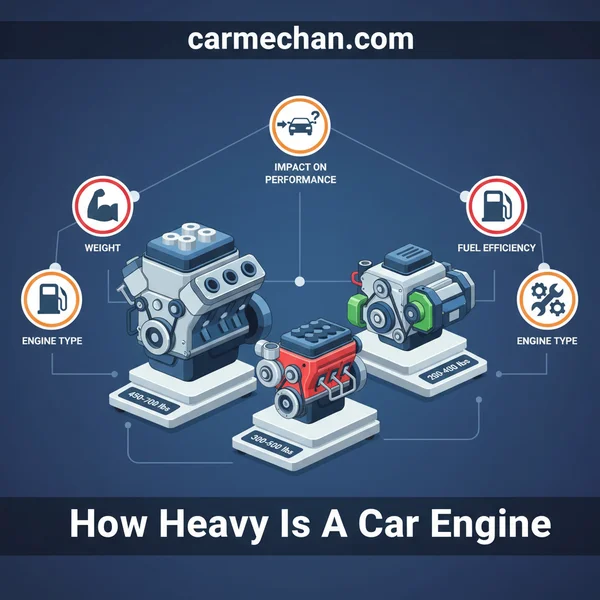
Knowing an engine’s mass is vital for anyone working on a vehicle, needing to move an engine, or considering aftermarket modifications. Whether you’re upgrading components, preparing for a full engine overhaul, or just curious about what powers your daily drive, grasping the typical weights and the factors behind them helps you make informed decisions and ensures you use the right heavy-duty equipment for the job.
Typical Car Engine Weight Ranges by Type
The number of cylinders and fuel type are primary indicators of an engine’s likely weight. Generally, more cylinders mean more material and, thus, more mass. Diesel engines, due to their higher compression ratios and robust construction, are almost always heavier than their petrol counterparts of similar displacement.
4-Cylinder Engines
Four-cylinder engines are the most common type found in compact and mid-size cars, balancing power and fuel economy. They are typically the lightest category of internal combustion engines in passenger vehicles.
- Petrol 4-Cylinder Engines: You can expect a petrol inline-four engine to weigh between 250 to 350 pounds (113 to 159 kg). Modern examples like a Toyota 2.5L Dynamic Force engine might be on the lower end, while older, simpler designs might push towards the higher end. These weights are often for the long block, sometimes including basic bolted-on accessories like the intake manifold and exhaust manifold, but generally without transmission fluid, or major external ancillaries like the alternator or AC compressor.
- Diesel 4-Cylinder Engines: Diesel engines in this configuration, found in many European and some Asian models, are noticeably heavier. Their blocks and cylinder heads are often reinforced to withstand greater internal pressures. Expect these to weigh closer to 350 to 500 pounds (159 to 227 kg). The added heft comes from stronger crankshafts, connecting rods, and often larger, more complex fuel injection systems.
V6 and V8 Engines
Moving up in cylinder count, V6 and V8 engines deliver more power but come with a significant increase in weight due to their larger displacement and additional components.
- Petrol V6 Engines: A typical petrol V6 engine will usually weigh between 350 to 450 pounds (159 to 204 kg). Modern V6 engines, especially those with aluminum blocks, aim to keep this weight down. For instance, a Honda J-series V6 might sit comfortably in this range. Their compact “V” configuration often helps with packaging, but the additional cylinders add mass.
- Petrol V8 Engines: For traditional V8 engines, commonly found in larger SUVs, trucks, and performance cars, you’re looking at weights from 450 to 700 pounds (204 to 318 kg). A cast-iron block American pushrod V8, such as an older small-block Chevy, could be near the 550-600 pound mark, while a modern, all-aluminum overhead cam V8 might shave 50-100 pounds off that, depending on its displacement and specific design. Performance V8s, designed for extreme durability, often feature heavier-duty internals.
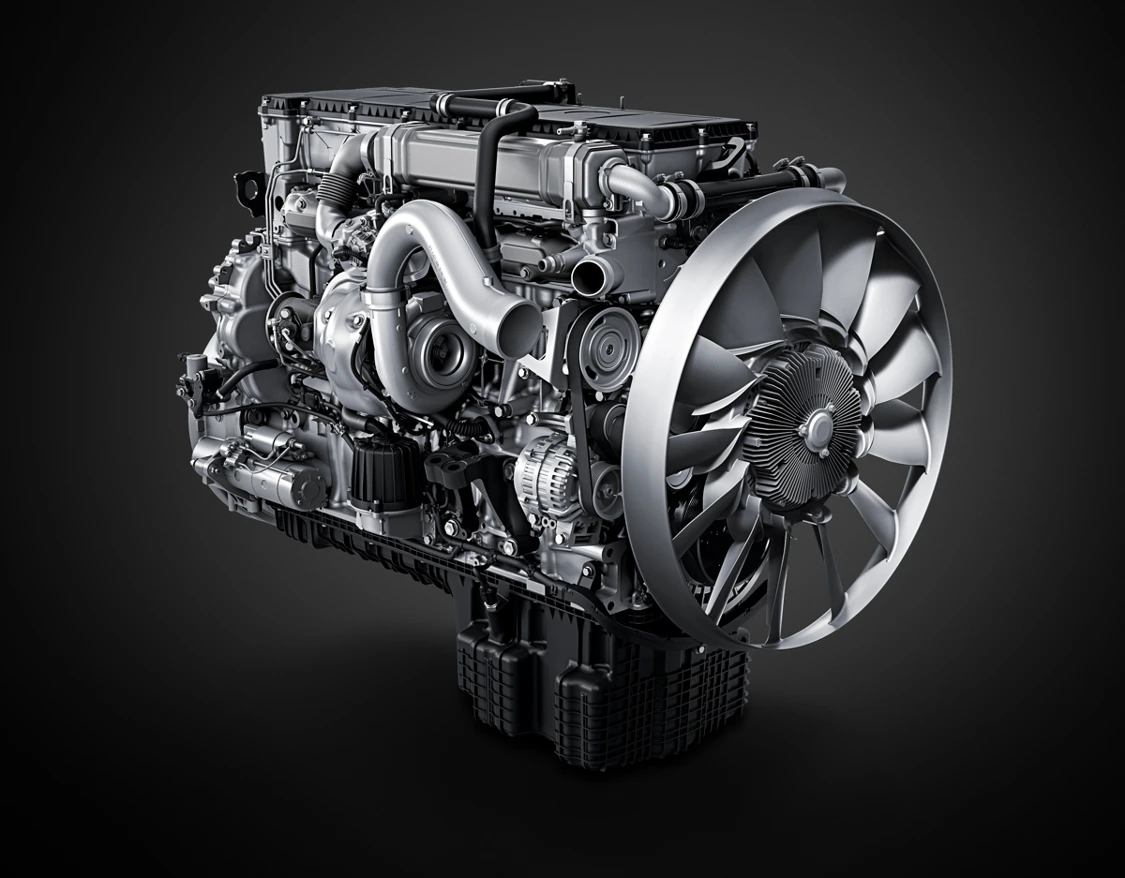
- Diesel V6 and V8 Engines: Diesel versions of V6 and V8 engines are heavyweights. A diesel V6 could easily top 500-600 pounds (227-272 kg), while a diesel V8, common in heavy-duty trucks, can exceed 700-900 pounds (318-408 kg), sometimes even approaching 1,000 pounds (454 kg) when fully dressed. Their robust construction for high torque and durability in demanding applications accounts for this substantial mass.
Key Factors Influencing Engine Mass and Design
Beyond the number of cylinders, several critical design and material choices significantly impact an engine’s final weight. These factors are carefully balanced by engineers to meet performance, durability, and cost targets.
Materials and Number of Cylinders
The materials used for the engine block and cylinder heads are perhaps the most influential factor in an engine’s weight. The sheer volume of material in the primary structure dictates much of the total mass.
- Cast Iron vs. Aluminum: This is a fundamental differentiator.
- Cast Iron: Traditionally, engine blocks were made from cast iron. It’s incredibly durable, relatively inexpensive, and excellent at dampening vibrations and sound. However, it’s also very heavy. An all-iron V8 can easily weigh 100-200 pounds more than its aluminum equivalent.
- Aluminum: Modern engines frequently use aluminum alloys for both the block and cylinder heads. Aluminum is significantly lighter than cast iron – roughly one-third the density – leading to substantial weight savings. While more expensive and requiring liners for cylinder bores, its weight reduction benefits are huge for fuel economy and vehicle dynamics. You often see mixed designs, like an aluminum head on a cast-iron block, to balance cost, weight, and durability.
- Number of Cylinders: More cylinders inherently mean a larger engine block, more pistons, connecting rods, valves, and a longer or wider crankshaft. Each additional cylinder adds material and complexity, directly increasing the engine’s overall mass. For example, a 6-cylinder engine will always be heavier than a 4-cylinder engine of similar technology and displacement.
Displacement and Accessories
The internal volume of an engine, along with the numerous components bolted onto its exterior, also play a crucial role in its final weight.
- Engine Displacement: Measured in liters or cubic inches, displacement refers to the total volume swept by all the pistons. Larger displacement engines generally have larger bores and/or longer strokes, necessitating a bigger block, cylinder heads, and larger internal components like the crankshaft and camshafts. This directly correlates to increased weight. A 3.0L V6 will almost always be heavier than a 2.0L 4-cylinder, even if both are made from aluminum.
- Forced Induction (Turbochargers/Superchargers): Adding a turbocharger or supercharger system, while enhancing power, also adds weight. These components, along with their associated intercoolers, plumbing, and stronger internal engine components designed to handle increased boost pressure, contribute to the engine’s overall mass. A turbocharged engine might be lighter than a naturally aspirated engine of significantly larger displacement, but the turbo system itself is additional weight.
- Attached Accessories and Driveline Components: Don’t forget the numerous accessories that bolt directly to the engine and are often included in “engine weight” figures (though sometimes separated). These can add considerable mass:
- Alternator, starter motor, and air conditioning (AC) compressor.
- Power steering pump (if not electric).
- Intake manifold, exhaust manifold, and catalytic converters.
- Flywheel or flexplate (connecting to the transmission).
- Engine mounts and brackets.
- Sensors, wiring harnesses, and fluid (oil, coolant – which can be 10-20 lbs alone).
Collectively, these accessories can add 50 to 100+ pounds (23 to 45 kg) to the engine’s base weight, turning a bare long block into a “dressed” engine ready for installation.
<h2>Specific Engine Examples and Weight Variances</h2>

<p>Moving beyond general categories, let's look at some specific examples to truly grasp the wide range of engine weights. It's often the blend of cylinder count, displacement, and material science that dictates the final figure.</p>

Audible — Listen Free for 30 Days
One free credit a month and thousands of titles included.
Listen Free for 30 Days<h3>Lightweight Four-Cylinder Engines</h3>
<p>Modern four-cylinder engines are engineered for efficiency and often feature advanced lightweight materials like aluminum for both blocks and heads. This keeps their weight down, benefiting smaller vehicles.</p>
<ul>
<li><strong>Honda K24 (2.4L I4):</strong> Found in many Accords and CR-Vs, a complete K24 engine typically weighs around <strong>350-400 lbs (159-181 kg)</strong>.</li>
<li><strong>Ford EcoBoost 1.0L (I3/I4 variants):</strong> These compact, turbocharged engines are marvels of lightweight design. The 1.0L version can be as light as <strong>200 lbs (90 kg)</strong> thanks to its small displacement and aluminum construction.</li>
</ul>
<h3>Heavier V6 and V8 Powerhouses</h3>
<p>As you add cylinders and increase displacement, the weight naturally climbs. V-configurations often require more material for their larger blocks and heads, especially when designed for high power output or durability.</p>
<ul>
<li><strong>Toyota 3.5L 2GR-FE (V6):</strong> A common and reliable V6, this engine can weigh around <strong>350-450 lbs (159-204 kg)</strong>, depending on accessories.</li>
<li><strong>Chevy LS V8 (various generations):</strong> These popular engines, widely used in performance cars and swaps, typically range from <strong>400-500 lbs (181-227 kg)</strong> for their all-aluminum versions.</li>
<li><strong>Traditional Cast-Iron V8s:</strong> Older V8s, like a classic small-block Chevy with a cast-iron block, could easily exceed <strong>550-600 lbs (249-272 kg)</strong>.</li>
<li><strong>Diesel Engines:</strong> Built to withstand immense compression, diesel engines are almost always significantly heavier. A large turbo-diesel, like a Cummins 6.7L, can weigh over <strong>1,100 lbs (500 kg)</strong>!</li>
</ul>
<p>These examples highlight that even within a category, there's considerable variation. Always check specific engine specs if weight is a critical factor for your project or purchase.</p>
<h2>Why Engine Weight Matters in Vehicle Performance</h2>
<p>Beyond just the number on a scale, an engine's weight plays a pivotal role in nearly every aspect of a vehicle's performance and driving experience. It's not just about power, but how that power is delivered and handled.</p>
<h3>Impact on Handling and Agility</h3>
<p>The engine is often the heaviest single component in a car, and its placement significantly affects the vehicle's <em>center of gravity</em> and <em>weight distribution</em>.</p>
<ul>
<li><strong>Cornering Dynamics:</strong> A heavy engine, especially if mounted high or far forward, can lead to more understeer (where the front wheels lose grip first), making the car feel less agile.</li>
<li><strong>Balance:</strong> Performance cars often strive for a balanced 50/50 front-to-rear weight distribution, which is easier to achieve with a lighter or more centrally mounted engine (like in mid-engine sports cars).</li>
<li><strong>Responsiveness:</strong> Reducing engine weight, or shifting its mass closer to the vehicle's center, can drastically improve a car's steering response, braking stability, and overall cornering ability. This is why exotic sports cars often feature incredibly lightweight engines.</li>
</ul>
<h3>Fuel Efficiency and Acceleration Considerations</h3>
<p>The physics are straightforward: it takes more energy to move a heavier object. An engine's weight contributes directly to the overall vehicle mass, impacting both how quickly it moves and how much fuel it consumes.</p>
<ul>
<li><strong>Fuel Economy:</strong> A lighter engine means a lighter car, which requires less power to accelerate and maintain speed. This translates directly to better fuel economy, as the engine doesn't have to work as hard.</li>
<li><strong>Acceleration:</strong> For every pound shed from the vehicle's mass, the engine has less weight to push, allowing for quicker acceleration. This is why drag racers and performance enthusiasts often invest heavily in lightweight components, including engine internals and accessories.</li>
<li><strong>Practical Tip:</strong> When considering engine swaps or significant modifications, the weight difference between engine options can make a noticeable impact not just on power-to-weight ratio, but on the car's overall character.</li>
</ul>
<h2>Conclusion</h2>
<p>The weight of a car engine is a complex interplay of its design, materials, and intended purpose. From the svelte four-cylinders tipping the scales at a couple hundred pounds to the robust V8s and heavy-duty diesels that can exceed half a ton, the variance is vast. More than just a number for lifting, engine weight profoundly influences a vehicle's handling, fuel efficiency, and acceleration.</p>
<p>Understanding these factors helps you appreciate the intricate engineering behind every car. So, whether you're a curious car owner, a potential buyer, or planning a project, consider engine weight as a key player in the performance equation. <strong>Always check the specific engine specifications for your vehicle or interest.</strong> The numbers tell a compelling story about power, efficiency, and driving dynamics!</p>
❓ Frequently Asked Questions
What are the main components contributing to an engine’s weight?
The primary contributors to an engine’s weight include the engine block, cylinder heads, crankshaft, camshafts, pistons, connecting rods, and flywheel. External accessories like the starter, alternator, and AC compressor also add significant mass.

How does material choice (cast iron vs. aluminum) impact engine weight?
Material choice has a profound impact. Cast iron is much denser and heavier, leading to heavier blocks and heads. Aluminum, being lighter, is used in many modern engines to reduce overall vehicle weight for better fuel efficiency and performance.
Is the quoted engine weight typically ‘dry’ or ‘wet’?
Most manufacturer-quoted engine weights are typically ‘dry,’ meaning they do not include fluids like oil, coolant, or fuel. They also often exclude peripheral accessories such as the alternator, power steering pump, and exhaust manifolds.
Audible Premium Plus — Annual Membership
12 audiobook credits up front, plus the full Audible catalogue.
See Annual PlansWhy are diesel engines generally heavier than similarly sized gasoline engines?
Diesel engines are heavier because they operate at much higher compression ratios and combustion pressures. This requires thicker, stronger, and more robust components—like the engine block, crankshaft, and cylinder heads—to ensure durability, adding to their overall mass.
How does engine displacement and cylinder count affect an engine’s weight?
Larger displacement engines typically have bigger blocks, longer crankshafts, and larger pistons, all of which increase mass. More cylinders generally mean a longer block and more internal components, directly adding to the engine’s overall weight.
Besides the bare engine, what other components add significant weight to the powertrain?
Beyond the bare engine, several other components add significant weight: the transmission, flywheel, clutch assembly, exhaust system, and critical accessories like the starter motor, alternator, air conditioning compressor, and power steering pump.