Dodge Ram 2500 Clutch Problems: The Definitive 2025 Troubleshooting and Repair Guide
Last Updated on September 1, 2026 by Ryan
Identifying dodge ram 2500 clutch problems early is essential for maintaining your vehicle’s heavy-duty performance. Whether you are dealing with friction surface slippage under load or hydraulic failure, understanding the mechanics behind these issues is the first step toward a permanent solution. This guide provides the technical expertise needed to troubleshoot, diagnose, and resolve common clutch failures efficiently.
Primary Symptoms: How to Diagnose a Slipping or Chatting Ram 2500 Clutch


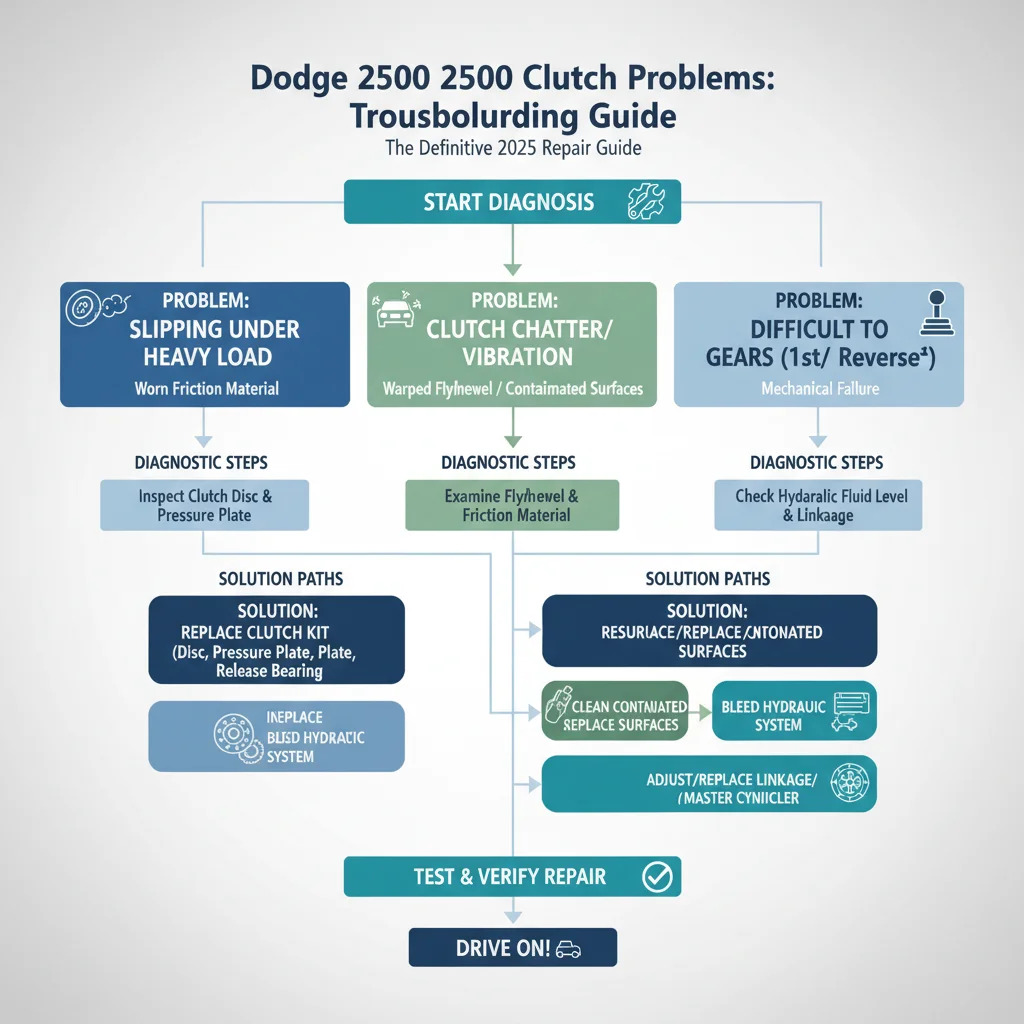
Diagnosing dodge ram 2500 clutch problems requires a keen ear and a tactical approach to testing under load. The most prevalent issue reported by owners is clutch slippage. This occurs when the friction material on the clutch disc can no longer provide the necessary grip against the flywheel and pressure plate. You will notice this most prominently in high gears (4th, 5th, or 6th) when applying heavy throttle or when the turbocharger begins to spoil while towing. If the engine RPMs rise but the vehicle speed does not increase proportionally, the cause is almost certainly a worn friction disc or a weakened pressure plate diaphragm.
Identifying Clutch Chatter and Vibration
Clutch chatter—a violent vibration or “shudder” during the initial engagement of the pedal—is another frequent complaint. This symptom typically points toward contamination on the friction surfaces, such as oil from a leaking rear main seal, or a warped flywheel. In Ram 2500 models equipped with the G56 transmission, the factory Dual-Mass Flywheel (DMF) is a common culprit. Over time, the internal springs of the DMF lose their tension, leading to excessive play and chatter that feels like the truck is about to shake itself apart during take-off.
To test for early slippage without a trailer, get the truck up to 45 MPH, shift into the highest gear, and floor the accelerator. If the needle jumps without a corresponding push in your seat, your clutch material is reaching the end of its service life.
By The Numbers
Upper Average Repair Cost
Max Miles on Stock Clutch
Failure Due to Towing Heat
Troubleshooting the Hydraulic System: Resolving Master and Slave Cylinder Failure


Not all dodge ram 2500 clutch problems involve the internal components of the transmission. Often, the issue is purely external, residing in the hydraulic linkage. A stiff or hard-to-press clutch pedal is a hallmark of hydraulic restriction or a failing master cylinder. Conversely, a pedal that stays on the floor or feels “spongy” indicates air in the lines or a leaking slave cylinder.
The Ram 2500 uses a closed hydraulic system. If you notice a drop in the fluid reservoir, there is a leak—likely at the slave cylinder pushrod where it enters the transmission bellhousing. Expert insights suggest checking the hydraulic system for leaks or air contamination first, as bleeding the system is often a simple fix for minor issues that mimic more expensive mechanical failures.
Do not continue to drive with a dragging clutch (incomplete disengagement). This puts immense strain on the transmission synchros, turning a $1,500 clutch job into a $5,000 transmission rebuild.
📋
Step-by-Step Guide to Troubleshooting Shifting Difficulties


Open the clutch fluid reservoir (located near the brake master cylinder). If the fluid is dark, murky, or contains black flecks, the internal seals of the master/slave cylinders are disintegrating.
With the engine off, shift through all gears. If it shifts smoothly, but becomes difficult to enter first or reverse once the engine is running, the clutch is not fully disengaging.
Listen for a high-pitched squeal when the clutch pedal is depressed. A seized pilot bearing can cause the input shaft to spin even when the clutch is disengaged, making it nearly impossible to shift into gear.
Drivetrain Solutions: Flywheel Resurfacing and Throwout Bearing Replacement
When you resolve to pull the transmission, the scope of the repair must extend beyond just the clutch disc. Professional best practice dictates that you must either resurface or replace the flywheel. On many Dodge Ram 2500 models, the factory-installed dual-mass flywheel cannot be easily resurfaced. Research indicates that replacing a failing DMF with a solid-mass flywheel (SMF) is the most effective solution for owners who demand durability.
The throwout bearing (release bearing) is another critical “while you’re in there” component. If you hear a grinding noise that changes when you push the clutch pedal, the throwout bearing has likely lost its lubrication or flat-spotted. Replacing this along with the pilot bearing is mandatory to ensure the longevity of your new clutch kit.
Flywheel Integrity
Always replace or resurface to prevent immediate “glazing” of the new clutch disc.
Bearing Refresh
New pilot and throwout bearings prevent future labor-intensive teardowns.
Cost Analysis: Average Expenses for Stock vs. Heavy-Duty Clutch Replacement
The financial impact of dodge ram 2500 clutch problems varies based on the parts selected and regional labor rates. According to RepairPal, the average cost for a standard replacement is between $1,278 and $1,586. However, for the Ram 2500 owner who uses their truck for work, a stock replacement may be a short-term band-aid.
Heavy-duty aftermarket kits—often featuring dual-disc designs and ceramic friction materials—can increase the parts cost by $800 to $1,200 but provide significantly higher torque capacity. This is an essential upgrade for any Cummins engine with an aftermarket tuner or performance exhaust.
✅ Pros: Heavy-Duty Upgrade
- Handles 600+ HP and 1000+ lb-ft torque
- Eliminates failing Dual-Mass Flywheel
- Superior heat dissipation for towing
- Longer service life under stress
❌ Cons: Heavy-Duty Upgrade
- Higher initial purchase price
- Increased pedal effort (stiffer feel)
- Increased gear rollover noise (rattle)
- More aggressive engagement
Final Verdict: Resolving Your Ram 2500 Clutch Issues
Successfully addressing dodge ram 2500 clutch problems requires moving beyond surface-level symptoms to find the root cause. Whether it’s a simple hydraulic bleed or a full drivetrain overhaul, the goal is to restore the clamping force necessary to move your heavy-duty load. Industry data from popular Ram truck forums indicates that most owners will face a replacement between 80,000 and 120,000 miles. If you find yourself in this window, don’t wait for a total failure on the side of the road.
For those who frequently tow heavy loads or use their Ram 2500 for demanding applications, upgrading to a heavy-duty clutch kit with a solid-mass flywheel is the most reliable long-term strategy. It improves durability, prevents premature failure, and ensures your truck remains a dependable tool for years to come. Inspect your hydraulics today, listen for throwout bearing noise, and choose a replacement kit that matches your specific torque needs.
Find Heavy-Duty Clutch Kits for Your Ram 2500
Frequently Asked Questions
How long should a clutch last on a Ram 2500?
Ram 2500 clutches typically last between 80,000 and 120,000 miles. However, lifespan is heavily influenced by driving habits, such as ‘riding’ the clutch, and the frequency of heavy towing. Regular inspections can help identify early wear before it leads to a complete mechanical failure while on the road.
What are the common signs of a failing clutch?
The most prevalent signs include a slipping clutch under acceleration, audible grinding or squealing during engagement, and a ‘spongy’ or abnormally stiff pedal. Drivers may also notice a burning smell or difficulty shifting into gear, which necessitates a thorough process to troubleshoot the hydraulic and mechanical components.
How much does it cost to replace a clutch on a Ram 2500?
According to industry data from RepairPal, the average cost for a Dodge Ram 2500 clutch replacement ranges from $1,278 to $1,586. This estimate includes both parts and labor. Prices may increase if you opt for high-performance heavy-duty components or if the flywheel requires a full replacement.
What makes a heavy-duty clutch different from a stock one?
Stock clutches are designed for standard daily driving and light utility. Conversely, heavy-duty clutches feature superior friction materials and increased clamping force. They are specifically engineered to resolve slipping issues in trucks that utilize performance tuners or frequently operate near the maximum towing and load capacity limits.
How can I diagnose a hydraulic clutch issue?
To diagnose hydraulic failure, inspect the master and slave cylinders for visible leaks and check the fluid reservoir level. If the pedal stays on the floor or feels soft, air may be trapped in the system. Bleeding the hydraulics is often the first step to troubleshoot and resolve disengagement problems.
Sources & References
This article was researched using the following authoritative sources. Click any link to learn more.
-
🏢
Dodge Official Website
↗ External Link -
🏢
Mopar Parts Website
↗ External Link
-
📄
RepairPal – Dodge Ram 2500 Clutch Replacement Cost
↗ External Link
-
📄
RockAuto Parts Catalog – Dodge Ram 2500 Clutch Components
↗ External Link -
💬
Ram Forum – Clutch Problems Discussions
↗ External Link
-
💬
Dodge Forum – Clutch Related Threads
↗ External Link
ℹ️ External links open in a new tab. We are not affiliated with these sources.