Why Does My Car Vibrate When Idle Why Your Car 2026 2026
Last Updated on September 1, 2026 by Albert Duke
When your car vibrates at idle, it typically signals an underlying issue within its mechanical, electrical, or vacuum systems. Addressing these vibrations promptly can prevent more significant damage and ensure your vehicle’s safety and performance.

Prime for Young Adults — 6 Months Free
Students and 18–24s get six months of Prime free, then half price.
Start 6 Months FreeIf you’re wondering why does my car vibrate when idle, rest assured that this is a common concern with several identifiable causes. Many vehicle owners experience this unsettling sensation, which can range from a subtle tremor to a noticeable shake. Addressing these vibrations promptly can prevent more significant damage and ensure your vehicle’s safety and performance for years to come.
This comprehensive 2026 guide is designed to help you understand the most common reasons your car might be shaking while stationary. We will walk you through systematic diagnosis steps, assess the potential severity of the issue, and discuss various solutions. Our goal is to empower you with the knowledge needed to either fix it yourself or confidently discuss the problem with a trusted mechanic.
When your car vibrates at idle, it typically signals an underlying issue within its mechanical, electrical, or vacuum systems. Addressing these vibrations promptly can prevent more significant damage and ensure your vehicle’s safety and performance.
Key Takeaways
- Idle vibrations stem from various causes.
- DIY checks can often narrow down problems.
- Severity ranges from minor to urgent.
- Contextual factors influence vibration causes.
- Professional diagnosis prevents costly mistakes.
7 Most Common Reasons Your Car Vibrates When Idle

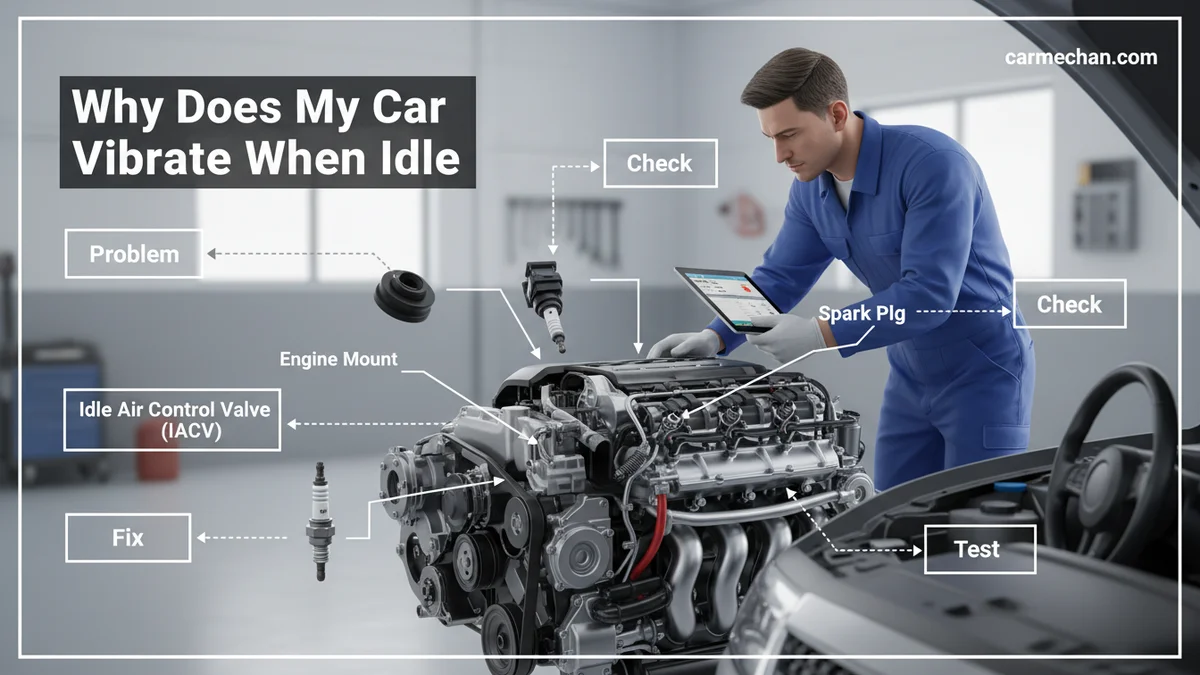
We’ve identified seven primary culprits behind a car vibrating at idle, each requiring careful consideration. Understanding these will help pinpoint the root cause.
Engine Mounts Weakened
Engine mounts are crucial components that absorb engine vibrations and keep the engine securely attached to the vehicle frame. Over time, these rubber or fluid-filled mounts can degrade, crack, or separate. Worn engine mounts fail to dampen the engine’s normal operating vibrations, transmitting them directly to the chassis and cabin. This can result in a noticeable shake, especially when the engine is idling or under load .
Spark Plugs Faulty
Spark plugs are vital for igniting the air-fuel mixture in your engine’s cylinders. If one or more spark plugs are fouled, worn, or incorrectly gapped, they can cause a cylinder to misfire. A misfiring cylinder leads to an uneven power delivery, creating an imbalance that the engine’s rotational forces cannot entirely smooth out. This imbalance is then felt as a rough idle or vibration .
Vacuum Leaks Present
Your engine relies on a precisely controlled vacuum system for many functions, including fuel delivery and emission control. A vacuum leak, often caused by cracked or disconnected hoses, introduces unmetered air into the engine. This disrupts the ideal air-fuel ratio, forcing the engine to compensate, which can result in a fluctuating idle speed and noticeable vibrations.
Fuel System Issues
Problems within the fuel system can also cause idle vibrations. This includes a clogged fuel filter, a weak fuel pump, or dirty fuel injectors. Any of these issues can restrict the proper flow of fuel to the engine’s cylinders. Insufficient fuel delivery leads to an incomplete combustion process, resulting in misfires and a rough, vibrating idle.

Audible — Listen Free for 30 Days
One free credit a month and thousands of titles included.
Listen Free for 30 DaysAir Intake Problems
The engine’s air intake system is critical for delivering clean, measured air. A dirty air filter restricts airflow, while a malfunctioning Mass Air Flow (MAF) sensor can provide incorrect air measurements to the engine’s computer. Both scenarios lead to an improper air-fuel mixture, causing the engine to run inefficiently and resulting in a rough idle vibration.
Transmission Concerns
While less common for idle vibrations, problems with the transmission can sometimes manifest this way. Issues such as a failing torque converter (especially in automatic transmissions) or worn transmission mounts can transmit vibrations to the vehicle when stopped in gear. These issues typically become more apparent when the car is in ‘Drive’ at a standstill.
Exhaust Leaks Detected
An exhaust leak occurs when exhaust gases escape before reaching the tailpipe, often due to a rusted pipe, a damaged manifold, or a failing gasket. While primarily an emissions and noise concern, some exhaust leaks can affect engine performance. Leaks near the engine, especially those affecting oxygen sensor readings, can cause the engine control unit to miscalculate the air-fuel ratio, leading to a rough idle and vibration.
Knowing the potential causes is crucial, but how can we pinpoint which one is affecting your vehicle?
How to Diagnose Idle Vibrations in 5 Steps
To accurately address why your car vibrates when idle, we recommend a systematic five-step diagnostic approach. These checks can often help narrow down the problem.
Check Engine Lights
Always start by checking your dashboard for any illuminated warning lights, particularly the “Check Engine” light. This light indicates that the vehicle’s onboard diagnostic (OBD-II) system has detected a fault. Many issues causing idle vibration, such as misfires or sensor failures, will trigger this light. Note any other lights like the oil pressure or battery warning.
Listen for Noises
While the car is idling, carefully listen for any unusual sounds. Hissing noises often indicate a vacuum leak. A knocking or tapping sound from the engine could suggest internal engine problems. A clunking or rattling might point to worn engine mounts or exhaust issues. Try to localize the sound to a specific area under the hood.
Inspect Visual Cues
Perform a visual inspection under the hood with the engine off and cooled. Look for cracked or disconnected vacuum hoses, especially around the intake manifold. Check for fluid leaks around the engine and transmission. Examine the condition of the engine mounts; look for obvious cracks, tears, or separation in the rubber components. .
Feel for Changes
Pay close attention to how the vibration feels. Does it get worse when you put the car in ‘Drive’ or ‘Reverse’? Does it change with engine RPMs? Is it more noticeable in the steering wheel, the seats, or the floorboard? These sensations can help differentiate between engine-related issues and transmission or suspension components.
Audible Premium Plus — Annual Membership
12 audiobook credits up front, plus the full Audible catalogue.
See Annual PlansScan for Codes
If your Check Engine light is on, use an OBD-II scanner to retrieve diagnostic trouble codes (DTCs). Even without a visible light, a pending code might exist. Common OBD-II codes related to rough idle include P0301-P0308 (cylinder misfire detected), P0171 (system too lean), or P0420 (catalyst system efficiency below threshold) . These codes provide a direct path to the problematic system.
Once you have an idea of the potential cause, your next concern might be the severity of the issue.
How Serious Are Car Vibrations at Idle?

Understanding the gravity of your car’s idle vibrations is key; we can categorize them into different levels of seriousness. This helps you decide how quickly to act.
Minor Discomfort Levels
Slight, barely noticeable vibrations, particularly in older vehicles, might fall into this category. These could stem from slightly aged engine mounts or minor fluctuations in engine performance. While annoying, they typically do not pose an immediate safety risk. However, ignoring even minor vibrations can allow underlying issues to worsen over time, leading to more significant repairs later in 2026.
Moderate Concern Areas
If the vibration is consistent and clearly noticeable, perhaps shaking the steering wheel or seats, it warrants prompt attention. This level often indicates issues like worn spark plugs, a developing vacuum leak, or a clogged fuel filter. While you might be able to drive the car, we recommend scheduling a diagnostic check soon. Continuous operation with moderate vibrations can accelerate wear on other engine components.
Urgent Repair Needs
Severe vibrations that cause violent shaking, are accompanied by loud noises (like knocking or grinding), smoke, or a flashing “Check Engine” light, demand immediate action. These symptoms suggest serious problems, such as a severe engine misfire, a failing transmission component, or critically damaged engine mounts. Driving with urgent issues can lead to catastrophic engine failure or unsafe driving conditions . .
Beyond the general severity, certain conditions can specifically trigger or worsen idle vibrations.
Why Does Vibration Change With Conditions?
It’s common to observe that your car’s vibration at idle can significantly change based on specific operating conditions. These variations provide important diagnostic clues.
Air Conditioning Usage
When you turn on your car’s air conditioning, the AC compressor engages, placing an additional load on the engine. If your engine is already struggling with minor issues like weak spark plugs or a marginal fuel supply, this extra demand can amplify existing vibrations. The engine’s computer attempts to increase idle speed to compensate, but if it cannot, the shake becomes more pronounced .
Drive Versus Park
Many drivers notice their car vibrates more when in ‘Drive’ or ‘Reverse’ compared to ‘Park’ or ‘Neutral’. This is largely due to the transmission being engaged and the torque converter putting a slight load on the engine. In ‘Park’ or ‘Neutral,’ the engine is free-wheeling. If engine mounts are worn, they will struggle more to absorb the vibrations when the engine is under even this slight load .
Cold Engine Starts
Vibrations that are prominent during a cold start but diminish as the engine warms up often point to issues related to engine temperature or initial combustion. The engine’s computer runs richer fuel mixtures and different timing strategies when cold. Problems like sticking engine valves, carbon buildup, or failing oxygen sensors might be more apparent before the engine reaches optimal operating temperature.
Neutral Gear Effects
If your car vibrates in neutral, it primarily points to issues directly within the engine or its mounts, rather than transmission-related concerns that are more common in drive. In neutral, the transmission is disengaged from the engine’s output shaft, so any shaking experienced is directly from the engine itself not running smoothly. This could strongly indicate problems like misfiring spark plugs or a significant vacuum leak.
Having understood the varying behaviors, the next logical step involves deciding the best course of action for a fix.
When to Seek Professional Car Help
After attempting initial diagnostics, it becomes clear when to rely on DIY fixes and when to seek professional car help. Knowing your limits can save you time and money.
DIY Fixes Tried
Several minor issues causing idle vibrations can be addressed by a capable DIYer. These include checking and replacing a dirty air filter, inspecting easily accessible vacuum hoses for cracks and reattaching loose ones, or even adding a quality fuel system cleaner to address minor fuel injector issues. Always consult your car’s service manual and prioritize safety before undertaking any repair. If these simple steps do not resolve the vibration, we recommend further action.
Professional Diagnostics Required
You should seek professional help if the “Check Engine” light is illuminated, you’ve retrieved persistent OBD-II codes, or the vibration is severe and accompanied by unusual noises or performance issues. Mechanics have specialized diagnostic tools and expertise to pinpoint complex problems like internal engine issues, failing transmission components, or hard-to-find vacuum leaks. Attempting complex repairs without proper knowledge or tools can lead to more expensive damage in 2026.
Repair Cost Estimations
Repair costs for idle vibrations vary widely depending on the underlying cause. Replacing spark plugs might cost $100-$300, while a new MAF sensor could range from $200-$500, including parts and labor . Engine mount replacements typically cost between $400-$1,000, depending on the number and type of mounts . Vacuum leak repairs can be anywhere from $100-$500, depending on the hose and accessibility . Transmission-related repairs can be significantly higher.
Ultimately, your approach to fixing the vibration will depend on these factors, leading us to a crucial summary.
Concluding Thoughts on Your Idle Vibrations
Experiencing your car vibrate when idle can be a concerning symptom, but as we’ve explored, it often points to an identifiable issue. We recommend you approach this problem systematically, starting with basic diagnostic checks like inspecting dashboard lights and listening for unusual sounds. Understanding the severity and context of the vibration is crucial for deciding your next steps.
Whether it’s a simple fix like replacing old spark plugs or a more complex issue requiring professional intervention, addressing idle vibrations promptly is always best. Proactive maintenance and timely repairs contribute to your vehicle’s longevity and ensure a safer, smoother driving experience. Don’t hesitate to consult a certified mechanic if you’re unsure or uncomfortable with any diagnostic or repair process in 2026.
Common Questions About Idle Car Vibrations
Can Bad Tires Make My Car Vibrate When Idle?
While tire issues typically cause vibration at speed, severely unbalanced or damaged tires could transmit some tremor to the chassis at idle. This is especially true if coupled with other suspension component issues. However, tire problems are not a primary cause of engine-related idle vibrations that most drivers experience.
Is It Safe to Drive My Car If It Vibrates at Idle?
The safety of driving depends on the severity and cause of the vibration. Minor tremors from worn engine mounts might be safe for short drives, but severe shaking accompanied by a flashing “Check Engine” light suggests an urgent issue. Driving with urgent problems risks further damage or unsafe operation.
How Much Does It Cost to Fix a Car Vibrating at Idle?
The cost varies significantly based on the cause. Simple fixes like a vacuum hose repair might be under $100, while new spark plugs could range from $100-$300. More complex issues like engine mount replacement or transmission repairs can cost several hundred to over a thousand dollars, depending on parts and labor.
Why Does My Car Vibrate Only When the AC Is on at Idle?
When the air conditioning is on, the AC compressor puts an additional load on the engine. If your engine has underlying weaknesses like slightly worn engine mounts, marginal spark plugs, or a dirty throttle body, this extra load can amplify existing vibrations, making them noticeable only with the AC engaged.
Can a Dirty Throttle Body Cause a Car to Vibrate at Idle?
Yes, a dirty throttle body can certainly cause a car to vibrate at idle. Carbon buildup on the throttle plate or within the throttle body assembly can restrict or disrupt the smooth flow of air into the engine. This leads to an inconsistent air-fuel mixture and an erratic idle, resulting in noticeable vibrations.