How Thick Does Concrete Need To Be For A Car Lift How 2026
Last Updated on September 1, 2026 by Albert Duke
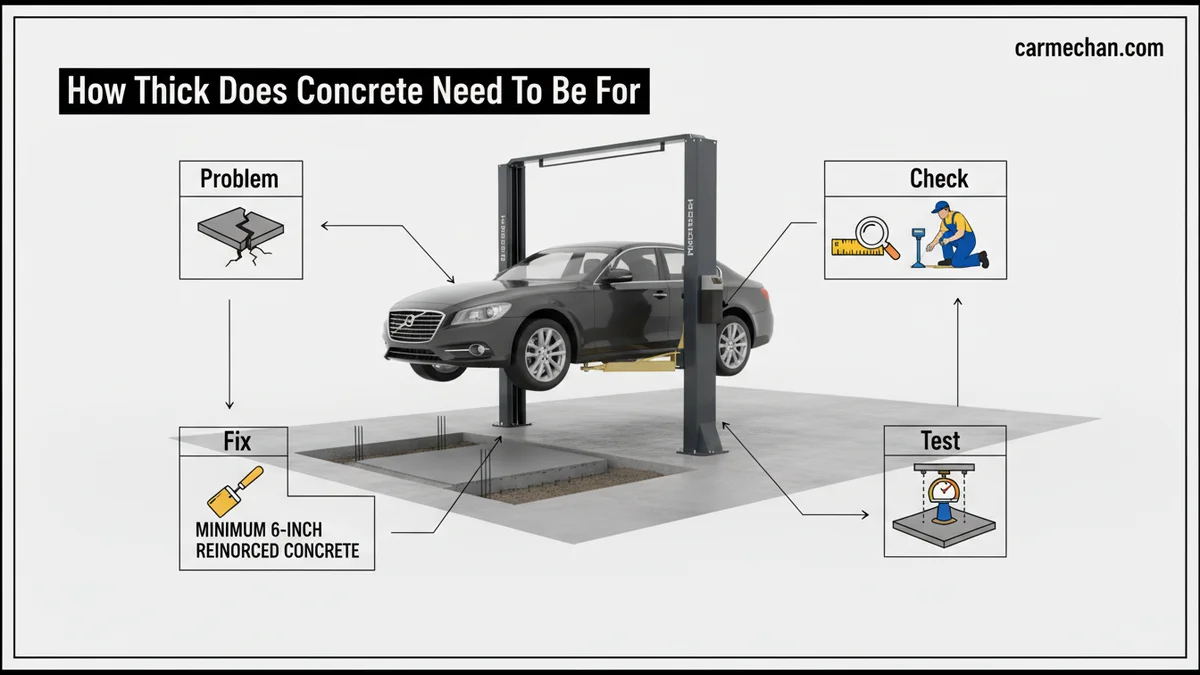
For most two-post car lifts, a minimum concrete thickness of 6 inches and 3000 PSI strength is typically required. However, specific needs vary significantly by lift type, capacity, and slab reinforcement, often necessitating a professional assessment.

Prime for Young Adults — 6 Months Free
Students and 18–24s get six months of Prime free, then half price.
Start 6 Months FreeFor most two-post car lifts, a minimum concrete thickness of 6 inches and 3000 PSI strength is typically required. However, specific needs vary significantly by lift type, capacity, and slab reinforcement, often necessitating a professional assessment.
- 6-inch, 3000 PSI minimum for 2-post lifts.
- Slab reinforcement is crucial for safety.
- Lift type and capacity dictate concrete specs.
- Professional engineering assessment is advised.
- Existing slab reinforcement options exist.
The question of how thick concrete needs to be for a car lift is paramount for any installation project. Ensuring a proper foundation is not merely about convenience; it is directly tied to the safety of personnel and the protection of valuable equipment in 2026. A substandard concrete slab can lead to catastrophic failure, causing severe injury or property damage. We explore the critical specifications that go beyond simple thickness, encompassing strength and essential reinforcement. This guide aims to provide clarity on these vital structural considerations. We will now explore the fundamental concrete requirements that underpin every safe car lift installation.
Key Takeaways
Recommended Best Deal Products


- 6-inch, 3000 PSI minimum for 2-post lifts.
- Slab reinforcement is crucial for safety.
- Lift type and capacity dictate concrete specs.
- Professional engineering assessment is advised.
- Existing slab reinforcement options exist.
What 3 Essential Concrete Requirements Ensure Car Lift Safety?

Ensuring your concrete foundation meets specific criteria is non-negotiable for safe car lift operation.
Minimum Slab Thickness
Concrete slab thickness is a primary factor. Generally, a minimum of 6 inches is needed for 2-post lifts. Four-post lifts might accept slightly less due to distributed weight, but 4-inch slabs are generally inadequate. Insufficient thickness risks anchor pull-out and slab cracking under dynamic loads.
Required Concrete Strength
Concrete strength is measured in pounds per square inch (PSI). Most manufacturers specify at least 3000 PSI for car lift installations. This strength rating ensures the concrete can withstand the compressive forces from the lift posts and the shear forces from anchor bolts. Higher capacity lifts often demand 4000 PSI or more.
Crucial Reinforcement Methods
Reinforcement significantly enhances concrete’s tensile strength, preventing cracks and increasing load-bearing capacity. Steel rebar, typically #4 rebar on 12-inch centers, provides structural integrity. Welded wire mesh can also be used, but rebar is generally preferred for heavy-duty applications. These reinforcing elements distribute loads and resist uplift forces, especially crucial for two-post lifts. While these general guidelines provide a solid starting point, the specific requirements often change dramatically depending on the type of car lift you choose.
How Do 4 Car Lift Types Impact Concrete Needs?
Different car lift designs distribute weight and apply stress to your concrete slab in unique ways, demanding tailored foundation specifications.
Two-Post Lift Specifications
Two-post lifts concentrate the entire vehicle load onto two narrow columns, creating significant stress points. For this reason, they typically require the most stringent concrete specifications. A minimum of 6 inches of 3000 PSI concrete is standard. Many manufacturers recommend 8 inches of 4000 PSI concrete, especially for lifts with capacities exceeding 10,000 lbs. Proper rebar placement is essential to manage concentrated loads and prevent pull-out.

Audible — Listen Free for 30 Days
One free credit a month and thousands of titles included.
Listen Free for 30 DaysFour-Post Lift Requirements
Four-post lifts distribute the vehicle’s weight over four points, often with a wider footprint. This dispersal reduces the localized stress compared to two-post lifts. Consequently, concrete requirements can sometimes be slightly less demanding. A 4-inch slab of 3000 PSI concrete might be adequate for some lighter 4-post lifts, though 6 inches is often preferred for added safety and stability. Always consult the lift manufacturer’s guidelines, as these can vary for specific four-post lift models.
Scissor Lift Considerations
Scissor lifts, particularly those that sit on top of the slab, generally exert pressure over a larger surface area when fully lowered. This can sometimes allow for slightly thinner concrete, such as 4-5 inches of 3000 PSI. However, anchor points for some models still demand proper slab integrity. Flush-mount scissor lifts require a recessed concrete pit built to specific dimensions, demanding careful engineering for their foundation type.
In-Ground Lift Foundations
In-ground lifts involve excavating and constructing a specialized concrete pit. This foundation must not only support the lift’s weight but also resist hydrostatic pressure from groundwater. Requirements are complex, involving reinforced walls, drainage systems, and often a substantial concrete slab at the pit’s base. A professional structural engineer is almost always necessary for an in-ground lift project. Understanding these specific lift requirements is crucial, but what if your existing garage slab doesn’t meet these rigorous standards?
When to Assess Your Existing Concrete Slab for Lifts?

Before installing any car lift, a thorough assessment of your existing concrete slab is absolutely essential to prevent costly and dangerous failures.
Evaluating Current Slab Integrity
Begin with a visual inspection. Look for significant cracks, spalling, or signs of previous settlement. To determine actual thickness, a concrete core sample can be taken, or non-destructive methods like ground-penetrating radar can be employed. For strength, a core sample can be tested for its compressive strength (PSI). Consider professional testing for accurate results.
Identifying Inadequate Slabs
An inadequate slab might show numerous hairline cracks, soft spots, or a thickness below manufacturer specifications. Any slab thinner than 6 inches for a 2-post lift should raise concerns. Visible moisture issues or signs of poor drainage also indicate potential problems. Never assume an old garage concrete slab is suitable without verification.
Three Reinforcement Strategies
If your slab is insufficient, several options exist. One method is localized pier pads or footings, where inadequate concrete is removed at each post location and a deeper, reinforced footing is poured. Another option involves cutting out and replacing entire sections with new, thicker, reinforced concrete. The most comprehensive, and often safest, approach for severely compromised slabs is a full new slab pour, ensuring uniform strength and reinforcement. Each strategy has different costs and complexities. Beyond the slab’s integrity and potential reinforcements, several other concrete-related factors contribute significantly to the overall stability and safety of your car lift.
What 5 Critical Factors Influence Car Lift Concrete Stability?
A concrete slab involves more than just thickness and strength; several environmental and installation-specific factors critically influence its long-term stability.
Achieving Proper Concrete Curing
Concrete does not dry; it cures through a chemical reaction. Proper curing is vital for achieving full strength. Concrete typically reaches its full design strength (e.g., 3000 PSI) after 28 days. Installing a lift or applying heavy loads before this period can permanently compromise the slab’s integrity and strength. Controlled moisture and temperature are key during concrete curing.
Audible Premium Plus — Annual Membership
12 audiobook credits up front, plus the full Audible catalogue.
See Annual PlansEnsuring Level Surface Preparation
A car lift requires a level surface for safe operation and proper functioning of its mechanisms. Unevenness can cause undue stress on the lift components or vehicle. Most manufacturers specify a maximum allowable deviation, often around 1/4 inch over 10 feet. A sloped garage floor may necessitate a leveling pour or shimming, which must be done carefully to maintain anchor integrity.
Optimal Sub-Base Support
The sub-base beneath your concrete slab provides crucial support and drainage. A well-compacted sub-base, often gravel or crushed stone, prevents settlement and ensures even load distribution. Poor sub-base preparation can lead to cracks or uneven settling over time. Ensure it is compacted to at least 95% Modified Proctor density for a stable sub-base foundation.
Managing Site Drainage
Water can undermine your concrete slab and sub-base over time, especially in outdoor or poorly sealed indoor environments. Proper drainage, including grading away from the lift area, is essential to prevent water accumulation. This protects the integrity of the concrete and prevents freezing and thawing cycles from causing damage. Consider the water table if building new.
Secure Anchor Point Installation
The correct installation of anchor bolts is paramount for a two-post lift’s stability. Anchors must be drilled to the correct depth and diameter, then torqued to manufacturer specifications. Avoid hitting rebar during drilling, which can weaken the slab. Improperly installed car lift anchors are a leading cause of lift failure. While adhering to these physical and installation-related factors is vital, overlooking regulatory requirements and professional guidance can lead to significant issues.
Why Expert Guidance Is Key for Car Lift Concrete?
Installing a car lift involves significant responsibility; ignoring regulatory requirements and professional advice is a risky proposition for any project in 2026.
Understanding Local Building Codes
Building codes vary by municipality and can have specific stipulations for garage foundations and equipment installations. Always check with your local planning department before beginning construction or installation. Permits may be required, and inspections could be mandated to ensure compliance. Non-compliance can result in fines or forced removal of your car lift setup.
Following Manufacturer Guidelines
Every car lift manufacturer provides detailed installation instructions, including precise concrete specifications. These guidelines are not suggestions; they are engineering requirements based on the lift’s design and load characteristics. Deviating from these specifications voids warranties and severely compromises safety. Always consult the specific manual for your chosen lift model.
Consulting Structural Engineers
For any uncertainty regarding your existing slab, or for new construction involving heavy-duty lifts or complex installations like in-ground units, hiring a qualified structural engineer is highly recommended. An engineer can assess your slab’s load capacity, design appropriate reinforcements, or specify a new foundation. Their expert assessment provides peace of mind and ensures compliance. By thoroughly understanding these concrete requirements, you lay the foundation for a secure and long-lasting car lift installation.
Common Questions About Car Lift Concrete Needs
Can I Install a Car Lift on a 4-inch Concrete Slab?
Installing a two-post car lift on a 4-inch concrete slab is generally not recommended and poses significant safety risks. Most manufacturers require a minimum of 6 inches of concrete, often 3000 PSI or higher, for proper anchoring and load support. A 4-inch slab might suffice for some lighter 4-post lifts or certain scissor lifts, but always verify with your lift’s specific requirements.
How Do I Test My Existing Concrete Slab’s Thickness and Strength?
To test thickness, you can have a core sample drilled from an inconspicuous area, or use non-destructive ground-penetrating radar. For strength (PSI), a core sample can be laboratory-tested. Less precise field methods exist, but professional testing provides accurate data essential for safety and structural integrity verification.
Is Rebar Necessary for Car Lift Concrete?
Yes, rebar is highly recommended and often necessary, especially for two-post lifts. It significantly increases the concrete’s tensile strength, helping to prevent cracking and improving the slab’s resistance to anchor pull-out under heavy, dynamic loads. Always follow manufacturer and engineering specifications for rebar size and spacing.
How Long Must Concrete Cure Before Installing a Car Lift?
Concrete typically needs a minimum of 28 days to reach its full design strength. Installing a car lift and applying heavy loads before this curing period is complete can permanently weaken the concrete, making it unsafe. Allow ample time for proper curing, ideally under controlled conditions, before use.
Do All Car Lifts Have the Same Concrete Requirements?
No, concrete requirements vary significantly between different types of car lifts. Two-post lifts generally demand the thickest and strongest concrete due to concentrated loads. Four-post and scissor lifts often have slightly less stringent requirements, but all necessitate specific PSI and proper preparation according to the manufacturer’s guidelines.
Safely installing a car lift in 2026 hinges entirely on a properly prepared concrete foundation. From ensuring adequate thickness and strength to incorporating proper reinforcement, every detail matters. Whether you are a DIY enthusiast or a business owner, never compromise on these structural necessities. Always consult manufacturer specifications for your chosen lift and, when in doubt, seek professional engineering advice. Investing in a concrete base protects your equipment, your property, and, most importantly, yourself and others. A secure foundation means years of reliable service from your car lift.