|

Nissan Rogue Ac Not Working: Diagnosing And Resolving Hvac System Malfunctions

Last Updated on May 5, 2026 by Ryan

Is your Nissan Rogue’s air conditioning system failing to deliver crisp, cool air, leaving you sweltering on the road? A malfunctioning AC in your vehicle, especially a Nissan Rogue, can stem from a variety of sources, from simple electrical glitches to complex refrigerant system failures, making effective troubleshooting challenging for the uninitiated. This comprehensive guide will equip you with the knowledge and systematic approach to diagnose and resolve common Nissan Rogue AC issues, empowering you to either perform essential repairs or accurately communicate the problem to a certified technician.

📌
Key Takeaway

Most Nissan Rogue AC issues can be systematically diagnosed by starting with simple checks of HVAC settings, cabin air filter condition, and electrical fuses before proceeding to complex refrigerant or component diagnostics. Proper troubleshooting can save significant time and expense.

Initial Diagnostics: Common AC System Overlooks in Your Nissan Rogue

Before delving into complex component failures, it is crucial to perform fundamental checks that often reveal a simple, easily rectifiable cause for your Nissan Rogue’s AC malfunction. These initial steps are designed to help you troubleshoot and diagnose common issues that don’t require specialized tools or extensive automotive knowledge. Statistical analysis indicates that approximately 15-20% of perceived AC failures in vehicles are attributed to user error or easily rectified maintenance issues like a clogged filter.

Verify HVAC Control Settings

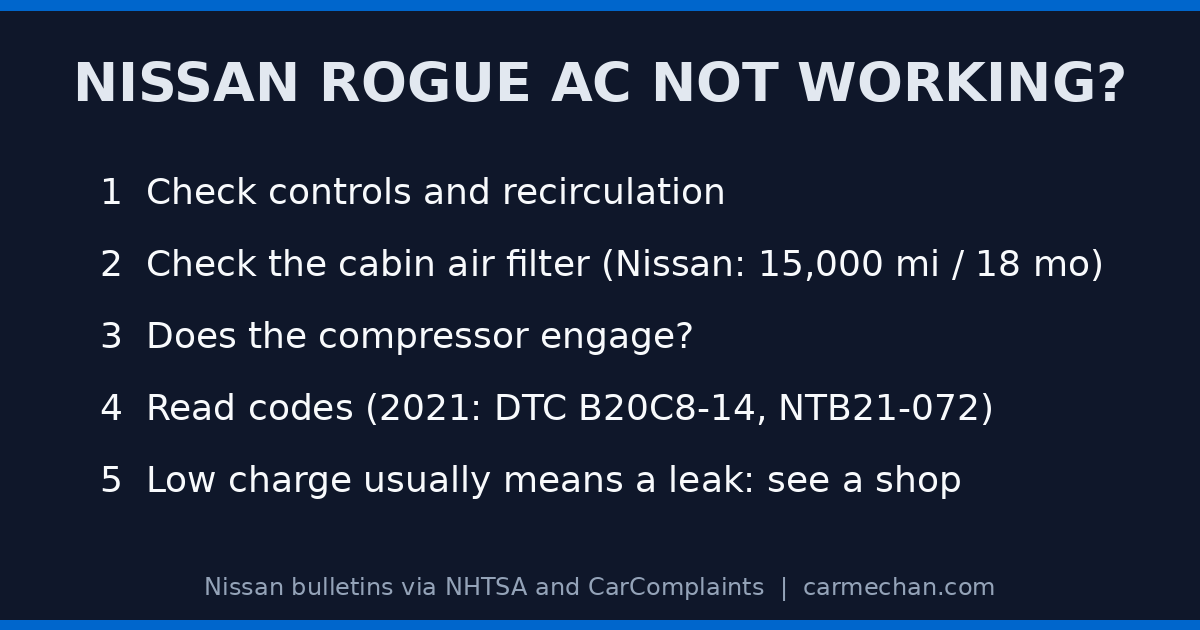
One of the most frequent oversights is incorrect climate control settings. Ensure that the AC button is firmly engaged (typically indicated by an illuminated LED), the temperature is set to its lowest ‘cool’ setting, and the fan speed is adequate. Confirm that the mode selection is set to direct airflow through the vents, not solely defrost or floor. It’s not uncommon for the system to appear non-functional when, in reality, it’s merely set to ‘vent’ or ‘heat’ from a previous drive. Also, experiment with the recirculated air mode (often depicted by an arrow looping inside the car) versus fresh air mode. Recirculation typically cools the cabin more efficiently in hot conditions by recycling already cooled air.

Inspect the Cabin Air Filter

A severely clogged cabin air filter is a primary cause of restricted airflow, leading to significantly reduced AC performance or even the perception of a complete failure. Nissan recommends cabin air filter replacement every 12,000 to 15,000 miles or annually, whichever comes first. This simple maintenance item can drastically improve your system’s efficiency and air quality.

nissan rogue ac not working

📋
Step-by-Step Guide: Inspecting Your Cabin Air Filter

1
Locate the Filter

Most Nissan Rogue cabin air filters are located behind the glove compartment. Open the glove box, then typically unclip or remove two small dampers on the sides to allow it to swing down further, exposing the filter housing cover.

2
Remove and Inspect

Unclip or slide off the filter housing cover. Gently pull out the old filter. Observe its condition: a new filter is typically white or light grey; a severely clogged filter will be dark, filled with leaves, dirt, and debris, appearing almost black and opaque. This visual comparison provides immediate insight into its impact on airflow.

3
Replace if Necessary

If the filter is dirty, replace it with a new one, ensuring the airflow arrow on the filter matches the direction indicated on the housing. Reassemble the glove box and test the AC performance. This simple solution can often resolve airflow issues.

Check for Basic Electrical Continuity

While electrical diagnostics can be complex, verify that there are no external power interruptions affecting your vehicle. A dead or weak battery, corroded battery terminals, or loose connections can indirectly impact AC operation by preventing the HVAC system from receiving adequate power. Ensure battery terminals are clean and tight. While less common, a general electrical issue can sometimes be the root cause.

Listen for Compressor Clutch Engagement

With the engine running and the AC activated, listen carefully under the hood, particularly near the AC compressor. You should hear a distinct ‘click’ sound as the magnetic clutch engages, followed by a slight change in engine idle speed as the compressor begins to work. The absence of this ‘click’ is a critical diagnostic indicator, suggesting issues with electrical power to the clutch, a faulty clutch itself, or insufficient refrigerant pressure preventing engagement.


Improved Airflow & Cooling

Regular filter checks and proper HVAC settings ensure optimal air distribution and cooling efficiency, enhancing cabin comfort.


Prevents Costly Repairs

Addressing minor issues early, like a clogged filter, prevents strain on major components like the blower motor or compressor, extending their lifespan.


Better Air Quality

A clean cabin air filter effectively traps dust, pollen, and pollutants, ensuring healthier air inside your Nissan Rogue.

nissan rogue ac not working

Refrigerant System Integrity: Pressure Checks and Leak Detection for Nissan Rogue AC

If your initial checks yield no obvious cause, the next critical area to diagnose is the refrigerant system. The AC system relies on a precise charge of refrigerant (either R-134a for older models or R-1234yf for newer Nissan Rogues, typically 2017+ but verify your specific model year) to effectively cool the air. Low refrigerant levels are a primary reason for diminished or absent cooling.

Symptoms of Low Refrigerant

The most common symptom of insufficient refrigerant is the AC blowing warm or only mildly cool air, especially on hot days. Other indicators include the AC compressor cycling on and off rapidly (short-cycling), a noticeable decrease in cooling performance over time, or even the compressor failing to engage at all due to low pressure switch activation. A typical Nissan Rogue AC system holds between 1.1 to 1.3 lbs (500-600 grams) of R-134a refrigerant. While an annual refrigerant loss of 5-10% is considered normal through hoses and seals, excessive loss unmistakably points to a leak, requiring more than just a simple top-off.

Utilizing AC Manifold Gauges

To accurately assess the refrigerant charge, a set of AC manifold gauges is indispensable. These gauges measure the high-side and low-side pressures of the system, providing a diagnostic snapshot. To use them: connect the blue hose to the low-pressure service port (larger port, usually on the accumulator/dryer) and the red hose to the high-pressure service port (smaller port, typically on the liquid line). The yellow hose connects to the refrigerant can or vacuum pump. With the engine running and AC on max cool, observe the readings. Optimal pressure ranges vary with ambient temperature, but generally, the low-side should be around 25-45 PSI and the high-side 150-250 PSI. Readings significantly below these ranges indicate a low charge.

💡

Pro Tip: Interpreting Manifold Gauge Readings

Don’t just look for low pressure. If both pressures are very low, it’s a severe undercharge. If the low side is too high and the high side is too low, you might have a failing compressor or a restriction. If the high side is excessively high and the low side is low, it could indicate an overcharge or a condenser airflow issue. Always consult a pressure-temperature chart for precise interpretation based on ambient conditions.

Methods for Leak Detection

Once low refrigerant is confirmed, locating the leak is paramount to finding a lasting solution. Several methods exist:

  • Visual Inspection: Look for oily residue around AC components (compressor, hoses, condenser, service ports). Refrigerant oil often escapes with the gas.
  • UV Dye: Introduce UV fluorescent dye into the system. After running the AC for a while, use a UV black light and specialized yellow glasses to scan all components. Leaks will glow bright green or yellow. Common leak points include O-rings, the condenser, evaporator, and compressor seals.
  • Electronic Leak Detector: A highly sensitive electronic sniffer can detect refrigerant escaping even in small amounts. Pass the probe slowly over AC components, especially joints and fittings.

Addressing Minor Leaks vs. Major System Breaches

A slow, evaporative leak, common through porous hoses or aging O-rings, might be temporarily addressed with a minor ‘top-off’ if you understand the underlying cause. However, this is merely a workaround and not a permanent fix. A significant leak, identified by rapid refrigerant loss or a large oily patch, requires professional attention. For 2020 Nissan Rogues utilizing R-1234yf refrigerant, specialized equipment and certified technicians are mandated for servicing due to its flammability and specific handling requirements. Attempting to fix a significant leak without proper evacuation and repair is both ineffective and potentially harmful.

Pros of Professional Leak Repair

  • Precise leak detection and component repair.
  • Correct evacuation and refrigerant recharge.
  • Long-term reliability and AC performance.

Cons of DIY Refrigerant Top-off (with leaks)

  • Does not address the root cause of the leak.
  • Potential for overcharging, damaging components.
  • Wasted refrigerant and environmental impact.

Electrical System Diagnostics: Fuses, Relays, and Compressor Clutch Engagement

When the AC system fails to engage or the fan doesn’t blow, electrical issues are often the culprit. Proper debugging of the electrical circuit is essential. This section guides you through troubleshooting common electrical failure points that directly impact your Nissan Rogue’s AC functionality.

Inspecting AC-Related Fuses

Fuses are safety devices designed to protect electrical components from overcurrents. A blown fuse will completely cut power to its respective circuit. Nissan Rogues typically have at least two fuse boxes: one under the hood and another inside the cabin (often behind a panel near the driver’s side or under the dash). Consult your owner’s manual for the exact locations and fuse diagrams.

Key fuses to check for the AC system typically include:

  • AC Compressor Fuse: Powers the clutch electromagnet. Usually a 10A or 15A mini fuse, often labeled “A/C” or “MAG CLUTCH.”
  • Blower Motor Fuse: Supplies power to the fan. This can be a larger fuse, sometimes 20A or 30A.
  • HVAC Control Unit Fuse: Powers the climate control panel itself.

Visually inspect each fuse for a broken filament. For a more definitive test, use a multimeter to check for continuity across the fuse terminals. A good fuse will show continuity, while a blown one will show an open circuit.

Testing the AC Compressor Relay

The AC compressor relay acts as an electrical switch, controlled by the HVAC system, to send power to the compressor clutch. A faulty relay is a common cause for the compressor not engaging (no ‘click’). Relays are typically found in the under-hood fuse box. A quick test involves swapping the AC relay with a known good, identical relay from a non-critical circuit (e.g., the horn relay, if compatible). If the AC then works, you’ve identified the faulty relay. You can also test a relay with a multimeter by applying 12V to the coil terminals and checking for continuity across the switch terminals.

Assessing the Compressor Clutch

If the fuses and relay are good, the problem might lie with the compressor clutch itself. With the engine off and the AC engaged, you can often manually test the clutch engagement. Locate the front of the compressor; there’s a plate (the clutch plate) that should spin with the serpentine belt when the AC is on. If it’s not engaging, carefully and briefly push the clutch plate towards the compressor body. If it engages and stays engaged with a ‘clunk’, power might not be reaching it, or the air gap is too wide. If it doesn’t engage, the clutch electromagnet might be faulty or there’s an internal compressor issue. Use a multimeter to verify electrical power supply to the clutch wire when the AC is activated; you should see ~12V. Compressor clutch coils typically have a resistance between 2.5 and 4.5 ohms; deviations indicate a faulty electromagnet.

⚠️

Important Warning: Manual Clutch Engagement

Manually testing the compressor clutch should be done with extreme caution. The engine must be off to avoid injury from moving belts and pulleys. Do not attempt this if you are uncomfortable or unsure, as serious injury can occur. If the clutch engages manually but not electrically, it points to an electrical supply issue, not necessarily a failed clutch.

Wiring Harness Inspection

Finally, visually inspect the wiring harnesses connected to the compressor, pressure switches, and HVAC control unit. Look for any signs of corrosion, fraying, cuts, or loose connections. Rodent damage to wiring is a surprisingly common, yet often overlooked, cause of electrical malfunctions. A simple break in a wire can prevent the entire system from receiving the necessary signals or power.

By The Numbers: Electrical Component Specifications

10-15A
AC Compressor Fuse
2.5-4.5Ω
Clutch Coil Resistance
12V
Required Clutch Voltage

Blower Motor and HVAC Control Unit Malfunctions in Your Rogue

Even if your AC compressor is engaging and the refrigerant levels are adequate, your Nissan Rogue won’t be comfortable if air isn’t being distributed correctly or at the desired temperature. This section focuses on diagnosing issues with the blower motor assembly and the HVAC control unit, providing potential solutions and workarounds for these specific problems.

Blower Motor Failure Symptoms and Testing

The blower motor is responsible for pushing air through your vents. Symptoms of its failure include: no airflow whatsoever, inconsistent airflow (e.g., stops working sporadically), or unusual noises coming from behind the dashboard (e.g., squealing, grinding, or whining sounds). The average lifespan of a blower motor is around 100,000 to 150,000 miles. To test, access the blower motor (usually located under the passenger side of the dashboard). With the fan on, check for voltage and ground at the motor’s connector using a multimeter. If power and ground are present but the motor doesn’t spin, the motor itself is likely faulty and requires replacement.

Troubleshooting the Blower Motor Resistor/Module

The blower motor resistor (or control module in newer Rogues with automatic climate control) regulates the speed of the blower fan. A common symptom of a faulty resistor is the blower operating only at certain speeds (most often, only at high speed) or not at all. This is due to individual resistance coils or the electronic module failing. Blower motor resistor failures are common due to heat and electrical stress. To test, visually inspect for signs of burning or corrosion. A multimeter can be used to check resistance across terminals, but often, the most practical test is to replace it with a known good unit, as they are relatively inexpensive and easy to access (often near the blower motor itself).

Diagnosing HVAC Control Unit Issues

The HVAC control unit is the brain of your climate system. A malfunctioning control panel can manifest as various issues: the AC button not illuminating, inability to change fan speed or temperature, or the system simply not responding. While rare, complete failure requires replacement. In some cases, a hard reset (disconnecting the battery for 15-30 minutes) might provide a temporary workaround by resetting the module. Modern Rogues might store diagnostic trouble codes (DTCs) related to HVAC issues, which can be retrieved with an OBD-II scanner, providing more precise diagnostic information.

Blend Door Actuator Problems

Blend door actuators control the mix of hot and cold air, directing it through the vents. When an actuator fails, it can lead to incorrect temperature delivery (e.g., always hot or always cold air, regardless of your setting). A common symptom is a repetitive clicking or grinding noise coming from behind the dashboard, especially when changing temperature settings. This noise indicates the actuator motor is struggling or stripped. Identifying which actuator is failing (there can be multiple) often involves listening carefully or using a diagnostic scanner that can command each actuator independently.

💡

Pro Tip: Pinpointing Blend Door Actuator Issues

If you hear clicking or grinding when changing temperature, fan mode, or vent direction, it’s highly likely a blend door actuator. To isolate which one, sit in the quiet cabin and cycle through all AC functions. The location of the clicking sound can help identify the problematic actuator. Replacement is often a DIY task, but accessing them can be challenging, sometimes requiring partial dashboard disassembly.

Advanced Component Failure: Compressor, Condenser, and Evaporator Issues Requiring Professional Service

When preliminary troubleshooting has been exhausted and simple fixes have not resolved the AC issue, it’s likely you’re dealing with a major component failure. These issues typically necessitate professional diagnosis and repair, often requiring specialized equipment and certified technicians due to the complexity and the handling of refrigerants. This section helps you identify signs that indicate it’s time to move beyond DIY efforts and seek expert assistance to fix your Nissan Rogue’s AC.

Symptoms of a Failing AC Compressor

The AC compressor is the heart of the system, responsible for compressing refrigerant gas and circulating it. A failing compressor will exhibit distinct symptoms:

  • Loud Noises: Grinding, knocking, or squealing noises emanating from the compressor area when the AC is engaged. These often indicate internal bearing failure or mechanical breakdown.
  • Seized Clutch: The compressor clutch may seize, preventing it from rotating with the serpentine belt, or it may continuously spin even when the AC is off.
  • Fluid Leakage: Visible signs of refrigerant oil leakage around the compressor body, which often appears as dark, oily stains. This is a clear indicator of a seal failure within the compressor itself.

A completely seized compressor can also cause the serpentine belt to shred or snap, leading to additional system failures. AC compressor replacement can cost between $800 and $1,500 for parts and labor, excluding refrigerant recharge, making it a significant repair.

Diagnosing a Clogged or Damaged Condenser

The condenser, located at the front of the vehicle, dissipates heat from the hot, compressed refrigerant. If it’s clogged with road debris (leaves, bugs, dirt) or physically damaged (e.g., from a collision), it cannot effectively cool the refrigerant. This leads to high system pressures on the high side and significantly reduced cooling efficiency. Visual inspection is crucial here: look through the grille at the condenser fins. They should be relatively clean and straight. A bent, blocked, or leaking condenser requires replacement. Condenser replacement typically ranges from $400 to $800.

Evaporator Coil Issues

The evaporator coil, situated inside the dashboard, absorbs heat from the cabin air. Problems here often manifest as musty odors (due to mold or mildew growth from condensation), visible moisture inside the cabin, or reduced cooling efficiency. A leaking evaporator is often the most challenging AC leak to debug and fix due to its location. Evaporator replacement is typically the most labor-intensive AC repair, frequently requiring complete dashboard removal, and can cost $1,000 to $2,000 or more for parts and labor. This complexity makes it an impractical DIY alternative for most vehicle owners.

Component Symptoms of Failure Typical Repair Cost (Parts + Labor)
Compressor Loud noises, no clutch engagement, visible leaks $800 – $1,500+
Condenser High system pressure, poor cooling, visible damage/blockage $400 – $800
Evaporator Musty odors, reduced cooling, visible moisture (leaks) $1,000 – $2,000+

When to Seek Professional Diagnostic Services

Recognizing when to call a professional is key. You should seek certified automotive HVAC technician services when:

  • You’ve identified a refrigerant leak but lack the equipment for proper evacuation and recharge.
  • Major components like the compressor, condenser, or evaporator need replacement.
  • Your Nissan Rogue uses R-1234yf refrigerant, which requires specialized handling.
  • You’ve completed all basic diagnostics and cannot pinpoint the cause of the AC failure.
  • Complex electrical issues persist after checking fuses and relays.
⚠️

Important Warning: Refrigerant Handling

Refrigerants are greenhouse gases and, depending on the type, can be harmful if not handled correctly. Releasing refrigerant into the atmosphere is illegal and environmentally damaging. Always use proper recovery equipment or seek professional service for any work involving the refrigerant circuit.

By The Numbers: Average AC Repair Costs

$800 – $1,500
Compressor Replacement
$400 – $800
Condenser Replacement
$1,000 – $2,000+
Evaporator Replacement

Summary Points: Start troubleshooting with basic checks like AC settings, cabin air filter, and fuse inspection. Systematic diagnosis of refrigerant levels, electrical components (fuses, relays, clutch), and blower system is crucial. Complex issues such as compressor, condenser, or evaporator failures typically require specialized tools and professional expertise.

By following this diagnostic blueprint, you can effectively pinpoint the root cause of your Nissan Rogue’s AC malfunction, from simple electrical glitches to intricate refrigerant issues. For advanced repairs or any work involving refrigerant handling, consult a certified automotive HVAC technician to ensure a safe and lasting solution.

Frequently Asked Questions

Why is my Nissan Rogue AC blowing warm air but the fan works?

If your Rogue’s AC fan operates but only warm air is dispensed, the primary suspects are often low refrigerant charge due to a leak, a malfunctioning AC compressor not pressurizing the system, or an electrical issue preventing the compressor clutch from engaging. Less commonly, a blend door actuator could be stuck in the heat position, despite AC activation.

Where is the AC fuse located in a Nissan Rogue?

The main AC compressor fuse in most Nissan Rogue models is typically located in the under-hood fuse/relay box, often labeled ‘AC COMP’ or similar. There might also be fuses for the blower motor and HVAC control unit in the interior fuse panel (usually behind a panel near the driver’s footwell). Always consult your owner’s manual for precise locations.

Can a bad AC relay cause my Nissan Rogue’s AC not to work?

Yes, a faulty AC compressor relay is a common cause for the AC system not engaging. The relay acts as an electrical switch, sending power to the compressor clutch when activated by the HVAC control unit. If it fails, power won’t reach the clutch, preventing the compressor from operating. It can often be tested by swapping it with a known good, identical relay.

How do I check if my Nissan Rogue AC compressor clutch is engaging?

With the engine running and AC switched on (and fan at a moderate speed), visually inspect the front of the AC compressor. You should see the outer plate (the clutch) spinning along with the pulley. If the pulley spins but the outer plate remains stationary, the clutch is not engaging. Listen for a distinct ‘click’ sound when the AC button is pressed.

What’s the typical cost to fix a Nissan Rogue AC system?

The cost to fix a Nissan Rogue AC system varies widely based on the issue. Simple fixes like a cabin air filter are under $50. A refrigerant recharge can be $150-$300. More complex repairs like a blower motor resistor might be $100-$300. Major components like a new AC compressor or condenser can range from $800 to over $1,500, including parts and labor.

Recommended
A/C Pro AE3 Ultra Synthetic R-134a AC Recharge Kit

A/C Pro AE3 Ultra Synthetic R-134a AC Recharge Kit

Check Price on Amazon →

Author

See also  Nissan Catalytic Converter Scrap Value: Real Case Study 2026

Similar Posts

Leave a Reply

Your email address will not be published. Required fields are marked *