How To Negotiate Car Price At Dealership Proven Guide 2026
Last Updated on September 1, 2026 by Albert Duke
Negotiating a car price at a dealership involves thorough preparation, strategic communication, and understanding common sales tactics. By researching market values, securing financing, and confidently employing specific negotiation techniques, you can significantly lower the final price and secure a better deal.
The best way to negotiate a car price at a dealership involves a strategic blend of research, clear communication, and unwavering confidence. Many buyers approach the dealership experience with apprehension, but with the right tactics, you can turn it into an empowering process.
By understanding how dealerships operate and equipping yourself with proven negotiation techniques, you can significantly reduce the final price of your vehicle. Our goal is to provide you with the knowledge to secure an excellent deal in 2026 and beyond.
We will begin by outlining the essential groundwork necessary for entering any dealership with strength and clarity.
Negotiating a car price at a dealership involves thorough preparation, strategic communication, and understanding common sales tactics. By researching market values, securing financing, and confidently employing specific negotiation techniques, you can significantly lower the final price and secure a better deal.
Key Takeaways

- Always research market value before visiting.
- Secure pre-approved financing beforehand.
- Negotiate the total out-the-door price.
- Recognize and counter common dealer tricks.
- Be ready to confidently walk away.
5 Critical Steps to Prepare for Car Negotiation
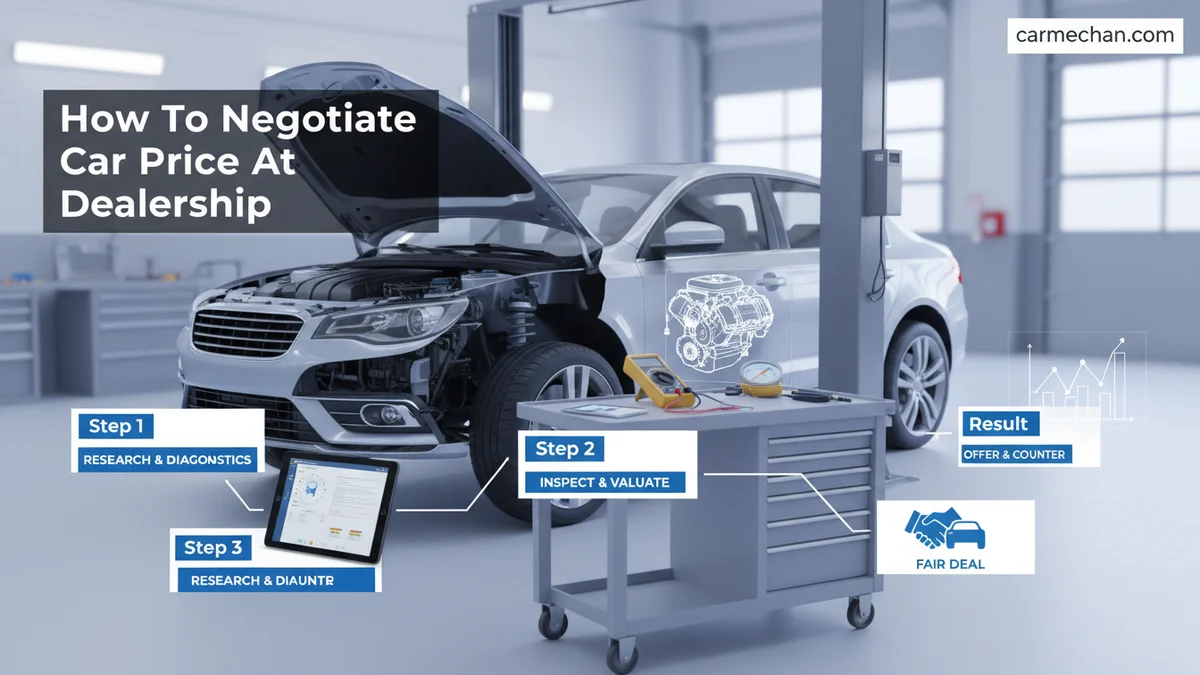
Effective preparation forms the cornerstone of successful car price negotiation at a dealership. Before you even set foot on the lot, meticulous planning empowers you with leverage.

Research Market Value
Understanding the true market value of your desired vehicle is paramount. Utilize resources like Kelley Blue Book, Edmunds, and NADAguides to compare prices for similar models in your area.
This research should cover both new and used vehicles, considering trim levels and options. Knowing what comparable cars are selling for provides a solid foundation for your negotiations.
Reviewing historical price data can also reveal trends. For instance, average car market value fluctuation has shown diverse patterns in recent years, with some models depreciating faster than others.
Secure Loan Pre-Approval
Separating the financing from the car price gives you immense power. Obtain pre-approved financing from your bank or a credit union before visiting the dealership.
This provides you with a benchmark interest rate and demonstrates your financial readiness. With pre-approval, you negotiate the car’s price based on cash, not monthly payments.
Many buyers regret not getting pre-approved, often accepting higher dealer-offered rates. Studies show that a significant percentage of buyers still rely solely on dealer financing, missing out on potentially lower rates from external lenders. [statistics on how many buyers get pre-approved loans vs. dealer financing]
Understand Dealership Costs
Gaining insight into a dealership’s profit margins can guide your offers. While precise dealer invoice pricing is complex, resources like TrueCar can offer estimates of what the dealer paid.
This understanding helps you gauge how much wiggle room exists above the invoice price. Aiming slightly above invoice price often leaves room for a fair profit for the dealer while securing a good deal for you.
Define Target Price
Based on your research, establish a clear target price for the vehicle. This includes the “out-the-door” price, which encompasses the car’s price, taxes, fees, and any other charges.
Have both a realistic target and a maximum absolute limit in mind. This clarity prevents emotional decisions during the negotiation process.
Practice Key Phrases
Confidence comes from preparation, including rehearsing how you will communicate. Practice phrases that help you stay firm, ask questions, and politely decline unwanted offers.
Being articulate and composed can help you maintain control of the conversation. Rehearsing helps you avoid stumbling or being swayed by sales pressure.
Once you have completed your crucial groundwork, you are ready to implement proven strategies during the negotiation itself.
How to Use Best Negotiation Tactics at Dealership
Deploying the right negotiation tactics at the dealership transforms a daunting process into an empowering one. These strategies help you remain in control and steer the conversation towards your desired outcome.
Aim for Out-The-Door Price
Always negotiate the total “out-the-door” price, not just the monthly payment or the car’s sticker price. This includes the vehicle cost, sales tax, registration, and all other mandatory fees.
Salespeople often try to focus on monthly payments to obscure the total cost. Politely but firmly insist on discussing the complete purchase price upfront.
- Clearly state, “My focus is on the total out-the-door price, including all taxes and fees.”
- Request a breakdown of all charges in writing.
Control Information Flow
Limit the personal information you share early in the process. Avoid discussing your trade-in, financing needs, or desired monthly payment until you’ve settled on the car’s price.
This prevents salespeople from using your personal circumstances to manipulate the deal. Keep the focus purely on the vehicle’s cost.
- When asked about trade-ins, state, “I’m focusing on the price of this vehicle first.”
- Decline to provide social security numbers or extensive financial details until necessary.
Employ Silence Effectively
Silence can be a powerful negotiation tool. After making an offer or countering one, stop talking and wait for their response.
Salespeople often feel uncomfortable with silence and may be more inclined to offer concessions. Let them break the silence.
- Make your offer and then remain quiet, making eye contact.
- Resist the urge to fill the void with more talking or justifications.
Counter Offers Strategically
Never accept the first offer, whether it is yours or theirs. Always be prepared to counter with a slightly improved or different proposition.
Your counter-offer should be reasonable but still push for a better deal. For example, if they offer $30,000 and your target is $28,000, counter with $28,500. [example dialogue for making a counter-offer]
- Respond to their offer with, “I appreciate that, but I was looking for closer to [your desired price].”
- Reference your market research to justify your counter-offer.
Walk Away Power
The ability and willingness to walk away from a deal is your strongest negotiating position. If you are not getting the price or terms you want, be prepared to leave.
This signals to the dealership that you are serious and not desperate. Often, a manager will call you back with a better offer if you genuinely depart. Imagine a scenario where a dealership refused to match a competitor’s price, and a customer, after confidently leaving, received a call the next day with an even better deal.
[scenario demonstrating the ‘walk away’ method’s effectiveness]
- State clearly, “It seems we’re too far apart on price. Thank you for your time.”
- Be prepared to physically leave the dealership.
While employing these tactics, it is equally important to recognize and skillfully navigate the common maneuvers dealerships use to maximize their profits.
7 Common Dealership Tricks to Skillfully Counter
Dealerships often employ specific tactics designed to increase their profit margins. Being aware of these strategies allows you to effectively counter them and protect your wallet.
Spot Four-Square Method
The “four-square” worksheet is a common tactic that confuses buyers by bundling multiple negotiation points. It divides the deal into four boxes: vehicle price, trade-in value, down payment, and monthly payments.
Dealers often shuffle numbers between these boxes to make it seem like you are getting a deal in one area, while losing in another. Your response should be to negotiate each element separately.
Always insist on discussing the price of the new vehicle first, in isolation. Then, address your trade-in, and finally, discuss financing options, even if you have pre-approval.
Avoid Payment Focus
Salespeople frequently attempt to steer negotiations towards your desired monthly payment. This strategy allows them to extend the loan term or inflate the vehicle’s price while keeping payments seemingly affordable.
Your response should be to firmly redirect the conversation back to the total “out-the-door” price. Do not discuss monthly payments until the full purchase price is agreed upon.
Reject Dealer Add-Ons
Dealerships push high-profit add-ons like paint protection, fabric guard, VIN etching, or nitrogen in tires. These products often have minimal value and exorbitant markups.
The average profit margin on dealer add-ons can be significantly higher than on the car itself. Your response should be to politely but firmly decline all unnecessary add-ons.
Be aware that some “mandatory” add-ons are often negotiable, despite what a salesperson might claim. For instance, a customer once realized a “mandatory” $500 pinstriping charge was entirely optional after threatening to walk away. [anecdotal examples of customers falling for certain tricks and how they could have avoided it]
Disregard Manager Approval
The salesperson’s disappearing act to “talk to the manager” is a classic technique. This creates artificial authority and pressure, making you feel like you are getting a special concession from a higher power.
Your response should be to recognize this as a routine part of their process. Remain patient and reiterate your offer to the salesperson when they return, without changing your stance.
Question Today Only Deals
High-pressure sales tactics, such as “this price is only good today” or “we have another buyer waiting,” are designed to rush your decision. These tactics prey on your fear of missing out.
Your response should be to resist the pressure. A genuinely good deal will likely be available tomorrow, or a similar deal can be found elsewhere. Do not let urgency dictate your purchase.
Watch for Yo-Yo Financing
Yo-yo financing occurs when a dealer lets you drive a car home, only to call you days later claiming the financing fell through, requiring a new deal with worse terms. This tactic leaves you emotionally invested and vulnerable.
Your response should be to never take delivery of a vehicle until all financing is 100% finalized and signed. Get a firm, non-contingent financing approval in writing before you leave the lot.
Beware Trade-In Games
Dealers might inflate your trade-in value on paper while simultaneously raising the price of the new car. Or they might lowball your trade-in significantly.
Your response should be to negotiate the price of the new car first, entirely separate from your trade-in. Once that is settled, then discuss your trade-in’s value based on your prior research of its worth. If they still offer too little, be ready to sell your trade-in privately.
Beyond the core vehicle price, understanding how to negotiate other critical components of the deal can lead to even greater savings.
How to Negotiate Other Key Deal Elements
A successful negotiation extends far beyond the vehicle’s advertised price. Savvy buyers understand that every component of the deal is a separate negotiation point, offering additional opportunities for savings.
Maximize Trade-In Value
Never discuss your trade-in until you have a firm price on the new car. Research your trade-in’s value using sites like NADAguides or Carvana.
Get offers from other dealerships or online buyers like Carmax. This gives you leverage and a clear understanding of your vehicle’s worth. If the dealer’s offer is too low, be prepared to sell it privately.
Lower Interest Rates
Your pre-approved loan provides a crucial benchmark. If the dealership’s finance department offers you a rate, compare it directly to your pre-approval.
Be prepared to show them your pre-approval letter and challenge them to beat it. Often, they can match or even slightly improve upon external offers to keep your business. For comparison, credit union financing rates are often more competitive than traditional dealer financing. [how dealer financing rates compare to credit union rates]
Decline Unnecessary Warranties
Extended warranties and service contracts are often high-profit items for dealerships. Carefully consider if you truly need one and research third-party options if you do.
Many new cars come with comprehensive factory warranties, making immediate extended coverage redundant. Politely decline these offers unless you have thoroughly researched their value and cost-effectiveness.
Some common types of dealer add-ons, like extended warranties, often carry substantial markups. [common types of dealer add-ons that are often overpriced]
Refuse Mandatory Extras
Some dealerships attempt to bundle seemingly mandatory extras into the price, such as rustproofing, paint sealant, or window tinting. These are almost always negotiable and often overpriced.
Challenge any “mandatory” charges that are not government-mandated taxes or fees. Consumer protection laws in some states prevent dealers from charging for unrequested services.
Review Final Paperwork
Before signing anything, meticulously review every line of the purchase agreement and financing documents. Ensure that all agreed-upon terms, prices, and fees are accurately reflected.
Check for any last-minute additions or discrepancies. Do not rush this step; take your time to understand every detail. Ask questions about anything unclear.
Even with the best preparation and negotiation tactics, knowing when to disengage is a crucial aspect of securing a truly favorable outcome.
When Is the Right Time to Walk Away From Deal?
Knowing when to walk away from a car deal is perhaps the most powerful negotiation tactic you possess. It signals your resolve and prevents you from settling for an unfavorable outcome.
Unmet Price Expectations
If the dealership cannot meet your target “out-the-door” price, even after multiple rounds of negotiation, it is time to consider walking away. Stick to your budget and your researched value.
Do not let a salesperson convince you that your target is unrealistic if your research proves otherwise. Your financial comfort should be the priority.
Excessive Pressure Tactics
Any sign of high-pressure sales, such as “today-only” deals, refusing to let you leave, or aggressive upselling, should be an immediate red flag. A respectful dealership will honor your pace.
Examples of such tactics include refusing to hand back your keys if they have them for a trade-in appraisal, or constant interruptions from multiple sales staff. [examples of high-pressure sales tactics that should trigger a walk-away]
Unclear Deal Terms
If the dealership is unwilling to provide a clear, itemized breakdown of the total price, or if the terms of the deal seem confusing or change frequently, walk away. Transparency is non-negotiable.
Do not sign anything you do not fully understand or trust. A reputable dealership will provide all information clearly.
Better Offers Elsewhere
If you have received a better offer from another dealership for the exact same vehicle, and the current dealership refuses to match or beat it, there is no reason to stay. Use competitive offers as leverage.
Be prepared to show them the competing offer in writing. If they do not value your business enough to compete, take it elsewhere.
Gut Feeling Discomfort
Sometimes, despite the numbers looking okay, something just feels off about the deal or the dealership. Trust your instincts.
A car purchase is a significant investment, and you should feel confident and comfortable with the transaction. Many car buyers regret their purchase due to rush or pressure, highlighting the importance of trusting your gut.
By mastering these strategies and maintaining a confident stance, you are well on your way to securing an excellent car deal.
Conclusion
Successfully navigating how to negotiate car price at dealership in 2026 requires more than just asking for a lower number. It demands meticulous preparation, shrewd tactical execution, and the confidence to walk away when necessary. By researching market values, securing independent financing, and understanding common dealership ploys, you empower yourself to achieve a favorable outcome.
Remember to focus on the total “out-the-door” price, keep financing and trade-ins separate, and politely decline unnecessary add-ons. These actionable steps will not only save you money but also transform a potentially stressful experience into a confident and rewarding one. Armed with this knowledge, you are ready to drive away with a deal you can be proud of.
FAQ
What Is the Best Way to Start Negotiating a Car Price?
The best way to start is by focusing on the “out-the-door” price, not monthly payments. Research your target car’s market value beforehand. Confidently state your desired price, ensuring it accounts for all fees and taxes. Be firm, but polite, and avoid revealing too much personal information early in the process.
Should I Get Pre-Approved for a Car Loan Before Negotiating?
Yes, absolutely. Securing pre-approved financing from a bank or credit union gives you significant leverage. It provides a benchmark interest rate, preventing the dealership from manipulating financing terms and allowing you to negotiate solely on the car’s purchase price. This separates the car price from the cost of money.
How Much Can You Usually Negotiate Off a New Car?
The negotiation range for a new car varies significantly based on make, model, demand, and inventory. Generally, you might negotiate 5% to 15% off the MSRP, but some popular models offer less room. Researching the dealer invoice price and local market conditions will provide a realistic target.
What Is the “Four-Square” Method and How Do I Avoid It?
The “four-square” method is a dealership sales tactic that bundles four negotiation points (car price, trade-in, down payment, monthly payment) to confuse buyers. Avoid it by insisting on negotiating each element separately, starting with the new car’s total purchase price in isolation.
When Should You Walk Away From a Car Deal?
You should walk away if the dealership cannot meet your reasonable price expectations, if you experience excessive pressure tactics, if the deal terms are unclear, or if you have a better offer elsewhere. Trust your gut feeling if something feels wrong; there are always other cars and dealerships.