Fan Still Running When Car Is Off Fix Fan Still 2026
Last Updated on September 1, 2026 by Albert Duke
It’s normal for a car’s fan to run briefly after shutdown, especially for modern engines or in hot conditions, as part of cooling or battery management. However, if it runs excessively long or continuously, it usually signals an underlying problem like a faulty sensor or relay, which needs prompt attention to prevent battery drain or engine damage.
For many car owners, discovering the fan still running when car is off can be unsettling, sparking immediate concerns about their vehicle’s health. This behavior isn’t always a sign of trouble. Modern vehicles often use their cooling fans for specific post-shutdown functions.
However, if the fan runs excessively long or continuously, it usually points to an underlying issue. This guide will walk you through distinguishing normal operation from a genuine problem. We will help you diagnose the specific cause and understand potential solutions.
We provide actionable insights to address the problem, helping you avoid potential damage or inconvenient battery drain. We will start by clarifying when this phenomenon is perfectly normal for your vehicle.
Key Takeaways
Recommended Best Deal Products


- Normal fan run-time is usually brief after shutdown.
- Faulty sensors or relays are common culprits.
- Ignoring the issue can drain battery power.
- DIY checks can identify simple electrical faults.
- Professional diagnosis prevents costly engine damage.
When Is Fan Still Running After Shutdown Normal?
Not every instance of your car’s cooling fan operating after the engine is off indicates a fault. Several scenarios involve normal, designed behavior.
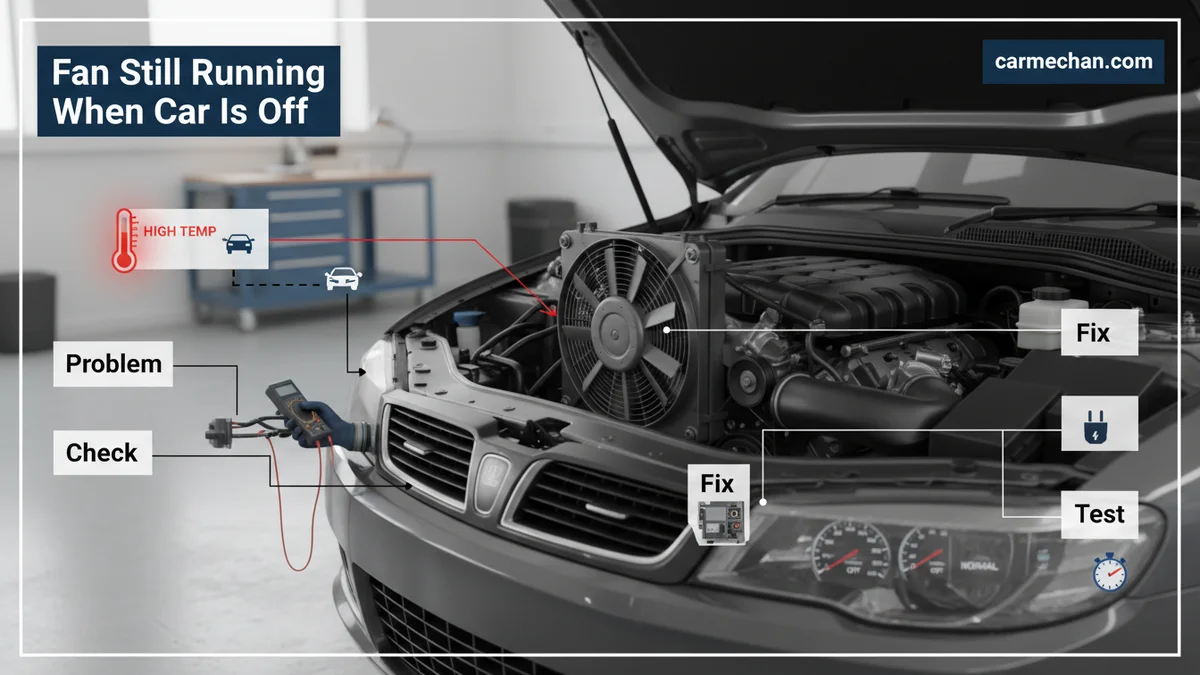
Manufacturers engineer these systems for optimal performance and longevity. Understanding these situations can prevent unnecessary worry or costly diagnostic visits.
Turbocharger Cooling Cycle
Turbocharged engines generate significant heat. The cooling fan often runs after shutdown to prevent heat soak, protecting critical turbo components. This typically lasts for a few minutes. .
Hybrid Battery Management
Hybrid and electric vehicles feature high-voltage battery packs that need precise temperature regulation. Their cooling fans may activate post-shutdown to maintain optimal battery temperature, especially after a drive. .
High Ambient Temperatures
Driving in hot weather puts extra strain on your engine’s cooling system. The fan might continue running for a short period to dissipate residual heat from the engine bay. This helps prevent components from overheating after the airflow from driving stops.
Engine Heat Soak Prevention
Even without a turbo, a hot engine can experience “heat soak” after shutdown. The fan’s brief operation helps to distribute heat more evenly and prevent localized hot spots. This proactive cooling extends the life of various under-hood components.
If your fan runs longer than these typical scenarios or exhibits unusual behavior, it’s time to investigate potential issues further.
7 Common Reasons Your Car Fan Stays On
When your radiator fan refuses to quit, it suggests an issue within the cooling or electrical system. Many components contribute to fan operation. A fault in any one of them can lead to continuous running. We will explore the most frequent culprits behind this problem.
Faulty Engine Sensor
A failing engine coolant temperature (ECT) sensor is a prime suspect. If this sensor reports an erroneously high temperature to the car’s computer, the computer will command the fan to run constantly. This happens even when the engine is cool. .
Stuck Radiator Relay
The cooling fan relay is an electrical switch that controls power to the fan motor. If this relay gets stuck in the “on” position, power continuously flows to the fan. This will keep the fan spinning indefinitely. A faulty relay is a common electrical problem.
Wiring Circuit Issues
Damaged, chafed, or corroded wiring in the fan’s circuit can create a short. This short can bypass control modules and cause the fan to run without interruption. Physical inspection of the wiring harness is crucial here.
Blown Fuse Connections
While often associated with components not working, a specific type of electrical fault, like a short to ground, can sometimes cause a fuse to blow. This might lead to unexpected fan behavior, though typically a blown fuse would stop the fan. Always check relevant fuses for integrity first.
ECU Software Glitch
The Engine Control Unit (ECU) manages many engine functions, including cooling. A software glitch or error within the ECU can send incorrect signals to the fan. This can cause it to run constantly, even after the engine is off. This requires specialized diagnostic tools.
Malfunctioning Thermo Switch
Some older vehicles use a separate thermo switch in the radiator to activate the fan. If this switch fails and remains closed, it will send a constant “on” signal to the fan. This bypasses other control mechanisms. .
AC System Overpressure
The air conditioning system often uses the radiator fan for cooling the condenser. If the AC system develops excessive pressure, perhaps due to a faulty pressure switch, it can trigger the fan to run continuously. This happens even when the AC is off.
Understanding these potential causes is the first step; next, we will guide you through diagnosing these problems systematically to pinpoint the exact issue.
How To Systematically Diagnose Cooling Fan Problems
Approaching a continuously running fan issue methodically is key to finding the root cause without unnecessary part replacement. Always prioritize safety. Disconnect the battery’s negative terminal before working on electrical components.
Let’s go through the steps to diagnose why your radiator fan stays on.
Check Coolant Levels
Start with the basics. Low coolant levels can cause the engine to run hotter, triggering the fan more often. Ensure your coolant reservoir is at the proper level. Inspect for any visible leaks around hoses and the radiator.
Inspect Fuse Box
Locate your vehicle’s fuse box, usually under the hood or inside the cabin. Identify the fuse for the cooling fan. Visually inspect it for a broken wire. Consider swapping it with a known good fuse of the same amperage from a non-critical circuit to test.
Test Cooling Fan Relay
Find the cooling fan relay in the fuse box or engine compartment. A common test involves swapping it with an identical relay from another non-critical component, like the horn. If the problem resolves, the relay was faulty. .
Examine Temperature Sensor
Locate the engine coolant temperature (ECT) sensor. This is usually threaded into the engine block or cylinder head. Disconnect its electrical connector. If the fan stops, the sensor or its circuit is likely the culprit. Reconnecting it should make the fan run again if the sensor is faulty and sending a high temperature signal.
Review Wiring Connections
Carefully trace the wiring from the fan motor, relay, and sensors. Look for any visible signs of damage, fraying, corrosion, or burnt insulation. Pay close attention to areas where wiring might rub against engine components or sharp edges. Ensure all connectors are secure.
Scan ECU Codes
Use an OBD-II scanner to check for diagnostic trouble codes (DTCs). Even if your check engine light isn’t on, pending codes related to the cooling system or sensors might exist. Look for codes like P0117 (ECT Sensor Low Input) or P0118 (ECT Sensor High Input).
.
Once you’ve identified the potential culprit using these diagnostic steps, the next step involves fixing the problem directly.
How To Fix A Radiator Fan That Won’t Turn Off
Resolving a persistently running cooling fan depends directly on what your diagnosis revealed. Some fixes are straightforward DIY tasks, while others may require more specialized tools or expertise. Always ensure your engine is cool and the battery is disconnected before attempting any repairs to prevent accidents or electrical damage.
Replace Fan Relay
If your diagnostic swap confirmed a faulty relay, replacement is usually simple. Purchase an OEM (Original Equipment Manufacturer) or equivalent quality relay. Ensure it matches the specifications of your original part. Simply unplug the old relay and plug in the new one. This is one of the easiest and most common fixes.
.
Clean Sensor Terminals
Sometimes, corrosion on the electrical connector of the coolant temperature sensor can cause erratic readings. Disconnect the sensor. Use an electrical contact cleaner and a small brush to clean both the sensor pins and the connector terminals. Reconnect securely.
Repair Wiring Harness
Damaged wiring needs careful attention. For minor fraying, electrical tape can offer temporary protection. However, for cut or severely chafed wires, a proper repair involves splicing in new wire sections with heat-shrink connectors. Ensure connections are waterproof and . If the damage is extensive, a new harness might be necessary.
Reset ECU Controls
A temporary ECU glitch can sometimes be resolved with a simple reset. Disconnect your car’s battery for 15-30 minutes. This clears the ECU’s volatile memory. Reconnect the battery, start the car, and check if the fan behavior returns to normal. This is a quick potential fix for software-related issues.
Drain Air Pockets
Air trapped in the cooling system can cause inaccurate temperature readings for the sensor. This tricks the ECU into thinking the engine is hotter than it is. Bleeding the cooling system carefully removes these air pockets. Refer to your car’s service manual for the correct procedure. .
While some fixes are straightforward, other situations demand expert intervention to ensure proper and safe vehicle operation.
When To Seek Professional Mechanic Help
While we encourage DIY diagnosis and repair for simpler issues, certain symptoms or diagnostic roadblocks signal it’s time to call a professional. Knowing when to hand over the reins can save you time, money, and prevent further damage to your vehicle.
Mechanics possess specialized tools, training, and experience that go beyond typical home garage capabilities. We will highlight scenarios where their expertise is invaluable.
Persistent Battery Drain
If the fan consistently runs and drains your battery, leading to repeated jump-starts, this is a serious issue. A mechanic can perform a parasitic draw test to pinpoint exactly what is consuming power. This is often a complex electrical diagnosis that requires precision. Diagnosing battery drain can be tricky for an untrained eye.
Recurring Engine Overheating
Should your fan issue be accompanied by the engine regularly overheating, stop driving immediately. Overheating can cause catastrophic engine damage. A professional can quickly identify the root cause of the cooling system failure. They will implement a reliable solution to protect your engine’s integrity.
Complex Electrical Faults
If your diagnostic steps indicate wiring harness damage, ECU problems, or intermittent electrical issues, professional help is warranted. These problems often require advanced diagnostic equipment like oscilloscopes and specialized training to resolve correctly. Incorrect repairs can create new, more serious electrical problems.
Specialized Diagnostic Needs
Some newer vehicles, particularly those from 2026 and beyond, feature highly integrated systems. These may require proprietary diagnostic software or tools to interpret sensor data or perform ECU recalibrations. A qualified mechanic or dealership technician has access to these resources. .
Regardless of whether you choose a DIY fix or professional repair, understanding the implications of a continuously running fan is crucial for your car’s longevity and your wallet.
3 Serious Risks From A Malfunctioning Fan
Ignoring a car fan that won’t turn off can lead to significant problems beyond mere annoyance. Understanding these risks should encourage prompt action. These consequences can impact your vehicle’s reliability, your personal safety, and your finances in 2026.
Significant Battery Drain
A fan running constantly when the engine is off will inevitably drain your car’s battery. This can lead to frequent dead batteries. This causes inconvenience and premature battery failure. Constant battery discharge significantly shortens its lifespan.
Premature Component Wear
The cooling fan motor, like any mechanical component, has a finite lifespan. Continuous operation, especially without the engine running, accelerates wear on its bearings and electrical windings. This leads to premature failure and costly replacement of the fan assembly itself.
Engine Damage
While the fan running constantly might seem like over-cooling, it often masks an underlying issue that could lead to under-cooling during actual driving. For example, a faulty sensor might eventually prevent the fan from activating when truly needed. This could cause severe engine overheating and internal damage, including warped cylinder heads.
.
Ensure Your Car’s Health
When your car’s fan still running when car is off, it’s a clear signal demanding your attention. We’ve seen that sometimes it’s normal behavior, but often it points to a problem. Addressing these issues promptly is vital for your vehicle’s health and your peace of mind.
Whether it’s a simple relay swap or a complex electrical diagnosis, understanding the cause is the first step toward resolution. Don’t let a continuously running fan deplete your battery or mask a more severe issue. Act quickly. This will ensure your vehicle remains reliable and safe on the road well into 2026.
Regular maintenance and attentive observation are your best tools against unexpected car troubles. Take the time to diagnose and fix these problems now. This will prevent larger, more expensive repairs down the line.
Common Questions About Car Cooling Fans
Is it normal for a car fan to run after turning off?
Yes, it can be normal for a short period, especially in modern cars with turbochargers, hybrid systems, or after driving in hot conditions. This post-shutdown operation helps cool down engine components or manage battery temperatures. However, excessive or prolonged running, typically over 10-15 minutes, is often a sign of a problem requiring investigation.
How long should a cooling fan run after the engine is off?
Under normal conditions, a cooling fan might run for a few seconds up to about 5-10 minutes after the engine is off. This duration varies greatly by vehicle make, model, engine type, and ambient temperature. If the fan continues for 15 minutes or more, or if it drains your battery, then it indicates an underlying issue.
What causes a car fan to stay on after the engine off?
Common causes include a faulty engine coolant temperature sensor sending incorrect readings, a cooling fan relay stuck in the “on” position, or a malfunctioning thermo switch. Wiring issues, ECU glitches, or high pressure in the AC system can also trick the fan into continuous operation. Diagnosis often involves checking these specific components.
Can a bad sensor make a fan run constantly?
Absolutely. A faulty engine coolant temperature (ECT) sensor is a very common reason for a fan to run continuously. If the sensor fails and reports an inaccurately high temperature to the car’s computer, the computer will command the cooling fan to operate nonstop, even when the engine is actually cool.
Will a car fan running too long drain the battery?
Yes, a car fan running excessively long or continuously after the engine is off will definitely drain the battery. The fan draws electrical power from the battery without the alternator recharging it. Over time, this consistent discharge will deplete the battery, leading to a dead battery and potential difficulty starting your car.